Generative Minds
Boltzmann machines, belief nets, sleep, and the search for brain-like learning.

“Settling to energy minimum when they represent memories is a way of having a content addressable memory.”Nobel Prize lectures in physics, 2024 · 49:22
The lesson
Hinton’s generative-model tradition starts from a simple question: how could a network represent structure in the world, not just map inputs to labels? He treats memory and perception as problems of inference inside a model that can reconstruct or explain the data. That is why Hopfield nets and Boltzmann machines matter in his story: they show how a network can settle into interpretations or memories by following local interactions rather than explicit symbolic rules12.
This view leads to a strong preference for learning from the input itself, because an image, sound, or sentence contains much more information than a class label. Hinton argues that deep learning advanced when feature learning came before supervised fine-tuning, and he later revised some of his own assumptions about how backpropagation fit into that picture34. He still thinks gradient-based learning works extremely well in large neural networks, but he does not take that to mean the brain literally uses the same mechanism56.
A central difficulty for deep generative models is inference: once many hidden causes can explain the same data, they interact and compete. Hinton’s response was to search for architectures and learning procedures that make hidden structure learnable, including Boltzmann machines, restricted Boltzmann machines, deep belief nets, and wake-sleep style ideas. The common aim is to let hidden units capture useful causes while keeping learning reasonably local and computationally feasible17.
That search connects directly to his neuroscience question: if ordinary backpropagation looks implausible in cortex, what could replace it? Hinton increasingly favors the idea that the brain may rely on many local objectives, neighboring representations that must agree, and learning signals that do not require one global end-to-end error. His skepticism extends to engineering tricks like convolutional weight sharing, which he finds useful in machines but unlikely to be how brains actually work89.
Sleep becomes important in this picture because it offers a way to separate helpful and harmful learning phases. Hinton points to unlearning during sleep as a more biologically plausible idea, and he links that to contrastive or positive-versus-negative phase learning in generative systems710. So the broader lesson is not that backpropagation failed; it is that Hinton sees successful AI as a clue, then asks which parts reveal general principles of intelligence and which parts are merely convenient engineering that biology probably avoids54.
4 principles from Geoffrey Hinton
Model how data is generated, not just how to label it
A generative approach tries to capture the causes and structure behind observations. In practice, this means valuing representations that can explain or reconstruct inputs, not only predict a target label.
“Settling to energy minimum when they represent memories is a way of having a content addressable memory.”
Use local computation as a guide to plausible learning
Hinton repeatedly looks for mechanisms where each unit can do useful work from information available nearby. When you design learning systems, ask whether improvement depends on global bookkeeping or could emerge from simpler local interactions.
“The whole point of a Hopfield net is that each neuron can locally compute what it needs to do in order to reduce the energy…”
Treat backpropagation as powerful engineering, not necessarily brain truth
Hinton strongly endorses gradient-based learning for large artificial networks, while doubting that cortex implements ordinary backprop as used in software. Apply backprop where it works, but keep searching for alternative learning rules if your goal is biological realism.
“We did it, we still don't know how we do it, but we can get artificial neural networks to do it now and do a pretty good job.”
Separate positive learning from negative unlearning
Generative learning can benefit from different phases that strengthen good explanations and weaken bad ones. Hinton connects this idea to sleep, suggesting that biological systems may use offline periods to remove harmful patterns rather than only reinforce useful ones.
“The idea of using unlearning during sleep, though, to get an algorithm that's more biologically plausible…”
In his own words
The quotes behind the lesson, word for word from the transcripts. Numbers match the lesson above.
“The whole point of a Hopfield net is that each neuron can locally compute what it needs to do in order to reduce the energy…”
“Settling to energy minimum when they represent memories is a way of having a content addressable memory.”
“…almost everything I used to believe about backpropagation is wrong.”
“So the idea is, gradient descent learning for big neural networks is a very sensible thing to do.”
“And the amazing thing is it works.”
“We did it, we still don't know how we do it, but we can get artificial neural networks to do it now and do a pretty good job.”
“The idea of using unlearning during sleep, though, to get an algorithm that's more biologically plausible…”
“I think the brain doesn't do weight sharing…”
“I think it'd be crazy if the brain wasn't somehow doing this.”
“So, it makes our contrastive learning algorithm much more plausible if you can separate the positive and negative phases and do them at different times and do a whole bunch of positive updates followed by a whole bunch of negative updates. And even for the standard contrastive learning, you can do that moderately well. You have to use lots of momentum and stuff like that. There's all sorts of little tricks to make it work, but you can make it work. Um. So, I now think it's quite likely that the function of sleep is to do unlearning on negative examples. And that's why you don't remember your dreams. You don't want to remember them. You're unlearning them. Crick pointed this out. You'll remember the ones that are in the fast weights.”
Reflect
- Where in your own work do you optimize only for labels or end results, when modeling the process that generated the data might teach you more?
- What learning method you use depends on a single global score or signal? How could you redesign part of it around local objectives or agreement between neighboring parts?
- If you had a 'sleep phase' in a project or habit, what would you use it to unlearn or weaken rather than reinforce?
Check your understanding
Go deeper
 Geoffrey Hinton on Neural Network Foundations: Hopfield Nets and Boltzmann Machines2024 · 79 min · full transcript
 Geoffrey Hinton on Deep Learning: Intro to Deep Belief Nets2016 · 65 min · full transcript
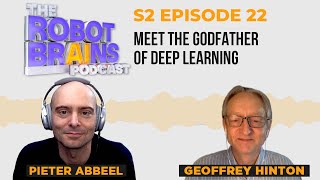 Geoffrey Hinton on Deep Learning and Brain-Like AI: Spikes, Learning, and Safety2023 · 88 min · full transcript
 Geoffrey Hinton on Deep Learning Origins: Backprop, Boltzmann Machines2017 · 40 min · full transcript
 Geoffrey Hinton on Backpropagation: Can the Brain Do It?2019 · 82 min · full transcript
 Geoffrey Hinton on AI Safety and Subjective Experience: We’re Not Safe2023 · 73 min · full transcript