Bill Gates on Optimism & Progress
Bill Gates sees optimism as a disciplined response to evidence: the world has made real progress, and more is possible when empathy, innovation, and measurement are aimed at the people left furthest behind.
- He believes the world is improving, especially against extreme poverty and preventable child deaths.
- His optimism is not naive: it depends on using data, innovation, and sustained effort on hard problems.
- Empathy matters because progress should be directed toward people the market and politics ignore.
- He thinks complexity, not indifference, is what most often blocks action.
- The practical test of optimism is whether it turns caring into measurable results.
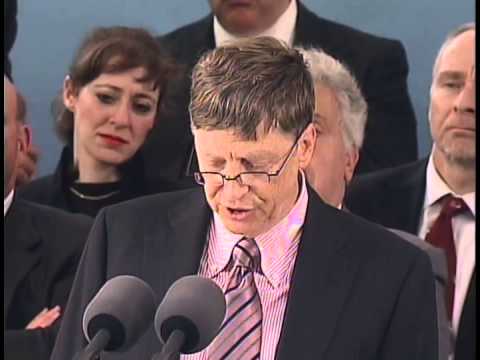
For Gates, optimism starts with facts, not mood
Gates argues that people often feel the world is getting worse because attention naturally goes to crises, while long-term improvement is easier to miss. His view is that progress is real and large-scale, especially in poverty reduction and health, so pessimism is often a failure to see the full trend.12
That is why his optimism is evidence-based rather than sentimental. He points to dramatic gains that have already happened and treats them as proof that human beings can solve problems that once looked permanent.23
Progress happens when innovation is aimed at inequity
Gates does not define progress mainly as more wealth or better gadgets. He defines it morally: real progress reduces the gaps in health, opportunity, and survival between people born into very different circumstances.45
That is why he focuses so much on diseases and conditions that mainly affect poor countries. He argues that many of the worst global problems persist not because they are unsolvable, but because the people suffering from them are poorly served by markets and often lack political power.678
In his view, technology becomes progress only when it reaches those most left behind. Otherwise innovation can remain impressive without being just.4
The biggest obstacle is complexity, not lack of caring
One of Gates's central ideas is that people usually do care, but they often do not know how to help. Problems like disease, poverty, and weak education systems are hard to see clearly, hard to solve, and hard to evaluate, so concern stalls before it becomes action.91011
His answer is practical: break complexity down. People need to understand the problem, see a workable approach, and then see evidence that the approach is working. When those three pieces are visible, caring can become commitment.1012
This is why he repeatedly urges people not to be intimidated by scale. Large problems still become tractable when they are studied, measured, and attacked with persistence.1314
Optimism requires commitment, not half-measures
Gates's optimism is demanding. He argues that some problems only yield when society stays with them long enough and at sufficient intensity, especially in global health.1516
He points to interventions like vaccines and disease control as examples of tools that work, but only if governments, scientists, funders, and communicators keep showing up. For him, success depends on sustained public action, not momentary enthusiasm.177
This is also why he cares so much about measurement. Optimism earns credibility when it can show declining deaths, wider vaccination, and other concrete gains that others can learn from and build on.12
Empathy tells us where progress should go next
Gates's optimism is tied to empathy because evidence alone does not choose priorities. People have to care enough about other lives to direct talent and resources toward those who are invisible, stigmatized, or geographically distant.56
That combination of empathy and optimism leads to a distinctive standard for the future: every person should have a real chance to build a better life. Ending extreme poverty matters to him not just as an economic milestone, but as the condition that allows human possibility to expand.1920
So his broader message is that progress is neither automatic nor exhausted. The world has improved a great deal, and the next leap depends on choosing hard inequities on purpose and refusing to surrender to them.314
Gates on optimism & progress, in his own words
“Don't let complexity stop you.”
“Still, I'm optimistic. Yes, inequity has been with us forever. But the new tools we have to cut through complexity have not been with us forever. They are new. They can help us make the most of our caring, and that's why the future can be different from the past. The defining and ongoing innovations of this age, biotechnology, the personal computer, and the Internet give us a chance we've never had before to end extreme poverty and end death from preventable disease.”
Where to watch
 Bill Gates on Optimism and Empathy: Change the World2014 · 25 min · full transcriptBest short statement of his core balance: optimism matters, but it must be guided toward people left behind.
 Bill Gates on Extreme Poverty: How the World Can End It2019 · 12 min · full transcriptShows how he connects hard poverty data with a practical case for future progress.
 Bill Gates on Poverty and Prosperity: Why the World Is Improving2014 · 67 min · full transcriptExplains why public perception is often more pessimistic than the long-term trend actually warrants.
 Bill Gates on Global Inequity: Don’t Let Complexity Stop You2007 · 36 min · full transcriptHis clearest argument that complexity, not indifference, is what blocks action on inequity.
 Bill Gates on Malaria and Education: Two Solvable Problems2009 · 20 min · full transcriptDemonstrates how he thinks solvable problems require talent, funding, and persistence beyond what markets provide.
 Bill Gates on Curiosity and Optimism: Reading, Health, and the Future2017 · 80 min · full transcriptAdds his view that curiosity, learning, and trust in strong scientific facts are part of making progress.
Questions people ask
- What advice did Bill Gates give Harvard graduates about making a difference?
- What did Bill Gates say about giving up on malaria and tuberculosis?
- What did Bill Gates say about new tools and extreme poverty?
- What did Bill Gates say is the main barrier to change?
- Why did Bill Gates say some important problems get ignored?
- Why did Bill Gates think poor children were dying needlessly?
Sources
Every quote above, word for word from the transcripts. Numbers match the text.
“…by 2035, there should be less than 10…”
“That means since 1990, 1.2 billion people have overcome extreme poverty.”
“Still, I'm optimistic. Yes, inequity has been with us forever. But the new tools we have to cut through complexity have not been with us forever. They are new. They can help us make the most of our caring, and that's why the future can be different from the past. The defining and ongoing innovations of this age, biotechnology, the personal computer, and the Internet give us a chance we've never had before to end extreme poverty and end death from preventable disease.”
“Reducing inequity is the highest human achievement.”
“I left Harvard with no real awareness of the awful inequities in the world…”
“For under a dollar, there were interventions that could save lives that just weren't being delivered. If you believe that every life has equal value, it's revolting to learn that some lives are seen as worth saving and others are not. We said to ourselves, this can't be true, but if it is true, it deserves to be the priority of our giving. So we began began our work in the same way anyone here would begin it. We asked how could the world let these children die? The answer is simple and harsh. The market did not reward saving the lives of these children, and governments did not subsidize it. So the children died because their mothers and fathers had no power in the market and no voice in the system.”
“A goal I had there was to draw more people in to work on those problems because I think there are some very important problems that don't get worked on naturally. That is the market does not drive the scientists, the communicators, the thinkers, the governments to do the right things. And only by paying attention to these things and having brilliant people who care and draw other people in can we make as much progress as we need to.”
“There's more money put into baldness drugs than are put into malaria.”
“The barrier to change is not too little caring. It is too much complexity.”
“If we had known how to help, we would have acted. The barrier to change is not too little caring. It is too much complexity. To turn caring into action, we need to see a problem, see a solution, and see the impact. But complexity blocks all three steps. Even with the advent of the Internet and twenty four hour news, it is still a complex enterprise to get people to truly see the problems. When an airplane crashes, officials immediately call a press conference. They promise to investigate, determine the cause, and prevent similar crashes in the future. But if the officials were brutally honest, they would say, of all the people in the world who die today from preventable causes, one half of one percent were on this plane.”
“Now this task is open ended. It can never be finished. But a conscious effort to answer this challenge can change the world. I'm optimistic that we can do this. But I talked to skeptics who claim there is no hope. They say, inequity has been with us since the beginning and will be with us until the end because people just don't care. I completely disagree. I believe we have more caring than we know what to do with. All of us here in this yard, at one time or another, have seen human tragedies that broke our heart. And yet we did nothing, not because we didn't care, but because we didn't know what to do.”
“The crucial thing is to never stop thinking and working and never do what we did with malaria and tuberculosis in the twentieth century, which is to surrender to complexity and quit. The final step after seeing the problem and finding an approach is to measure the impact of the work and to share that success or failure so that others can learn from the efforts. You have to have the statistics, of course. You have to be able to show, for example, that a program is vaccinating million more... Millions more children. You have to be able to show, for example, a decline in the number of children dying from the diseases.”
“Don't let complexity stop you.”
“In line with the promise of this age, I wanna exhort each of the graduates here to take on an issue, a complex problem, a deep inequity, and become a specialist on it. If you make it the focus of your career, that would be phenomenal. But you don't have to do that to make an impact. For a few hours every week, you can use the growing power of the Internet to get informed, find others with the same interests, see the barriers, and find ways to cut through them. Don't let complexity stop you. Be active... Activists. Take on big inequities. I feel sure it will be one of the great experiences of your lives. You graduates are coming of age in an amazing time.”
“If you go in kind of half heartedly for a period of time, you'll reduce the disease burden, but eventually, those tools will become ineffective.”
“We need to double down on key investments in these very tough places.”
“The facts about vaccines are very clear and very strong.”
“The world we want, a world in which every person can dream of a better future and make it come true, is a world without extreme poverty.”
“We have to change it so that people have equal opportunity.”
How this guide was made: drafted with AI from the full transcripts of the recordings cited, then checked: every quotation must match a transcript word for word and be the speaker's own words, and an independent review gates accuracy. Methodology and corrections.