Inner Voice
Start with Jobs’s personal philosophy: curiosity, loss, death, and doing work you love.

“I'm convinced that the only thing that kept me going was loving what I did. You need to find what you love. This applies to work and your lovers. Your work will fill a large part of your life. And the only way to be truly fulfilled is to do what you believe is great work. And the only way to do great work is to love what you do. If you haven't found it yet, keep looking and don't despair. As with all matters of the heart, you'll know it when you find it.”Stanford commencement speech, 2005 · 7:11
The lesson
Jobs’s personal philosophy starts with curiosity that does not need an immediate practical use. In his Stanford story, a class he took simply because it fascinated him later shaped the Macintosh, which is his clearest example that useful ideas often begin as unexplained interests rather than planned career moves1. His point is not that every curiosity pays off directly, but that you often understand its value only later, so you need enough trust to follow it before the outcome is visible2.
That trust also means resisting the standard path when it narrows your thinking. Jobs argues that innovation comes from having a different set of experiences than everyone else, because otherwise you make the same connections and arrive at the same ideas3. He repeatedly returns to the belief that the world is built by ordinary people and therefore can be reshaped by other ordinary people who decide to act, which turns curiosity into responsibility rather than passive admiration4.
A second part of this philosophy is courage in the face of loss and uncertainty. Jobs describes being fired from Apple as devastating, yet in the Stanford talk he treats that loss as a release that let him begin again and keep building from what he still loved to do6. In the earlier interviews, he connects this spirit to youth, experimentation, and the willingness to fail, arguing that action matters more than waiting for certainty.
The deepest filter for Jobs is mortality. He says time is the one thing you really possess, and his daily question about whether he would want to do today’s work if it were his last day turns death into a practical decision tool, not just a philosophical theme78. That is why he warns against living by other people’s expectations: if time is limited, borrowed goals are too expensive9.
From there, Jobs arrives at a demanding conclusion about work: you should find work you love, because love is what sustains high standards through setbacks and over time106. But loving the work does not mean becoming self-congratulatory; in later life he emphasizes moving on to the next worthy thing, keeping attention on family, craft, and what comes next rather than on reputation111213. In Jobs’s view, the inner voice is not self-expression alone; it is a way to choose curiosities, endure losses, remember death, and keep making useful things.
5 principles from Steve Jobs
Follow curiosity before you can justify it
Jobs’s example of calligraphy shows that interests without obvious payoff can later become central to your best work. Give some time to subjects that genuinely absorb you, especially when they expand your taste or way of seeing.
“I decided to take a calligraphy class to learn how to do this. I learned about serif and Sans serif type faces, about varying the amount of space between different letter combinations, about what makes great typography great. It was beautiful, historical, artistically subtle in a way that science can't capture, and I found it fascinating. None of this had even a hope of any practical application in my life, but 10 years later, when we were designing the first Macintosh computer, it all came back to me and we designed it all into the Mac.”
Build from uncommon experiences
Jobs links creativity to having a different bag of experiences, because originality comes from making fresh connections. Seek inputs outside your normal track so your judgments are not limited to the conventional path.
“…you have to not have the same bag of experiences as everyone else does, or else you're going to make the same connections and then you won't be innovative…”
Act even when failure is possible
For Jobs, waiting for certainty is less useful than trying, learning, and beginning again after setbacks. Treat losses as conditions of serious work, not proof that you chose wrong.
Use mortality as a decision filter
Jobs turns the fact of limited time into a practical question: is this really how you want to spend your day and your life? When a choice is driven mainly by status, imitation, or fear, this filter helps expose it.
“…the only thing you really have in your life is time…”
Refuse someone else’s life and find work you love
Jobs believes love of the work is what makes great work possible, especially over long periods and through difficulty. That requires separating your real convictions from other people’s expectations about what you should do.
“Your time is limited, so don't waste it living someone else's life.”
Moments to watch
In his own words
The quotes behind the lesson, word for word from the transcripts. Numbers match the lesson above.
“I decided to take a calligraphy class to learn how to do this. I learned about serif and Sans serif type faces, about varying the amount of space between different letter combinations, about what makes great typography great. It was beautiful, historical, artistically subtle in a way that science can't capture, and I found it fascinating. None of this had even a hope of any practical application in my life, but 10 years later, when we were designing the first Macintosh computer, it all came back to me and we designed it all into the Mac.”
“Of course it was impossible to connect the dots looking forward when I was in college, but it was very, very clear looking backwards 10 years later. Again, you can't connect the dots looking forward; you can only connect them looking backwards. So you have to trust that the dots will somehow connect in your future. You have to trust in something: your gut, Destiny, Life, Karma, whatever. Because believing that the dots will connect down the road will give you the confidence to follow your heart even when it leads you off the well-worn path. And that will make all the difference.”
“…you have to not have the same bag of experiences as everyone else does, or else you're going to make the same connections and then you won't be innovative…”
“…everything around you that you call life was made up by people that were no smarter than you…”
“I'm convinced that the only thing that kept me going was loving what I did. You need to find what you love. This applies to work and your lovers. Your work will fill a large part of your life. And the only way to be truly fulfilled is to do what you believe is great work. And the only way to do great work is to love what you do. If you haven't found it yet, keep looking and don't despair. As with all matters of the heart, you'll know it when you find it.”
“…the only thing you really have in your life is time…”
“My third story is about death. When I was 17, I read a quote that went something like, "If you live each day as if it was your last, someday you'll most certainly be right." It made an impression on me, and since then, for the past 33 years, I've looked in the mirror every morning and ask myself, "If today were the last day of my life, would I want to do what I am about to do today?”
“Your time is limited, so don't waste it living someone else's life.”
“You've got to find what you love.”
“I'm a private person, and when I think of the most valuable things in my life, I think of my family.”
“…if you do something and it turns out pretty good, then you should go do something else wonderful…”
“…our focal length is, you know, is always forward.”
Reflect
- What interest or side path are you drawn to right now even though you cannot explain its practical value yet? How could you explore it seriously for the next month?
- Where in your work or life are you following a script you inherited from other people rather than a conviction you chose yourself?
- If you used Jobs’s mortality question on your current main project, what would it tell you to stop, start, or change?
Check your understanding
Go deeper
 Steve Jobs on Connecting the Dots: Three Stories2005 · 22 min · full transcript
 Steve Jobs on Apple Origins: From Blue Boxes to the Apple I1995 · 96 min · full transcript
 Steve Jobs on the Secret of Life1994 · 24 min · full transcript
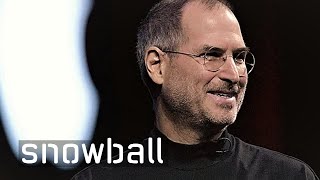 Steve Jobs on Founding Apple: Building for Ourselves2001 · 8 min · full transcript
 Steve Jobs on Innovation and Creativity: Change the World1982 · 7 min · full transcript
 Steve Jobs on Focus: Always Forward2011 · 11 min · full transcript
- What did Steve Jobs say about calligraphy?
- What did Steve Jobs say about connecting the dots?
- What did Steve Jobs say about doing great work?
- What did Steve Jobs say about getting fired from Apple?
- What did Steve Jobs say about living each day as if it were your last?
- What did Steve Jobs say about dropping out of college?