Bicycle for the Mind
Jobs’s original mission: computers as tools that amplify human ability.

“Man is a toolmaker, has the ability to make a tool to amplify an inherent ability that he has.”Regis McKenna agency presentation tape, 1980 · 5:49
The lesson
Jobs’s starting point was simple: the personal computer was not just a smaller version of existing computers. He saw it as a tool that amplifies what one person can do, the way a bicycle amplifies human movement123. That idea explains why he cared so much about putting computing power at the personal level instead of leaving it centralized in institutions45.
From that view, the real importance of the computer was not raw calculation but human use. Jobs described the personal computer as a new medium, especially for communication, creation, and thought, which meant its impact would come from changing how people write, learn, and exchange ideas678. This is why he treated products like word processors and document tools as central: people did not want to become programmers first; they wanted to use a flexible tool for many kinds of work9.
That mission required accessibility. Jobs argued that personal computers had to be affordable and personally justifiable, and that simplicity for the user demanded more sophistication in the product itself1011. In his view, these machines were tools rather than toys, because they could remove drudgery and raise people toward more conceptual and creative work12.
He extended this argument into education and knowledge. If the computer is a new interactive medium, then it can reshape learning, make powerful information resources widely available, and support richer forms of exploration such as simulations and networked libraries13141516. But he also insisted that technology is not enough on its own: the most important factor in education remains another person who guides curiosity17.
So the deeper lesson of the 'bicycle for the mind' is not that computers matter by themselves. They matter when they give individuals more power to think, create, communicate, and learn without unnecessary friction2714. Jobs’s original mission was therefore to make computers personal, useful, and humane enough that millions of people could use them as intellectual tools rather than as specialized machines418.
5 principles from Steve Jobs
Design for amplification, not automation alone
Treat technology as something that should increase a person’s capability, not merely replace effort. When evaluating a tool or product, ask whether it helps someone think, create, or communicate better at an individual level.
“Man is a toolmaker, has the ability to make a tool to amplify an inherent ability that he has.”
Build for personal use, not institutional dependence
Jobs’s view depended on moving computing from centralized systems to something one person could justify and control. A tool becomes transformative when it fits directly into an individual’s daily work rather than requiring gatekeepers.
“What we think the personal computer industry is about is the invention of the fractional horsepower computer…”
Make powerful tools simple to use
Ease of use is not the opposite of sophistication; it often requires more of it. If people have to master the machine before doing their work, the tool has failed its purpose.
“To make a computer simpler to use requires a more sophisticated computer…”
Treat computers as a medium for communication and learning
A medium changes habits, workflows, and possibilities, not just speed. Apply this by looking beyond computation and asking how a tool changes writing, collaboration, teaching, or discovery.
“The personal computer is a new medium of communication…”
Remember that people still matter most
Even when technology expands access to information, learning still depends on human guidance. Use tools to support teachers, mentors, and communities rather than imagining the tool alone is the solution.
“…the most important thing is another person…”
In his own words
The quotes behind the lesson, word for word from the transcripts. Numbers match the lesson above.
“Man is a toolmaker, has the ability to make a tool to amplify an inherent ability that he has.”
“This is a 21st century bicycle that amplifies a certain intellectual ability that man has.”
“…it's the equivalent of a bicycle for our minds…”
“What we think the personal computer industry is about is the invention of the fractional horsepower computer…”
“…it's a process of taking very centralized things and making them very democratic…”
“…the computer will become the predominant medium of communication…”
“The personal computer is a new medium of communication…”
“My particular view is that a computer is a new medium…”
“But where we're trying to get is we're trying to get away from programming. We've got to get away from programming because people don't want to program computers. People want to use computers. And so our strategy right now is let's write some programs that are generic, that sort of will write 90% of the program and you fill in the last 10% of the blanks. A perfect example of that is a word processor. A word processor can be used to write a business letter, a report for a college exam. It can be used to write a correspondence letter to your friend. Same word processor. We write it once. Millions of people use it. Another program, you know, there's a lot of database programs. There's some spreadsheet modeling programs. We do 90% of the work. You do the other 10%. Where we're moving in the future, though, is programming with graphics, connecting the dots, if you will.”
“…something that can be cost justified on the personal level…”
“To make a computer simpler to use requires a more sophisticated computer…”
“We describe our business as really making tools and not toys…”
“I think that computers can radically revolutionize the educational process around the world.”
“…we can make a tool of a new kind, of an interactive kind.”
“…we will have the entire Library of Congress at our fingertips…”
“These simulations will become what most of our students are learning from…”
“…the most important thing is another person…”
“We didn't start Apple to build adequate products. And we didn't start Apple to simply put computers on the desks of computer-trained professionals to connect to IBM mainframes. What we wanted to do and what we want to do now is to build great personal computers and bring them to tens of millions of people. Never before has the time been riper, and never before with our radically easier-to-use family of 32-bit products have we been closer to doing just that. Thank you very much.”
Reflect
- What tool in your work genuinely acts like a 'bicycle for the mind' by amplifying your ability, and what tool only adds complexity without increasing your capability?
- Where are you still thinking of a new technology as a smaller version of an old one instead of asking what new medium it enables?
- If you build products, teach, or lead, what would it mean to remove drudgery so people can spend more time on conceptual and creative work?
Check your understanding
Go deeper
 Steve Jobs on Apple's Early Vision: Computers for One Person1980 · 23 min · full transcript
 Steve Jobs on Personal Computers: a fractional horsepower tool1981 · 20 min · full transcript
 Steve Jobs on Computer Literacy: The 21st Century Bicycle1981 · 12 min · full transcript
 Steve Jobs on The Future of Computing: Design Meets Society1983 · 55 min · full transcript
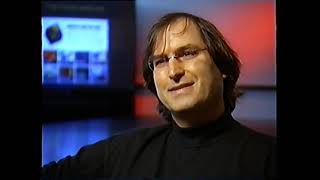 Steve Jobs on Computer Science as a Liberal Art1984 · 20 min · full transcript
 Steve Jobs on Education: Computers as a New Medium1985 · 16 min · full transcript
 Steve Jobs on the Future of Libraries: The Computer Is a Bicycle for the Mind1990 · 5 min · full transcript
 Steve Jobs on Education: Great Teachers, Real Competition1995 · 83 min · full transcript