Steve Jobs on Education: Computers as a New Medium

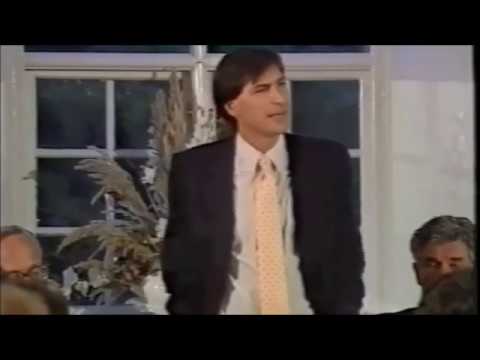
What Jobs talks about
Jobs says computers can radically revolutionize education, especially if people stop thinking of them as smaller versions of big computers and start seeing them as a new medium. He compares computers to books, television, and other media that took time to find their own form.
He also imagines a future in which students could capture the ideas of great thinkers in computers and ask them questions directly. For him, personal computers are a form of “free intellectual energy” that will transform how people learn and connect.
The talk closes with a broader vision of networking universities and computers around the world. Jobs believes the change will take time, but that education will be permanently changed within a generation.
Jobs speaks first, followed by a host and a Lund University representative who offers remarks and a gift.
In his words
“I think that computers can radically revolutionize the educational process around the world.”
“My particular view is that a computer is a new medium”
“We can make a tool of a new kind, of an interactive kind.”
“The computer industry is in a tank.”
“It will happen within 20 years. It probably will happen within 10 years. But it could happen within five years.”
Key points
- Computers can radically revolutionize education worldwide.
- A computer is a new medium, not just a smaller mainframe.
- People often use new media in old ways before discovering their true potential.
- The personal computer is “free intellectual energy” that will keep getting more refined.
- Students should be able to read great thinkers and someday ask them questions directly.
- Networking universities and computers could connect many brains across the world.
- The educational impact may take years, but it will happen.
Full transcript
The doors have been locked and all of you that don't sign up to buy computers will stay here and we will bring back the singers. I am extraordinarily pleased to be able to be here with you. This is one of my personal hopes and wishes actually is that I think that computers can radically revolutionize the educational process around the world.
The average age at Apple as you know is about 29 or 30 and we haven't been out of college so long ourselves, at least most of the people at Apple haven't. It's very, very important to us and I think that as you all know better than I, Europe is sort of a, doesn't exist, it was just a word invented for the convenience of Americans and others. And the fact that you're all here in this room as a step towards cooperating with each other in new ways pleases me very much. It's difficult enough to get cooperation amongst the competitive universities in America and I think that that's great. What are we trying to do here?
What are we trying to do? You can have many views of what a computer is. My particular view is that a computer is a new medium, a new medium, one of the media, prints, television, radio and a computer will in the future be looked at I think more in this way, as a delivery vehicle for software, just like a book is a delivery vehicle for its own kind of software. And whenever we develop a new medium, we generally tend to fall back into our old habits from our old media. As an example, when the television first came of age in America, the first television shows were simply a camera pointed at a radio show and it took about 20, 30 years for television to really come into its own in the late 1950s.
We have this new medium of interactive video because of the laser disc and what is the first thing we do with it? We put movies on it. So again, we tend to fall back into our old habits. In the same way, when the personal computer was invented, we tended to look at it as a smaller version of a big computer. So we put COBOL and FORTRAN and these bizarre things on it and looked at it in terms of simple economics rather than the revolutionary nature that it really was. Do you know who Alexander the Great's tutor was for about 14 years? Aristotle. And I read this, I became immensely jealous.
I think I would have enjoyed that a great deal. And through the miracle of the printed page, I can at least read what Aristotle wrote without an intermediary. And maybe if there's a professor, they can add to that. But at least I can go directly to the source material. And that is, of course, the foundation upon which our Western civilization is built. But I can't ask Aristotle a question. I mean, I can, but I won't get an answer. And so my hope is that in our lifetimes, we can make a tool of a new kind, of an interactive kind.
And when I look at the personal computer, we're, as you know, living in the wake of the last revolution, which was a new source of free energy. And that was the free energy of petrochemicals. And it completely transformed society, and we're products of this petrochemical revolution, which we're still living in the wake of today. We are now entering another revolution of free energy. Macintosh, as you know, uses less power than a few of those light bulbs, and yet can save us a few hours a day or give us a whole new experience. And it's free intellectual energy. It's crude, very crude. But it's getting more refined year after year after year. And in our lifetimes, it should get very refined.
And so my hope is someday, when the next Aristotle is alive, we can capture the underlying world view of that Aristotle in a computer. And someday, some student will be able to not only read the words Aristotle wrote, but ask Aristotle a question and get an answer. And that's what I hope that we can do. So this is a beginning. I think that, as you know right now, the computer industry is in a tank. Personal computers, big computers, everything. And it's difficult. It's a difficult time.
But I'm sure that Henry Ford had a few bad quarters back in the 1920s. And the automobile had a sort of historical imperative. The minute it was invented, a sequence of events had to happen. The same is true with the personal computer. There is a tremendous momentum behind this. And I think that this year may be a delay. This year, we may look back and say, well, 1985 was a slow year. There is such momentum behind this that it will happen. It will permeate and change forever our educational processes. And my hope, again, is that not too many generations of students will pass through before this happens.
It will happen within 20 years. It probably will happen within 10 years. But it could happen within five years. I am going back to the United States this weekend. And then about two weeks from today, I'll be in the Soviet Union for the first time in Moscow. Because one of my dreams has been to sell Macintoshes in the Soviet Union. And one of the highest agendas on my priority is to get them starting to think about exactly the same thing. So maybe six months or a year, year and a half from now, we can have some Soviet schools here at our Europe consortium meeting. Thank you. But first, I would like to say that I find it very interesting to meet Mr. Jobs, arriving as he was, out of the blue.
Out of the blue. And after making about three circles, so that we were certain to notice that there was something in the air. And you can almost hear everybody saying, there is something in the air tonight. Anyhow, I feel somewhat, I felt somewhat like the Finnish Prime Minister, Prime Minister, Mr. Karjalainen. When he was, he spoke a very bad English too. And I had to pep him up heavily with language tuition.
Before he was meeting Mr. Henry Kissinger, arriving from the States, I don't think it was in a helicopter, but it was in a big jumbo plane. Anyhow, they taught Kissinger the essential phrases, and these were welcome, nice weather, and lastly, how are you? And Karajalainen, he learned those words, and he was very happy. Now, damn it, now he comes. I know the language. And out steps Kissinger, and Karajalainen steps forward to him. And all his teachers are very worried. Will he do it? Can he do it? Can he speak English? And he says, welcome.
Oh, well. And then he goes into the second phrase, nice weather, nice weather. And the third phrase, and who are you? Well, it was great meeting you. And I will stop making jokes with Steve Jobs, who is such a nice fellow, and is giving so much of himself and his dreams. We have been very happy at Lund University for this association with apple. I have never been worried that by eating apple we should start thinking apple.
But other people have been worried about that. I'm not so worried either about computers. Some people are. They feel that they will deform our minds. I do not think so. And I happened to think of yesterday something that other people have thought about many times, namely the relation to the car. When I came to Lund many years ago after the war, a friend of mine bought a Volkswagen. You could almost call it a Mac Volkswagen. And I said, what is it like having a car, an idiotic machine, which cannot think, it just does what you tell it to do. And he says, it is like the seven-mile boots of the fairy tale.
You know, we have tales in Sweden, and one of them deals with the seven-mile boots. Boots that you put on your legs, and with them you could take seven miles in each step. And you got a huge distance by wearing these boots. And to me, that was a wonder of the car. Because with a car you can go seven miles without noticing it. And with computers you can do a lot of things that you couldn't otherwise do. And with weapons like that, or rather machinery like that, the only problem is in the human mind, and not in the computer. It's just like the boots.
And we are talking here about connecting many brains and many computers in a worldwide network, which will hopefully solve all the problems. I'm not entirely certain that it will, but it will help, of course. The networking reminds me of a story of the building workers. It's actually an example from the school mathematics days, where the problem was, if it takes seven days for six men to build a wall, which is a hundred meters long, how long does it take for 10,000 men? And the answer is, just less than a second.
That is, I'm reminded of that story when people at Apple and other places tell me how we connect all the universities of the world. And then if we have one really big problem, we put it into the bitnet, and out pops the answer, even from Aristotle. Now, finally, I've heard that Apple has been having some trouble. And we have always been very generous towards industry. We like to support it. And there are no strings attached. Your integrity will not be broken.
And I think you need a fresh supply of silicon oxide. So I would like to give you, Steve, from the University of Lund, this unique piece of glass, Swedish glassware. It has the emblem of the University of Lund. If you put the Mac in the back, I don't mind. If you had been really hard up, I would have sent it around for cash. Thank you.
And a final word. Give my love to Mac Gorbachev. Thank you.
Transcribed from the audio with OpenAI Whisper. Timestamps link to the video above. Errors are possible.