Steve Jobs on Focus: Always Forward
What Jobs talks about
In this NBC News interview from the 5th Avenue Apple Store, Steve Jobs resists being placed in the American pantheon of inventors and thinkers. He says he is a private person and prefers to think about family and the next thing his team is building.
Jobs emphasizes momentum over retrospection. After making something he’s proud of, he says, the right move is to keep going and build something else wonderful rather than dwell on past achievements.
The interview matters because it captures Jobs’s core operating style: forward-looking, intensely focused, and deeply tied to a small team of talented people working on products still to come.
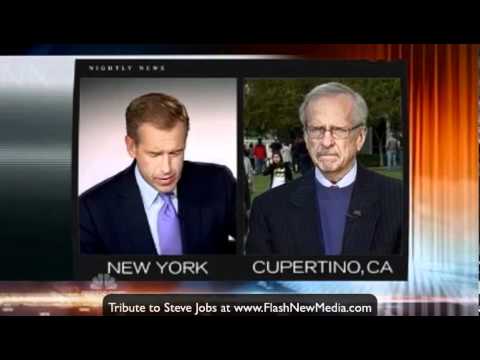
Brian Williams introduces the segment and asks questions; Steve Jobs answers throughout the interview.
In his words
“I don't really think that way.”
“I'm a private person, and when I think of the most valuable things in my life, I think of my family.”
“If you do something and it turns out pretty good, then you should go do something else wonderful”
“Just figure out what's next.”
“Our focal length is, you know, is always forward.”
Key points
- He doesn’t think much about where he fits in history.
- Family is one of the most valuable things in his life.
- Great work should lead to the next challenge, not self-congratulation.
- He values working with extremely talented people.
- His team’s focal length is always forward.
- He hints at major products still in development.
Full transcript
On the broadcast tonight, The Visionary, tonight we remember Steve Jobs, a genius of the modern age who changed our world, and tonight how the world is remembering him. Also, one-on-one, what it was like to sit across from Steve Jobs, surrounded by all of his creations, in one of his last network interviews. From NBC News World Headquarters in New York, this is NBC Nightly News with Brian Williams. Good evening. Since the news arrived from California last night and all day today, we've heard people say Steve Jobs changed the world, and it's true. We've heard him compared to Henry Ford, Thomas Edison, Alexander Graham Bell, and it's true. His death was a global event. In his own way, he changed life, and along the way, computing and music.
He gave us something to point to with pride. He gave us the icons and the fonts and shuffles and swipes of our modern lives. He was relentless and exacting and unique, and he was dying of cancer during some of the most productive years of his life. Steve Jobs was Apple, and Steve Jobs was the American innovator of the modern age. He's gone at the age of 56, and we remember him tonight, beginning with NBC's George Lewis. With the help of a top design team, Jobs turned electronic gadgets into objects of desire. There was the Macintosh computer in 1984. And it has turned out insanely great. The iPod in 2001. And then, in 2007...
Today, Apple is going to reinvent the phone. The iPhone. And in 2010, the iPad. So all these things, one after another after another, it's like home run, home run, home run, home run. You know, and there's only one babe. In 1976, Steve Wozniak and Jobs co-founded Apple, and within 10 years, it had turned into a $2 billion company with 4,000 employees. They were the most fun years of my life. It wasn't all fun. After losing a corporate power struggle in 1985, Jobs left Apple for 11 years. He went into computer animation, acquiring Pixar Studios and striking pay dirt with a string of hit movies, starting with Toy Story.
To infinity and beyond! When Jobs came back to Apple in 1996, he began reinventing the Mac, dressing it up in a variety of colors. They looked so good, you kind of want to lick them. Concerns about his health began in 2004, when he underwent surgery for pancreatic cancer. A year later, he spoke about that during a commencement speech at Stanford University. This was the closest I've been to facing death, and I hope it's the closest I get for a few more decades. But Jobs was losing weight, something revealed in these photos taken in 2007 and 2008. In April 2009, he underwent a liver transplant. Five months later, back on the job at Apple, he expressed his gratitude.
I now have the liver of a mid-20s person who died in a car crash and was generous enough to donate their organs. Friends say one of the things that drove Steve Jobs was a premonition he had that he would die young. As he told the Stanford grads in 2005, Your time is limited, so don't waste it living someone else's life. Don't let the noise of others' opinions drown out your own inner voice. Time Magazine stopped the presses when Jobs died and redid tomorrow's edition, putting him on the cover for the seventh time. Steve Jobs is Edison in the sense that he was a terrific inventor and innovator. He was Henry Ford, the businessman. He might go down as the top CEO of any company of any kind in the history of business.
Apple employees have been stopping by this improvised memorial at company headquarters. And people have been paying their respects at one of Jobs' residence in nearby Palo Alto. And all over the Internet, there are images like this popping up on social network sites. Jobs has survived by his wife and four children. Communique from the family said that Steve was surrounded by the people he loved, that he died peacefully. Brian? George Lewis, starting us off in Cupertino, California tonight. George, thanks. And as you look back and as we think back over all those new Apple product rollouts over the years, it is astounding how much innovation this one man is responsible for.
Today, for the first time ever, I'd like to let Macintosh speak for itself. Hello, I am Macintosh. It is with considerable pride that I introduce a man who's been like a father to me, Steve Jobs. There it is, right there. Amazing little device, holds a thousand songs. Ever wonder what this pocket's for? I've always wondered that. Well, now we know. Because this is the new iPod Max. This is really hot.
An all new design. Now, stop me if you've already seen this. Believe me, you ain't seen it. They were all amazing, one after the other. It can be said what Steve Jobs sold, the world bought. And he built a $350 billion company from scratch, which is why he's being remembered around the world tonight. NBC's Ann Thompson with us tonight from one of the four Apple stores in Manhattan. Ann, good evening. Good evening, Brian. Good evening, Brian. But you know, it's more than that, because Steve Jobs didn't just change the way we communicate. With his keen eye for design and a sleek pair of white earbuds, he made his customers cool.
And today, they showed their appreciation. The grief mirrored Steve Jobs' worldwide reach, expressed from Times Square to Tokyo in its own unique way. Someone who did so much, it makes me want to do more. For me, it's sort of like comparable to the day that Princess Diana died, because I guess Steve Jobs was kind of one of my heroes. He opened our minds. We saw the world differently. His products brought the news to fans in Atlanta. I heard about Steve Jobs' death on my MacBook Pro. I was on Twitter on my iPad. I heard about Steve Jobs' passing on my iBook T4. An iPad, an iPhone. I mean, look at that. That's impact. And they are everywhere.
An iPhone in the war zone of Afghanistan. An iPod in the International Space Station. And today, the iPad used by this American scientist in Antarctica. And the second grade class at St. Margaret of Cortona School in Riverdale, New York. New technology that helps the tried and true method. And that makes math cool? Yeah. Jobs' ideas changed our lives as cancer changed his. On all levels, he was a man to be admired. The digital world Jobs democratized paid its respects. On Twitter, messages came at an estimated 10,000 a second with hashtags such as ISAD. One fan writing, without you, Apple is just a fruit. On the nightly Facebook page, when asked to choose a favorite Apple product, Linda Pitler wrote, that's like trying to decide which of your children is your favorite child.
Tonight, from the virtual world to the real one, a special thank you from all who benefited from Jobs' tree of knowledge. In death as in life, Jobs continues to sell. His authorized biography was number 424 this morning on Amazon. Tonight, it's number one. And it's also number one on iTunes Books. Brian. Ann Thompson here in Manhattan. Ann, thanks. And now listen to Steve Jobs during a rare interview. One of his last network television interviews. And for the record, he did not enjoy being interviewed. I sat down with him on the eve of the opening of the flagship Apple store in Manhattan just a few blocks from here on 5th Avenue. Now remember, back in 2006, when we met him at the store, it was the coolest store anyone had ever seen, containing the coolest products you could imagine.
And when you think about it, back in 06, Steve Jobs was still just getting started. Listen in this interview to how he sees himself or chooses not to. You really don't like introspection. I know that about you. But I'm going to ask you to be introspective for a moment. Where do you fit in the American family of thinkers and inventors? When you see a mouse in public, when you see a click, drag, garbage can logo, all the things you had a hand in that are part of our daily lives, where do you put yourself? How do you view yourself and your achievements? You know, I don't really think that way.
Try it. Well, I'm a private person, and when I think of the most valuable things in my life, I think of my family. And when we talk about our work, you know, I work with and myself, when we finish doing something that we're really proud of, we want to get on to the next thing. So we're, you know, I think if you do something and it turns out pretty good, then you should go do something else wonderful and not dwell on it for too long. Just figure out what's next. So while you should be applauded for saying that about your family in a society that doesn't always venerate those things, the fact that you have left us with the tools of our life now is not really the most important part of your life.
You know, that's for other people to figure out. I'm very lucky. I get to work with a group of extremely talented people and, you know, we're racing ahead. We've got some really great ideas of the products we're going to build next year and the year after that we're working real hard on. So I think that's our focal length is, you know, is always forward. And think of the projects that were yet to come out there.
Transcribed from the audio with OpenAI Whisper. Timestamps link to the video above. Errors are possible.