Stanley Druckenmiller on George Soros
Stanley Druckenmiller sees George Soros as the mentor who taught him the central lesson of investing: press big opportunities hard while staying brutally aware of downside.
- Druckenmiller says Soros’s biggest influence on him was sizing, not idea generation.
- The core lesson is to focus on payoff asymmetry: make much more when right than you lose when wrong.
- That lesson helped shape Druckenmiller’s habit of pressing high-conviction macro opportunities with size.
- The Soros influence fits Druckenmiller’s broader style: conviction, concentration, and fast emotional recovery after mistakes.

“…every event in the world affects some security somewhere…”How Leaders Lead interview, 2024 · 2:12
Soros taught Druckenmiller the most important lesson: sizing
Druckenmiller is unusually clear about what he got from George Soros. He did not come away saying Soros gave him a secret formula for currencies or a special theory of markets. He says he already felt he understood the mechanics of markets well, but Soros taught him how to size positions so that being right actually matters.1
That lesson became the center of Druckenmiller’s investing philosophy: the game is not simply about forecasting correctly, but about structuring positions so gains on winners outweigh losses on losers by a wide margin. He repeats that principle across interviews, which shows how foundational he considers it.123
What Druckenmiller admired was not prediction alone, but the courage to press an edge
Druckenmiller’s view of Soros lines up with his own belief that investing rewards conviction more than intellectual showmanship. He says his advantage is not raw IQ but acting decisively, and he links great results to the willingness to pull the trigger when the odds are favorable.4
In practice, that means seeing a future others do not yet see, then committing enough capital for the insight to count. Druckenmiller describes investing as envisioning the future differently than other people, and the Soros lesson gave him a way to turn that vision into outsized returns through position size.51
He also openly says that one of the disappointments of getting older has been becoming less aggressive with high-conviction positions. That admission makes his respect for Soros’s style even clearer: the ideal is not timid correctness, but boldness when the setup is exceptional.6
The Soros lesson only works with discipline about downside
Pressing a bet is only half the idea. Druckenmiller pairs the Soros sizing lesson with strict attention to losses, emphasizing over and over that the key is how much you lose when wrong. In his framework, aggressiveness is justified only when the downside is understood relative to the upside.123
That is why his style combines concentration with discipline. He says diversification is overrated and argues for being unemotional, which suggests that the Soros influence was not reckless swinging but concentrated risk-taking under control.78
Even his refusal to rely on mechanical stop-loss rules fits this mindset. He does not present risk as something managed by formulas alone, but by judgment, flexibility, and constant reassessment of whether the thesis still holds.910
Soros helped shape Druckenmiller’s macro style
Druckenmiller’s mature investing approach has three recurring features: think in big regime shifts, connect world events to securities, and size up when the opportunity is large. That is the natural extension of the Soros lesson. He says every event in the world affects some security somewhere, which is exactly the kind of broad macro canvas on which sizing matters most.11
He also stresses that investing is about recognizing when the world has changed and then acting with size. That makes Soros’s influence practical, not merely biographical: it shaped how Druckenmiller approaches bonds, currencies, stocks, and macro turning points.91
The result is a style that is less about always being contrarian than about being prepared to concentrate when a non-consensus view has strong odds and large payoff potential. His repeated emphasis on payoff asymmetry shows how deeply that Soros lesson runs through his process.23
“…every event in the world affects some security somewhere…”How Leaders Lead interview, 2024 · full transcript →
The personal application: be bold, then recover fast from mistakes
One practical way Druckenmiller applies the Soros lesson is emotional resilience. If you are going to take large positions, you will also be wrong sometimes. His answer is not to become small and cautious, but to recover quickly, learn, and preserve the ability to act again.1213
He says mistakes and emotion never disappear entirely, which makes the real skill learning how not to let a setback paralyze you. That complements the Soros approach: big swings only work if you can survive errors and still pull the trigger on the next great opportunity.4
So the deepest takeaway from Druckenmiller on Soros is not hero worship. It is a usable operating principle: develop a differentiated view, bet hard when the odds and payoff are in your favor, stay disciplined about losses, and move on fast when you are wrong.1128

“Just get over it and move on.”Morgan Stanley Hard Lessons interview, 2024 · full transcript →
Druckenmiller on george soros, in his own words
“…it's not whether you're right or wrong it's how much money you make when you're right and how much you lose when you're wrong…”
“Just get over it and move on.”
Where to watch
 Stanley Druckenmiller on Entitlement Reform: Why the Young Are Getting Squeezed2013 · 32 min · full transcriptBest concise account of Soros’s direct influence on Druckenmiller, especially the sizing lesson.
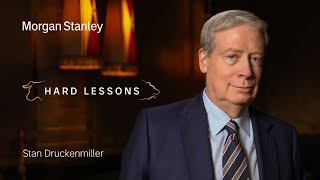 Stanley Druckenmiller on Investing Lessons: Invest, Then Investigate2024 · 28 min · full transcriptShows how Druckenmiller still frames investing around the Soros lesson: payoff asymmetry and decisive execution.
 Stanley Druckenmiller on Risk and Trading: Charts, Conviction, Discipline2009 · 83 min · full transcriptBest for seeing how concentration, discipline, and risk control support the kind of big betting Soros taught him.
 Stanley Druckenmiller on Macro Investing: Size, Flexibility, and Trump2016 · 39 min · full transcriptShows how that lesson translates into macro investing: size up when the world changes and the thesis is strong.
 Stanley Druckenmiller on Future Vision: Seeing Ahead First2024 · 71 min · full transcriptUseful for understanding the mindset behind big Soros-style bets: seeing a future others do not yet see.
Questions people ask
Sources
Every quote above, word for word from the transcripts. Numbers match the text.
“It's funny, when I went there, I thought I would learn what makes the yen in the market go up and move.Immodestly, I learned I knew much more about that than he did. What I learned from him was sizing. It's not whether you're right or wrong, it's how much you make when you're right and how much you lose when you're wrong. And that was a, that was an invaluable lesson. So, you can have something innate. But if you don't have mentors and people to teach you, you're not going to maximize it as much as you do when you do have them.”
“It's not whether you're right or wrong, it's how much you make when you're right and how much you lose when you're wrong.”
“…it's not whether you're right or wrong it's how much money you make when you're right and how much you lose when you're wrong…”
“My advantage is not IQ. It's trigger pulling.”
“…you envision the future, particularly in a way that others have not…”
“Not really. There's no silver bullet. And I'm the great beneficiary of 40 years of scars and successes that I can go back on, and a lot of pattern recognition, because there's not much I haven't seen in this business. I'd say the biggest disappointment in my career has been I think I have more wisdom, and I have more tools of the trade than I had in my 30s and 40s, and I was a much better portfolio manager then because back then I had courage. I would take bigger convicted positions. I'm trying to regain some of my nerve just because it's more fun. Bouzali: So you're chickening out? Druckenmiller: Oh for sure. I've been chickening out for a long time. I'm Mr. Taco, except it's not T, it's DACO. Druck Always Chickens Out.”
“I think diversification is really overrated…”
“You have to be disciplined, you have to be unemotional…”
“I've never used a stop loss in 40 years…”
“I don't use a, like, a number. I know that's a discipline system…”
“…every event in the world affects some security somewhere…”
“Just get over it and move on.”
“…admit that you've had failures, and then go back and analyze those failures…”
How this guide was made: drafted with AI from the full transcripts of the recordings cited, then checked: every quotation must match a transcript word for word and be the speaker's own words, and an independent review gates accuracy. Methodology and corrections.