Simon Sinek on Purpose-Driven Leadership
Simon Sinek argues that leadership becomes enduring when it starts with a clear cause, serves other people, and builds trust strong enough to sustain effort beyond short-term wins.
- Leadership starts with a clear why: a purpose, cause, or belief.
- People commit to leaders because they feel inspired and aligned, not merely managed or persuaded.
- Purpose is fundamentally about service to others, not status, money, or self-centered achievement.
- A purpose-driven leader creates trust and a circle of safety so people can grow, speak honestly, and contribute.
- The point is not to win once, but to advance a Just Cause over the long haul.
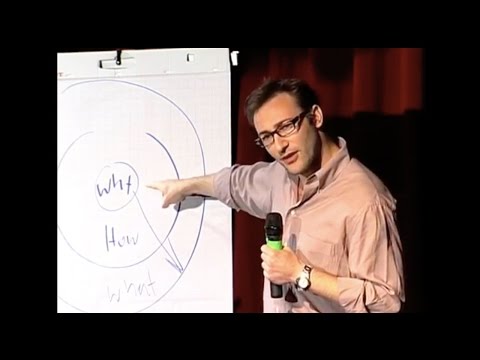
“Leaders hold a position of power or authority, but those who lead inspire us. Whether they're individuals or organizations, we follow those who lead, not because we have to, but because we want to. We follow those who lead, not for them, but for ourselves. And it's those who start with "why" that have the ability to inspire those around them or find others who inspire them. Thank you very much.”TEDxPugetSound talk, 2010 · 17:24
Purpose begins with why, not with what you sell or produce
Sinek’s core claim is that effective leadership starts with a clear why: the cause, belief, or purpose behind the work. He contrasts this with the common habit of leading with what an organization does or how it does it, which may inform people but rarely inspire them to act.12
In his view, people connect most deeply when they understand the belief underneath the offering. That is why he repeatedly argues that loyalty and commitment come from shared belief, not from product features alone.345
This is also why he treats purpose as deeper than profit. Money can be a result of good work, but it is too thin to function as the central reason for leading.31
Leadership is earned through inspiration, not authority
Sinek draws a sharp distinction between holding power and actually leading. A title can give someone authority, but leadership exists only when people willingly choose to follow.67
That is why purpose matters so much. People may comply because of incentives, pressure, or fear, but those tools do not create enduring loyalty. Inspiration does, because it gives people a reason to join that feels personal and voluntary.8910
This also explains his view that organizations should attract people who believe what they believe, not just people who need a job or a vendor. Alignment around purpose turns transactions into commitment.41112
“Leaders hold a position of power or authority, but those who lead inspire us. Whether they're individuals or organizations, we follow those who lead, not because we have to, but because we want to. We follow those who lead, not for them, but for ourselves. And it's those who start with "why" that have the ability to inspire those around them or find others who inspire them. Thank you very much.”TEDxPugetSound talk, 2010 · full transcript →
Real purpose is about serving other people
For Sinek, purpose-driven leadership is not self-expression for its own sake. He consistently ties purpose to service: the deepest sense of joy, fulfillment, and meaning comes from helping another human being.1314
That is why he warns against building a life around finite goals such as money, status, or achievement alone. Those goals can motivate effort for a while, but they do not provide lasting meaning; service does.131516
He extends this idea into everyday leadership. Listening, in his view, is not simply hearing words but helping another person feel heard, and helping people change or grow is rarely a solo act.18
Purpose-driven leaders create trust, safety, and honest relationships
Sinek treats trust as emotional and relational, not procedural. If leadership is about taking care of people, then a purpose-driven leader has to build the conditions in which people feel safe enough to ask for help, admit mistakes, and contribute fully.202122
He describes this as a circle of safety, and he sees it as essential to strong teams. Without that environment, engagement and innovation weaken because people protect themselves instead of advancing the mission together.21
This kind of leadership also requires honesty and hard conversations. Purpose does not remove discomfort; it gives leaders a reason to face it in service of other people’s growth and the health of the group.2324
Purpose gives leadership a long horizon
Sinek’s later work broadens purpose-driven leadership into an infinite mindset. The aim is not to beat everyone else once, but to keep improving, keep serving, and keep advancing a cause that remains worthy over time.252627
That is where his idea of a Just Cause fits. Leaders need a future worth sacrificing for, something larger than quarterly targets or momentary advantage.28
Finite goals still matter in this picture, but they are supposed to serve the larger cause rather than replace it. Purpose keeps leaders grounded when metrics, growth, or success threaten to blur the reason the organization exists in the first place.293031
Sinek on purpose-driven leadership, in his own words
“Life is not about a finish line. Life is a journey.”
Where to watch
 Simon Sinek on Purpose-Driven Leadership: Start With Why2010 · 18 min · full transcriptBest short statement of the golden circle and why purpose comes before how and what.
 Simon Sinek on Start With Why: Leadership, Loyalty, and Trust2012 · 61 min · full transcriptBest for the link between why, loyalty, trust, and the difference between inspiration and manipulation.
 Simon Sinek on The Infinite Game: Lead for the Long Haul2018 · 91 min · full transcriptBest for seeing how purpose-driven leadership becomes a Just Cause and an infinite mindset.
 Simon Sinek on Purpose-Driven Leadership: Why Service Matters2020 · 96 min · full transcriptBest for Sinek’s claim that purpose is rooted in service and not in finite personal success.
 Simon Sinek on Purpose at Work: Finding Your Why74 min · full transcriptBest for applying why to everyday work, team performance, and the feeling of meaningful effort.
 Simon Sinek on Purpose-Driven Leadership: Help Others to Help Yourself2022 · 105 min · full transcriptBest for the practical interpersonal side of purpose: listening, support, and helping others grow.
Questions people ask
- How does Simon Sinek explain the biology behind decision making?
- How does Simon Sinek explain the brain and decision making?
- How does Simon Sinek think about career and purpose?
- What did Simon Sinek say about values in leadership and decision making?
- What does Simon Sinek say about hiring people?
- What does Simon Sinek say about staying grounded when you become successful?
Sources
Every quote above, word for word from the transcripts. Numbers match the text.
“Why is this: it's this deep-seated purpose, cause, or belief.”
“Why, I mean what's your purpose, what's your cause, what's your belief? Why does your organization exist? Do we really need another company to do what you're doing? Do we really need another one? Why did you get out of bed this morning, and why should anyone care? As a result, the way we think, the way we act, the way we communicate is from the outside in. It's obvious. We go from the clearest thing to the fuzziest thing. We tell people what we do. We tell them how we're different or how we're better or how we're special, and we expect some sort of behavior—a vote, a purchase, support, whatever it is. But not those leaders with the capacity to inspire. Regardless of their size,…”
“People don't buy what you do they buy why you do it.”
“The goal is to do business with people who believe what you believe.”
“People don't buy what you do; they buy why you do it.”
“Leaders hold a position of power or authority, but those who lead inspire us.”
“All leaders have one thing and one thing only: followers.”
“We follow those who lead, not because we have to, but because we want to.”
“The problem is none of them breed loyalty.”
“There are a million reasons why people will do business with you that have nothing to do with you. You happen to meet some checklist that they have. They happen to hate your competition more. There's a difference between repeat business and loyalty. You see, repeat business means I'll do business with you over and over and over again. Loyalty means I'm willing to turn down a better product at a better price to continue to do business with you. And it's the loyal ones, those who feel like they belong, those who, doing business with you, gives them some sense of identity or belonging—those are the ones. Those are the ones who do great, and the reason is it becomes personal. It becomes personal.”
“The goal is not to surround yourself with people who need what you have.”
“Again, the goal is not just to sell to people who need what you have, the goal is to sell to people who believe what you believe. The goal is not just to hire people who need a job, it's to hire people who believe what you believe. I always say that, you know, if you hire people just because they can do a job, they'll work for your money, but if you hire people who believe what you believe, they'll work for you with blood and sweat and tears. And nowhere else is there a better example of this than with the Wright brothers. Most people don't know about Samuel Pierpont Langley. And back in the early 20th century, the pursuit of powered man flight was like the dot com of the day. Everybody was trying it. And Samuel Pierpont Langley had, what we assume, to be the recipe for success.”
“Our sense of joy and fulfillment and love and purpose comes from our ability to serve another human being.”
“Um, it's—it’s service. Um, true—true purpose. True purpose is the opportunity to serve those who serve others. There—There was a guy named Matthew O'Reilly, and he was an EMT. It's a 5-minute TED Talk. You can find it on YouTube. And basically what happens is he showed up to a scene of a car accident or bike—a motorcycle accident. And he could tell from this person's injuries that they weren't going to make it. They were conscious, but they weren't going to make it. And, you know, people look at these EMTs and they say, "Am I going to make it? Am I going to die?" And for some reason, we believe that by lying to them, it makes it better.”
“Uh, the golden rule is, um, it has to be for the benefit of others. Um, um, high performance for the benefit of yourself, I don't really know what that means because, at some point, you know, I want to make a million pounds, or make two million pounds. Like, you're going to keep just moving the goal lines and it'll feel like a treadmill at some point. You're, you're going to crash, it's going to happen. Um, but when you live a high performance life for the benefit of others, it's, it's, it's infinite. You can do it forever, and it's rewarding until the day you die.”
“Working hard for something we don't believe in is called stress. Working hard for something we love is called passion.”
“Listening is when the other person feels heard…”
“Trust is a feeling. Trust is a human experience.”
“That's what creating a circle of safety is.”
“Being in charge. It's about taking care of those in our charge, and I don't think people realize this, and I don't think people train for this. When we're junior, our only responsibility is to be good at our jobs. That's all we really have to do. And some people actually go get advanced educations so that they can be really good at their jobs: accountants or whatever, right? And you show up and you work hard, and the company will give us tons and tons of training on how to do our jobs. They'll show us how to use the software. They'll send us away for a few days to get trained in whatever it is that we're doing for the company. And then they expect us to go be good at our jobs.”
“We don't teach leaders how to have uncomfortable conversations.”
“That I'm not 100% honest with myself. Because if I'm not honest with myself, I won't be honest to others. Um, you know, and when somebody asks me a question that I'm afraid of the answer—not because I'm afraid of offending them, but I'm afraid of how I feel about the answer myself, you know. Uh, I think that would be it.”
“Life is not about a finish line. Life is a journey.”
“We are finite players in the infinite game.”
“And there's no such thing as winning or being the best. There's only ahead and behind. And the only true competitor in an infinite game is yourself. The goal is to make a better product this year than you had last year, to ensure that your culture is stronger this year than it was last year, that your leaders are growing at a stronger pace this year than they were last year, that everything about your organization, your systems, everything is improving, improving, and improving. It's constant improvement. There is no end to this game. It's a game of constant improvement, which means if we have to completely reconfigure how we think about leadership for the infinite game, it begs the question, "Well, how are we supposed to lead in the infinite game?" There are five things that have to happen to really…”
“You have to have a Just Cause.”
“The goal is to make a better product this year than you had last year.”
“Ideally, we want to run all of our decisions through our values. These are what make us enduring. Our values are enduring, and this is what is the foundation of an infinite contest. So you consider up here is where our values lie, what I call the why, our values, right? These things are infinite; they're enduring. Right down here you have what I call the what. These are our interests, and they are finite. And ideally, what you want to do is you run all decisions through our values and then through our interests.”
“The problem is, as they grow, as what they do becomes more successful, they can no longer rely on themselves. They have to hire somebody who hires somebody who hires somebody who hires somebody... who has to make a decision. Based on what? And what they do starts to grow. That metric. The problem is why they do it starts to go fuzzy. And this is the biggest single challenge any organisation will face. It's this thing right here, the thing that I call 'the split'. Symptoms of the split inside an organisation are when stress goes up and passion goes down. Symptoms of split are things like when the old-timers, the people who were there from the founding, from the beginning start saying things like, "It's not like it used to be. It doesn't feel the same anymore.”
How this guide was made: drafted with AI from the full transcripts of the recordings cited, then checked: every quotation must match a transcript word for word and be the speaker's own words, and an independent review gates accuracy. Methodology and corrections.