Simon Sinek on Mental Fitness
Simon Sinek treats mental fitness as an ongoing practice of resilience, friendship, honesty, and human connection rather than a problem you solve once and for all.
- Mental fitness is something you practice continuously, with ups and downs, not a fixed state.
- Loneliness is often about feeling unseen or misunderstood, so healing starts with real connection, not quick fixes.
- Friendship is a core mental fitness skill because trust, belonging, and asking for help make people more resilient.
- Technology and instant gratification can weaken coping skills and deep relationships if they replace patient human interaction.
- Purpose, service, and the willingness to do hard human work build the strength that convenience and shortcuts cannot.
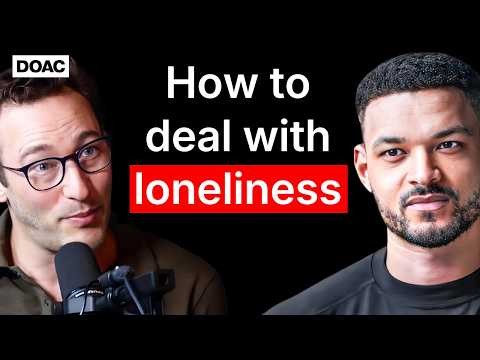
“I like to call it mental fitness rather than mental health…”The Diary of a CEO interview, 2022 · 6:39
Mental fitness is a practice, not a diagnosis
Sinek prefers the language of mental fitness because it makes emotional struggle feel more normal and more active. Fitness implies ongoing work, fluctuations, and maintenance; some days are stronger than others, but the answer is still to keep practicing rather than expecting a permanent state of arrival12.
That framing matters because it removes some of the shame people feel when they are struggling. In his view, a person can be having a hard time and still have hope at the same time, which is a more realistic picture of inner life than treating wellness as all-or-nothing34.
“I like to call it mental fitness rather than mental health…”The Diary of a CEO interview, 2022 · full transcript →
Loneliness is not just being alone; it is feeling unseen
For Sinek, one of the deepest threats to mental fitness is loneliness, but he does not reduce loneliness to physical isolation. The pain often comes from feeling misunderstood, unable to express what is true, or not having someone who can simply stay present in the struggle56.
His image for real support is not rescue but companionship. Instead of trying to solve another person's pain immediately, the stronger response is to remain with them in it, which helps them feel less abandoned and less defective for having a hard season5.
Friendship is a mental fitness skill
Sinek treats friendship as far more than a pleasant extra. Close friends help people regulate stress, feel that they belong, and recover when life becomes overwhelming, which is why he warns against sacrificing friendships for work or status7.
He also makes trust practical. Trust grows when people let others matter to them, especially by asking for help instead of only offering it. That kind of mutual dependence strengthens resilience because it teaches people they do not have to carry everything alone910.
This is one reason he links purpose and wellbeing to service rather than self-absorption. A life organized around caring for others creates connection, and connection is one of the strongest protections against despair and isolation1112.
Mental fitness weakens when convenience replaces human struggle
Sinek repeatedly warns that modern tools can train people away from patience, depth, and coping. Social media, phones, and constant stimulation can become rewarding in the same way other addictive behaviors are rewarding, which makes it harder to tolerate boredom, discomfort, and delayed gratification.
He is especially concerned that people may outsource too much of their growth to technology. Output can be accelerated, but the inner development that comes from effort, mistakes, and persistence cannot be automated away without loss1516.
That is why he pushes for habits that protect real human connection, including device boundaries and face-to-face conversation. Mental fitness depends on practicing listening, empathy, conflict resolution, and presence, not just consuming tools that promise efficiency17.
Resilience grows through honesty, boundaries, and hard conversations
Sinek does not confuse vulnerability with emotional dumping. For openness to help, it needs boundaries and trust; otherwise it becomes performance rather than connection. Mental fitness includes learning what to share, with whom, and in what kind of relationship19.
He also emphasizes self-honesty and uncomfortable conversations. People become stronger when they can face what is true about themselves and talk through difficult realities with others instead of hiding behind politeness, image, or avoidance2021.
This is part of his broader belief that human growth comes from doing hard things well. Mistakes, repair, and real conversations are not signs of failure; they are the training ground where emotional maturity is built154.
Purpose supports mental fitness when it turns outward
Sinek connects mental fitness to purpose, but not to chasing status or short-term wins. Goals like recognition, money, or achievement can motivate for a while, yet they do not reliably produce lasting fulfillment if they are detached from contribution and relationships1122.
His alternative is outward-facing purpose: serving other people, teaching, building, and helping others grow. That orientation gives struggle meaning, which makes it easier to endure setbacks without feeling empty or lost1123.
In that sense, mental fitness is not just about feeling better. It is also about becoming the kind of person who can stay human, connected, and useful in difficulty166.
Sinek on mental fitness, in his own words
“I like to call it mental fitness rather than mental health…”
“What makes people beautiful is not that we get everything right. It's that we get many things wrong.”
Where to watch
 Simon Sinek on Loneliness and Mental Fitness: Sit in the Mud2022 · 120 min · full transcriptBest single source on his mental fitness frame, loneliness, and the need for people who stay with us in hard moments.
 Simon Sinek on Friendship and Belonging: Why Friends Matter More2024 · 24 min · full transcriptShows why friendship, belonging, and asking for help are central parts of mental fitness.
 Simon Sinek on Purpose-Driven Leadership: Why Service Matters2020 · 96 min · full transcriptExplains how purpose, service, honesty, and uncomfortable conversations support emotional health.
 Simon Sinek on Millennial Work Expectations: Loyalty, Purpose, and Patience2017 · 15 min · full transcriptUseful for understanding how phones, dopamine, impatience, and weak coping habits undermine resilience.
 Simon Sinek on Vulnerability and Leadership: Why Both Matter2021 · 53 min · full transcriptBest for his view that vulnerability needs boundaries and that emotional strength requires nuance.
 Simon Sinek on Human Skills: Why AI Can't Replace Growth2025 · 126 min · full transcriptConnects mental fitness to doing hard work yourself and preserving human skills in an age of shortcuts.
Questions people ask
- What did Simon Sinek say about technology and human connection?
- What does Simon Sinek say about how trust is built in teams?
- What is Simon Sinek most afraid of about how he’s living his life?
- What did Simon Sinek say about building, teaching, and leading?
- Why does Simon Sinek talk so much about mental health and mental fitness?
- Why does Simon Sinek think millennials are so impatient at work?
Sources
Every quote above, word for word from the transcripts. Numbers match the text.
“I like to call it mental fitness rather than mental health…”
“You know, people often ask me why on the DVD I spend so long talking about health, mental health, mental fitness, mental fitness, mental fitness, um, struggles and all of those things, because I think that's the subject matter that is underserved. So that's pretty much the whole space that I play in. I spend very little time talking about how to scale a company, and all I focus on is what I believe is the underserved foundations of being a great, successful, quote unquote, individual, which is all the stuff we've talked about today.”
“I am lonely and optimistic simultaneously.”
“The world is actually quite gray, and it's usually an "and," not an "or.”
“I need somebody to sit in the mud with me…”
“We cannot do this thing called career or life alone.”
“…your friends will be there for you, your work won't.”
“Trust doesn't form in an event, in a day.”
“Relationships are formed this way. We're waiting for a meeting to start and we go, "How's your dad? I heard he was in the hospital." "Oh, he's really good. Thanks for asking. He's actually at home now." "Oh, I'm really glad." "It was really amazing." "I know. It was really scary for a while." That's how you form relationships. "Hey, did you ever get that report on—" "Oh my god, no, I didn't. I'll help you out." "I totally—I can help you out with that." "Really?" That's how trust forms. Trust doesn't form in an event, in a day. Even bad times don't form trust immediately. It's the slow, steady consistency. And we have to create mechanisms where we allow for those little innocuous interactions to happen. But when we allow cell phones in conference rooms, we just—Okay, have the meeting.”
“Our sense of joy and fulfillment and love and purpose comes from our ability to serve another human being.”
“What gives our lives purpose is not to wake up every morning to learn meditation so that we can be present for ourselves…”
“What makes people beautiful is not that we get everything right. It's that we get many things wrong.”
“There's a premium on being human.”
“There should be no cell phones in conference rooms. None. Zero.”
“Vulnerability minus boundaries is not vulnerability.”
“We don't teach leaders how to have uncomfortable conversations.”
“That I'm not 100% honest with myself. Because if I'm not honest with myself, I won't be honest to others. Um, you know, and when somebody asks me a question that I'm afraid of the answer—not because I'm afraid of offending them, but I'm afraid of how I feel about the answer myself, you know. Uh, I think that would be it.”
“We want to work in a place with purpose.”
“We came up with three words, three actions that everybody who goes through Air Force Top Gun is required to do, which is build, teach, lead. Which is the idea that you build a skill set, you teach that skill set to other people, and then you build leaders, and you lead, right? This whole idea that you have a responsibility to build, to teach, and to lead. Accumulate and give, and serve. And the thing that is so powerful is the Commandant of the Weapons School, after we— he the work, he took those words, and he put them on the coin.”
How this guide was made: drafted with AI from the full transcripts of the recordings cited, then checked: every quotation must match a transcript word for word and be the speaker's own words, and an independent review gates accuracy. Methodology and corrections.