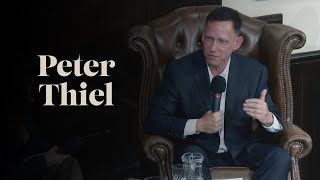
Peter Thiel on Religion & Meaning
Peter Thiel treats religion as a framework for integrating life, history, politics, and technology, and for resisting both fatalism about death and false salvation through centralized power.
- Religion matters because it helps connect personal life to history, politics, and technology instead of living in fragments.
- He reads Christianity as exposing scapegoating and taking the side of victims, not justifying blame.
- He rejects making peace with death and sees the fight against disease and aging as morally serious.
- He fears apocalyptic politics that promise security through centralized global control.
- Meaning requires reconstruction and judgment, not passive faith in systems, crowds, or software.

“I think if it's too high a lift to go to church or something like that. I would say that it's important to try to find a way to integrate your life to just fragment in all these different ways. And to integrate the knowledge, to connect what we think is going on in your life with history, with our society. We need to somehow not have this postmodern MTV like incoherence, and there's some way that asking these questions, we need somewhat more integration.”Uncommon Knowledge interview, 2025 · 39:10
Religion is a way to integrate a fragmented life
Thiel sees one of the central modern problems as fragmentation. People are pulled into isolated specialties, disconnected identities, and shallow narratives that never add up to a coherent picture of the world. His answer is not mere private spirituality but a more integrated view that connects personal life with history, society, and the big civilizational questions.12
That is why political theology matters to him. He thinks modern people often assume they can drift along without asking first questions, but that refusal to think at a higher level leaves them unprepared for crises. Meaning comes partly from rebuilding this larger frame of understanding instead of accepting cultural incoherence.23
“I think if it's too high a lift to go to church or something like that. I would say that it's important to try to find a way to integrate your life to just fragment in all these different ways. And to integrate the knowledge, to connect what we think is going on in your life with history, with our society. We need to somehow not have this postmodern MTV like incoherence, and there's some way that asking these questions, we need somewhat more integration.”Uncommon Knowledge interview, 2025 · full transcript →
Christianity matters because it unmasks scapegoating
A core part of Thiel's religious outlook comes through René Girard. He is deeply suspicious of explanations that dump guilt onto God, fate, or some convenient target, because he thinks human communities repeatedly stabilize themselves through blame and sacrifice. Religion, at its best, helps reveal this mechanism rather than sanctify it.4
This is why he emphasizes the biblical reversal toward the victim. In his reading, the Bible differs from many pagan or political stories because it increasingly tells events from the side of the one who is sacrificed or excluded. That gives religion moral significance: it can expose collective violence that otherwise hides behind order, myth, or consensus.5
This also shapes how he thinks about victimhood in politics. He does not treat every claim of victim status as automatically true, but he does think serious religious thought trains people to look carefully at how mobs, institutions, and ideologies create scapegoats.45

“And then you have to somehow say there's some progress. But the the gerardian intuition I would have is it's just always this this this reversal in perspective where the Bible takes things from the the the side of the victim. There's a... And it's already in the book of Genesis where it's the story of Cain and Abel. The founding of the first city in the history of the world is a parallel but opposite story to the story of Romulus and Remus, the founding of the greatest city where you know, Romulus and Remus' story is told from the point of view of Romulus, the Cain and Abel story is told from the point of view of Abel, or the, you know, the Israelites coming out of Egypt that would normally be told from the point of view of the Egyptians where you have these troublemakers and we got rid of them. And and it's... And you have this sort of inversion of perspectives, you know, throughout the Old Testament, would say.”Conversations with Tyler podcast, 2024 · full transcript →
Meaning is not found in accepting death
Thiel's view of meaning is sharply anti-fatalist about death. He does not think death becomes meaningful simply because it is natural or inevitable. On the contrary, he argues that modern culture too often romanticizes limits that should be challenged.6
This is why he links the struggle against aging, disease, and decline to a wider moral and religious inheritance. He argues that the main problem is not excessive scientific ambition but a loss of ambition. In that sense, hope requires refusing resignation and recovering the will to make progress where suffering is still immense.78
That position gives his theology a practical edge. Religion is not mainly there to console people into passivity; it should support a civilization willing to heal, build, and push against what diminishes human life.76

“…there is no meaning in death…”ISI debate, 2023 · full transcript →
False salvation appears as peace, safety, and total control
Thiel's most dramatic religious-political theme is his warning about the Antichrist as a recurring pattern. He does not reduce it to a movie-script end-times figure. Instead, he sees a danger in leaders or systems that exploit fear of catastrophe in order to demand global obedience.910
The trap, in his view, is that real threats like nuclear war, pandemics, or AI can push people toward a centralized authority that promises to save them from apocalypse. That promise can sound reasonable precisely because the risks are so frightening. But for him the danger is not only destruction; it is also a world order that abolishes meaningful self-government in the name of survival.101112
This concern extends to technology and geopolitics. He worries about centralized AI and surveillance when they become tools for manufacturing consensus, compressing thought, and turning political judgment into obedience. Religion matters here because it gives language for resisting counterfeit forms of salvation offered by the state, the crowd, or the machine.131415
Technology cannot replace moral and political judgment
Thiel repeatedly argues that meaning cannot be outsourced to technology. Computers and software may be powerful, but they do not absolve human beings of the need to think, choose, and govern themselves. The deeper crisis is not just technical misuse but the weakening of human judgment.161718
That is why he is so critical of systems that manipulate attention and intensify social conflict. When algorithms degrade thought and inflame contradiction, they do not simply entertain; they corrode the human capacity for truth-seeking and responsibility.1917
His practical conclusion is that reconstruction is necessary. A meaningful life and a healthy society require institutions, beliefs, and habits that pull scattered experience back into a coherent whole. Neither market momentum nor technological momentum can do that work by themselves.318
Thiel on religion & meaning, in his own words
“…there is no meaning in death…”
“…we should be deeply distrustful of of scapegoating mister God for everything like that…”
“…the problem with the culture of science today is not Promethean hubris…”
Where to watch
 Peter Thiel on Political Theology: Antichrist, AI, and Liberalism2024 · 87 min · full transcriptBest overview of how he connects religion, scapegoating, history, politics, and technology.
 Peter Thiel on Antichrist and Global Governance: The one-world trap2025 · 41 min · full transcriptBest for his idea of the Antichrist, apocalypse, and the danger of one-world political salvation.
 Peter Thiel on Death and Technological Progress: Stagnation vs. Hope2023 · 103 min · full transcriptBest for his claim that death is an enemy and that hope requires real technological progress.
 Peter Thiel on Artificial Intelligence: Intelligent, Conscious, or Evil?2022 · 57 min · full transcriptBest for how he links AI, evil, manipulation, and the decline of human judgment.
 Peter Thiel on Straussian Moment: Reason, violence, and the future2019 · 47 min · full transcriptBest for the philosophical background on violence, reason, and why first questions returned.
Questions people ask
- What advice did Peter Thiel give young people about living a good life in a time of crisis?
- What did Peter Thiel say the Antichrist would do to gain power?
- What does Peter Thiel think is the biggest political risk from AI?
- Why does Peter Thiel worry about the Antichrist and one-world government?
- What did Peter Thiel say about reconstruction after deconstruction?
- What did Peter Thiel say about victimhood and the Bible?
Sources
Every quote above, word for word from the transcripts. Numbers match the text.
“I think if it's too high a lift to go to church or something like that. I would say that it's important to try to find a way to integrate your life to just fragment in all these different ways. And to integrate the knowledge, to connect what we think is going on in your life with history, with our society. We need to somehow not have this postmodern MTV like incoherence, and there's some way that asking these questions, we need somewhat more integration.”
“Whenever people think you can just muddle through, yeah, you're probably set up for some kind of disaster…”
“We need to somehow pull things back together. It's what the universities were supposed to do, don't think they will do it, but you have to figure- >> Peter Robinson: After years of deconstruction, you're calling for an act of reconstruction. >> Peter Thiel: Yeah, it may not happen, the progressive cult that is the university, but still it is really a time for reconstruction.”
“…we should be deeply distrustful of of scapegoating mister God for everything like that…”
“And then you have to somehow say there's some progress. But the the gerardian intuition I would have is it's just always this this this reversal in perspective where the Bible takes things from the the the side of the victim. There's a... And it's already in the book of Genesis where it's the story of Cain and Abel. The founding of the first city in the history of the world is a parallel but opposite story to the story of Romulus and Remus, the founding of the greatest city where you know, Romulus and Remus' story is told from the point of view of Romulus, the Cain and Abel story is told from the point of view of Abel, or the, you know, the Israelites coming out of Egypt that would normally be told from the point of view of the Egyptians where you have these troublemakers and we got rid of them. And and it's... And you have this sort of inversion of perspectives, you know, throughout the Old Testament, would say.”
“…there is no meaning in death…”
“…the problem with the culture of science today is not Promethean hubris…”
“The optimistic scenario is that, you know, the world has growth in the world and you have technological progress. That's the optimistic scenario. That's—that's—that's the optimistic—that's the only optimistic scenario.”
“…the slogan of the Antichrist is peace and safety…”
“And this is sort of where my speculative thesis is that if the Antichrist were to come to power, it would be by talking about Armageddon all the time. And- >> Peter Robinson: Peter Thiel, the antichrist would talk about Armageddon all the time. He'll scare people and then offer to save them. >> Peter Thiel: Yes, it's the 1 Thessalonians 5:3. The slogan of the Antichrist is peace and safety, which is nothing wrong with peace and safety. But you have to sort of imagine that it resonates very differently in a world where the stakes are so absolute, where the stakes are so extreme, where the alternative to peace and safety is Armageddon and the destruction of all things.”
“And in my mind, one other existential risk is a one world totalitarian government. And I find that as least as scary as the others. And in sort of a biblical eschatological context, you're supposed to worry about Armageddon. You're also supposed to worry about the Antichrist. Maybe you're supposed to worry more about the Antichrist because the Antichrist comes first. And so if we're going to find a pathway through this apocalyptic age, you have to sort of navigate between the Scylla of all these existential risks that are... And and the chorebdas of the sort of political totalitarian catastrophe. If if I had to do sort of a more literary version on this, it's very hard to write sort of a literary account of the Antichrist.”
“We have human self-government or human self-destruction.”
“…it's a centralizing AI that's controlled by communist China…”
“It's it's sort of a purely theological question. I wanna focus more on the political theology question, which would be something like if it's a centralizing AI that's controlled by communist China, will it just be very good at convincing people that the party is God or that the wisdom of crowds or whatever the consensus is the truth. And then, yeah, there are these metaphysical questions where it doesn't seem like it's exactly a transcendent traditional monotheistic god. But I would go to more of the political questions than the metaphysical ones. And probably the risk danger is that there's something about it sort of telescopes even more the sort of consensus, truth, wisdom of crowds.”
“…you could do worse than every single time that you hear the word Dei to simply think CCP.”
“…when you hear AI you should just think software or computers…”
“…the real problem is not whether machines think but whether men do.”
“…technology is no alternative to politics.”
“I think that the TikTok algorithm is evil.”
How this guide was made: drafted with AI from the full transcripts of the recordings cited, then checked: every quotation must match a transcript word for word and be the speaker's own words, and an independent review gates accuracy. Methodology and corrections.