Paul Graham on Startup Validation
Paul Graham sees startup validation as a process of releasing early, watching what users actually do, and letting that learning shape the product instead of relying on plans or market stories.
- Validation comes from user behavior, not from theories or forecasts.
- Start with a simple core product and learn through direct contact with users.
- Early customers are valuable mainly because they teach you what to build next.
- Optimize for making something people want before worrying about business models.
- Do not lock in a market or outcome too early; stay empirical and adaptable.
Validation means learning from users, not defending a plan
For Graham, the point of an early launch is not to prove that your original idea was right. It is to begin learning from users as quickly as possible. He treats validation as an evidence loop: build, release, watch what happens, and let that change your next move.
That is why he is skeptical of long-range planning at the earliest stage. Big forecasts and polished stories can distract founders from the only thing that matters early on: whether users respond to what you made. Plans look tidy, but startups succeed by discovering reality, not by predicting it.
The first job is to understand users deeply
Graham pushes founders toward expertise in their users rather than expertise in startup theater. Validation is strongest when you know the people you are serving well enough to notice confusion, indifference, and genuine enthusiasm. Founders should trust their instincts about people and keep sharpening their understanding of what users care about.
This focus on users is also a guardrail against gaming the process. In school or large organizations, you can sometimes win by looking impressive. In a startup, the product has to work for real people, so founders have to face reality directly.
Do things that don't scale because manual work reveals the truth
A recurring Graham idea is that early founders should do labor-intensive, unscalable work if it helps them learn. Directly helping users, testing rough versions, and handling edge cases by hand are not signs that the startup is broken. They are ways to discover what matters before automation hides the signal.
He also argues that good startup ideas often look awkward or implausible at first. That is another reason validation has to be practical rather than theoretical: if you wait for the idea to sound respectable, you may never test it. Early execution matters more than sounding polished.
Watch what users choose, then keep the product simple
Graham's standard is not what users say they need in the abstract, but what they actually choose to use. That pushes founders toward simple tests of behavior instead of elaborate explanations of market size or intent. If users reliably come back, engage, or adopt the simplest version, that is meaningful validation.
This is why he keeps steering founders away from overbuilding and premature sophistication. Start with the core, get usage, and let the product evolve toward the use case that emerges. In his view, wiring in a fixed destination too early cuts off learning.
Make something people want before worrying about money
Graham repeatedly says founders should not make early validation about revenue optimization first. The harder problem is making something users genuinely want, and that is where a startup should concentrate. If users love the product, monetization is often easier than founders fear.
His decision rule is simple: do what is best for users. That mindset is not just moral; it is practical. It improves founder morale, makes allies more likely to help, and gives a clean way to decide what to build next when the situation is changing fast.
Where to watch
 Paul Graham on Startup Validation: Build, Test, and Focus2013 · 29 min · full transcriptBest direct look at how Graham validates early ideas by pushing founders toward user behavior, simpler tests, and evidence-based next steps.
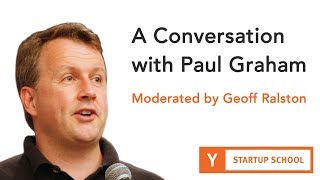 Paul Graham on Startup Ideas: How Ideas, Teams, and Growth Work2018 · 63 min · full transcriptShows why early manual work and unscalable tactics are often the fastest route to real validation.
 Paul Graham on Before the Startup: Just Learn2014 · 48 min · full transcriptExplains why user expertise matters more than startup cleverness and why founders should stop trying to game the process.
 Paul Graham on Benevolence in Startups: being good works2014 · 31 min · full transcriptClarifies why making something users want comes before monetization and how user-first decisions guide validation.
 Paul Graham on Startups and Innovation: How Y Combinator Works2009 · 63 min · full transcriptUseful for Graham's broader principle that releasing is for learning from users, not for presenting a finished plan.
Questions people ask
- What did Paul Graham say about growth hacks?
- What did Paul Graham say about startup ideas not feeling like lightbulbs?
- How does Paul Graham decide between multiple startup solutions?
- What did Paul Graham say about building what people need versus what people want?
- Why did Paul Graham say customers teach you in the beginning of a startup?
- Why does Paul Graham say the rule is to do what is best for the startups?
How this guide was made: drafted with AI from the full transcripts of the recordings cited, then checked: every quotation must match a transcript word for word and be the speaker's own words, and an independent review gates accuracy. Methodology and corrections.
