Neil deGrasse Tyson on Free Will
Neil deGrasse Tyson treats free will as deeply constrained by biology and environment, which shifts attention from blame toward understanding causes and reducing suffering.
- Tyson leans toward the view that our choices arise from biology plus environment, not from an independent inner freedom.
- He stresses that people are born with predispositions and then shaped within those biological limits.
- He connects free will to brain science: hunger, sleep, hormones, and development affect judgment before reflection does.
- This view weakens simple blame and merit, and strengthens the case for understanding causes.
- Even without full free will, Tyson still points toward helping others and reducing suffering.

“We know now is that, we're born with certain genetic predispositions, to behave in certain ways, and then within that sort of, within that range of, you can modify behavior within a range that you're given, biologically.”StarTalk Live at BAM, 2018 · 29:03
Tyson sees human choice as the product of causes, not pure personal authorship
Tyson’s basic position is that what we call choice sits on top of prior causes we did not choose. In his discussion with Robert Sapolsky, the core claim is that a person is the outcome of biology and its interaction with environment, both arriving before any conscious decision appears1.
That does not mean behavior is random or mysterious to him. It means the real explanation for action should begin with the body, the brain, development, and lived conditions rather than with the idea of a fully self-creating chooser1.
Biology gives you a range, and life experience shapes what happens inside it
Tyson does not frame human behavior as genetics alone. He says people are born with genetic predispositions and can modify behavior only within a biologically given range, which makes free will limited rather than unlimited2.
This matters because it rejects the common picture that everyone starts from the same inner freedom. If biology sets the range and environment pushes development in one direction or another, then different outcomes between people are not simply the result of one person choosing better than another21.
“We know now is that, we're born with certain genetic predispositions, to behave in certain ways, and then within that sort of, within that range of, you can modify behavior within a range that you're given, biologically.”StarTalk Live at BAM, 2018 · full transcript →
Tyson uses brain science to challenge the idea that judgment is fully sovereign
His broader view of the mind supports this skepticism about free will. Tyson repeatedly treats the brain as the place where behavior, consciousness, and judgment arise, which is why changes in brain state matter so much for what people do1.
He also accepts a humbling picture of human reasoning: our brains are not naturally built for clean logic. That means many decisions people experience as clear and self-directed may actually be filtered through cognitive limits and evolved shortcuts rather than independent rational control4.
This is one reason Tyson is open to examples involving sleep, hunger, hormones, and development affecting behavior. If judgment depends on brain conditions, then the freedom of that judgment is never detached from the state of the organism making it14.
The biggest practical consequence is less moral blame and less faith in merit
Once behavior is understood as caused, the usual moral story becomes harder to sustain. In the Sapolsky conversation, the logic pushed to its end is that blame, punishment, praise, reward, and even meritocracy lose their simple moral foundation because people do not author the conditions that made them who they are51.
Tyson’s side of this discussion is important because he does not treat this as a minor academic issue. It changes how you think about crime, addiction, depression, prejudice, and failure: less as proof of a bad soul and more as outcomes that need explanation at the level of brain, history, and circumstance1.
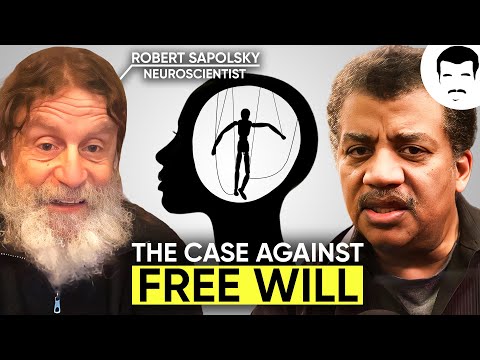
“And blame and punishment make no sense. Praise and reward make no sense. Meritocracies make no sense. Criminal justice makes no sense. Feeling like you have earned anything makes no sense. Hating somebody makes as little sense as hating an earthquake. All of that—that’s the only logical point you can get to. And I’ve been thinking this way since I was 14, and I can actually function this way about three minutes every other month because it’s incredibly hard.”StarTalk interview with Robert Sapolsky, 2021 · full transcript →
Even with diminished free will, Tyson still lands on compassion and better action
A reduced belief in free will does not leave Tyson with apathy. His stated moral aim is to lessen the sufferings of others and to keep learning, which fits a worldview focused less on blame and more on improving conditions6.
This also matches his broader scientific attitude. Human intuition is limited, and reality does not have to conform to what feels obvious, so we should be willing to revise comforting beliefs about control when science points elsewhere74.
Applied to everyday life, Tyson’s view encourages a practical shift: ask what caused a behavior, what conditions can be changed, and how to build systems that produce better outcomes. Responsibility becomes less about condemnation and more about understanding, prevention, and care16.
Tyson on free will, in his own words
“We know now is that, we're born with certain genetic predispositions, to behave in certain ways, and then within that sort of, within that range of, you can modify behavior within a range that you're given, biologically.”
“And blame and punishment make no sense. Praise and reward make no sense. Meritocracies make no sense. Criminal justice makes no sense. Feeling like you have earned anything makes no sense. Hating somebody makes as little sense as hating an earthquake. All of that—that’s the only logical point you can get to. And I’ve been thinking this way since I was 14, and I can actually function this way about three minutes every other month because it’s incredibly hard.”
Where to watch
 Neil deGrasse Tyson on Free Will: Biology, Culture, and Responsibility2021 · 55 min · full transcriptThe clearest statement of Tyson’s view that free will is constrained by biology, environment, and prior causes.
 Neil deGrasse Tyson on Brain and Consciousness: From Sleep to Selfhood2018 · 127 min · full transcriptShows how Tyson connects behavior to genetic predispositions, brain function, and the limits of biological flexibility.
 Neil deGrasse Tyson on Logic And Religion: Science, Belief, and Labels2014 · 82 min · full transcriptAdds Tyson’s broader claim that human brains are not naturally wired for logic, which supports his skepticism about fully independent choice.
 Neil deGrasse Tyson on Cosmic Queries: Deep Questions and Big Ideas2021 · 48 min · full transcriptHelps place the free-will question inside Tyson’s larger worldview about human limits, humility, and reducing suffering.
Questions people ask
Sources
Every quote above, word for word from the transcripts. Numbers match the text.
“…we are nothing more than the biology over which we had no control and its interactions with environment over which we had no control…”
“We know now is that, we're born with certain genetic predispositions, to behave in certain ways, and then within that sort of, within that range of, you can modify behavior within a range that you're given, biologically.”
“…our brain is not wired for logic…”
“And blame and punishment make no sense. Praise and reward make no sense. Meritocracies make no sense. Criminal justice makes no sense. Feeling like you have earned anything makes no sense. Hating somebody makes as little sense as hating an earthquake. All of that—that’s the only logical point you can get to. And I’ve been thinking this way since I was 14, and I can actually function this way about three minutes every other month because it’s incredibly hard.”
“I want to lessen the sufferings of others and make sure I learn something more about the world today than I did yesterday.”
“The universe is under no obligation to make sense to you.”
How this guide was made: drafted with AI from the full transcripts of the recordings cited, then checked: every quotation must match a transcript word for word and be the speaker's own words, and an independent review gates accuracy. Methodology and corrections.
