Naval Ravikant on The Internet
Naval sees the internet as a permissionless system for leverage, learning, ownership, and global creation, but one that also amplifies noise and demands better judgment.
- The internet gives people infinite leverage without asking permission.
- It rewards creators who productize their specific knowledge with code, media, and software.
- Computers and digital literacy are now basic economic literacy.
- The internet is decentralizing media and lowering barriers to publishing, ownership, and entrepreneurship.
- It also creates a fog of bots, bad data, and conflict, so judgment matters more, not less.

“They allow for infinite leverage without permission…”New Frontiers March 2019 Summit fireside chat · 2:28
The internet matters because it gives ordinary people leverage
Naval’s core idea is that the internet changed the economics of action. A single person can now create software, media, products, and communities that reach vast numbers of people without needing permission from institutions. He describes this era as one of infinite leverage, and he ties that directly to computers and networks that let output scale far beyond hours worked.12
That is why the internet is so central in his thinking about wealth and freedom. If you want more freedom, you need forms of work that scale without you being present every minute, and the internet is the distribution layer that makes that possible. It turns code and media into tools that can work while you sleep.134
“They allow for infinite leverage without permission…”New Frontiers March 2019 Summit fireside chat · full transcript →
Computers are the new literacy, so internet fluency is a life skill
Naval treats computer skill the way earlier societies treated reading and writing. He says computers are the most powerful tool humanity has created, and being good with them is modern literacy. That means internet fluency is not a niche technical hobby; it is becoming a basic advantage in work, learning, and wealth creation.56
He pushes this beyond software engineers. His point is that a digitally literate population can raise innovation and wages across many professions because digital tools increase each person’s capability. In his view, countries and individuals who become fluent early get a compounding edge.567
“They allow for infinite leverage without permission, and, to me, knowing how to be good with computers is the modern literacy. It's the new reading, writing, arithmetic, and this will be widely accepted and acknowledged decades from now. But today we're in that transition phase where as a software engineer you're very well paid, and there's no unemployment. But as someone transitioning out of the old economy, you have this giant gap to jump. So I think it would be interesting. One system design experiment that would be interesting is to create an entirely digitally literate nation, where everybody is facile with computers.”New Frontiers March 2019 Summit fireside chat · full transcript →
The internet favors creators who productize themselves
Naval’s advice for using the internet well is not to imitate everyone else. It is to combine authenticity with scale: bring your own specific knowledge, then package it into something that can travel through code, capital, or media. That is what he means by productizing yourself.4
This is why the internet is so powerful for independent builders and creators. If your work feels like play because it matches your genuine interests, you can keep doing it long enough to get excellent, and then the network lets that excellence spread. The result is a path where output matters more than credentials, geography, or social status.849
The internet is decentralizing media, institutions, and ownership
Naval thinks the internet is breaking old gatekeepers in media and publishing. More people can now report, comment, teach, entertain, and build audiences directly, which weakens the monopoly once held by newspapers, broadcasters, and other large institutions. His view is not that everyone becomes equally influential, but that the system becomes far more open to participation.
He extends this idea further with blockchains. In his view, the next phase of the internet is not just publishing and communication, but native ownership. Digital private keys create digital private property, allowing users and builders to own pieces of the network itself rather than merely renting access inside centralized platforms.121314
That is why he is so interested in Web3. He sees tokens, smart contracts, and portable assets as ways to create internet-native companies, projects, and communities owned by users and creators. The important shift is from using the internet to distribute content toward using it to coordinate ownership and incentives at global scale.15161718
The internet expands opportunity globally, but it does not remove all constraints
Naval repeatedly returns to the idea that the internet opens opportunity for people outside traditional power centers. Builders can create, publish, and sell into global markets based on what they make, not just where they were born or which institutions admit them. That is why he emphasizes removing barriers for entrepreneurs rather than layering on new ones.9
At the same time, he does not pretend the internet erases reality. Location, policy, and surrounding systems still matter, which is why he talks about attraction, talent concentration, and national choices around digital literacy and openness. The internet expands the playing field, but people and countries still need the right conditions to capitalize on it.7
“There's nothing to add. There are things to take away that are in the way of people who want to create things.”Clubhouse podcast on entrepreneurship, 2021 · full transcript →
The internet also creates confusion, conflict, and low-quality reality
Naval is not naive about the downside. He sees modern online life as full of bad data, bots, and conflicting realities, where truth becomes harder to establish because everyone is flooded with information but human judgment does not scale as fast as distribution. In practice, this means the same system that empowers individuals also amplifies noise and manipulation.
His answer is not to retreat from the internet, but to become more discerning in how you use it. The more open and permissionless the network becomes, the more valuable judgment, calmness, and independence of mind become. Opportunity rises, but so does the need to choose carefully what you consume, what you build, and which incentives you trust.
Naval on the internet, in his own words
“They allow for infinite leverage without permission…”
“Digital private keys enable digital private property. And so we finally have private property in the Internet, and we don't need people like Spotify or even the studios and the labels to determine who owns what private property and hold it with their database entries and their lawyers. We can each do it ourselves. We can finally each... And and Chris got made fun of on Twitter for this. We can each own a piece of the Internet, but it's absolutely true. We can create digital scarcity, and it is a very powerful thing because then it can map to real world scarcity. Because the real world is not completely abundant in everything. The real world does have scarce economic resources, and so we can have digital scarcity and digital private property.”
“They allow for infinite leverage without permission, and, to me, knowing how to be good with computers is the modern literacy. It's the new reading, writing, arithmetic, and this will be widely accepted and acknowledged decades from now. But today we're in that transition phase where as a software engineer you're very well paid, and there's no unemployment. But as someone transitioning out of the old economy, you have this giant gap to jump. So I think it would be interesting. One system design experiment that would be interesting is to create an entirely digitally literate nation, where everybody is facile with computers.”
Where to watch
 Naval Ravikant on Media Decentralization: Clubhouse, Substack, and power2021 · 49 min · full transcriptBest overview of how the internet is decentralizing media, institutions, and influence.
 Naval Ravikant on Web3 and Crypto: Why Native Wins2020 · 152 min · full transcriptBest for Naval’s view that the internet is moving from publishing and platforms to native ownership and coordination.
 Naval Ravikant on Technology and Systems Design: New Zealand's Edge2019 · 23 min · full transcriptBest for his argument that computers and internet fluency are the new literacy and a national advantage.
 Naval Ravikant on Entrepreneurship in India: Celebrate Creators2021 · 99 min · full transcriptBest for how the internet expands entrepreneurial opportunity globally and lowers status barriers.
 Naval Ravikant on Simulation And Internet Truth: Fall, the miasma, and free minds2019 · 60 min · full transcriptBest for the darker side: misinformation, bots, and why truth gets harder online.
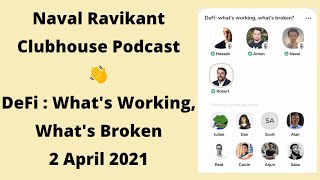 Naval Ravikant on DeFi and NFTs: Composable Finance2021 · 78 min · full transcriptBest for how permissionless, composable internet-native finance changes what online systems can do.
Questions people ask
- What did Naval Ravikant say about Web3 and native internet companies?
- What did Naval Ravikant say about communities in Web3 and crypto?
- What did Naval Ravikant say about digital literacy and computers?
- What did Naval Ravikant say about productizing yourself?
- What did Naval Ravikant say makes Web3 different from Web2?
- Why does Naval Ravikant think Web3 will create new products instead of copying old ones?
Sources
Every quote above, word for word from the transcripts. Numbers match the text.
“We live in an age of infinite leverage…”
“They allow for infinite leverage without permission…”
“What you really want is freedom. You want freedom from your money problems. Right. And I think that's okay. So people... Once someone can solve their money problems, either by lowering their lifestyle or by making enough money, and, you know, essentially, what you want to get everybody to is retirement, But not retirement in the, I'm 65 years old sitting in a nursing home collecting a check retirement. Different definition. Retirement is when you stop sacrificing today for some imaginary tomorrow.”
“Productize and yourself. Yourself has uniqueness. Productize has leverage. Yourself has accountability. Productize has specific knowledge. Yourself also has specific knowledge in there. So all of these pieces, you can combine them into these two words. Whenever you're doing anything in business, if you're looking towards a long term of getting wealthy, you should ask yourself, is this authentic to me? Is it myself that I am projecting? And then am I productizing it? Am I scaling it? Am I scaling with labor or with capital or with code or with media?”
“…computers are the most powerful tool ever created by humanity…”
“They allow for infinite leverage without permission, and, to me, knowing how to be good with computers is the modern literacy. It's the new reading, writing, arithmetic, and this will be widely accepted and acknowledged decades from now. But today we're in that transition phase where as a software engineer you're very well paid, and there's no unemployment. But as someone transitioning out of the old economy, you have this giant gap to jump. So I think it would be interesting. One system design experiment that would be interesting is to create an entirely digitally literate nation, where everybody is facile with computers.”
“Silicon Valley is not a place that creates entrepreneurs or wealth or technology. It is a place that attracts entrepreneurs…”
“I'm always working, but it looks like work to them, but it feels like play to me…”
“There's nothing to add. There are things to take away that are in the way of people who want to create things.”
“I think blockchains are really, really, really important.”
“I think it is literally as important to the internet's development as mobile phones were and as the web browser was.”
“Digital private keys enable digital private property. And so we finally have private property in the Internet, and we don't need people like Spotify or even the studios and the labels to determine who owns what private property and hold it with their database entries and their lawyers. We can each do it ourselves. We can finally each... And and Chris got made fun of on Twitter for this. We can each own a piece of the Internet, but it's absolutely true. We can create digital scarcity, and it is a very powerful thing because then it can map to real world scarcity. Because the real world is not completely abundant in everything. The real world does have scarce economic resources, and so we can have digital scarcity and digital private property.”
“So there's just this huge opportunity now to make every person a worker, an investor, a shareholder, an evangelist, an owner, a creator, a designer. We can fold it all into one, and that's really what Web three is enabling with tokens at the core. And it would be a mistake to just think of this as securities law, investor protection, and derivatives. I get that's where it started because you have to create money, Internet native money first before any of this is possible. But now that we have Internet native money, we can start creating true Internet native corporations, Internet native collectives, Internet native projects, Internet native platforms that are owned by the users.”
“Before this, you know, when people would ask, like, how do I participate in crypto? There's an answer for individuals, which is, hey. You can bet on sound money, digital gold. That's Bitcoin. And then if you were a company, you could say, hey. You can build something on top of Ethereum. You can build decentralized finance. You can build applications on this computer, this Turing complete blockchain that is running... Computer that's running on the blockchain. And now for the first time, a community can show up, and you can have an answer for the community. You can say, okay. If you have a passionate group of believers, you can spread ownership amongst them. You can spread governance amongst them. You can build a DAO. You can issue NFTs. You can have an online gaming community. You can have a conversational community.”
“We own the NFTs. They're simple. They're portable. They're programmable. They're composable.”
“Once it's done, then anybody else can copy it. Then it can just be plugged in, dropped into any new application. So if you look at, for example, games that are going to come out that are web three based, they're going to have entire market economies in them. They will have custody solutions. They will have NFTs built inside of them. They'll be completely composable in that any piece from any other app can plug into any other app permissionlessly. And so you're building an edifice. It's almost like building a civilization or a city of interconnected apps instead of these silos in which the data is not portable, the code isn't portable, users aren't portable.”
How this guide was made: drafted with AI from the full transcripts of the recordings cited, then checked: every quotation must match a transcript word for word and be the speaker's own words, and an independent review gates accuracy. Methodology and corrections.
