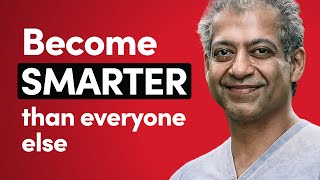
Naval Ravikant on Decision Making
Naval treats decision making as a function of inner calm, clear understanding, and choosing fewer desires so your best judgment can compound through leverage.
- A calm mind makes better decisions because judgment improves when desire and anxiety are quieter.
- Most bad decisions come from wanting too much, reacting to status games, and scattering attention.
- Good decisions come from understanding first principles, not memorized jargon or consensus.
- In a leveraged world, one high-quality decision can matter more than huge amounts of effort.
- The point is not to win every game forever, but to choose the right games and become freer over time.

“Understanding is the thing to strive for, not the words.”Tim Ferriss Show interview, 2016 · 24:43
Decision quality starts with your internal state
Naval links better decisions to a quieter mind. When desire, anxiety, and conditioned reactions are running the show, judgment gets distorted. When the mind is calmer and less needy, it can see more clearly and choose better.1234
He treats this as trainable rather than fixed. Happiness, self-awareness, and emotional steadiness are skills, and building them improves every area of life, including investing and other high-stakes choices. The practical point is that decision making is not just about analysis; it is also about reducing inner turbulence.5467
That is why he values presence so highly. If your attention is trapped in regrets, fantasies, and agitation, you are not responding to reality as it is. Better decisions require being here enough to notice what is actually happening.8910
Want less, and your choices get sharper
A recurring Naval idea is that too many desires create confusion. If you want everything, you cannot focus, and you will be easier to manipulate by status, comparison, and impulse. Choosing fewer desires gives decisions force and simplicity.111213
He also sees unnecessary desire as a direct source of suffering. If wanting something means binding your mood to its outcome, then decision making becomes emotional and brittle. Reducing desire does not kill ambition; it removes noise so ambition can be directed more intelligently.11210
This applies especially to attention. Naval treats attention as the scarce currency of life, so every commitment has an opportunity cost. Good decision makers are selective not only about what they pursue, but about what they refuse to care about.141516
Seek understanding, not borrowed opinions
Naval prefers decisions built on understanding rather than slogans, credentials, or consensus. He returns to basics and first principles because real comprehension lets you re-derive what matters when conditions change. Memorization is fragile; understanding is adaptable.1718
His model is closer to science than to certainty. You form the best explanation you can, stay open to criticism, and correct errors as reality pushes back. That makes humility central to good judgment: you are making educated guesses, not claiming omniscience.192021
This is also why he is wary of noise. If media and social churn make every issue feel urgent and personal, you end up making decisions based on borrowed emotional priorities. Clear thinking requires filtering aggressively enough to preserve independent judgment.1622
“Understanding is the thing to strive for, not the words.”Tim Ferriss Show interview, 2016 · full transcript →
In a leveraged world, one great decision matters a lot
Naval argues that modern outcomes are highly nonlinear. Because code, capital, labor, and audiences can magnify judgment, a single good decision can produce outsized results. That shifts the game from pure effort toward clarity, accountability, and choosing well.232425
This helps explain his emphasis on specific knowledge and work that feels like play. When your actions fit your genuine strengths and interests, you are more likely to develop rare judgment and make decisions other people cannot easily copy. Then leverage can multiply the result.262728
The practical implication is not to become passive. It is to stop treating busyness as proof of value. Iterate enough to learn, but then aim your energy where one sound decision can have compounding effects.2425
“So if I can just make one good decision a year that makes me all the money that I need for that year, then that's perfect. And that's the way it should be because we're living in an age of infinite leverage, and your judgment just gets multiplied through this massive force multiplier through code, capital, community, labor, what have you. So if you're smart and you kinda know what you're doing, you don't need to work hard. Working hard is the last... Least important thing. You have to pay your dues. You have to put in all the iterations, 10,000 iterations, not ten thousand hours to figure out what to do and how to do it well. But once you know, you don't have to put in the time anymore. It's your judgment. And the judgment comes from clear thinking. The clear thinking comes from having time to reflect and to pursue your genuine intellectual curiosity.”Tim Ferriss Show interview, 2016 · full transcript →
Choose games that buy freedom, not endless entanglement
For Naval, decisions should be judged partly by whether they increase freedom. Money matters because it removes certain constraints, but its deeper purpose is freedom rather than status display. A smart life decision solves recurring problems and reduces future compulsion.293031
That is also how he thinks about ambition. You pursue goals, win games, and then ideally become less trapped by them. The mistake is to keep replaying the same status-driven loops long after they have stopped serving you.3233
This is why he emphasizes the journey. Since most of life is spent along the way, a decision that makes the present miserable in exchange for a constantly postponed payoff is suspect. Better choices improve both trajectory and day-to-day experience.3431
Naval on decision making, in his own words
“Understanding is the thing to strive for, not the words.”
“…we are searching for the best explanation…”
Where to watch
 Naval Ravikant on Happiness and Status: Enjoy the journey2025 · 196 min · full transcriptBest for how fewer desires, attention, status, and freedom shape better choices.
 Naval Ravikant on Happiness and Anxiety: Self-Reflection, Not Noise2016 · 122 min · full transcriptBest for understanding versus jargon, filtering noise, and thinking from first principles.
 Naval Ravikant on Explanation and Error Correction: Science, Markets, Speech2021 · 61 min · full transcriptBest for Naval’s model of explanation, guessing, criticism, and error correction.
 Naval Ravikant on Happiness and Wealth: Calm, Leverage, and Freedom2019 · 132 min · full transcriptBest for the link between calmness, desire, judgment, and leverage.
 Naval Ravikant on Parenting Sovereign Children2025 · 183 min · full transcriptBest for self-honesty, integrity, and why emotional self-work improves decisions.
Questions people ask
- How does Naval Ravikant decide what to focus on?
- How does Naval Ravikant think about investing and emotions?
- What did Naval Ravikant say about happiness and wanting less?
- What did Naval Ravikant say about hard work and judgment?
- What did Naval Ravikant say about honesty and integrity?
- What did Naval Ravikant say about anxiety and reflection?
Sources
Every quote above, word for word from the transcripts. Numbers match the text.
“…desire to me is a contract that you make with yourself to be unhappy until you get what you want…”
“I want it to be weaker and more muted so that I can live much more in present everyday reality…”
“The mind should be a servant or a tool, my master.”
“That's a really good question. It's a... This is a very deep question that's gonna have lots of answers. But at the end of the day, I think you have to work on your internal state until you are free of as many biases and conditioned responses as you can be, and it will improve every aspect of your life, including investing. And I am a bookworm, so I read an enormous amount. I was raised essentially in a library as a daycare center. And so I've just read so much that I don't even know where to start. But if you work on your internal state, one of the things you start realizing is as an investor, emotions dominate. Investors are very emotional, even though we act or we pretend to be very rational. For example, you'll decide in the first five minutes of a meeting usually whether you wanna invest in the company or not. And if a company doesn't take your money in the first round, you get annoyed with them or you feel like they crossed you, then you have to undo that emotional state so when the second round comes along, you can still be a positive force and continue helping the company and maybe have a bite at the apple a second time.”
“I think happiness is a skill.”
“And these kinds of skills are extremely hard to build. They're not things you're gonna build by reading one book and then you're like, So I don't believe in the epiphany theory of self development where you read some book, you have an incredible epiphany, you read one phrase, you're like, okay, that's great. This changes my life. And then you scroll it down a piece of paper and you keep looking at it or you put it as a backdrop to your computer screen. Life doesn't work that way. What you kinda have to do is you have to build skills. And I think happiness is a skill. Nutrition is a skill. Diet is a skill. Investing is a skill. Self awareness is a skill. And skills get built up over decades with feedback loops, and you just have to constantly keep working at it on it. So the books that have helped me a lot, I think there's a class of books that I would kinda put in the stoicism category. And I know you've been a big advocate of these in the past, and I sort of discovered them independently, but they were very influential.”
“You have a whole set of sensory experiences and stimulations and lights and colors and sounds and then you die. Yeah. And how you choose to interpret that is up to you. You do have that choice. So this is what I meant, that happiness is a choice. If you believe it's a choice, then you can start working on it. And I can't tell you how to find it because it's your own conditionings that are making you unhappy, so you have to uncondition yourself. It's just like, can't fix your eating habits for you. I can give you some general guidelines, but you gotta go through the hard habit forming of how to eat right. But you have to believe it's possible and it is absolutely possible. I was miserable, I'm happy as a clam. And it's not just the money, I got there before the money.”
“There is actually nothing but this moment.”
“…to live in the present moment is the highest calling.”
“The best... My definition keeps evolving. So the answer I would've given you a year ago would be different than what I tell you now. But today, I believe that happiness is... It's really a default state. It's what's there when you remove the sense that something is missing in your life. And we are highly judgmental survival and replication machines. We're constantly walking around thinking, I need this, I need that, trapped in the web of desires. And happiness is that state when nothing is missing. And when nothing is missing, your mind shuts down, and your mind stops running into the future or running into the past to regret something or to plan something. And then in that absence for a moment, you have internal silence. And when you have internal silence, then you are content and you're happy.”
“How many things there are in this world that I do not want?”
“You could focus. You could decide that I don't want most things. I I think we have a lot of unnecessary desires that we just pick up everywhere. We have opinions on everything, judgments on everything. So I think just knowing that those are the source of unhappiness will make you be choosy about your desires. And frankly, if you wanna be successful, you have to be choosy about your desires. You have to focus.”
“Happiness. Okay. So very complicated topic, but I always like the Socrates story where he goes into the marketplace, and they show him all these luxuries and fineries. And he says, how many things there are in this world that I do not want? Right? And that's a form of freedom. So not wanting something is as good as having it. In the old story with Alexander Dionysius, right, Alexander goes out and conquers the world, and he meets Dionysius who's living in a barrel. And Dionysius says, get out of the way. You're blocking my son. And Alexander says, oh, how I wish I, you know, could be like Dionysius in the next life. And Dionysius says, that's the difference. I don't wish that I could... Sorry. Diogenes. Diogenes. Diogenes says, I I I don't wish to be Alexander. So two paths to happiness, and, one path is for success.”
“…the real currency of life is attention.”
“You know, the the currency of life. Right? People think it's money. And, yes, money is important, and it does let you trade certain things for time. But it doesn't really buy you time. Ask Warren Buffett how much time money can buy you or Michael Bloomberg. They're, you know, rich as Scrooge and and and Chris's, but they can't buy more time. Right? Brian Johnson notwithstanding. So you can't trade money for time. Money is not the real currency of life. And time itself doesn't even mean that much because as we talked about before, a lot of time can be wasted because you're not really present for it. You're not paying attention. So the real currency of life is attention. It's what you choose to pay attention to and, and and what you do about it.”
“The goal of the media these days is to make every problem your problem.”
“Understanding is the thing to strive for, not the words.”
“This is a very deep point. Yep. And I think that a lot of times that we just define something with another definition or we just throw out a piece of jargon as if that means we know something. And, you know, it's a difference between memorization and understanding. Understanding is a thing that you want. You wanna be able to describe it in 10 different ways in simple sentences from the ground up and rederive whatever you need. If you just memorize, you're lost. So I think this is one of the things that I get stuck on a lot, which is, just keep going back and reading the basics over and over trying to understand them. So don't necessarily have that tall edifice of knowledge that is very seductive in academia. But as anyone who's operated much in the real world knows, in the real world, you get paid for making good judgments and decisions based on the basics.”
“…science is not simply about observing the same thing over and over again…”
“…we are searching for the best explanation…”
“All we can do is guess.”
“…you must never ever fool yourself and you are the easiest person to fool.”
“We live in an age of infinite leverage…”
“So if I can just make one good decision a year that makes me all the money that I need for that year, then that's perfect. And that's the way it should be because we're living in an age of infinite leverage, and your judgment just gets multiplied through this massive force multiplier through code, capital, community, labor, what have you. So if you're smart and you kinda know what you're doing, you don't need to work hard. Working hard is the last... Least important thing. You have to pay your dues. You have to put in all the iterations, 10,000 iterations, not ten thousand hours to figure out what to do and how to do it well. But once you know, you don't have to put in the time anymore. It's your judgment. And the judgment comes from clear thinking. The clear thinking comes from having time to reflect and to pursue your genuine intellectual curiosity.”
“The entire structure of rewarding people comes from the agricultural and industrial age where your inputs and your outputs matched up very closely. The amount of hours that you put into doing something was a good rough proxy for what kind of output you're going to get. Today, it's extremely nonlinear. One good investment decision can make a company 10 or $100,000,000. One good product feature can be difference between product market fit and complete failure. So judgment and accountability matter much, much more. And you want the accountability because sometimes the best engineers or the best salespeople are the ones who don't work very hard, but then they'll ship that one critical product at just the right time or they'll make that one huge sale or that one huge deal that will make the company or at least make the numbers for the quarter.”
“I'm always working, but it looks like work to them, but it feels like play to me…”
“You must own a piece of a business if you want a path to financial freedom.”
“That one right there is the most important one, which is you you basically... In modern life, what happens is, like, the person who is the best at doing something in the world will get to do it for the entire world through a combination of leverage and distribution, accountability, and specific knowledge with all of which I talk about in the tweet storm. If you're the best in the world at doing something, like, you're the best teacher in the world at math, you should be teaching the entire world math. If you're the best podcast interviewer, you should be doing all the top interviews. And the returns will accrue to you, especially in this highly digital world that where we live in where the cost of distributing something is very close to zero. And so what you kinda wanna do is you wanna productize yourself into a business, and then you wanna own that business. That is the way to make wealth.”
“Money solves all your money problems…”
“The purpose of money is freedom.”
“What you really want is freedom. You want freedom from your money problems. Right. And I think that's okay. So people... Once someone can solve their money problems, either by lowering their lifestyle or by making enough money, and, you know, essentially, what you want to get everybody to is retirement, But not retirement in the, I'm 65 years old sitting in a nursing home collecting a check retirement. Different definition. Retirement is when you stop sacrificing today for some imaginary tomorrow.”
“…the reason to win the game is to be free of it.”
“It depends on the person, but I I I think you have to try that path. If you want something, go get it. You know, like, I I I quipped that the reason to win the game is to be free of it. So you you play the games, you win the games, and then you get... Hopefully, you get bored of the games. You don't wanna just keep looping on the same game over and over, although a lot of these games are very enticing and have many levels that are relatively open ended. And then you become free of the game in a sense that you're no longer trying to win it. You know you can win it, and either you move to a different game, or you play the game for the sheer joy of it.”
“The journey is the only thing there is.”
How this guide was made: drafted with AI from the full transcripts of the recordings cited, then checked: every quotation must match a transcript word for word and be the speaker's own words, and an independent review gates accuracy. Methodology and corrections.