Naval Ravikant: Joe Rogan Experience #1309
On Happiness and Wealth: Calm, Leverage, and Freedom

What Naval talks about
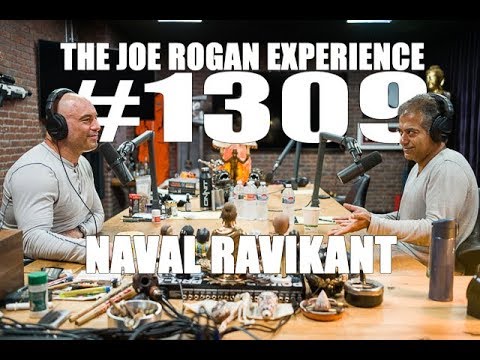
Naval Ravikant joined The Joe Rogan Experience podcast on June 4, 2019, for a wide-ranging conversation about happiness, wealth, meditation, leverage, social media, and politics.
Also known as: Joe Rogan Experience #1309 - Naval Ravikant; Everyone Can Be Rich; You Can Learn to be Happy.
Naval argues that happiness, wealth, and health are learnable goals, and that the best life is built by combining calmness with ambition rather than chasing success at any cost. He explains why desire can make people unhappy, and why clear judgment matters more than raw hustle.
He also lays out his ideas on leverage, equity, and wealth creation: don’t rent your time if you want freedom, own pieces of businesses, and use modern tools like code, media, and capital to scale your impact. He frames work as something closer to play, creativity, and art when it’s aligned with curiosity.
The conversation turns to social media, censorship, culture wars, universities, and technology’s political effects. Naval argues that algorithms shape public opinion, that centralized platforms will face pressure, and that decentralized media and privacy-preserving technologies are likely to grow.
Joe Rogan interviews Naval Ravikant throughout.
In his words
“Specialization is for insects”
“Desire to me is a contract that you make with yourself to be unhappy until you get what you want”
“We live in an age of infinite leverage”
“I'm always working, but it looks like work to them, but it feels like play to me”
Key points
- Happiness is a choice and a skill, not just a reward for success.
- Desire can be a contract to be unhappy until you get what you want.
- A calm mind improves judgment, and better judgment improves outcomes.
- To build wealth, own equity rather than just selling your time.
- Modern leverage comes from code, media, capital, and teams.
- Social media platforms and their algorithms have enormous cultural power.
- Technology tends to push society leftward, though some tools like encryption can push privacy and individual power back.
Full transcript: Naval Ravikant, Joe Rogan Experience #1309 (2019)
Joe Rogan21. Boom. Alright. We're live. Thank you very much for doing this, man. I really appreciate it. I've been absorbing your information and listening to you talk for, quite a while now. So it's, it's great to to actually meet you.
Naval RavikantThanks for having me.
Joe RoganMy pleasure. My pleasure. You are one of the rare guys that is, you're a big investor. You are, you're deep in the tech world, but yet you seem to have a very balanced perspective in terms of how to live life as opposed to not just be entirely focused on success and financial success and tech investing, but rather how to live your life in a happy way. That's a... It's a... That's not balance.
Naval RavikantYeah. You know, I I think the reason why people like, hearing me is because, like, if... It's like if you go to a a circus and you see a bear, right, that's kind of interesting, but not that much. If you see a unicycle, that's interesting. But you see a bear on a unicycle, that's really interesting. Right? So when you combine things you're not supposed to combine
Joe RoganRight.
Naval RavikantPeople get interested. It's like Bruce Lee. Right? Striking thoughts, philosophy, plus martial arts. Mhmm. And and I think it's because at some level, all humans are broad. We're all multivariate, but we get summarized in pithy ways in our lives. And at some deep level, we know that's not true. Right? Every human basically is capable of every experience and every thought. You know, you're a UFC comedian, commentator, podcaster, but you're also more than that. You're also father, lover, you know, thinker, etcetera. So I like the model of life that the ancients had, the Greeks, the Romans, right, where you would start out and when you're young, you're just like going to school, then you're going to war, then you're running a business, then you're supposed to serve in the senate or the government, then you become a philosopher. There's sort of this arc to life where you try your hand at everything.
And, as one of my friends says, specialization is for insects. Right? So everyone should just be able to do everything. And so I don't believe in this model anymore of trying to focus your life down on one thing. You've got one life. Just do everything you're gonna do.
Joe RoganI couldn't agree more. And I I think that sometimes people find certain success in whatever the endeavor is, and then they think that that is their niche and they stick with it and they never change and they did it almost out of fear.
Naval RavikantWell, it's it's hard because there's a... You know, the analogy around mountain climbing. Like, if you find a mountain and you start climbing, you spend your whole life climbing it and you get, say, two thirds of the way, and then you see the peak is, like, way up there, but you're two thirds of the way up. You're still really high up. But now to go the rest of the way, you're gonna have to go back down to the bottom and look for another path. Nobody wants to do that. People don't wanna start over. Yeah. And it's the nature of later in life that you just don't have the time. So it's very painful to go back down and look for a new path, but that may be the best thing to do. And that's why when you look at the greatest artists, and and creators, they have this ability to start over that nobody else does. Like, Elon will, you
Joe Roganknow Mhmm.
Naval RavikantBe called an idiot and start over doing something brand new that he supposedly is not qualified for. Or when Madonna or Paul Simon or U2 come out a new album, their existing fans usually hate it because they've adopted a completely new style that they've learned somewhere else. And a lot of times, they'll just miss completely. So you have to be willing to be a fool and kinda have that beginner's mind and go back to the beginning to start over. And if you're not doing that, you're just getting older.
Joe RoganYeah. I mean, don't even know if it's willing to be a fool. It's just to me that the most exciting thing is to try to get better at something, to learn things. I mean, it's it's really exciting when you just have incremental progress in something that you're completely new to.
Naval RavikantYeah. I I live for the moment, that moment when you connect two things together that bit you hadn't connected together before and it fits nicely and solidly and it kinda helps form a steel framework of understanding in your mind that you can then hang other ideas off of, that's what I live for. Yeah. It's that curiosity fulfilled. And it's what little children do too. You know, my my little son is always asking why, why, why, why, why, and I always try and answer him and half the times I realized, actually, I don't really understand why. I just have a memorized answer for you, but that's not really understanding.
Joe RoganYeah. Those are weird conversations. Right? When you're you're talking to your kids and you say, look, the reality is I don't know a lot of things.
Naval RavikantYes. I just memorize a lot of things.
Joe RoganYeah. And there's certain things that you just can't know.
Naval RavikantYeah. You've realized that, you know, you have you have answers for a few things that you've thought through, then you sort of have cover ups, like Mhmm. Like trap doors, like, don't go here. This is just a cover up. I don't really know the answer to what the meaning of life is or how we got here. Yes. And then you've got a whole bunch of memorized stuff because a lot of your, a lot of intelligence these days is just the external brain pack of civilization. I know it's out there. I know the answers are out there. I know how to look them up, and I've memorized some of them. I I kinda understand how money works and the Federal Reserve prints it and what this government thing is, but not really.
Joe RoganRight. So Not good enough to teach it in university. Yeah. Yeah. I think people do that with almost everything in life these days in terms of, like, have a, like, a a one page, a one sheet, like, a brief summary of what an... The the explanation for what this very complex subject might be.
Naval RavikantTLDR. Right? Don't give me the don't give me the lecture, give me the book, don't give me the book, give me the blog post, me the tweet, don't give me the tweet, I just... I I already know.
Joe RoganYeah. I I got really fascinated by the way you read because I thought there was something wrong with me by doing that, but you you don't really just read a book to completion. You read and then you pick something else up and you just kind of go based on your whims, whatever you're interested in.
Naval RavikantWell, I was raised by my... I was raised by a single mom in New York and she used the local library as a day care center because it was a very tough neighborhood. And so she would basically say, when you get back from school, go straight to the library and don't come out until I pick you up late at night. So I used to basically live in the library, and I read everything. I read every magazine. I read every pictograph. I read every book or every map. I just ran out of stuff to read. I just read everything. So I got over this idea of that reading a large number of books or reading a book to completion as a vanity metric. Because really Mhmm. When people are putting up photos on Twitter, Instagram of look at my pile of books that I'm reading, it's it's a show off thing. It's a signaling thing. Right? Sure. And the reality is I would rather read the best 100 books over and over again until I absorb them rather than read all the books. Right. Yeah. Because your your brain has finite information, in a finite space.
You get enough advice, it all cancels to zero. There's a lot of nonsense in books out there too. So I don't read anymore to complete books. I read to satisfy my genuine intellectual curiosity. And it can be anything. It could be nonsense. It could be history. It could be fiction. It could be science. It could be sci fi. These days, it's mostly sci fi, philosophy, science because that's just what I'm interested in. But I will read for understanding. So a really good book, I will flip through. I won't actually read it consecutive in order, and I won't even necessarily even finish it. I'm looking for ideas, things that I don't understand. And when I find something really interesting, I'll reflect on it, I'll research it. And then when I'm bored of it, I'll drop it or I'll flip to another book. Thanks to electronic books, I've got 50, 70 books open at any time in my Kindle or iBooks and I'm just bouncing around between them. It's also a little bit of a defense mechanism to how in modern society, we get too much information too quickly and so our attention spans are very low.
So you get Twitter, you get Instagram, you get Facebook, you're just used to being bombarded with information. So you can take that to... You you can view that as a negative and be like, I have no attention span or you could view that as a positive. I multitask really well and I can dig really fast. I can... If I find a thread that's interesting, I can follow through five social networks through the web, through the libraries, through the books and I can really get to the bottom of this thing very quickly. It's like the Library of Alexandria that I can research at my disposal. So I I no longer track books read or even care about books read. It's about understanding concepts.
Joe RoganYeah. You brought up two awesome points. First of all, the the social media aspect of of books and basically anything. It's like, it's such a weird way to display your life because it's Yeah. You know, you're displaying the the best aspects of your life in some sort of a glass case. You know, just... It's an unrealistic version of your life that you cultivate and you curate.
Naval RavikantAnd I'm I'm as guilty of that as anybody.
Joe RoganEverybody's guilty of it. I'm guilty of it too. Yeah. You know what I mean? I pose with my dog every time I run.
Naval RavikantYeah. We're always signaling.
Joe RoganYes.
Naval RavikantIt's like, rather than really looking at yourself, you're looking at how other people look at you. So it's like this one removed mental image. And it's kind of a disease because social media is making celebrities of all of us, and celebrities are the most miserable people in the world. Right? Because they have this strong self image that gets built up. It gets built up by compliments. Every time somebody pays you or me a compliment and we're like, oh, well, thank you. Right? Then that builds up an image of who we are. And then one idiot comes along, one out of 10, one out of a 100, and they can easily tear it down. Because it doesn't take many insults to cancel out a lot of compliments. And now you're carrying around this big weighty self image, and it's just very easy to be attacked. And because you're you're famous or you're well known, people wanna attack you. So being a celebrity is no good. It's actually a problem. Like, one of my tweets is... And these are all reminders to myself is you wanna be rich and anonymous, not poor and famous.
Joe RoganMhmm.
Naval RavikantRight?
Joe RoganThere's benefits to it.
Naval RavikantOf course. Of course.
Joe RoganBut We wouldn't do it. It has unusual problems that you don't get trained for, and you really will not understand unless you experience it. You know, I was having this conversation with my wife. We were talking about people that just come up to you, and they don't care what you're doing. They don't care if I'm with my daughter, if I'm I'm holding her, if I'm feeding her, if we're... You know, we're in the middle of an intense conversation. She's crying. She could be crying, And some bro will come over and just immediately have to take a picture, doesn't care. His needs supersede the daughter. And my wife was saying I... That before she knew me, she used to think that that's just part of the price of being famous, that people people like you, this is part of the price of being famous. Now when it interrupts her life and, you know, it interrupts the children and it interrupts friends and, you know, she...
Now she's like, this is annoying. Like, this is not this is not healthy. This is not a smart way to to interact with people and that people have this weird challenge... This weird thing that if you're... If you become famous, there's this weird challenge where people just want to come to you, especially today. Because if they can get a photo of you, then that boosts their social media profile. Like, hey. I'm sitting here with Naval. Look at that smile. I'm like, what?
Naval RavikantAnonymity is a privilege. On the other hand, it's self inflicted. I mean, we bought it on ourselves.
Joe RoganYeah. We I don't think we knew what it was, though.
Naval RavikantWe we did, but we carry on. So it tells us we are getting something out of it. So, you know Yeah. There are times when someone will approach me in public and I'm a little resentful and then other times when I'm just like, actually, I'm really grateful that, you know, I worked for this. I got this.
Joe RoganRight.
Naval RavikantThis is the payoff. Just embrace it, smile, grit and bear it, Meet someone.
Joe RoganDifferent sort of celebrity too. Right? You're you're a hero amongst investors and amongst... I mean, you've just
Naval Ravikantbeen a among young male geeks, which is
Joe RoganThose are some of my favorite people.
Naval RavikantRight. But that's not the kind of celebrity I think most people set out to get, especially most guys. Right? Right. Right. You want the cute females. You know? Yeah. Want chicks. Yeah. I I look at my brief little YouTube clips. I'd have a tiny little podcast going now, and it's, like, 95% male.
Joe RoganOh, sure. Yeah. This
Naval Ravikantis this
Joe Roganis very highly.
Naval Ravikant18 to 35.
Joe RoganRight? Yeah. We... What do we... What is the numbers? Same thing. Yeah. It's in the nineties.
Naval RavikantYeah.
Joe RoganYou you did that one you do that one very small podcast where you just have small, like, three or four minute clips.
Naval RavikantYeah. So what it was, I I did a tweet storm, called how to get rich without getting lucky and it got pretty popular in Twitter. And, it's really about wealth creation. I just use the clickbaity title. And it's trying to basically lay out timeless principles of wealth creation that if you absorb them, you become the kind of person who can create wealth, create business, make money. And my theory behind that is, like, there are three things everybody wants. There's actually more than three, but let's let's just start with three, the three basics. Everybody wants to be wealthy, everybody wants to be happy, and everybody wants to be fit. And I know there's a lot of virtue signal that goes on, like, we don't want money and, you know, I don't care about being happy, and happiness is for stupid people. Mhmm. But let's face it, like, you wanna be rich and happy and healthy. Yeah. Like, that's the trifecta. Now, of course, you also want an internally calm state of mind. You want a loving household. So there are other things that come into it, but those three, I think, they can actually be taught.
Right? And a fitness, I'm not gonna teach. There are a lot of people who you've had on here including yourself who know a heck of a lot more about fitness and health than I do. But I was born poor and miserable and, I'm now pretty well off and I'm very happy. And I don't... And I worked at those. And so I've learned a few things, there are some principles, and so I try to lay them out but in a timeless manner where you can kind of figure it out yourself because at the end of the day, can't really teach anything, I can only inspire you and maybe give you a few hooks so you can remember things when they happen or put a put a name to them. So this podcast actually ended up explaining this tweet storm. So the tweet storm was, like, 36, 38 tweets, got very famous, got translated into dozens of languages. And these were principles that I came up with for myself when I was really young, around 13, 14. And I've been carrying them in my head for thirty years.
And I've been sort of living them. And over time, I just realized, like, sadly or fortunately, the thing that I got really good at was looking at businesses and figuring out the point of maximum leverage to actually create wealth and capture some of that, and do it in a very long term kind of way, not not the, you know, banker.
Joe RoganMhmm.
Naval RavikantCrash the economy. Right. Build out kind of way. But, you know, build businesses and help people and, provide value kind of way, especially when applied to modern technology and leverage in this age of infinite leverage that we live in. So the podcast is just explaining each tweet. So these are little three, four, five minutes snippets. I don't like to say the same thing twice. I don't like to explain in detail. I just... I I feel like if you have something original and interesting to say, you should say it. Otherwise, it's probably been said better. So that podcast tries to be information dense. It tries to be very concise. It tries to be high impact. It tries to be timeless. And it has all the information. I think you need the principles that if you absorb these and you work hard over ten years, you'll get what you want. So I've got the one on wealth creation. I'm going to attempt to do one on...
Happiness is a big word, but, you know, happiness and inner peace and calm and all that. Because what you want is, you don't wanna be the guy who succeeds in life while being high strung, high stress and unhappy and leaving the trail of emotional wreckage with you and your loved ones.
Joe RoganWhich is more common than not.
Naval RavikantBecause you gotta focus and it's very hard to be great at everything. You wanna be the guy or the gal who gets there calmly, you know, quietly, without struggle. Mhmm. You wanna be the person who's the... When there's a crisis going on, you wanna be the calmest, coolest cucumber in the room who still also figures out the correct answer.
Joe RoganIf you can be. You were... One of the things that you were saying is that you feel like happiness is something that you can learn and then you can teach yourself to be happy even just by adopting the mindset that you are a happy person and proclaiming that to your friends. And so you've sort of developed a social contract. I'm a happy person. And then, well, I have to live up to that.
Naval RavikantYeah. The... I've got hundreds of techniques. But the... Did you develop that one? Oh, well, there's just a... There's social consistency. Right? Humans have a need to be highly consistent with their past pronouncements. Mhmm. So the way I started my first tech company was I was in a... In... Working inside a larger organization, and I told everybody that I was gonna go start a company. I was like, I hate this place. I'm gonna do my own thing. I'm gonna be a successful entrepreneur. Six months pass, nine months pass, then people start getting... You're still here? I thought you were gonna go start a company. What's... Are you... Are you Right? That was the implication. So we kind of know this. Right? Social contracts are very powerful. Like, if you wanna give up drinking, right, and you're not serious about it, you'll say, I'm gonna cut back. I'm gonna have only one drink a night. I'm gonna only drink on weekends. You tell yourself. But if you're serious, you'll announce it on Facebook.
You'll tell all your friends. You'll tell your wife. You'll say, I'm done drinking. I'm throwing everything out of the house. You'll never see me drink again. When you say that, you know you're serious. So I think a lot of these are choices that we make and happiness is just one of those choices. And this is unpopular to say because there are people who are actually depressed, you know, chemically or what have you, and there are people who don't believe that it's possible because then it creates responsibility on them. It says, oh, now if I'm... You're saying if I'm not happy, that's my fault. I'm not saying that, but I'm saying that just like fitness can be a choice, health can be a choice, nutrition can be a choice, Working hard and making money can be a choice. Happiness is also a choice. If you're so smart, how come you aren't happy? How come you haven't figured that out? That's my challenge to all the people who think they're so smart and so capable. If you're so smart and capable, why can't you change this?
Joe RoganThere are a bunch of people though that actually take pleasure in being miserable. There... There's something about the pursuit of excellence and of success that supersedes all other pursuits. That in in their eyes, it it is it is the the peak, the pinnacle, the most important thing.
Naval RavikantIt's not a trade off. I would argue that it... No. When I say happy, happy is one of those words that means a zillion different things. Right. It's like love. Right? What does that mean?
Joe RoganRight. I love cheese.
Naval RavikantYeah. I'm gonna define it a little bit more tightly. Right? So let's go back to desire. Right? This is old old Buddhist wisdom. I'm not saying anything original. But desire to me is a contract that you make with yourself to be unhappy until you get what you want. Okay? And I keep that in front of mind. So when I'm unhappy about something, I look for what is the underlying desire that I have that's not being fulfilled. It's okay to have desires. You're a biological creature. You're put on this earth. You have to do something. You have to have desires. You have a mission. But don't have too many. Don't pick them up unconsciously. Don't pick them up randomly. Don't have thousands of them. My coffee is too cold. It doesn't taste quite right. I'm not sitting perfectly. Oh, I wish it were warmer. You know, oh, my dog, you know, pooped in the lawn. I didn't like that. Whatever it is. Pick your one overwhelming desire and it's okay to suffer over that one, But on all the others, you wanna let them go so you can be calm and peaceful and relaxed, and then you'll perform a better job.
Mhmm. Most people when you're unhappy, like a depressed person, it's not that they have a very clear calm mind. They're too busy in their mind. Their sense of self is too strong. They're sitting indoors all the time. Their mind's working, working, working. They're thinking too much. Well, if you wanna be a high performance athlete, how good of an athlete are you gonna be if you're always having epileptic seizures? If you're always, like, twitching and running around and, like, jumping and your your your limbs are flailing out of control. The same way, if you wanna be effective in business, you need a clear, calm, cool, collected mind. Warren Buffett plays bridge all day long and goes for walks in the sun. He doesn't sit around, like, constantly loading his brain with nonstop information and and and getting worked up about every little thing. We live in an age of infinite leverage. What I mean by that is that your actions can be multiplied a thousand fold either by broadcasting at a podcast or by investing capital or by having people work for you or by writing code.
So because of that, the impacts of good decision making are much higher than they used to be because now you can influence thousands or millions of people through your decisions or your code. So a clear mind leads to better judgment, leads to better outcome. So a happy, calm, peaceful person will make better decisions and have better outcomes. So if you want to operate at peak performance, you have to learn how to tame your mind just like you have to learn how to tame your body.
Joe RoganI love what you're saying. Warren Buffett might not be the best example because he drinks, like, I think six Coca Colas a day and he eats mostly McDonald's.
Naval RavikantAnd he's still alive somehow,
Joe Roganbut that
Naval Ravikantshows you that low stress is more important
Joe Roganthan one. Shit. Like, how old is he? I mean, he's he's a fairly old man. Right?
Naval RavikantCharlie Munger is, I think, in his nineties. Right? Yeah. He's made it really far.
Joe RoganI wonder what Warren's doing. You know? I mean, just... He's gotta know that's bad for him, but he doesn't care.
Naval RavikantHe doesn't care. I think he's just a little stressed. Yes. Stress is the big thing.
Joe RoganRight. So he just enjoys that Coca Cola. Yeah. And that's... Maybe there is a trade off. Right? Like, maybe him enjoying that junk food and that Coke just, ah, that the pleasing of the mind is maybe better than him just eating wheatgrass shots and
Naval RavikantYeah. Be miserable.
Joe RoganAnd just being, yeah, just super Right. Worked up about everything.
Naval RavikantIt's like if you need your glass of red wine to de stress and calm down, that's probably better than you flying off the rails.
Joe RoganRight. Right. And I think that that's applicable not just in business, but in probably any pursuit. And I like what you're saying about allow that one thing to be your obsession, But everything else is, you know, learn how to Yeah. Learn how to let things go, pick your battles.
Naval RavikantAnd we like to think that we we like to view the world as linear, which is I'm gonna put in eight hours of work, I'm gonna get back eight hours of output. Right? Mhmm. It doesn't work that way. Guy running the corner grocery store is working just as hard or harder than you and me. How much output is he getting? What you do? Who you do it with? How you do it? Way more important than how hard you work. Right? Outputs are nonlinear based on the quality of the work that you put in. The right way to work is like a lion. You don't... You and I are not like cows. We're not meant to graze all day. Mhmm. Right? We're meant to hunt like lions. We're closer to carnivores in our omnivorous development than we are to herbivores.
Joe RoganWe... Don't tell vegans that.
Naval RavikantYeah. Sorry. Look look, I wish all that stuff worked. I don't wanna eat meat. Future generation will look back at us as worse than slavers, you know, because the holocaust were committing with the animals, but they'll have artificial meats that taste and are healthier as, better than the real thing. So
Joe RoganAllegedly.
Naval RavikantAllegedly. But... So as a as a modern knowledge worker athlete, as an intellectual athlete, you want to function like an athlete, which means you train hard, then you sprint, then you rest, then you reassess, you get your feedback loop, then you train some more, then you sprint again, then you rest, then you reassess. This idea that you're gonna have linear output just by cranking every day at the same amount of time sitting, that's that's machines, you know. Machines should be working nine to five. Humans are not meant work nine to... Are not meant to work nine to five.
Joe RoganNo. I agree wholeheartedly, but that's... For people that are working for someone, there's not really that option.
Naval RavikantSo that's unfortunately the the rub, right? That Yeah. That's kind of where my tweet storm starts which is, first of all, the first thing if you're gonna make money is that you're not gonna get rich renting at your time. Even lawyers and doctors who are charging $3.04, $500 an hour, they're not getting rich because their lifestyle is slowly ramping up along with their income and they're not saving enough. They just don't have that ability to retire. Mhmm. So the first thing you have to do is you have to own a piece of a business. You need to have equity, either as an owner, an investor, shareholder, or a brand that you're building that accrues to you to gain your financial freedom.
Joe RoganYeah. And I was really fascinated by another thing that you were bringing up about working for yourself that you feel that in the future, whether it's fifty or a hundred years from now, virtually everyone is going to be working for themselves. And I believe the way you put it is that the information age is gonna reverse the industrial age.
Naval RavikantYeah. If you go back to hunter gatherer times, how we evolved, we basically worked for ourselves. We communicated and cooperated within tribes, but each hunter, each gatherer stood on their own and then combined their resources with the family unit. But there was no boss hierarchy hierarchy hierarchy where you're like the third middle manager down. In the farming age, we became a little bit more hierarchical as we had to run farms, but even those were still mostly family farms. It's industrial work with factories that sort of created this model of thousands of people working together on one thing and having bosses and schedules and times to show up. The reality is if you have to go... I don't care how rich you are. I don't care whether you're like a top Wall Street banker. If you have to go... If somebody has to tell you... If somebody can tell you when to be at work and what to wear and how to behave, you're not a free person. You're not actually rich.
So we're in this model now where we think it's all about employment and jobs and intrinsic in that is that I have to work for somebody else. But the information age is breaking that down. So Ronald Coase is an economist who has this Coase theorem, very famous theorem, but it basically just talks about why is a company the size that it is? Why is a company one person instead of 10 people instead of a 100 instead of a thousand? And it has to do with the internal transaction costs versus the external transaction costs. Let's say I wanna do something, let's say I'm building a house and I need someone to come in and provide the lumber. I'm a developer. Right? Do I want that to be part of my company or do I want that to be an external provider? A lot of it just depends on how hard it is to do that transaction with someone externally versus internally. If it's too hard to keep doing the contract every time externally, I'll bring that in house.
If it's easy to do externally and it's a one off kind of thing, I'd rather keep it out of the house. Well, information technology is making it easier and easier to do these transactions externally. It's becoming much easier to communicate with people. Gig economy, I can send you small amounts of money. I can hire you through an app. I can rate you afterwards. So we're seeing an atomization of the firm. We're seeing the optimal size of the firm shrinking. It's most obvious in Silicon Valley. Tons and tons of startups constantly coming up and shaving off little pieces of businesses from large companies and turning them into huge markets. So what looked like the small little vacation rental market on Craigslist is now suddenly blown up into Airbnb. One example.
Joe RoganThat's a great example.
Naval RavikantBut what I think we're going to see is whether it's ten, twenty, fifty, hundred years from now, high quality work will be available. We're not talking about driving an Uber. We're talking about super high quality work will be available in a gig fashion where you'll wake up in the morning, your phone will buzz, and you'll have five different jobs from people who have worked with you in the past or have been referred to you. It's kinda like how Hollywood already works a little bit with how they organize for a project. You decide whether to take the project or not. The contract is right there on the spot. You get paid a certain amount. You get rated every day or every week. You get the money delivered. And then when you're done working, you turn it off and you go to Tahiti or wherever you wanna spend the next three months. And I think the smart people have already started figuring out that the Internet enables this and they're starting to work more and more remotely on their own schedule, on their own time, on their own place with their own friends, in their own way. And that's actually how we are the most productive.
So the information revolution by making easier to communicate, connect, and cooperate is allowing us to go back to working for ourselves, and that is my ultimate dream. Even when I run a company and I have employees, I always tell those people, hey, I'm gonna help you start your company when you're ready because I think that's the highest calling. Maybe not everybody will get there, but it would be fine if we were... Even working a 10 person company or 20 person company is way better than working in a thousand person company or 10,000 person company. So this idea that we're all factory like cogs in a machine who are specialized and have to do things by rote memorization or instruction is gonna go away and we're gonna go back to being small groups of creative bands of individuals setting out to do missions. And when those missions are done, we collect our money, we get rated, and then we rest and reassess until we're ready for the next sprint.
Joe RoganHas there ever been a study done on happiness as it regards to the size of companies?
Naval RavikantNot that I'm aware, but to me, it's obvious. It's just obvious. The smaller the company, the happier you're gonna be. The more human your relations are, the less you have rules to operate under, the more flexible, the more creative, the the more you be treated like a human just because you're able to do multiple things.
Joe RoganYeah. This brings me to what is a a subject that keeps getting brought up nowadays is universal basic income, with the oncoming Yeah. Apocalypse of automation. This is how it's being portrayed by Andrew Yang, who's running for president. I sat down and talked with him about it. He's very compelling. And he's a very smart guy, and he's an entrepreneur himself. And when he starts talking about automation and how it's going to just eliminate massive amounts of jobs and leave people stranded. What do when... I know you're a guy who thinks about the future and...
Naval RavikantI'm gonna take that as popular point of view on I don't... I think it's a non solution to a non problem. Oh. And I mean that in a sense that automation has been happening since the dawn of time. Mhmm. And then when electricity came along, that put a lot of people out of work. Did it? Right. A lot of people carrying buckets of water and, you know, lighting lamps and all those kinds of things.
Joe RoganAnd this was the concern with factories as well.
Naval RavikantAbsolutely. Literally, every single thing that comes...
Joe RoganPrinting press.
Naval RavikantAbsolutely. And what it does is it frees people up for new creative work. So the question is not, is automation going to eliminate jobs? There is no finite number of jobs. We're not, like, sitting around dividing up the same jobs that were around since the stone age. So, obviously, new jobs have been created and they're usually better jobs, more creative jobs. So the question is, how quickly is this transition going to happen and what kinds of jobs will be eliminated and what kinds of jobs will be created? It's impossible looking forward to predict what kinds of jobs will be created. If I told you ten years ago that podcaster was gonna be a job or that, you know, playing video games is gonna be a job or commentating on video games is gonna be a job, you would have laughed me out of the room. Those are nonsense jobs, but yet here we are. So society will always create new jobs, civilization creates new jobs, but it's impossible to predict what those jobs are. So the question is how quickly is that transition happening?
Well, the reality is even though everybody keeps talking about this automation apocalypse, we're at record low unemployment. Explain that. Where's the transition?
Joe RoganDonald Trump. That's how...
Naval RavikantAll I'm saying is it's it's it's... I don't see it in the numbers, I don't see it actually happening.
Joe RoganRight.
Naval RavikantThe question is how quickly can you retrain people? So it's an education problem. The problem with UBI... There's a couple of problems with UBI. One is you're creating a straight... You're creating a slippery slide transfer straight into socialism. Right? The moment people can start voting themselves money combined with a democracy Right. It's just a matter of time before the bottom 51 votes themselves everything in the top 49. Yes. And it just... It it... And and by the slippery slope fallacy is not a fallacy. I know I know people like saying that, but they haven't thought it through. But the moment you start having a direct transfer mechanism like that in a democracy, you're basically doing it with capitalism which is the engine of economic growth. You're also forcing the entrepreneurs out or telling them not to come here. The estimate I saw for 15 k a year basic income for everybody would be three quarters of current GDP and of course GDP would shrink in responses, all the entrepreneurs fled.
So you would essentially bankrupt the country. Another issue at UBI is that people who are down in their luck, they're not looking for handouts. It's not just about money. It's also about status. It's about meaning. And the moment I start giving money to you and put you on the dole, I've lowered your status. I've made you a second class citizen. So I have to give you meaning and meaning comes through education and capability. I have... You have to teach a man to fish, not to basically throw your rotting leftover carcasses at him and say, here, eat the scraps. Mhmm. So it doesn't solve the meaning problem. And lastly, it's nonsense to hand 15 k out to everybody. You wanna means test people. There's no reason to give it to you and me. So you end up back towards the welfare system where you do have to figure out who needs it and who doesn't. So I think the better route is that we actually establish a set of basic substance services that you have to have, and we provide those in abundance through technology based automation.
So get basic housing, get basic food, get basic transportation, get high high speed Internet access, get a phone in your pocket. Those are the kinds of things you wanna give people. And finally, in terms of the rate of automation, I think we can educate people very quickly. One of the myths that we have today is that adults can't be reeducated. We view education as this thing where you go to school, you come out when you're out of college and you're done. No more education. Well, that's wrong. You have all these great online boot camps and coding schools coming up. They're ones that will even pay you to go there now. You can educate people en masse and you can educate them into creative professions. People who are talking about AI automating programming have never really written serious code. Coding is thinking. It's automated structure thinking. An AI that can program as well or better than humans is an AI that just took over the world.
That's endgame. That's the end of the human species. And I can give you arguments why I don't think that's coming either. People who are thinking... And I know I take the opposite side from some very famous people in this debate, but we're nowhere near close to general AI, not in our lifetimes. You don't have to worry about it.
Joe RoganEven in our lifetimes? Really?
Naval RavikantIt's so overblown. It's it's another... It's a combination of Cassandra complex, you know, it's fun to talk about the end of the world
Joe RoganMhmm.
Naval RavikantCombined with a god complex, like people who have lost religion, so they're looking for meaning in some kind of end of history.
Joe RoganRight. Right.
Naval RavikantThe reason why I don't think AI is coming anytime soon is because a lot of the advances in so called AI today are what we call narrow AI. They're really pattern recognition, machine learning to figure out, like, what is that object on the screen or how do you find this signal and all of that noise. There's nothing approaching what we call creative thinking. To actually model general intelligence, you run into all kinds of problems. First, we don't know how the brain works at all. Number two, we've never even modeled a paramecium or an amoeba, let alone a human brain. Number three, there's this assumption that all of the, computation is going at the cellular level, at the neuron level, whereas nature is very parsimonious. It uses everything at its disposal. There's a lot of machinery inside the cell that is doing calculations, that is intelligent, that isn't accounted for. And the best estimates are it would take fifty years of Moore's Law before we can simulate what's going on inside a cell near perfectly and probably a hundred years before we can build a brain that can simulate inside the cells.
So putting it at saying that I'm just gonna model neuron as on or off and then use that to build a human brain is overly simplistic. Furthermore, I would pause that there's no such thing as general intelligence. Every intelligence is contextual within the context of the environment that it's in. So you have to evolve an environment around it. So I think a lot of people who are peddling general AI, the burden of proof is on them. I haven't seen anything that would lead me to indicate we're approaching general AI. Instead, we're solving deterministic closed set finite problems using large amounts of data, but it's not sexy to talk about that.
Joe RoganIf you... You're talking about mirroring the actual abilities of cells or are you talking about recreating the actual mechanism? Like, what what what is going on inside cells and and biological organisms?
Naval RavikantYeah. We just don't know how intelligence works. Right. We don't know what the conscious idea. So most of the AI approaches basically say we're gonna try and model how the brain works, but they model at the neuron level, which is saying this neuron's on, that neuron's off, they're combining their signal. But I'm saying in... The neuron is a cell. Inside the cell, there's all this machinery going on that's operating the neuron that is also part of the intelligence apparatus. You can't just ignore that and abstract that out. You have to model it down to the in... Inside the cell level.
Joe RoganIt's also part of the biological organism itself. Exactly. And and it has all these needs that, you know, the biological organism has to have food and rest and Exactly. There's a balance going on. But when you eliminate all that, when there is none of that Yeah. And it's just calculations, and we get to a point where it's just this thing that we've created, whether you call it a computer, whether it doesn't have to be a a moving thing even. But a thing that you've created that stores virtually all the information that's available in the world, store... Stores all the patterns of all the thinking, of all the great people that have ever lived, all the the writers, all the people that have ever published anything, all the people that have ever spoken any words, stores all of their points, all of their counterpoints, all their contradictions, applies logic and reason and some sort of sense of the future and starts improving upon these patterns and then starts acting on its own based on the information that it's been provided with.
Naval RavikantWhere's... Well, first, you would have to actually simulate a structure of the human brain that can hold all that information. You're basically talking about tens of thousands of brains worth of information. Right. We can't even build one brain in the next decade or two or three.
Joe RoganWell, in terms of an actual physical brain, yes. But what about something that recreates the abilities of a brain?
Naval RavikantLike I said, nature is parsimonious. So we've got this three pound wetware object
Joe RoganMhmm.
Naval RavikantThat can hold all this data. Nature has been very efficient in evolving kind of how we get there. I I just don't think computers are anywhere close to that, like, can hold that amount of data with that complexity, with, the holographic structure of the brain where it can recall in many, many different ways. Mhmm. And then I don't think you can evolve a creature to be intelligent outside of the boundaries of of feedback in a real medium. Like, if you evolved... If you raised a human being a concrete cell with no input from the outside, they wouldn't have any feedback from the real world. Wouldn't evolve properly. So I think just dumping information into into a thing isn't enough. It has to have an environment to operate in to get feedback from. It needs to have context.
Joe RoganBut isn't that biological? I mean, what... If you if you have just the... All the information that people have accumulated and the lessons that people have learned and you program that into the computer. Like, if if we can take a computer that can beat someone at chess, the the real question was, well, can we make some sort of an artificial intelligence that could beat someone at Go, which is far more complex than chess? They figured out how to do that too, and that was a giant shock. Right? The...
Naval RavikantThese are still man made, very closed, bounded games.
Joe RoganMhmm.
Naval RavikantThey're they're not they're not on the road to the unbounded game of life. They are completely artificial.
Joe RoganBut this... Didn't Go... Didn't that give you, like, a little bit of a pause?
Naval RavikantA little bit. Go is not... Go or League of Legends or Fortnite, they're not completely deterministic.
Joe RoganRight.
Naval RavikantBut they're still very artificial, very bounded games. Being good at Go doesn't mean that you can then suddenly figure out how to write great poetry.
Joe RoganRight. The creativity for sure is something that's
Naval RavikantCreativity is the last frontier. So I do believe that automation over a long enough period of time will replace every non creative job
Joe RoganMhmm.
Naval RavikantOr every non creative work, but that's great news. That means that all of our basic needs are taken care of and what remains for us is to be creative, which is really what every human wants. Yeah. I mean, what are you doing right now? This is a creative job. Sure. Right.
Joe RoganThat that brings us back to the idea of meaning and universal basic income. I think the idea of giving someone $15,000 a year doesn't necessarily cause whatever... What everyone would worry about is Peel being on the dole. You would have a bunch of listless people out there with no meaning in life. But the idea is that $15,000 a year, and I'm not necessarily sure I agree with this. I'm not I'm not even endorsing this. But that $15,000 a year would just provide you with the necessities to get by in life. It would give you food, it would give you shelter.
Naval RavikantWell, it's not gonna stop at 15 because the moment people are like, I mean, at 15, like
Joe RoganThen people will demand more. Bernie Sanders will be on
Naval Ravikantthe I want 16.
Joe Rogan17. A year. These companies are too big. Yeah. That could
Naval Ravikanthappen. Doesn't it doesn't stop. It just it just goes all the way to bankruptcy.
Joe RoganThe concern is the slide to socialism.
Naval RavikantIt's obvious. Yeah. I mean, heck, if I was on... If I was not working and I was getting my fifteen year, I would happily vote for the guy who'd give me twenty or twenty five. It's just common sense.
Joe RoganWhat do you say to the people that don't believe that there is such a thing of ethical... As ethical or compassionate capitalism? There... There's many people today that are espousing Marxism and they're espousing some sort of a a socialist society where they believe that capitalism has screwed people over and eliminated Yeah. The middle class and...
Naval RavikantThere there are absolute problems with capitalism. I think monopolies are a problem.
Joe RoganMhmm.
Naval RavikantI think that crony capitalism is a problem, but the government, you know, kinda gets in bed with them and sort of forces things. I think the bankers have really, you know, raped society and the rest of us are suffering... Really? Yeah. They they've essentially taken huge risks where they privatize the gains and they socialize the losses. So when it fails, they basically get build out and bankrupt everybody else. Capitalism has gotten a really bad name. Let's talk about its free exchange, free markets. Free markets and free exchange are intrinsic to humans from when the first person started a fire and somebody came along with a deer and said, hey, if I cook my deer in your fire, I'll share some of it with you. Right? So specialization of labor, we trade, that's built into the human species. Basic math comes from accounting, keeping track of debts and credits and so on. We need to be able to engage in free trade. The correct criticism of capitalism is when it does not provide equal opportunity, and so we should always strive to provide equal opportunity.
But people confuse that with equal outcome. When you have equal outcome, that can only be enforced through violence because different people... Free people make different choices, and when they make different choices, they have different outcomes. And if you don't let them suffer the consequences of bad choices or reap the rewards from good choices, then you are forcibly redistributing through violence. It's interesting that there isn't... There there are no socialist... Working socialist examples that exist without violence. You basically need someone to show up with a gun and say, okay, you're not allowed to do that, you hand this over to that person. One So of the reasons why I do this podcast is because I believe everybody can be wealthy, everybody. It's not a zero sum game, it is a positive sum game. You create something brand new, you exchange it with me for something brand new, I've created this higher utility for both of us, the sum of the value created is positive. It's not like status where it's like, you're higher up, I'm lower down.
You're president, so I must be vice president. You're a plus one, I'm a minus one and has to cancel the zero. We should all be all for playing positive some ethical games. The problem is because of these looters who have ruined capitalism's name
Joe RoganMhmm.
Naval RavikantThat then you get socialists coming in and saying, burn the whole system down.
Joe RoganRight.
Naval RavikantYou burn the whole system down, we end up like Venezuela or the former Soviet Union. You know, you don't wanna be a failed socialist state with emaciated teens hunting cats in the streets to eat. Right? That's literally what happens in some of these places. So I think it's very important not to destroy the engine of progress that brought us here.
Joe RoganYeah. The idea that socialism just hasn't worked yet, that it needs to... That didn't... We just need to do it right. If we do it right, we can... Have you ever...
Naval RavikantHundred hundred million dead and...
Joe RoganYeah. Yeah.
Naval RavikantWell Let's keep trying.
Joe RoganAll over the world. Yeah. And and every single time, it's been implemented.
Naval RavikantYeah.
Joe RoganDo... Have you ever had a conversation with someone who's a socialist who... Where where you...
Naval RavikantMany times. Some of my better better friends are socialists. Really? We we really get into it.
Joe RoganYeah. And what is the... I mean, does anyone have a compelling perspective at all?
Naval RavikantI I think really socialism comes from the heart. Right? You all... We all wanna be socialist. Capitalism comes from the head because they're always cheaters in any system
Joe RoganYes.
Naval RavikantAnd there's incentives in any system. So when you're young, if you're... If if you're not a socialist, you have no heart. When you're older, if you're not a capitalist, you have no head. Right? You haven't thought it through. So I understand where it comes from. I always like Nassim Taleb's framing on this where he said, with my family, I'm a communist. With my close friends, I'm a socialist. You know, at my state level politics, I'm a democrat. At, you know, higher levels, I'm a I'm a republican and at the federal level, I'm a libertarian. Right? So basically, the larger the group of people you have massed together who have different interests, the less trust there is, the more cheating there is, the better the incentives have to be aligned, the better the system has to work, the more you go towards capitalism. The smaller the group you're in, you're in a kibbutz, you're in your commune, you're in your house, you're in your tribe, by all means, be a socialist with my aunts, with my brother, with my cousins, with my uncles, with my mom, with Yes.
Family. I'm a socialist. That's the right way to live a loving, happy, integrated life. Yes. But when you're dealing with strangers, I mean, you wanna be a real socialist? Great. Open all your doors and windows tomorrow. Please, everybody, come take what you want. See how that works out.
Joe RoganYeah. This idea of income inequality, that always strikes me as a very... It's a deceptive term, income inequality.
Naval RavikantWell, let's flip it around. It comes from outcome inequality. Yes. And the outcome inequality is there because you made different choices. Now, again, going back, it if was because you didn't have the same opportunities, that's a problem. Yes. So society should always try to give people equal opportunities. So for example, instead of basic income, what if we had a retraining program built into our basic social fabric which said that every four years or every six years or whatever it is, maybe it's every ten, you can take one year out and we'll pay for you to go retrain completely and you can go into any profession you like that has some earning power and output, hopefully a creative long term profession and you can reeducate yourself. That would be much better for society on all levels than basically just saying, now you're gonna be the dole for the rest of your life. Yeah.
Joe RoganYou just... You'd have to lead that horse to water and then make him drink.
Naval RavikantIt requires people to put in some effort. Yes. But, you know, we can't all just sit around. It's just not...
Joe RoganWell, that's my my perspective on income inequality. There's always effort inequality and and thought inequality. Mean, there's just some people that are obsessed. And if those people become successful, it doesn't mean they stole from you. It just means that they put in the amount of energy and effort that was... That's required to reach where they're at.
Naval RavikantAnd there's a lot of virtue signaling that goes on now where people say, well, it's because you're privileged. It's like, well, you know you know what the greatest privilege is? You're alive. 85% of humanity is dead. Yeah. So how privileged are you? Then you're living in the first world and you're, you know, you have four limbs, etcetera. So you can take that argument all the way. It's kind of a nonsense discussion.
Joe RoganWhat's a very weird progressive argument and it it... As it pertains to, race is always a weird one, right, because white privilege to me, although you could look at what they're saying on paper, like, yes. Yeah. I'm sure there's more black people that are harassed by the police. I'm sure there is more black people who are treated suspiciously by shop owners and and the like. But the problem isn't the people who aren't treated poorly. The problem is the people who treat the people poorly. The problem is racism. The problem is not people that didn't ask to be born white or whatever they are, and they don't get harassed. The... So this idea of white privilege or male privilege or whatever it is, that's not the problem. You're you're just looking at someone who's not a victim of this particular problem that you're highlighting, but you're not looking at the perpetrators of the problem.
You're making people perpetrators by simply existing and having less melanin in their skin or having their ancestors come to me
Naval Ravikantcheat your people.... By another another way.
Joe RoganWay It's a sneaky being racist.
Naval RavikantYeah. And then they say you can't be racist. You... It's not racist because you're white. That's right.
Joe RoganThat is Yeah. This hilarious if you can't be racist against white people. Right. That one that follows
Naval Ravikanta variation of the whole still while I hit you argument, you know, stop struggling while I'm hitting you.
Joe RoganBut it's just so silly, you've just completely changed what racism means.
Naval RavikantBut what's hilarious is that mostly the people who are yelling racist are not the minorities. When I look on my Twitter or my social media or on my news, it's white on white violence.
Joe RoganVirtue signaling.
Naval RavikantYeah. It's white on white violence. Yeah. What's mostly going on is it's elitist whites, blue state whites, college educated whites beating up on high school educated whites, blue collar. It's a white collar versus blue collar war that's going on and the rest of us are just kind of watching like, oh, that's kind of interesting.
Joe RoganWell, it's also a side effect of the the ability to broadcast. Right? Like, everyone with a Twitter handle has the ability to broadcast. Everyone with a Facebook page has the ability to pontificate and have these long rambling... These huge statements that people put out. When you you read them. It's like, how much time did you put in this? What the... Do you put that much time in your kids?
Naval RavikantOr your job.
Joe RoganYour job or your life or your future or planning for your... You know what? How much do you work out a day? I mean, are you just these... Some... I read some people's Facebook posts. I'm like, this is a preposterous amount of effort that you put into saying virtually nothing.
Naval RavikantLet's say humans are being creative. Yeah. Let's see an AI do that.
Joe RoganWell, that's true. It is creative. It's it's creative in a very odd way. Right? Because it's creative in that they're trying to elicit a response from people and they're trying to raise their their social value or raise their their position, the social totem pole?
Naval RavikantIt's it's signaling, and it's easy signaling because it's the kind of thing that everybody has to agree with you on because nobody wants to be seen as a horrible person. Yeah. And it's very hard to make the nuanced arguments against than this to just kind of go along.
Joe RoganRight. Well, it's also... It's... Some of it is so cliche that it seems like... I I know one guy who poses as a woman on on Twitter, but he does it Just one. Obviously.
Naval RavikantYeah. Okay.
Joe RoganWhat is this... The name Tatiana
Naval RavikantMcGrath.
Joe RoganMcGrath. Yes.
Naval RavikantYeah. Yeah. Hilarious. Godfrey Elwicke. Yes.
Joe RoganYeah. Oh, is that the same guy?
Naval RavikantI think so.
Joe RoganYeah. That's hilarious. No. I did not. They killed his account. They killed think it was the same
Naval Ravikantone for for
Joe Roganpretending to be transracial.
Naval RavikantThat's right.
Joe RoganThey didn't Yeah.
Naval RavikantHe basically says all the crazy stuff that the people on the left say but he says the craziest version
Joe RoganYes.
Naval RavikantAnd kind of just shows how it's okay. Like, I I saw a tweet from him recently, just said, or her, that it's not okay to be white. Yes. Yes. That's the whole tweet.
Joe RoganAnd then some people agree. Yeah. But it's it's so close to what they say. It's so close that it's, like, the most artful form of subtle parody because it's...
Naval RavikantWell, if you if you replace in half of these things, if you replace the word white with black or Asian, why's why's the lynch mob descending on you?
Joe RoganYeah. It's it's a strange time in that respect that the...
Naval RavikantThere's a famous whole thing that if you want to see who rules over over you, see who you're not allowed to criticize. Excellent.
Joe RoganYeah. That is a... That's so true. Right? Yeah. That's so true. I wonder where this is going. I really do. I I wonder because this is... It seems like this newfound ability to broadcast that we have with... Whether you have a YouTube page or whether you have Twitter or whatever you're doing. This newfound ability to spread whatever you're trying to say to so many people with very little understanding on the most part from...
Naval RavikantWell, think it's actually a great thing overall.
Joe RoganYeah. Because now it means
Naval Ravikantthat any human can broadcast to any other human on the planet at any time. So, for example, if, you know, a totalitarian dictator were to come to power and someone was beating up, you know, had fascists beating up an old woman, like, that would get broadcast out instantly. There would be an instant outrage, hue and cry rallying. So in that sense, it helps bring attention to the plight of anybody. But right now, we're going through the phase where we have this newfound power to assemble mobs and Mhmm. People don't know how to deal with that. So it becomes very easy to set up a mob and have it attack somebody, take all the context out. Like, even this conversation, I'm sure people will take out snippets, put them on social media and try and get somebody outraged.
Joe RoganOf course.
Naval RavikantAnd so you have to learn how... First of all, society just has to get over this idea of outrage. Like, to me, like, outraged people are just people who get easily outraged are the stupidest people on social media. Those are the people I block instantly. It's just kind of very low level thinking. Right? These are the foots of... The these are the foot soldiers in the mob. Eventually, society just has to get over it. They have to understand that these are all snippets being taken out of context. These are doctored video clips. These are just someone who's trying to get outraged over something. Eventually, there'll also be anti mob tactics. Like, for example, if if I go to someone's Twitter feed and all it is is full of polit... Political ranting, raving, conspiracy theories, do I wanna work with this person? Do I wanna associate with this person? Do I wanna be friends with this person? Their mind is just cluttered with junk. Now, I don't necessarily blame them. I think that the human brain is not designed to absorb all of the world's breaking news twenty four seven emergencies injected straight into your skull with clickbait headline news.
If you pay attention to that stuff, even if you're well meaning, even if you're sound of mind and body, it will eventually drive you insane. This is... Goes back to Clockwork Orange where he's, you know, has his eyes opened up, he's forced to watch the news, but I think that's what's happening right now because these are addictive. Right? Twitter, Facebook, Instagram, these are weaponized. You have social statisticians and scientists and researchers and people in lab coats, literally, best minds of our generation figuring out how to addict you to the news. Yes. And if you fall for it, if you get addicted, your brain will get destroyed. And I think this is the modern struggle. Right? The modern struggle. So the ancient struggle used to be the tribal struggle. You had your tribe of friends and family, you had your religion, you had your country, you had your loyalty, you had your nationality. At least you had meaning and support, but now you would struggle against other tribes. Modern life, we're so free, everything's become atomized.
We stand alone. You live in your apartment alone. You live in your house alone. Your parents don't live nearby. Your friends don't live nearby. You don't have any tribal meaning, you don't believe in religion anymore, you don't believe in country anymore. It's fine, you got a lot of freedom, it's fantastic. But now, when they come to attack you, you're alone you can't resist. So how do they attack you? It's all well meaning. I don't fault capitalism, I love capitalism, but look at how it happens. Social media, they've massaged all the mechanisms to addict you like a Skinner's pigeon or a rat who's just gonna click click click click click, can't put the phone down. Food, they've taken sugar and they've weaponized it. They've put it into all these different forms and varieties that you can't resist eating. Drugs, right, they've taken pharmaceuticals and plants and they've synthesized them. They've grown them in such a way that you can't...
You get addicted, you can't put them down. Porn, right? If you're a young male, you wander on the internet, it'll like sap away your libido and you're not going out in real life society anymore because you've got this incredibly stimulating stuff coming at you. Video games, another way to addict people. So you have this... You have entire large factories of people that are working to addict you to these things, and you stand alone. So the modern struggle as an individual is learning how to resist these things in the first place, drawing your own boundaries, and there's no one there to help you.
Joe RoganThat's terrifying.
Naval RavikantI mean, it is a new
Joe Roganroad that needs to be navigated by young people that are... There's no map. There's no guidebook on how to handle this.
Naval RavikantOur generation is the transition generation. I think our kids will know how to handle it better because they'll grow up with it. I hope. I hope.
Joe RoganI hope too because you're seeing some ridiculous behavior from people today that's so common. I mean, I don't know if you've been paying attention to this, but there was a a guy who... He made a a a video. It turns out it wasn't even him that made the video. At least that's not what he said, but it was a video where he sort of doctored Nancy Pelosi talking Mhmm. And made it look like she was drunk.
Naval RavikantMhmm.
Joe RoganAnd then a bunch of people retweeted it. Mhmm. And, like, oh my god. Look. She's drunk. And and so one of the online publications, some website tracked him down and doxed him. And turned out he's just a day laborer who is an African American Trump fan
Naval RavikantMhmm.
Joe RoganAnd thought it would be funny to do that. And it turns out that he didn't even... At least according to him, he actually just put it up on his Facebook page. What's even more disturbing is Facebook gave up his information to this website.
Naval RavikantRight.
Joe RoganFor what? Because he made something funny that made people seem drunk? There's a million of those about me. I mean, you you could find them. I mean, I...
Naval RavikantWell, I I think Facebook and Twitter and a bunch of these other social media platforms are committing slow motion suicide through these kinds of activities.
Joe RoganThat was a stunning one though, that they would give up this guy who's a laborer because he made a parody video or he made someone look foolish with editing.
Naval RavikantWell, you now have... Basically, the media views it as their job to go after individuals they don't like.
Joe RoganYeah. I use media with air quotes in that regard. Yeah. So I don't think this is something that the New York Times would have done or anything responsible,
Naval Ravikantbut... But the media is getting more and more desperate. Right? Because what happened was before the Internet, you could have two local newspapers in every town, and you could have two local news stations, you know, TV stations in every town. And then CNN came along and started commoditizing the news twenty four seven broadcast. And then the Internet came along, and that was the final nail in the coffin. Because what the Internet did was it said, actually, if there's a fact that's news, you can distribute that immediately. It can go on Twitter, it can go on Facebook, it gets reprinted in Google News a thousand times. You know, you go on Google News, you're like, okay, what's the piece of news? Which source and 3,000 other articles? Too many. Right? Yeah. So news has become commoditized. So the entire news media has shifted into peddling opinions and entertainment. Yes. And so now they've become a variation between like cheerleaders, shock troops, enforcers, you know, talking heads.
So these are not tribal... These are not propaganda machines signaling for their tribes. It's a right wing one. There's a left wing one. Right? There's the alt right. There's a control left, and the two of them are just fighting it out using their various media organs and memes. So, basically, when you see one of these news organizations doxing an individual, that's like a tank running over a soldier. Right? That's what's going on. It's just war. And so there's no there's no such thing anymore as a neutral media commentator. The the illusion of objectivity that journalism had is lost. There's no longer one guy like a Walter Cronkite that everyone's gonna listen to. Yeah. It's now all the shock troops fighting wars with each other.
Joe RoganHow does this play out? Have you thought about it?
Naval RavikantYeah. A little bit. So what the Internet does... A lot of this is Internet driven. What the Internet does is the Internet creates one giant aggregator or two for everything. One taxi dispatcher, one ecommerce store, one search engine, one, you know, one social media site for friends and family, one for business, etcetera. So the Internet is this giant aggregator where it creates one big hegemon for everything, and it creates an atomized long tail of millions and millions of individuals. What it gets rid of is the medium medium sized ones in the middle. So for example, you might have had like seven Hollywood studios, that's all gonna be Netflix. You had, you know, like, 10 large e commerce players, e commerce players from Walmart to, Costco to, you know, Kmart and whatever.
No. No. It's just gonna be Amazon and a ton of small individual brands. Brands. So that's the world that we're headed towards. One hegemon and millions of individuals. So where it ends up long term is media will be a few gigantic outlets, you know, it could be the New York Times, it could be Facebook, a few like that. And there's gonna be just a really long tail of millions of independent people. So this idea of who's a journalist and who's not, you know, is Assange a journalist or not? Everyone's a journalist. That's the world that we're headed towards. I do think that extreme power, the most powerful people in the world today and this is not well known but the most powerful people in the world today are the people who are writing the algorithms for Twitter and Facebook and Instagram because they're controlling the spread of information. They're literally rewriting people's brains, they're programming the culture and they're doing it very subtly. Like Google, believe that, you know, one of their execs got up in front of congress and the congressman asked him, you know, do you manipulate search results?
He said, no, we do not manipulate search results. Really? That's your job. That is literally all Google does. Google has one job which is to manipulate search results, to pull them out of the noise and rank them properly And the out... The precise algorithms of how they do that is very hidden, very complex, but influences the hearts and minds of everybody, including all the voters. Now if Google, Facebook, and Twitter had been smart about this, they would not have picked sides. They would have said, we're publishers. Whatever goes through our pipes goes through our pipes. If it's illegal, we'll take it down, give us a court order. Otherwise, we don't touch it. It's like the phone company. If I call you up Right. And I say something horrible to you on the phone, the phone company doesn't get in trouble. But the moment they started taking stuff down that wasn't illegal because somebody screamed, they basically lost their right to be viewed as a carrier, and now all of a sudden, they're...
They've taken on liability. So they're sliding down the slippery slope into ruin slope into ruin where the left wants them to take down the right, the right wants them to take down the left, and now they have no more friends, they have no allies. Traditionally, the libertarian leaning Republicans and Democrats would have stood up in principle for the common carriers, but now they won't. So my guess is as soon as congress... And this is... This day is coming if not already here. It might even been here today actually because I saw something related in the news. The day is coming when the politicians realize that these social media, platforms are picking the next president, the next congressman. They're literally picking, and they have the power to pick so they will be controlled by the government.
Joe RoganIn in what way? How do you think they're gonna be controlled? Well, you think they're gonna have to adhere to strict principles of freedom of speech No. No. First amendment.
Naval RavikantUnfortunately, it's headed the opposite direction. Right? The opposite direction. Wish it was freedom of speech. Much more likely, they're gonna be... In the short to medium term, they're gonna be hauled in for hearings. They're gonna be pressured massively, do this, don't do that.
Joe RoganMy my concern about that is the the hearings that I saw with Zuckerberg, those people were completely incompetent. They didn't seem to understand.
Naval RavikantThey don't. They don't. But they're just applying pressure. They're just trying to scare him so he'll do what they want. And...
Joe RoganWhat do they want him to do?
Naval RavikantThey want him to basically suppress the other side. So if you're right wing, you wanna suppress the left wing. If you're left wing, you wanna suppress the right wing. And if you just see where these companies are headquartered in Silicon Valley, all the sensors, and that's really what they are, they're sensors working inside these companies, they're just called... They're called by different names, obviously. Right? It's doublespeak. You call it the department Defense when it's the Department of War. So in this case, the Department of Safety and Trust when it relates to Department of Censorship. The censors are inside Silicon Valley, so it's going to reflect Silicon Valley's politics.
Joe RoganWhich is extremely progressive left wing. Yeah. And if you're not that, you really have no place. There's...
Naval RavikantI mean
Joe RoganThat's right. Try being a conservative, an open conservative at Google. Good luck.
Naval RavikantNow you get lynched. Yeah. It's crazy.
Joe RoganYeah. I mean, I don't think that there was ever a thing like that that was so influential and so politically, ideologically one-sided.
Naval RavikantYeah. There's a there's a little saying on the Internet, I think it's called conquest law, that any organization that's not explicitly right wing eventually becomes left wing. And I don't know why that's true, but it it does seem to me to be true.
Joe RoganWhat's a... It's a fascinating battle that's going on right now. I mean, really is. And conservatives in in... As far as social media is concerned, they're just getting chopped off at the hams left and right.
Naval RavikantYeah. What'll eventually happen is that, whenever you suppress speech, the organism metastasizes, then it has to start turning towards other means. If you're unlucky, it goes towards violence. If you're lucky, they find other outlets. I think what will happen is we will start creating decentralized media that's not owned by any single entity that can't be suppressed or shut down that will then start spreading these various things.
Joe RoganAnd that will take the place of Twitter or Facebook
Naval Ravikantor whatever. But it's gonna take ten years, twenty years, it's not Well,
Joe Roganyou know, Twitter took ten years to get to the point where it's at this mess right now. But it was so interesting to to have Jack Dorsey and to to talk to him about where it's going, where he thinks it's going, and then his own principles, which he believes that it's a fundamental right. And he believes that freedom of speech is something that we all should have and that these platforms should essentially be like like utilities, like the electric company.
Naval RavikantJack is correct, and he has the right vision. It's just he's in an organization where the other individuals in the organization feel differently.
Joe RoganVery differently.
Naval RavikantSo the organization itself can get hijacked.
Joe RoganAnd his timeline for changing things, it's like... It's decades. I mean, I I don't I don't... I shouldn't say decades, but, I mean, I was like, when do you think that something... Well, there... There's a part... There was one idea of having an uncensored Twitter, like one Twitter that's the Wild West. Like, you can have regular Twitter
Naval RavikantMhmm.
Joe RoganOr you could try Wild West Twitter.
Naval RavikantLike Well, that that already exists. There's a network called Gab.
Joe RoganYes. But Gabb isn't even Wild West Twitter. They... When when people dox people, they they remove things like that.
Naval RavikantYeah. I mean, I think there's certainly lines around violence and illegality that you don't wanna cross. But Gab is closer to free speech platform, but it's still not decentralized. It can still get shut down. It can still get taken out.
Joe RoganSo... It's also suppressed heavily.
Naval RavikantYes. So the... So there... And the people on there are right now extremely right wing, so it's not a pleasant place for someone like me to hang out.
Joe RoganWell, solve the people that have been kicked off of something else.
Naval RavikantThat's right. So That's right.
Joe RoganTry going over there and being moderate. Try going over there. There's no room for you.
Naval RavikantYeah. Unfortunately, because I don't identify as any party or any Yeah. Creed, you know, it it doesn't work for me.
Joe RoganIs that a problem in Silicon Valley when you don't identify as anything? Do do you get pressure to...
Naval RavikantTotally. It used to be okay. It's not okay anymore.
Joe RoganWhen was it okay?
Naval RavikantLike, ten years ago, I would say it was okay.
Joe RoganAnd then you started seeing a shift?
Naval RavikantYeah. And now you have to pick sides, otherwise, you're automatically the enemy. Really? Yeah. Struggle sessions and all that.
Joe RoganGod. Struggle sessions.
Naval RavikantI'm exaggerating for effect, but but it definitely has that oppressive feeling to it.
Joe RoganRight. And you also have to be politically outspoken. Right?
Naval RavikantIt
Joe Rogancan't it can't be something that you just stay neutral about.
Naval RavikantRight. It's like when, Tim Ferriss, I think at some point put out a tweet about how you can't just say anything anymore and you know, people are being suppressed and a whole bunch of people who allowed them from Silicon Valley piled in and said, what is it that you can't say? What are you afraid to say? You can say whatever you want, Tim, go ahead. What are you afraid of? Yeah. They're like baiting him. Yeah.
Joe RoganYeah. What was he trying to say? Wow. We have to put him in that box.
Naval RavikantHe was
Joe Rogansomeone who was thinking about saying something he shouldn't have said. Exactly. Now we know.
Naval RavikantOne great tweet I saw was, you know, the left won the culture wars, now they're just driving around shooting the survivors.
Joe RoganWow. That's hilarious. Yeah. I wonder, I wonder who has has won the culture war. There's certainly a battle that's been won in terms of, like, control of social media. Control of social media is absolutely left.
Naval RavikantWell, this is unfortunate for conservatives, but technology is a force that also pushes left. Mhmm. So if you look all throughout human history, like, the left essentially grows and grows and grows. Right? Why is that? Why is it inexorably that as some commentators have said, Leviathan slouches left. Right? Leviathan is the government. Why does it slouch left? And I think a lot of that has been because of technology. Technology has made it so that it makes more... Like industrial revolution technology. We all band together. We're wards of the state. Right? Contraception is a technology that it kind of helps lean leftward. It takes away from the family unit. Abortion is a technology. Right? It wasn't possible thousands of years ago. So technology actually empowers the individual. The individual means that you have the breakdown of family structure and religion and all that, and I'm not necessarily opposed to that, but it does mean that there's a leftward shift to it.
Now we are getting a small set of technologies that actually can take you more rightward. Encryption is an example because encryption makes it easier to have privacy. It makes it easier to have money that is outside of the state. Guns... Three d printing of guns is an example of a technology that is more of a rightward shift. But generally, technology leads the world left.
Joe RoganYeah. It's it's also usually highly educated people that are involved in technology in the first place. And I think when you look at universities in particular, they tend to lean left in this country as well.
Naval RavikantWell, universities, what happened with universities is very interesting. Universities first when, you know, became the arbiters of data and intellectualism and what's right and wrong. So there's a time period when it was like, should we be doing that or not? Well, let's look at the university. What do they have to say? What are the smartest people, the professors, the think tanks have to say? The universities got this this credibility from the hard sciences. So they got this from, you know, physics and math and computer science and chemistry because these deliver real things, Manhattan Project, the microprocessor, the space vehicles, so on, the electric car. So they gain this mantle of authority and legitimacy from the hard sciences. So then come the social sciences kinda sneak in. Then you get economy, economics. And microeconomics is a real discipline, real science, real math behind it, logic, reason.
And then you get macroeconomics, which can be politicized a little bit more voodoo. And then you get social studies, and then you get gender studies, and then you get blah blah blah blah blah blah blah blah. And so what happened is that because we took scientists to be the high priests of our new world, science itself has gotten corrupted. And the social sciences, and you can tell they're fake sciences because they're the word science tacked on at the end, have come in and hijacked the universities and become the new think tanks. And so, essentially, what you see going on today in the universities is a war between the social sciences and the physical sciences. And the crossover point is biology, right, where you can see, like, the whole gender is a social construct movement is attacking biology and evolutionary biology. Just like in the social sphere, they're coming after the comedians. Right? But you can see the struggle going on in the universities. And I would say the physical sciences are essentially losing that war.
Joe RoganWhat can be done, or is it just something that has to play out? Is it... Do we have to realize the consequences of the foolishness?
Naval RavikantWell, the good news is the physical sciences have a reality on their side.
Joe RoganYeah. But it's not even... I mean, in many ways, it's not respected.
Naval RavikantYeah. But you... At the end of the day, your your aircraft still has to fly. You know, your microprocessor still has to compute. So there's only so far they can they can take it. But I do see, for example, in biology, a lot of biologists are facing this difficult thing where they have to say things that they know are not true to keep their job.
Joe RoganLike what?
Naval RavikantOh, you had Brett Weinstein on here. Mhmm. Right? So that's a that's a clear example. Yeah. So it... There's just... The the crossover line of what is acceptable and what's not is entering into biology, and biology will probably suffer the most. Synthetic biology, for example, will... You know, a lot of this will end up in China, because it won't be... You you won't be able to map facts and reality, and actions together. You won't be able to get grants. You won't be able to get the adulation of your peers. I don't I don't know enough here, so now I'm in shaky territory.
Joe RoganMhmm.
Naval RavikantBut it's just my sense that that crossover battleground right now is in evolutionary biology. Economics lost.
Joe RoganWell, certainly in terms of gender and that that that sort of... That seems to be one of the major battlegrounds.
Naval RavikantYeah. And it's also gonna happen, for example, blank slate theory, you know, are we nature, are we nurture? It's kind of, socially unacceptable to say that, you know, a lot of it is nature and and not nurture or vice versa depending on which side you're on. Right. Those kinds of discussions get corrupted.
Joe RoganThey do get corrupted and it's really unfortunate because that's an unbelievably important thing to understand. Like, what makes a person a sociopath? What makes a person a super successful person, a a winner? Right. What what makes a person a drug addict? What what what are these factors?
Naval RavikantYou can't have a reasonable conversation about climate science anymore. Right. It's not a science. It's all politicized.
Joe RoganYou can't even bring it up.
Naval RavikantEveryone's got their minds made up already.
Joe RoganWell, it's... What's uncomfortable to me is people have their minds made up and they don't even have the data.
Naval RavikantOn most of these topics, people are talking past each other anyway. Yes. They're talking about different things. Like, when you get into, you know, when you when you get into gun control, for example. Right? One side is talking about the right to bear arms in case a tyrannical ruler or king tries to take over the country. The other the other side is talking about school shootings and, you know, protecting people in their homes, right, from crime. So they're just talking about two different things.
Joe RoganRight.
Naval RavikantAnd it's just not politically acceptable to even talk about the same thing. Or when it gets to immigration, the right is talking about, you know, the the... Or the left is, like, bundling together illegal immigration and legal immigration into one thing. Yes. Right? Whereas in the... On the right, sometimes you've got racist hiding in there, so it doesn't help their cause. Right? They're talking about two different things. Yeah. If they were talking about the same thing, which is how many immigrants should we let into the country and, you know, what are the criteria for that, that would be a very different conversation than no immigrants or everybody comes in. And then also on the left, you know, you have this benefit that everybody who's currently coming in illegally is gonna vote for the left because of where they're coming from and their socioeconomic circumstances. To me, the test of any good system is you build a system, hand it over to your enemies to run for the next decade. So for example, if you want a censorship on Twitter or Facebook, you should build that system and then hand it over to the other side to run.
So if you're a left winger who's promoting, censorship, let somebody else run it. Same with immigration. If you want immigration system, build the system, then hand it over to the other side to run it. That's how you know it's a good system.
Joe RoganThere's no room for nuance when you're dealing with these political battlegrounds, when when you're dealing with right versus left and one side has, a clearly established stance that you're supposed to take. Like, control is a great example of that. Right? There's no room for what about mental health? What about the fact that so many of these people are on psych medications?
Naval RavikantRight.
Joe RoganWhat... Why is that not being discussed?
Naval RavikantWe're running one of the greatest, mental health experiments in history when we're doping everybody up in SSRIs. Yeah. And, you know, maybe if you give 30,000,000 people SSRIs, maybe like twenty nine point nine million are a lot happier and then you have a fraction that commits suicide or detonate. Yes. You're basically trading the mean for the variance.
Joe RoganRight.
Naval RavikantYou have blow up risk. Yeah. There's no room for nuance which is why I stay out of politics largely.
Joe RoganDo they drag you in though sometimes? They always try. Mean, these conversations can force you get to get dragged in. Sure. But... I'm sure there's gonna be some people that...
Naval RavikantHere's the thing about politics. Because there... We we have a first past the post system. What that means is, like, whoever wins 51% of the vote in this country gets a lot of the power. Right? It's not like proportional representation where the greens have 10% and, you know, libertarians have 3% or whatever. It's just like you're all democrat in power now, all republican. Because of that, to win, you have to pick one of these two sides. Right? You have you have to choose. You can't just you can't just you can't just basically say, I'm gonna be, you know, nuanced about it. You you can't vote for a third party that's throwing away your vote. Right? I have a friend who's trying to fix that. He's starting this thing called a good party where, like, you kick start your vote. So you combine all your votes, you hold them in reserve, and then when you have enough to win, then you vote that person in power. Right? You don't Mhmm. So you don't throw away your vote. But outside of those hacks, we're never gonna get a third party elected. So because of that, all of your beliefs have to neatly fit into the Democrat bundle or the Republican bundle.
And so when you get into that tribe, if you signal outside of that... Out out of that bundle, you get attacked. Yeah. So it's literally... It's making you into an unclear thinker. It's making you into a muddled thinker. If all of your beliefs line up into one political party, you're not a clear thinker. If all your beliefs are the same as your neighbors and your friends, you're not a clear thinker. You're literally just... Your beliefs are socialized. They're taken from other people. So if you want to be a clear thinker, you cannot pay attention to politics. It will destroy your ability to think.
Joe RoganUgh. What dread.
Naval RavikantLook, most of modern life, all our diseases are diseases of abundance, not diseases of scarcity. Right? Old times I may have starved. I'm... You know, old times if I got sugar, that was a wonderful thing. I should have eaten all the sugar to get my hands on. If I'd gotten a piece of news or gossip, that was interesting data that would have helped my life and moved me forward. If I'd gotten some brief amount of entertainment, whether through video games or magazines or whatever, that would have been good. Now, it's all disease of abundance. We are overexposed to everything. So the way to survive in modern society is to be an ascetic. It is to retreat from society. There's too much society everywhere you go, society in your phone, society in your pocket, society in your ears. You're being socialized right now by listening to this podcast. Right. We're socializing you. We're programming you. Everyone's trying to program everybody. The only solution is turn it off.
Joe RoganThe only solution is to turn it off and concentrate on your breathing.
Naval RavikantMeditation. Yeah. Yes.
Joe RoganI mean, that's huge.
Naval RavikantIt... It's it's been a lifesaver for me.
Joe RoganOh, I do it, and I I do it whenever I get, like, spare time. I was at the doctor's office this morning, and, I knew it was gonna be twenty minutes. So I just sat there with my eyes closed for twenty minutes, and I meditated.
Naval RavikantYou know, when I was growing up, there was a statement, I think it was Pascal, he said, you know, all of man's problems arise because he cannot sit by himself in a room for thirty minutes alone. And it's very true. I always needed to be stimulated and when the iPhone came along, boredom was dead. I would never be bored again. I... Even if I'm standing in line, I'm on my iPhone and I thought it was great. And when I was a kid, I used to try and overclock my brain, be like, how many thoughts can I think at once? The answer is only one, but I would try to, like, think multiple thoughts at once. And I was proud of that. I was proud that my brain was always running, this engine was always moving, and it's a disease. It's actually the road to misery. And now that I'm older, I realized, like, you actually want to, again, rest your mind. You wanna learn how to settle into your mind. Now I look forward to solitary confinement. You leave me alone for a day. It'll be, like, the happiest day I've had in a while. And and that is a superpower that I think everybody can attain.
Joe RoganThe superpower of learning to be alone and enjoying it.
Naval RavikantYeah.
Joe RoganYeah. Well, I think it's critical, and I and I do think that this this... These times where you just think about things, just be alone and think about things are so rare these days. And I think during those rare times is when you really get to understand what you actually believe or don't believe.
Naval RavikantYeah. It's it's funny. When I first started meditating, it was really hard. Right? Because everybody... I I think a lot of people who listen to this broadcast, they've heard of meditation that has a good rep, so everybody tries it, they struggle, they kind of give it up. It's one of those things that everybody says they do, but nobody actually does. Right? It's like not eating sugar. Right? Everyone talks about how, yeah, I don't eat sugar, but like, yeah, then Right. Then the dessert tray rolls around and everyone's going for the cookies.
Joe RoganYep.
Naval RavikantRight? Yep. It's become one of those thing and and in fact, it's now even become a signaling thing where it's like, oh, how much did you meditate? I meditated this much. Yep. You know, there are people now wearing headbands saying with Tweety Birds that chirp and then when they're in deep meditation, I don't I don't know how they make it work, but they'll be like, got a lot of chirps today. How many chirps did you get? Oh, god. Oh, your meditation technique is wrong. Mine is right. But Yeah. Really, all it is is the art of doing nothing. Mhmm. Okay? And it's important because I think when we when we grow up, right, it's all this stuff happening to you in your life. And some of it you're processing, some of it you're absorbing, and some of it you should probably think a little bit more about and work through, but you don't. You don't have time. So it gets buried in you. And it's all these preferences and judgments and unresolved situations and issues. And it's like your email inbox. It's just piling up email after email after email that's not answered going back ten, twenty, thirty, forty years.
And then when you sit down to meditate, those emails start coming back at you. Hey, what about this issue? What about that issue? Have you solved this? Do you think about that? You have regrets there? You have issues there? And that gets scary. People don't wanna do that. It's like, it's not working. I can't clear my mind. I better get up and not do this. But really what's happening is it's it's self therapy. It's just that instead of paying a therapist to sit there and listen to you, you're listening to yourself. And you just have to sit there as those emails go through one by one, you work through each of them until you get to the magical inbox zero. And there comes a day when you sit down, you realize the only things you're thinking about are things that happened yesterday because you've processed everything else, not necessarily even resolved it but at least listened to yourself. And that's when meditation starts and I think it's a it's a very powerful thing that everybody should experience and that's when you arrive upon the art of doing nothing.
Joe RoganWell, I think it's even a problem that most people are getting their meditation from an app.
Naval RavikantI will not use an app.
Joe RoganIt's sneaky. I mean, Sam Harris is a very good meditation app, I should say that. But you should be able to just do it and and many people can't.
Naval RavikantLiterally It the art of doing nothing. Yes. All you need to do for meditation is just sit down, close your eyes, comfortable position, whatever happens, happens. If you think, you think. If you don't think, you don't think. Don't put effort into it. Don't put effort against it. It's all you need.
Joe RoganDo you concentrate on your breath or do you have a specific technique? Nothing.
Naval RavikantNothing. Nothing. No. You just You just sit. You just sit.
Joe RoganI think about my breath. That's all I do. I just You can do that. Try to only concentrate on breathing.
Naval RavikantI used to do that, but at some level, all the concentration... Every meditation technique is leading you to the same thing, which is just witnessing. Yes. And concentration is a technique to still your mind enough that you can then drop the object of concentration. You could also just try going straight to the end game. The problem with what I'm talking about, which is not focusing on your breath, is you will have to listen to your mind for a long time. It's not gonna work unless you do at least an hour a day and preferably at least sixty days before you kinda work through a lot of issues. So it'll be held for a while, but when you come out the other side, it's great.
Joe RoganYou get rid of the chatter.
Naval RavikantOr when the chatter comes, it's in the background, it's dimmer, it's smaller, you've heard it before, you see the patterns, it's more recent, it's something you need to resolve anyway, and you will get moments of actual silence.
Joe RoganWhat is your... What's your ultimate state when you meditate? Like, there a a state where you've achieved rarely if ever where you just... You you... You're in bliss or you're in harmony or you're in enlightenment? Like, what...
Naval RavikantIt's kind of it's kind of indescribable, because when you're really meditating, you're not there. When there's no thoughts, there's no experience or there's nothing. There's just nothing. So it's it's hard to describe, but I would say that, it's like a... You could definitely... Psychedelic state that people encounter using so called plant medicines can be arrived at just through pure meditation. I've definitely hit some of those states.
Joe RoganYou've hit some transcendent psychedelic states where you're Yeah. Hallucinating the whole deal.
Naval RavikantI've had trippy visuals. I've had the kind of the lights and colors. I've had the the so called downloads. I've had the realizations. I've had the bliss. I've had the light. I've had the colors.
Joe RoganBut not every time.
Naval RavikantNo. It's rarely. And in fact, I would say that's a that's a that's also like an experience that you can start craving, which will then actually take you out of meditation. Mhmm. Where you really... And I'm not enlightened or anything close to it, so not even the ballpark, but my own experience, and this is just personal experience, is the place where I end up the most that is really the one that I I I I want to be at is peace. It's just peace.
Joe RoganPeace. Happy.
Naval RavikantYeah. Peace... To to me, peace is happiness at rest, and happiness is kind of peace in motion. You can convert peace to happiness anytime you want, but peace is what you want most of the time.
Joe RoganThat's interesting. You can convert peace to happiness anytime you want.
Naval RavikantYeah. If you're a peaceful person, anything you do will be a happy activity. And by the way, being on social media and engaging politics will not bring you peace.
Joe RoganThere's nothing less peaceful.
Naval RavikantRight. And the...
Joe RoganIn today's day and age?
Naval RavikantThe way we think you get peace is by resolving all your external problems, but there's unlimited external problems. So the only way to actually get peace is on the inside by giving up this idea of problems.
Joe RoganWho thinks you can get peace by resolving external problems other than politicians?
Naval RavikantEverybody. That's what everybody's struggling to do. Right? Why are you trying to make money? To solve all your money problems. Why are trying to win at politics? Because then you'll be at peace because your people will have won.
Joe RoganIt's a daunting task to get your shit together.
Naval RavikantIt's easier to change yourself than to change the world.
Joe RoganThat's true. Yeah. And the best way to change the world is to change yourself.
Naval RavikantExactly. It's all... Yeah. It's... All these people who are shouting on social media, the best way is just to actually live the life that you want other people to live. Like, I went out in New Zealand, and there's this guy, that I met with. And, you know, everyone's on social media shouting about environmentalism and conserve and sustain. And I go to this guy's house, and he was doing a... Very quietly, very gently, he was doing a two week long, zero waste experiment where he was throwing out nothing. So every package that he opened, he would keep, and he would, like, clean it up so he would keep his Amazon boxes. He would keep a little container. Even a tea bag, if he opened the tea bag, he has to figure out how to compost the tea inside, how to make the tea itself useful, how to make the tea bag like a little storage item. So there was no trash. He was literally living with zero trash waste and he was doing it and it was really inspirational. Meeting people like him made me far more environmentally conscious than, you you know, any amount of people yelling at me on social media ever will.
Joe RoganHow long did he do that for?
Naval RavikantI think it was two weeks. It was hard.
Joe RoganWhat the fuck are you gonna do with teabags?
Naval RavikantHe had quite the collection. The teabags. Filling them with little things.
Joe RoganYeah. He sounds like a crazy hoarder, like a hoarder person with stacks of teabags in his house.
Naval RavikantA very impressive guy.
Joe RoganYeah. That's a strange way to go about things. I I I appreciate it. I mean, look. It is entirely possible to somehow or another engineer all of our cups and all of our things and all of our... To be biodegradable.
Naval RavikantYou know, the the struggle with the modern environmental movement is that they identify the correct problem, which is finite earth spaceship earth, this is all they got. Don't But ruin they don't have the solution. So what they say is no growth, no growth, no growth. The problem is you got 3,000,000,000 Indian and Chinese who aren't gonna stay in poverty. Gonna grow whether you like it or not. So you can yell at them, you can scream at them, you can yell at us and scream at us, but that's not gonna happen. So the only way out, unfortunately, is again through technology, which is you have to build green technology, and I give Musk a lot of credit, you know, for being one of the few people who's out there trying to do that. So you build things that are biodegradable and good for you and healthier and everybody wants to be healthier. Chinese wanna be healthier. Indians wanna be healthier. They wanna be cleaner. If you say, I can clean up your rivers, I can clean up your forest, I can have your children not get sick with cholera and diphtheria and typhoid, I can cure your diseases, I can help make your immune system stronger, I can give you clean drinking water, like, that is what causes people to become environmentalists.
Not shouting and screaming at them that they shouldn't grow and they should stop pumping things into the sky and, you know, they have no concept of that. They're just trying to get out of poverty. So I I think the modern environmental movement identifies the correct problem, but then doesn't come up with the right set of solutions that are appealing to people. People are not going to give up economic growth. They're gonna have to get rich first.
Joe RoganThat's... Yeah. That's a very good point. But how do you do... How do how do you do both?
Naval RavikantYou lower the price of clean technologies massively. So you basically make clean technologies cost competitive with the technology. Innovation, ideally, you can subsidize in the short to medium term until the innovation curve is is crossed. I mean, like, Tesla doesn't have any patents. Right? Right. Or they they freely give away their patents. That's the example of how you can do it. So, you know, someone in... If you wanna get rid of plastic straws, yeah, you can do it here and there. You can get San Francisco to ban plastic straws, but China is not gonna ban plastic straws not until you build a paper straw that is, you know, same cost, good durability, and then you and then you educate Chinese like, hey, this is petroleum. You know, this plastic that you're drinking is petroleum. This is bad for you. Here's the chemical composition. Here's the things that are going in your bloodstream and they want healthy, happy kids also. So they're have their kids use paper straws.
Maybe straws aren't the best example but you can, you know, this is true with fossil fuels for example. That's that's probably the best one or replacing a lot of plastics with glass and paper and so on.
Joe RoganYeah. There's a new technology that was just... Rhonda Patrick had it on her Twitter today about they're they're able to convert plastic, waste into fuel and that there's companies that are actively trying to do that now. So then in that way, plastic waste will become valuable.
Naval RavikantRight.
Joe RoganAnd it'll become a commodity. It'll become something that people resource.
Naval RavikantNow there's certain problems this doesn't solve. This doesn't solve carbon. This doesn't solve Mhmm. Deforestation. You know. So there, you kinda have to step in with other means. So for example, you look at the Amazon. Right? Everyone's complaining about the Amazon being deforested. Well, you're not the poor Brazilian farmer. Right? So you're you're you're sitting here in your comfortable chair, like social media hammering away at, you know, the evil Brazilians for deforesting the Amazon. But the Amazon has incredible resources. If we really care about it, we should turn it into an incredible tourist park and put your money where your mouth is, start doing ecotourism in the Amazon, start paying for it and then maybe take the future rights for all the pharmaceuticals that are gonna come out of all the incredible plants there and start selling those off so that people... So that maybe give the pharmaceutical companies an incentive to preserve the biodiversity of the Amazon. Say, hey, if you buy this patch of the Amazon, you conservative whatever plant medicines that come out of there that you could then license, you get the patent for twenty years or thirty years or whatever.
So I think there are solutions where we, as the first worlders who have money, can put our money where our, where our mouth is and go and rescue these kinds of properties.
Joe RoganThat's a very interesting solution, but I could see immediate pushback from people that don't think the pharmaceutical company should have the rights to this natural plant,
Naval Ravikantthe gross... Or the or the government does it, and then the government gets the patents, and the government will auction off the patents later or they'll --... Worse. Or they'll license them or whatever it is. Right?
Joe RoganWell, that's a... They're often... Like, just this. The... Often, the problem is there is no really good solution. There's a bunch of solutions that also have drawbacks.
Naval RavikantThat's life. Yes. Right? That's a trade off.
Joe RoganThat's being human. It's very messy.
Naval RavikantYeah. It's a constrained environment. Obviously, I skew more towards a private property capitalist type solutions because even though they're not perfect, they have been proven to actually work. Right? Something is your property, you take care of it. Yes. Right? You're not gonna you're not gonna crap all over your own house. But it it should probably be temporary property, not permanent property. You see a lot of countries around the world now doing this no foreign ownership of land thing, for example Mhmm. Or Mexico has no private ownership of beaches. Right? So you can draw the line at certain points.
Joe RoganMhmm. Yeah. Do you enjoy doing this kind of thing where you break things down and and give your perspective on things and try to illuminate certain complex subjects.
Naval RavikantI'm not I'm not trying to illuminate so much as, you know, talking to you, I learn as much as I say, and I learn it for myself because I'm being forced to articulate it. I can sit around and think my thoughts all day long, but it's... A lot of it's gonna be nonsense. It's not... I'm I'm gonna... Because there are there are gaps in thinking where you make leaps
Joe RoganMhmm.
Naval RavikantBecause you're kind to yourself that you don't realize you're making. But when you're forced to write it down, and this is why I tweet, or when you're... Have to talk to somebody, you have to complete those gaps and make it a proper logical chain. And the mistake that I made when I was young was, you know, I always wanna seem like the smartest kid in the room. You know, like, just like you probably wanna seem like the funniest kid in the room or the toughest kid in the room. Right? We're all losers starting out, we wanna be winners, so we pick the thing we're good at and we double down on it. So I always wanna be the smartest kid in the room. So what did I do? I read a lot of books, I memorized a lot of things, and then whatever I hadn't memorized is pre Google, I made it up, so it sounded good. Okay. Pre Google. After Google, fact checking started and I had to get better. Right? So Google improved me that way.
Joe RoganYeah. A lot of people.
Naval RavikantExactly. So now what I realized is that the biggest mistake was memorization. Right? Because when you're actually trying to live your life in congruence with reality, you you want to have a deep understanding of what you do and why you do it. And so it's much more important to know the basics really well than just to know the advanced. Knowing calculus wouldn't help you today. It doesn't help you in business, doesn't help you in most things, but knowing arithmetic really will help you really whether it's at the corner grocery store counting change to figuring out the value of your podcast business, to figuring out how to do the probability math on, you know, some action that you wanna take. So understanding basic mathematics cold is way more important than memorizing calculus concepts. And the problem is... And this is true of, I think, all reasoning. It's much better to know the basics from the ground up, solid foundation of understanding, a steel frame of understanding than it is to just have a scaffolding where you're just memorizing advanced concepts.
Mhmm. This is why there are a lot of people, I'm sure, that you listen to who are really smart. They use a lot of jargon and you can't quite follow their reasoning, you don't know how they're putting things together and you have this deep down suspicion they don't even really understand. Right? So if you look at the the the most powerful thinkers, especially the ones where money or life is on the line, they have to understand the basics really, really well. Richard Feynman, the famous physicist, was able to... He had this piece in one of his lectures where he takes you from counting numbers on your hand all the way to calculus in four pages of text orally, but written down as four pages of text. And it's a complete unbroken logical chain that takes you through geometry, trigonometry, precalculus, analytic geometry, graphs, everything all the way to calculus. He understood numbers at a core level. He didn't have to memorize anything. When you're memorizing, it's an indication that you don't understand.
You should be able to re derive anything on the spot. And if you can't, you don't know it.
Joe RoganSo do you apply that to things other than mathematics?
Naval RavikantEverything.
Joe RoganApply it to everything?
Naval RavikantEverything.
Joe RoganYeah. You don't even make attempt to memorize things. Just make attempt to understand them.
Naval RavikantYou can't help but memorize things.
Joe RoganRight.
Naval RavikantBut if you can't... And this is where Twitter is great for me, is I try to understand something and then I try to write it down in such a way that I could remember it. Just the basic hook that'll point towards the deeper understanding and I'm forced to explain it to people and that's how I know I understand something. So this is what I meant originally we talked about reading. A good book, I'll read one page in a night and then I spend the rest of the night thinking about it or I'm chasing down references in Wikipedia or weird blog posts trying to understand it. You know, so for example, there was a... I I was dealing with... This is a few months back. I was dealing with a question of stupid topic, but the meaning of life. Right? What's the meaning?
Joe RoganHow could that be stupid though?
Naval RavikantWell, a
Joe Rogansense It's trite.
Naval RavikantIt's trite. You're not supposed to think about it. It's something you ask your parents when you're young Yes. They tell you don't worry about it or they say Go
Joe Roganget a job, hippie.
Naval RavikantYeah. Exactly. Go get a job, you freaking hippie or here's God, God is the meaning of Right? Yeah. And so I was just trying to resolve for myself, like, what could the answer be? Right? Not what is the answer, but what could the answer be? And so at a core level, I was forced to kinda hunt down all these weird little things and really understand for myself. It's gotta be personal. Right? But I have to establish for myself what it could and could not be, and that gave me some level of peace. So now I don't have to keep asking that question.
Joe RoganWhat is the meaning of life?
Naval RavikantI mean, you you... I think the question is more interesting than the answer. Everyone should explore this on their own, but let me just explore a few parts with you. Right? Okay. So first is, if I gave you an answer, if I said the meaning of life is to please God, well, which God? Okay. Judeo Christian God. Well, okay. Why that one? Why this thing? The problem is it's a why question. You can keep asking why forever. Right? Any answer I give you, you'll just ask why again. Why again? Why little kid? That's right. And you end up in a place called Agrippa's Tilemma. Okay. This is a philosophical exercise but I I I kind of thought it through then Googled around it, there's a thing called Agrippa's Tilemma. And Agrippa's Tilemma says that any questioning like this, the why, will always end in one of three places. Okay. First is infinite regress. Right? Why? Because of this. Why that? Why... And just keep playing forever. The second is circular reasoning.
Well, a. Why a? Because of b. Well, why b? Because of a. Right? You get trapped in that. Or the third is an axiom, and the most popular axiom is god, but it could be anything because of math, because of science, because of the big bang, because of simulation. Right? These are all axioms. These are all just stopping points. Saying simulation... We're in a simulation or saying it's the Big Bang is just another way of saying God. It's just... God's a dirty word, so we don't use it as much anymore, but same thing. So you end up in one of these three dead ends, essentially. Right? So there is no answer. The real answer is because.
Joe RoganRight? What is the meaning of life?
Naval RavikantYeah. You get to make up your own answer is the beauty. If there was a single answer, we would not be free. We would be trapped because then we would all have to live to that answer. Then we'd be borg like robots, each one competing with each other to fulfill that single meaning more than the others. Back to signaling, like, I'm better at it than you are. But luckily, there is no answer, so you just do whatever you want.
Joe RoganThe meaning of life. It's funny that that... Well, that's the basis of all existential angst that you don't...
Naval RavikantYou don't know why you're here.
Joe RoganAnd you have this feeling that it could be meaningless. It it is... I mean, if you... When you start pondering the the multiverse, the universe, the galaxies, the solar system, the planet, the organism, the cells inside the organism, the bacteria, the parasites.
Naval RavikantRight.
Joe RoganThe symbiotic relationship we have to our environment and you start going, Jesus Christ, what... Am I just a little piece of this thing? It's like...
Naval RavikantWell, the answers to all the great questions are paradoxes. Yeah. So for example, you're asking, like, do I matter? That's like really the question you asked. Right? Well, how do I matter in this infinite universe? Well, you know, on the one hand, you're separate. No two points are the same. Every point is... Every two points are infinitely different. You're completely separated. No one will have your thoughts, your emotions, your feelings, your experience. So your life is a single player game, you're trapped inside your head and you're just aware of a bunch of things going on and that's it. On the other hand, I cannot say the word Joe Rogan without invoking the entire universe. Joe Rogan alien comes along says, what's that? Joe Rogan. What's Joe Rogan? It's a human. What's a human? Bipedal ape. What's an ape on the earth? What's the earth planet? What's a planet solar system? Where was the carbon made? Inside stars, right? Instead, I have to create the entire universe to just say the words Joe Rogan.
So in that sense, you're connected to everything. It's inseparable. So the answer to that question of do I matter is I am nothing and I am everything. And you'll find this with all the great questions. The answers are all paradoxes, which is why at some level, it's sort of pointless to pursue them to find a trite answer like I'm giving, but the act of pursuing them is actually really useful because then it gives you certain intrinsic understanding in your life that brings a level of peace.
Joe RoganI feel like there's... With many people, this stress of this question is also accentuated by unhappy lives. It's accentuated by unhappy choices, by being trapped. There's a big difference between not knowing what the meaning of life is and God, I gotta get the fuck out of this job. I have to... I can't live my life this way. What's the meaning of life if this is my life?
Naval RavikantWhich is why I always start with, let's get you rich first. Right? That's why I'm very practical about it because look, the, you know, Buddha was a prince. Okay. He started out really rich and then he got to go off in the woods. And in the old days, what happened was if you wanted to be peaceful inside, you would become a monk, you would renounce everything, you would become an ascetic, you would give everything up, you renounce women, men, You'd renounce children. You renounce money. You renounce politics, science, technology, everything. And you would go out in the woods by yourself. You have to give everything up to be free inside. Well, today, we have this wonderful invention called money where you can just store stuff up in a bank account. Okay? And you can basically save up... You can you can work really hard, you can do great things for society and society will give you money for giving it things that it wants and it doesn't know how to get and then you can save that up and you can live well below with your means and you can find a certain freedom in that and that will give you the time and the energy to pursue your own internal peace and happiness.
So I believe the solution to making everybody happy is to give them what they want. Let's get them all rich, Let's get them all fit and healthy, and then let's get them all happy.
Joe RoganIs... Are those things even possible? Absolutely. Everyone can be rich?
Naval RavikantEveryone can be rich. Everyone. Here's my thought exercise for you.
Joe RoganNow it seems like we're in an infomercial. Everyone can be rich.
Naval RavikantI'm not selling it. Look at
Joe Roganmy home. This is my Rolls Royce.
Naval RavikantYeah. No. So so that's a good point. Right. So everything that I've ever created on this topic of how to make money, I will never charge a dollar for Mhmm. Because that would ruin it. That would show that I'm just another huckster who's trying get rich off of you. There are no get rich quick schemes, that's just somebody else trying to get rich off of you. Right? So it's... So to me, it's more of a philosophical contribution where for it to have meaning and to be legit, I can't charge you anything for it. But yes, everybody can be rich and let me give you a thought exercise. Okay. Imagine if tomorrow we could wave a wand and everybody was trained as a scientist or an engineer, everybody. Even if you weren't very good, you had enough understanding of computers, you could write some code, you could build some hardware, and don't tell me people can't do it because they can. That's just the tyranny of soft expectations. That's just you looking down on somebody else.
They can't do it. They just have to be educated. Now if they're educated all as hardware, software, engineers, scientists, biologists, technicians, hard sciences, not the social sciences, we would all be done within five years. Robots would be doing everything from cleaning toilets to cooking food to flying airplanes to driving Ubers. And And what would we be doing? We would be doing all creative jobs to entertain each other and researching science and technology. We would have wonderful lives. So it is really just a question of education, nothing else.
Joe RoganIs this a scale issue though? I mean, you're you're talking about it as if this would work with 300,000,000 people.
Naval RavikantIt'll work with 10,000,000,000 people. It'll work with a space faring race with a 100,000,000,000,000 people. Just
Joe RoganWe have the resources. We have the ability.
Naval RavikantThe universe is infinite resources. You build it, you know... Have you heard of a Dyson sphere? Mhmm. You know, you build a Dyson sphere on a star and you gather all its energy, like, there's so much energy out there. One asteroid's got all the minerals that we need. One sun, one solar system has got all the power we will need for a long long time. You know, we can extract it out of nuclear fusion, you know. We're we're not that far from those kinds of technologies working. It's just a question of guts and, you know, and interest. Like, we should be building nuclear fusion test plants on the moon. The moon should be littered with f. There's no downside.
Joe RoganRight. Yeah. If you could... How would that work? Well, does... Send a bunch of people up there to work?
Naval RavikantOh, the problem... Robots. The problem with fission... Nuclear fission is that, you know, nature creates energy through nuclear energy. Right? Like, the sun creates energy, nuclear energy. Now for transmission, we use photons because photons don't interact. Mhmm. And so photons are great for information transmission, but they're actually not great for energy transmission. For energy creation, you want nuclear to work. And the problem is because nuclear energy, you know, we built it with a bomb, we have dirty nukes, all those kinds of problems with Fukushima, Three Mile Island, Chernobyl. We don't innovate anymore on nukes. Imagine if when the first steam engine blew up, we said, oh, no more steam engines for a while. Right. Or very carefully regulated billion dollars of regulation.
Joe RoganMhmm.
Naval RavikantYou can't innovate that way. When the first airplane crashed, we said no more innovation in airplanes. Right? So we need a way to iterate on nuclear fission and eventually fusion and get them working safely, cleanly, passive failure, etcetera, if we're gonna find our way out of the energy trap. And the best place to do that is someplace like on the moon or Mars.
Joe RoganDo you think that it's actually a possibility that they could get nuclear power to the point where it's not a a detriment? Because what what everyone's worried about is a meltdown. Right?
Naval RavikantYeah.
Joe RoganAnd we do have these old plants that are running that are running on this
Naval RavikantThis is 50 technology.
Joe RoganIt's crazy because they... There's no ability to shut them off.
Naval RavikantRight. Very old technology. They do now have gen four nuclear reactors that are passive fail safe. So in other words, when they fail, they fail into a... When you pull the plug on them, they fail into a state where there's no leakage, there's no problem.
Joe RoganRight.
Naval RavikantTheir default is a positive outcome as opposed to the current ones, the old ones where if you unplug them, like...
Joe RoganAnd these... Even these Gen four are just Gen four. They're not Gen five.
Naval RavikantThey're not Gen six.... 80, Gen 100 where we have microprocessors. Right?
Joe RoganAnd that should be something that people are working towards.
Naval RavikantI hope so. I mean, in an ideal world, we would... The the problem is if you have nuclear energy on the moon, how do you get it home? Right. So what you actually gotta do is you gotta rev it on the moon and you're using it there maybe to launch more satellites, more rockets further out into the solar system, and that's the initial use case. But then eventually, the technology gets so good, you can bring it home.
Joe RoganNow, I wanna go back to this idea of getting people rich that somehow or another that's gonna make people happy. How do you stop the the the natural progression that people have of, you know, oh, you know, I have got a nice Chevrolet
Naval RavikantYeah.
Joe RoganBut I really want a BMW. I've got a nice BMW, but now I want a Mercedes. I have a... I want a Ferrari. How do you stop that material Right. Possession trap because...
Naval RavikantYou can't at some level, but I think most smart people over time realize that possessions don't make them happy. Right? It's just you have to go through that. You have to buy your stupid car realize that it doesn't attract attractive girls, it actually just attracts other dudes who are like, hey, I like that car, man. Right. Like like, you have some expensive cars out there, some fancy cars, tell me how, you know, how much that attracts women versus men.
Joe RoganWell, I'm married. Those are for me. I I just enjoy machines. Yeah. So that... For me, they're toys.
Naval RavikantThat's a particular thing where you enjoy machines, but I think very... As you get older, you just realize that there's no happiness in material possessions. Now, lack of material possessions can make you very unhappy. Yes. So being poor can make you unhappy, but being rich is not gonna make you happy. And what happens, unfortunately, a lot of people struggle through their whole lives to make money. They make some, they're exhausted and then they're like, well, now why why am I not happy? I guess I'm just not a happy person and smart people aren't happy. That's like a great little way to people feel better about it. They say, well, if you're smart, you're not happy. Right? Whereas, I positively the other way. If you're smart, you should be able to figure out how to be happy, otherwise, you're not that smart.
Joe RoganYeah. That is an offensive statement that if you're smart, you're not happy. I've I've heard that before and I I just do not understand the logic of that other than self justifying.
Naval RavikantI understand where it comes from. It comes from if you're smart, it's usually because you thought things through and you have a very busy mind. Yeah. And so busy mind can often rob you of peace of mind. Right. Because what'll... The peace that we seek is not peace of mind, it's peace from mind. Right? So if you look at all the crazy activities you do to be happy, right, whether it's like trying to get laid and have an orgasm or, you know, extreme sports or looking at something beautiful or taking a psychedelic, you're trying to get out of your own mind. You're trying to get your monkey mind to stop chattering at you for a moment. You're trying to get peace from the mind, and there are other better ways to do that. Most of the ways we try to get peace from mind are indirect. Whereas if you understand things, if you see things properly, you will naturally slowly develop peace from mind. Sorry if I went on a tangent there.
Joe RoganNo. It's a good tangent. It's a good tangent because I think that oftentimes, the pursuit is what's thrilling to people and the possibility that one day they'll be able to rest and that they'll reach this goal.
Naval RavikantThat's the fundamental delusion that there is something out there that will make me happy forever. Yeah. Golden years. There is. It's called death. Oh. That'll take care of everything. That's a great level there.
Joe RoganBut when people look at particularly social media, let's bring it back to that. When you see someone who, you know, you see them posed in front of their mansion with their beautiful car and they're leaning against it with their designer clothes on, their expensive watch, you go, I want that. Right. That's what I want.
Naval RavikantWhat you really want is freedom. You want freedom from your money problems. Right. And I think that's okay. So people... Once someone can solve their money problems, either by lowering their lifestyle or by making enough money, and, you know, essentially, what you want to get everybody to is retirement, But not retirement in the, I'm 65 years old sitting in a nursing home collecting a check retirement. Different definition. Retirement is when you stop sacrificing today for some imaginary tomorrow.
Joe RoganOkay. Yes.
Naval RavikantWhen today is complete in and of itself, you're retired. Yeah. And so how do you get there? Well, one is you can have so much money saved up that just your passive income off of that without you having to lift a finger covers your burn rate, keep your burn rate low. Right?
Joe RoganMhmm.
Naval RavikantA second is you just drive your burn rate down to zero. You become a monk. A third is you're doing something you love. You enjoy it so much. It's not about the money. Right. So there are multiple ways to that path, but the most common is people just say, I need to make more money. And the kind of wealth creation that I talk about is about creating timeless principles and adapting yourselves that making money won't be an issue. And you can do it by doing what you love. Right? Like, we get into this model of I must work for other people, work my way up the ladder. I must, like, do what that person is doing to make money. But really, today in society, you get rewarded for creative work, for creating something brand new that society didn't even know yet that it wanted, that doesn't know how to get other than through you. So the most powerful money makers are actually individual brands, people like yourself or Elon or Kanye or Oprah or Trump. Right?
These are individual brands, eponymous name brands who themselves are leveraged, like you're leveraged. You have podcast media going out to everybody that's leveraged, the podcast work for you when you sleep. They have knowledge that nobody else has which is your knowledge is the knowledge of being Joe Rogan. I mean, else is a UFC fighter and a commentator and a podcaster and a comedian and, you know, interested in all these things and knows all these people? Can't replace you. So we have to pay you what you're worth and who's... I never fought
Joe Roganin the UFC though. Same...
Naval RavikantOh, you didn't? Okay. Sorry. Or, you know, you you... Whatever. You're you're you're involved in that whole scene. You just have a unique set of skill sets. Mhmm. So because of this unique, what I call specific knowledge, because of the accountability that you have with your name, because of the leverage that you have through your media, you're a money making machine. You're... I'm sure at this point, I could make you start over tomorrow, wipe out your bank account, you'd be rich again in no time because you have all the skill sets. So once people have those skill sets and the beauty is the way you've done it is you don't have any competition. There's no substitution. If Joe Rogan were to disappear off the air tomorrow, it's not like random podcaster number 12 would step in and fill that thing. No. It's it's just gone. So the way to get out of that competition trap is actually to be authentic. The way to retire is actually to find the thing that you know how to do better than anybody, and you know how to do that better than anybody because you love to do it.
No one can compete with you if you love to do it, be authentic, and then figure out how to map that to what society actually wants, apply some leverage, put your name on it so you take the risks, but you gain the rewards, have ownership and equity in what you do, and then just crank it out.
Joe RoganI think people have to be very careful to not get trapped along the way with things that you can afford with your current lifestyle, like the way you're living and the the way you're earning, but they're also imprisoning you in the fact that you are now going to have to work this forty hour a week job in order to get this thing that you can afford, but now you... You're saddled down to this job. You've no... You're not saving. You're not you're not putting things in a in a good play, and you're working for these things. Working for things as rewards
Naval RavikantRight.
Joe RoganIs a real trap that a lot of people fall into.
Naval RavikantIt's the biggest one. And Nassim Taleb also says that, you know, there are two great addictions, heroin and a monthly salary. Right? And and that's why you can't get rich renting out your time because even when you start charging more and more for your time, it's a slow upgrade loop and then you upgrade your house at the same time, bring your car at the same time, you move in the neighborhood. You really also have to get used to ignoring your peers or upgrading or changing the definition of your peers. A lot of people here who are poor here, but they would be rich if they were living in Thailand and Bali and if they have the luxury of a remotely doable job, they may wanna be living there, and saving up money.
Joe RoganBut the ignoring the peers is an issue because the keeping up with the Joneses is a real phenomenon.
Naval RavikantYeah. Envy makes the world go around.
Joe RoganYeah. And then there's a there's a other thing that people have to avoid even allowing their mind to think. When they're hearing what you're saying and you'd... All this logical fantastic advice, there's these six dirty words that's easy for you to say. Yeah. That is a terrible trap.
Naval RavikantYou know, I grew up as a first generation immigrant in Jamaica, Queens with zero money, single mom, two kids, working day and night, go to school. You know, I wash dishes. I was k... I was working catering jobs. I was mowing lawns. I was working since the age of 11 on and off here and there. Didn't have 2¢ to rub together, you know. I had to borrow $400 to go to college, like, literally, I was short $400.
Joe Rogan400?
Naval RavikantI had to find $400. Wow. I didn't have it. You know, got rejected from a job at Dunkin' Donuts. So, like, okay. It's not to say that it's easy. Not easy. It's not easy. It's actually really freaking hard. Yeah. It is the hardest thing you will do, but it's also the rewarding thing. You know, look at the kids who are born rich, no meaning to their lives.
Joe RoganYou're a terrible place.
Naval RavikantYeah. Yeah. Your real your real resume is just a cataloging of all your suffering. Right? If I were to ask you to describe your real life to yourself and you look back on your deathbed, you're gonna go back and say, are the interesting things I've done? And it's all gonna be around the sacrifices that you made and the hard things that you did. Anything you're given doesn't matter. You know, you you have your four limbs, you have your brain, you have your head, you have your skin, that's that's all for granted. So you have to do hard things anyway to create your own meaning in life. Making money is a fine one. Yeah. Struggle. It it is hard. I'm not gonna say it's easy. It's really hard, but the tools are all available. It's all there.
Joe RoganThere's also these these traps that people sort of establish in their own mind of giving themselves excuses or giving themselves in... Insurmountable obstacles, insurmountable
Naval Ravikantpaths, victory. Victim mentality. Yes. Yeah. It's somebody else's fault. It's my skin color's fault. It's the system's fault. Yeah. Those people are sinking. I I feel bad for them. I wanna shake them out of it and say, actually, you can get out of it. You just have to stop thinking it's everybody else's
Joe Roganto the perspective. Yeah. But it's so difficult for people to do. It's one of the most difficult things for people to do is to change the way they approach approach reality itself.
Naval RavikantAt the end of the day, I I do think even despite what I said earlier, life is really a single player game. It's all going on in your head. You know, whatever you think you believe will very much shape your reality both from what risks you take and what actions you perform, but also just everyday experience of reality. If you're walking down the street and you're judging everyone, you're like, I don't like that person because their skin color, I don't like that, oh, she's she's not attractive. That guy's fat. This person's a loser. Oh, who put this in my way? You know, the more you judge, the more you're gonna separate yourself, and you'll feel good for an instant because you'll feel good about yourself. I'm better than that. But then you're gonna feel lonely, and then you're just gonna see negativity everywhere. The world just reflects your own feelings back at you. Reality is neutral. Reality has no judgments. To a tree, there's no concept of right or wrong or good or bad. Right? Mhmm. You're born.
You have a whole set of sensory experiences and stimulations and lights and colors and sounds and then you die. Yeah. And how you choose to interpret that is up to you. You do have that choice. So this is what I meant, that happiness is a choice. If you believe it's a choice, then you can start working on it. And I can't tell you how to find it because it's your own conditionings that are making you unhappy, so you have to uncondition yourself. It's just like, can't fix your eating habits for you. I can give you some general guidelines, but you gotta go through the hard habit forming of how to eat right. But you have to believe it's possible and it is absolutely possible. I was miserable, I'm happy as a clam. And it's not just the money, I got there before the money.
Joe RoganYou got happy before the money?
Naval RavikantMostly. Yeah.
Joe RoganHow did you get happy before the money?
Naval RavikantI started getting older, you know. I just realized like life is short, I'm gonna die.
Joe RoganAgain, trite, right?
Naval RavikantTrite.
Joe RoganIn many ways.
Naval RavikantYeah. Well, Confucius had a great saying that, you know, every man has two lives and the second starts when he realizes he has just one. Wow. And I read that, it was one of those book dropping lines, you know, it's like mic drop. Confucius had a lot of mic drops.
Joe RoganConfucius was a bad motherfucker.
Naval RavikantHe was.
Joe RoganThat's a crazy one.
Naval RavikantThat was a great one. Or another one is next time you get sick, you know, because everybody gets sick every now and then. It's like a happy person wants 10,000 things. A sick person just wants one thing. Right? So it's your it's your unlimited desires that are clouding your peace, your happiness. Have desires. Your biological creature stands up and says, I can do something. I I move. I resist. I live. But just be very careful of your desires. This is the oldest, most trite wisdom. Desire is suffering. That's what it means. Right? Every desire you have is an access where you will suffer. So just don't focus on more than one desire at a time. The universe is rigged in such a way that if you just want one thing and you focus on that, you'll get it. But everything else, you gotta let go.
Joe RoganDid you make a gradual shift to happiness or was it a radical change?
Naval RavikantIt's ongoing. It's gradual. Every day...
Joe RoganSo you're happier today than you were a month ago
Naval RavikantYeah. Allegedly. Yeah. Yeah. I'm I'm very happy these days, deliriously so. It's actually hard for me to hang out with normal
Joe Roganpeople. Really? Yeah. So you... You've made a significant shift over the period of, like, how many years?
Naval RavikantAbout eight years.
Joe RoganEight years?
Naval RavikantYeah. Wow.
Joe RoganAnd is this something that you've pursued through certain books or is it just like you've you've made an understanding or gained an understanding in your own mind and then started pursuing it based on that understanding?
Naval RavikantYeah. It's very very personal. It's basically, you have to decide as a priority. Mhmm. And then I tried every hack I possibly could. I used to, you know, I tried all the... I tried meditation, I tried witnessing, you know, I even tried an SSRI just to see what it would feel like.
Joe RoganHow did it feel?
Naval RavikantIt was... It turned me from a pessimist to an optimist, but I didn't like the physical side effects nor did I wanna be on a drug for a sustained basis. Mhmm. So I dropped it. And I felt But
Joe Roganit did turn you into an optimist?
Naval RavikantYes. At the time, I used to be a pessimist.
Joe RoganYeah.
Naval RavikantI started doing things like I would start looking at the... You know, in every moment, in everything that happens, you can look on the bright side of something. Mhmm. Right? And so I used to do that forcibly, and then I trained it until it became second nature. So for example, like a friend of my wife's was over and she... When we were dating, and she took all these photos. She took, like, hundreds of photos, and then she sends them all to us. And my immediate reaction was like, why are you dumping hundreds of photos of my phone? I don't need hundreds of photos. That's some judgment. That's an immediate reaction. And then I could say, actually, how nice of her. She sent me hundreds of photos. I could pick the one that I like. Right? There are two ways of seeing almost everything. There are a few things that are, like, high suffering, so you can't do that other than just saying, well, this is a teacher. Right? But I slowly worked through every negative judgment that I had until I saw the positive and not second nature to me. I also realized that like, what you want is you want a clear mind, so you wanna let go of thoughts.
Happy thoughts disappear out ahead automatically, very easy to let go of them. Negative thoughts linger. So if you interpret the negative, the positive and everything very quickly, you let it go. Right? You let it go much faster. Simple hacks, get more sunlight. Right? Learn to smile more. Learn to hug more. These things actually release serotonin in reverse. They aren't just outward signals of being happy. They're actually feedback loops to being happy. Spend more time in nature. You know, these are obvious. Watch your mind. Watch your mind all day long. Watch what it does. Not judge it, not try to control it, but you can meditate twenty four seven. Meditation is not a sit down, close your eyes activity. Meditation is just basically watching your own thoughts like you would watch anything else in the outside world and say, why am I having that thought? Does that serve me anymore? Is that conditioning from when I was 10 years old? Like, for example, getting ready for this podcast.
Joe RoganYou got ready?
Naval RavikantI didn't.
Joe RoganOh, good.
Naval RavikantI did. But I did. But I did. But you... I couldn't help it. And what happened was the few days leading up to this, my mind was just running. And normally, my mind is pretty calm, and it was just running and running and running. And every thought I would have, I would imagine me saying it to you. My brain couldn't help but rehearse what what it's doing. It's just rehearsing all the time to talk to you. And then I was even rehearsing rehearse... Telling you about the rehearsal. Right? So it's all playing all these meta games, and I was just like, shut up. Stop it. What is going on? And it took me a while to figure out, oh, yeah. You know what it is? When I was a kid in Queens and I had no money and I had nothing and I needed to save myself, the way I got out was by sounding smart, not being smart, sounding smart. That was the skill I perfected. So I am hardwired to always rehearse things so I will sound smart.
It's a disease. It keeps me from being happy. So... But when you see that, when you realize that, when you understand something, then it naturally calms you down. So after that, I stopped rehearsing as much.
Joe RoganWow.
Naval RavikantBut it's still a trained habit.
Joe RoganThat that is a really interesting point that you want to sound smart, that that many people do that and especially young people. When you you see someone who is smart or someone who appears smart, they say smart things. Right. Oh, god. I wanna sound smart. I want people to think about me the same way I think about that person.
Naval RavikantThat that is my disease. That is my feeling. It is what clutters my mind. I I... The the the thing I have to ask myself now is if I can... Would I still be interested in learning this thing if I couldn't ever tell anybody about it? That's how I know it's real. That's how I know it's something I actually wanna know.
Joe RoganThat's a common thing though. I I know I suffered from that when I was young, the desire to sound smart. That's... It's very it's very common.
Naval RavikantWell, all of us start out, you know, every... Everything you're the winner now in your life, you were to... You... It's because you were a loser at some point. Right. If if you had gotten all the girls, if you had all the money, if you had everything you want, you were good looking in in junior high or high school, you wouldn't have done anything with your life. Mhmm. And you would have peaked early. It's like the Bruce Springsteen Glory Days song. Right? You would have married your high school sweetheart, you'd be living in your hometown, you know, you'd be a manager at the local McDonald's, whatever the first dream job you had. Thank God we didn't all get what we wanted when we were young. Right. Right? Or we would be trapped in that. So you have to be able to break out of where you came from. I I don't know where else going.
Joe RoganThat is interesting too about people who peak too early.
Naval RavikantYeah.
Joe RoganOr maybe those people that peak too early can do the Elon Musk thing and just abandon it and start something new and then learn the the the the joys of sucking at something.
Naval RavikantYeah. And actually, the the... In our profession, especially when you're high visibility, the problem with peaking is that you then get drowned in in death of a thousand cuts. People have expectations of you. Hey, Joe. Can you come to my event? Hey, Joe. Can you look at my business plan? Hey, Joe. Can you give me advice on this? Can you, you know, talk to my friend? Can you come in this podcast? You're just being assaulted all the time with inbound opportunities. So you have no time to start over with anything. So you have to ruthlessly ruthlessly disappoint everybody, eliminate and clear your schedule, all the meetings, not even respond to the emails. The only way you're gonna be able to start over with anything.
Joe RoganYeah. And I... We talked about this, and I'd love your approach to meetings. That... They're not life or death. I'm the same way. I avoided a a good one recently, and this was someone that was just tracking me down as a high profile person in a big organization. And I'm like, can we just talk on the phone? And then we talked on the phone. There nothing to say. It was just... They wanted to get me in the office.
Naval RavikantAnd Yeah. And meeting should really be phone calls. Phone calls should be emails, and emails should just be texts. Right?
Joe RoganMany of them. Right?
Naval RavikantWith meetings, I I mean, I I despise meetings. I used to own the domain, I don't do coffee.com. I eventually let it go, but I used to respond from Naval, I don't do coffee, you know.
Joe RoganOh, that's hilarious.
Naval RavikantBut it's a little bit of a jerk move, but really where it comes from is when I was young, one of my principles was I I knew I had to make money. It was my overwhelming desire and, one of the things I did was I said, I'm never gonna be worth more than what I think I'm worth. Okay. No one's gonna pay me more than what I think I'm worth. So what am I worth? So I I picked an hourly rate for myself that I was worth and I said, I'm never gonna squander my time for less than this. If if... Originally, it's $500 an hour, then I upgrade to $5,000 an hour and, you know, it's ludicrous, but pick an aspirational hourly rate. Aspirational. It has to be a little ludicrous. And then what I would do is if I if I have to return something, I'm standing in line to return something and it's below my hourly rate, I'll throw it away. If I have to... If I... Or give it away. If I have to do some task and I can hire somebody to do it for less than my hourly rate, I would hire them. And so I just became extremely jealous of my time, which doesn't mean you can't have fun.
Rest, leisure, spending time with your friends and family, that's all great. Don't count that. But if you're doing anything you don't want to do, which is the definition of work, it's a set of things that you have to do that you don't wanna do. If you're working, it better be for your hourly rate. Otherwise, don't do the work. And so once it came out of that, then I just realized the cost of meetings. The cost of meetings is so high, especially given all the people who are in there. Right? One person's talking, seven people listening, you're literally just dying an hour at a time. So you have to just drop non urgent meetings or figure out how to be more efficient with them if you're gonna do anything great. The extreme example is business travel. Getting on a plane to fly half around the world for one meeting, which never amounts to anything, and then, like, wasting your whole little life there and then flying back. So about five years ago, I resolved, I am never gonna travel for business.
Wow. And I haven't traveled for business since. I only travel if the travel experience will be so entertaining and joyous because I have friends or it's a place I wanna see or whatever that it will be complete in and of itself because I know that whatever the business meeting it came from is is never worth it. Wow. And actually, that principle applies larger than just travel. It applies to life in general. The the... This... One of the secrets to happiness is to really embrace what you're doing in that moment. That's trite. But where that where that comes from is saying, I only wanna do actions that are complete in and of themselves. Right? If I'm looking for some ulterior motive down the line, it's not gonna materialize. And and if you think it is, maybe even if it does, it'll be very short lived. Anything you want in your life, whether it was a car or whether it was a girl or whether it was money, when you got it, a year later, you were back to zero.
Your brain had hedonically adapted to it, and you were looking for the next
Joe Roganthing. That's a great statement. Hedonically adapted. That's... That is what happens to people. You get accustomed to whatever it is. I I realized that when I first got a a new apartment, it was a nice apartment. After a while, I got used to it. I was like, oh, okay. This is just an apartment. This is where I live. I'm used to... It's nice, but I'm used to it.
Naval RavikantYeah. We all go through this learning. It's it's, you know, it's riding the Ferris wheel of life. It's like, you get out the bottom, you're like, oh, I wanna get the top. This is so exciting. You ride it up, you get a little dopamine rush and get a little serotonin, then you ride it back down as that wears off. Then you need another high, then you ride it back up, you ride it back down. And in fact, the more highs you get, the harder it gets to go around the wheel. The more bored you get of it, the harder it goes to go back up.
Joe RoganSo what lights your fire now? Like, what what gets you motivated to do things and to act?
Naval RavikantArt. Art. This is art.
Joe RoganOh, okay.
Naval RavikantArt is just creativity. It's just anything that's done for its own sake. Mhmm. So what are the things that are done for their own sake? There's nothing beyond, loving somebody, creating something, playing, art. To me, creating businesses is play. I create businesses early stage because it's fun because I I I... I'm into the product. Even when I invest, it's because I like the people. I like hanging out with them. I learn from them, and I think the product is really cool. So these days, I will pass on all kinds of great investments because I'm like, just... The product's not interesting, it's boring. I'm not gonna learn anything.
Joe RoganThat's a beautiful luxury.
Naval RavikantIt is a luxury. Art and learning, yeah. It is a luxury. These are not 100% or zero things. Right? You can Right. In your life start moving more and more towards that.
Joe RoganRight. But it's a goal.
Naval RavikantIt's a goal. When when I was younger, I I used to be so desperate to make money that I wouldn't have anything. Right? If you'd shown up and said, hey, I got a sewage trucking business and you're gonna go into that, I was like, great. Let's do it. I'm gonna make money. Thank God no one gave me that opportunity. I'm glad that it went down the road to technology and science which I genuinely enjoy. Mhmm. And so I got to, like, combine my vocation and my avocation. I mean, what are you doing? You're playing. You're having fun. You're doing art. You're not you're not working.
Joe RoganNo. That's what I always say when people say, work hard. I'm like, sorta. Yeah. Not really.
Naval RavikantI'm always working, but it looks like work to them, but it feels like play to me. And that's how I know no one can compete with me on it because I'm just playing sixteen hours a day. And if they wanna compete with me and they're gonna work, they're gonna lose because they're not gonna do it sixteen hours a day, seven days a week.
Joe RoganListen, man. There are some gems of wisdom in this conversation, and I hope people pull things out of this and apply them to their own life. And I'm certainly going to listen to you again and and and try to apply some of this to my own life, stuff that I'm not already applying. But I really appreciate your time, and I really appreciate you coming in here.
Naval RavikantThanks for having
Joe Roganme. And, please tell people, you you know, small little podcast... It's just the Naval podcast. Right?
Naval RavikantYeah. Best way to find me is on Twitter, actually.
Joe RoganOkay.
Naval RavikantJust at Naval. Then I have a website at nav.al. I have a YouTube channel, Naval, and I have a podcast, Naval. That's it.
Joe RoganWell, thank you very much. Thank you. Really appreciate it. Thank you. Bye, everybody. Bye bye.
Transcribed from the audio by speech recognition (Deepgram); speaker labels are automatic. Timestamps link to the video above. Errors are possible.
Cite this recording
Naval Ravikant, “Joe Rogan Experience #1309 (2019)”, The Joe Rogan Experience, June 4, 2019. Transcript and video: Thinkers Archive, https://thinkersarchive.com/naval-ravikant/happiness-wealth-joe-rogan-experience-2019/
Quoting a passage? Link to its exact moment: every timestamp above has its own anchor (for example https://thinkersarchive.com/naval-ravikant/happiness-wealth-joe-rogan-experience-2019/#t-46).