Naval Ravikant on Simulation And Internet Truth: Fall, the miasma, and free minds
What Naval talks about
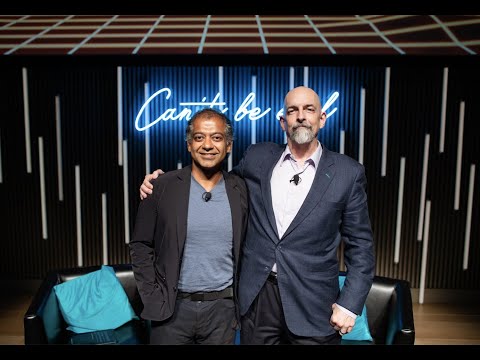
Naval Ravikant joined Neal Stephenson for this fireside chat at the Blockstack Summit in March 2019, discussing Stephenson’s Fall, simulation theory, social trust, and internet misinformation.
Also known as: Fireside Chat with Naval Ravikant and Neal Stephenson; Blockstack Summit 2019 fireside chat.
Naval Ravikant frames Neal Stephenson’s Fall as a meditation on simulation theory, intersubjectivity, and how reality gets built from shared belief. He focuses on how a digital world can still recreate myth, ethics, and the limits of knowledge.
He also connects the book to the modern internet: social media, misinformation, bots, encryption, and the difficulty of scaling human judgment. The conversation argues that trusted systems are possible in theory, but social trust, moderation, and reality itself remain messy and contested.
Naval introduces and moderates the conversation with Neal Stephenson, with occasional audience questions.
In his words
“Free minds are the only company worth having.”
“The miasma behaves sometimes as if it expected every man, woman, and child on Earth to have a social media and PR staff and 24-hour call.”
“Editing doesn't scale”
“How much of reality is reality because you believe in it, and how much of it is there because it's real?”
“What's the difference?”
Key points
- Fall extends Stephenson’s earlier ideas from Snow Crash into post-death simulation and digital afterlife.
- Reality depends heavily on intersubjectivity: we compare notes with others to know what is real.
- The internet is described as a stressful miasma of bad data, bots, and conflicting realities.
- Filtering and moderation do not scale well because they require human judgment and cost money.
- Crypto could support trusted internet systems through signatures, web-of-trust ideas, and better verification.
- Social media, money, code, and speech blur together in the same regulatory and philosophical debates.
- Naval emphasizes that “free minds” and user control matter more than centralized control by monopolies or politicians.
Full transcript: Naval Ravikant, Blockstack Summit fireside chat (2019)
I'm very excited to be here with Neal Stephenson, who is, like many of you, one of my childhood heroes actually. Snow Crash — which, raise your hand if you read Snow Crash. Just Snow Crash? All right. How many people have read something by Neal? Yeah? Good. If you haven't read anything by Neal, as some of you may know, I'm a very avid reader, a very avid consumer of science fiction, and in fact, I have many things to blame Neal for, but among them, Snow Crash is actually my most reread fiction novel of all time. I've probably given away—it doesn’t copies—I have two physical and a digital copy at home. My oldest physical copy is very well dog-eared, and I probably made the
mistake when I was in college of taking everything Neal said very literally, so the things that he was trying to make fun of and to warn against is kind of sort of where I ended up. But that's—that's another story. If you haven't read Snow Crash, I highly, highly recommend it. You should probably just stop what you have been doing right now and buy a copy. I'm getting no commission on this, but seriously, I picked it up last night again because I wanted to refresh my memory, and I ended up 'til 2:00 a.m. reading the book. The first two chapters alone are incredibly fast, witty, brilliant, and you'll find it's the kind of book that you have a very hard time putting down. Thank you, and thank you for being such a profit center, buddy. I hope you're still getting royalties on it.
Although I do remember you saying somewhere that writing is not how you get rich, it's not a—not a good way to get rich anyway. Well, compared to some other activities that are popular in this area. In this area, right? Like speculating on critical things, Michael. Let me get through his background very quickly. For those of you who don't know, Neal is mostly an incredible science fiction novelist. I would say he's one of the really key founding fathers of the cyberpunk genre alongside William Gibson and Bruce Sterling. He's also wrote some great nonfiction pieces. Mother Earth Motherboard back in the day was a big one in Wired magazine that I loved about the wiring of the globe. He's written a bunch of other books: Seveneves, Reamde, and Cryptonomicon, which was a series; The Diamond Age, beautiful book and
nanotechnology, many others. He's a chief futurist for Magic Leap, whatever that means. And he is so prescient at predicting things in the near future that he was recently even accused of being Satoshi Nakamoto. So he joined that hallowed pantheon of people accused of being Satoshi Nakamoto or credited with being Satoshi Nakamoto. Unfortunately for Neal, I think no such luck on that one, although he holds neither confirm nor deny. I deny it. Okay. His most recent book is a book called Fall, which is mostly what we're going to talk about or use as the springboard to talk about various higher-level topics. There will be some spoilers, or we'll try and keep away from some of it, but it's
it's a—it's a book that's, regardless of what you think, you know, what you glean from this conversation is absolutely worth reading. It revisits simulation theory, which was a big piece of Snow Crash. Snow Crash decades ago talked about the metaverse, which is an internet-type virtual reality world, and he's really updated that in this book Fall. Fall combines questions of religion, consciousness, nature of truth, the future of the human race, what happens to life after death, and so on, and we're gonna be talking about that. I'm gonna launch into the first part of Fall to kick us into a conversation that I think is very relevant today. A lot of us here thinking about the future of the internet, and
today, the Internet is dominated by a few giants, especially in the social media space, and of course, we have Facebook and Twitter. In the book, there's a company called Lyke, that's used as a proxy for Facebook and similar, but the Internet has taken the dark turn in Neal's book Fall. And in fact, you refer to the internet as the miasma and can talk about that a little bit and the pet name that one of the characters has for the internet. He's got two names. One is the Din. So when you look at your phone, it's got little red speckles all over the apps telling you that you've got messages waiting or that
you've failed to look at your phone enough recently. That—that's under the heading of the Din. And then the miasma is just kind of the whole swamp of bad data that's out there, sort of, you know, wrong information and stuff that's been put there either by people who are just wrong or, more often now, by people who are deliberately trying to steer the—I mean, national dialogue in one direction or another for purposes of their own. So that's—that's the miasma that the people in the book are referring to at the beginning of the book, and then sort of we keep jumping forward in time from there, and the
miasma is kind of the internet is always kind of almost attacking you, and it's attacking you with all these streams of information, and people have to set up filters to keep the noise out, and they have to have editors to determine what gets in, but that editing actually creates its own version of reality. And so everyone's kind of living in their, in a different reality based on which edit stream they're subscribing to and who they're pushing out, and it sounds highly stressful. You have a line in the races the miasma, and this will sound familiar to those of you who are in Twitter. It certainly resonates with me. The miasma behaves sometimes as if it expected every man, woman, and child on Earth to have a social media and PR staff and 24-hour call. And I think there's that moment where, when you send out a tweet or you
Do a Facebook post or you put something on the internet where you're both titillated and terrified. You're like, "Oh, this is gonna be popular. Was this good? Am I gonna get attacked over this?" You're, "I have to cancel what I was gonna do for the rest of the day, right? 'Cause I need to deal with the aftermath of this, this thing." Yeah, and then there were these BOTS and programs floating around, and they're much more advanced than what we think of as BOTS today. But you have ones called autonomous proxies for execration apes. Yeah, well, that's an idea that is an old idea with, so the Bay Area cypherpunks and people like that, like 25 years ago, Eric Hughes was talking about the idea.
Of a slander service. You could hire somebody to just spam the internet with negative information about you so that any true negative information that happened to come out would be discounted. Nobody would believe it. This is a great political strategy now. Yeah, apparently it works. And Matt Blais was talking about the Encyclopaedia Distant from Attica, which is a sort of anti-Wikipedia—that woman or maybe it is the wiki, yeah—anyway, it was a sort of seemingly believable source of information that was actually giving, putting out information that was subtly wrong. So if you cited it in your
term paper, you'd get a bad grade and you'd learn your lesson not to just trust anything that was on the internet. So those are ideas that have been around for 20, 25 years in the crypto world. And, you know, they did not get adopted. So we ended up with that version of the Internet in which people still take everything at face value. And even now, after everything we've seen in the last few years, I see it all over the place. People, if you know, even super sophisticated people who are very discerning and very sophisticated,
will see a tweet or a meme that just happens to line up with what they want to believe, and they'll just fall for it hook, line, and sinker. Yeah, I think pretty much everybody in this room is subscribing to a conspiracy theory. It's just a different one for each person based on who they follow and who they trust and which rathole they happen to have fallen into in the past week. Well, I can't speak for everyone in the room, but it's just a common human trait, right? You see somebody out there who's saying something that confirms what you believe, what you wish were true, and your filters just fall away. You know, you lose your ability
to filter this stuff out. So one of the concepts you have in the book is that instead of trying to establish truth, you want the people to create a trusted internet. But the way to do it is to, as you said, discredit the existing internet by exposing all of the lies. It's kind of a clever rhetorical bit. But, well, yeah, I mean, it's an idea that again that's been around for a while—the idea that you could implement some kind of a secured system that would be where, you know, assertions would be somehow traceable to just, like, a signed authority or something like that.
And again, it's all within the realm of possibility from a technological standpoint. We've had cryptographic protocols in place for a long time that could do all of that, but, you know, it just has not been adopted. Yeah, and I think that's partially the promise of a crypto-based internet where you have sort of a trusted internet model where you can subscribe to people, they can sign off on it, going back to the old PGP web of trust models where you can have rings of trust, layers of trust and filter it. But then that gets to the problem of different people trust different people, for example, who you follow on Twitter and who you're friends with on Facebook, and so you're just looking at different versions of reality.
And so that will actually separate you as people. And in your book, America is quite separated. Well, I think not just in my book. Yeah, oh, you have blue states and you have what you fondly call Ameristan. Yeah, well, the point there is just that I don't—it's easy to look at war-torn parts of the world that are just a mess and to think that there's those places are just different somehow. You know, they went down the wrong path and/or they never found the right path.
And that's just, that's just those people. But, you know, I think we're always one or two generations away from being a failed state, and maybe that time is getting closer. So the Ameristan thing is a, like, half serious way of trying to make the point that, you know, geography is not going to save us. You know, the fact that we had a functioning democracy or a somewhat better functioning democracy, you know, in past decades isn't going to save us at all, because you have to reinvent a
stable democracy with every generation. We're not doing that right, so we can't take it for granted. Yeah. So in this model, where you have that social media and choose your own reality is sort of separating the country, pushing people further apart, it's almost toxic exposure to the unfiltered internet or to a poorly filtered or edited Internet that drives my direction. I was struck by this quote you said, and this gets to where the internet is maybe headed: direct unfiltered exposure to the flumes of the internet, the torrent of porn, propaganda, and death threats, 99% of which were algorithmically generated, never actually seen by human eyes, was relegated to a combination of AIs and third-world
Eyeball farms see if all these people filtering everything gets that you, but even then, what makes it through can still poison you and poison you against your fellow person. Well, there's things that you can do to, you know, to apply some filters, but if you don't have—I mean, they cost money, right? So the whole problem with where we are now is that editing doesn't scale. Like putting eyeballs in the loop and having someone who exercises discretion says, "No, that's a bogus story. That shouldn't go out on our system." Cost money and it just doesn't scale, and so—
You can't—that does not lead you to the IPO down the road. That makes you a billionaire. So what this kind of gets to is this idea you mentioned that we're wired for intersubjectivity. A lot of our reality comes from what other people are thinking, and then this sort of flows into—is the book actually gets to a simulation part without being too much of a spoiler. The main character in the book sort of dies and ends up in a—yeah. Oh, oh, this is not a Game of Thrones kind of expose. It happens pretty quickly, and I think it's even mentioned on the back cover, so I'm not really blowing anything. Yeah, most of a large part of the book takes place in the simulated world where this character—
Emerges, and this is a very different simulated world than the one you had in Snow Crash. And in Snow Crash, there is a what I would call kind of a crudely rendered, very commercial Metaverse, which feels top-down, holodeck style, that the living step into. Whereas the big world that's featured in this book feels very organic. It feels like designed by, you know, not chat Minecraft, where you're sort of going out and creating the world, but in a very organic fashion created by necessity by the beings that live in it. Very high resolution, very consensus based, and in fact, a lot of times what you can and can't do in that world, what manifests as reality in that world, is based on the consensus of other organisms around you. So this leads—
Instance to kind of a large exploration of simulations. And it's worth looking at Fall because you're talking about simulation theory from a completely different angle than we always think about it from. When we hear Elon Musk, for example, in Joe Rogan talking about sim theory, we're always envisioning that OVR AR is gonna get a lot better. We're gonna put on these headsets and we're gonna go inside, but there's still gonna be a meatspace mapping of the real person, whereas you're talking about post-death simulation theory, the digital afterlife, living forever, immortality. It's a completely different take on it, so just wondering if you have any, you know, how your thoughts developed on all of this. Well, yeah, I mean, so of intersubjectivity is a thing that I became aware of when I was working on Anna Thumb, and I was—I ended up, God helped me—
Reading Husserl because Girdle was obsessed with Husserl. So this is the hardest stuff I've ever read in my life. It's really hard to wade through, but he talks about in their subjectivity, and a way to kind of describe that is that one of the reasons that solitary confinement is a terrible thing to do to someone is that you lose the ability to compare notes with other people. And so you—it’s hard to know what's real at a certain point. And a reason that prisoners in that situation will take as a pet, they'll take a cockroach or a mouse or whatever they've got and sort of keep them around just to have another organism in their space—
That's reacting to things and kind of helps convince them that they're not crazy. And so what happens to our main character when he sort of wakes up in a digital world is that he doesn't have that. There's nobody else to compare notes with. He doesn't know where he is. His memory has been wiped. He doesn't have a world to exist in, and so he ends up making that world, and he makes it based on kind of half-remembered things from the prequels of whatever was in his brain during the last few hours before he passed away is what tends to come to the surface first. So the last thing he sees before he—
Passes away is a street with falling leaves on it, red leaves. And so that's kind of the first thing that he creates when he's reincarnated in Bitworld, and then the level of the resolution of the simulation kind of gets better from there. So, yeah, it goes back a little bit to Snow Crash where you've got this class distinction between—you've got the Klintz and the Brandy's, who are the people who can't afford a nice avatar, so they have a low-res avatar, and people who are wealthy can have a higher-res avatar. And there's a kind of similar—
Dynamic in Bitworld, in the book Fall, where essentially computing costs money. It takes resources to compute it. In order to get better computation, you know, better shaders, better materials in a simulation, you need to put more cycles into it, more resources. And so the thing gets more and more resource-hungry as time goes on, and it's all to be—to be fair, it—so a lot of this comes from David Deutsch, who has a book called The Fabric of Reality, where he talks about a lot of these issues of like, how much—
Computing power would it take to simulate the physical world at full resolution without losing any—anything? And it seems—the answer seems to be it would take a lot. Yeah, Deutsch, a video, which I highly recommend reading as well. He also has another great book called The Beginning of Infinity, which is about epistemology and good explanations and how we know, how the human race progresses by understanding the universe around it, what the limits are to that. It's actually a very optimistic but yet grounded in science book, and he—I think he's one of the creators or the fathers of, popularizers of quantum computing. Yeah, really, really impressive guy. Yes.
And so one of the things that, at this point, when you get into the same theory piece, now we start doing the really hard thing of mapping what is going on in the virtual world, which turns increasingly into a fantasy-oriented world. I should warn you, this book switches halfway through from a sci-fi to being a fantasy book, like a lot of Neal's books do. It's very wide-ranging, but it's kind of fun. It keeps you from kind of getting bored into one set of things. But then you map really interesting concepts from computing into explaining age-old problems. So, for example, the problem of like, why is there evil? Well, it could be a bug in the system. It could be legacy code. It's good because of backwards compatibility with an older model. You know, why can't we be everywhere at once? Why is your speed of light cause and effect? You
start mapping those things in mana and computation. So I think that must have been a fun part for you, trying to map something that on one end looks a fantasy world, which you model after, I think, the Greek pantheon meeting Paradise Lost, Milton's Paradise Lost. I came and do justices—you have to read it—but there's a Zeus-type character in there, there's angels, and there's demons, and the whole Adam and Eve story is recreated in some very, very clever ways, right from the beginning, running as a threat throughout the whole book. But then you're mapping it to server farms, data centers, tech billionaires in Seattle fighting it out, life extension, etc. Sounds like quite a romp. Yeah. Yeah, well, now I'm just getting lost and trying to remember this book. It's a 900-page
book. There's a lot going on. Yeah. Where some of that comes from is conversations I've had with my brother-in-law, Steve Wiggins, who's an Old Testament scholar, about the idea of chaos. So if you read a lot of old mythologies, there is some mention of chaos. It's always, you know, the primordial God, whoever that might be in your particular religious system, so creates order out of chaos, and then that starts the ball rolling and hijinks
ensue. And that always was interesting to me because it seems like such an abstract idea; it seems like such a modern sort of scientific notion—the idea of chaos. And so when people used that word three thousand years ago, making up stories around the campfire, what were they thinking? You know, what was their experience that led them to imagine such an idea? And so today we've got, you know, chaos theory. You know, it's actually—we can sort of create a mathematical definition of what chaos is. So, to me, that was kind of a bridge that I thought I could sort
of build on between ancient mythologies and moderns of topics that are of interest to computational physicists. And then, you know, having established that, it became possible to map other sort of—yeah, it becomes kind of an origin of the world story that's sort of plausible, latches onto existing mythology but still stems from technology. It's a very clean—or as clean as it's gonna get—sort of mapping from technology to mythology. I mean, Milton, or the author of Paradise Lost, was an incredibly interesting guy who was from a sort of Puritan family,
went to, I think, Cambridge, carried his sword. He was just sort of like a Puritan duelist, almost like, and went to Italy during the English Civil War, where it was a dangerous place to be for him because a lot of the people who were there—the English people who were there—were Royalists who were on the other side of that civil war. So, but he went there to hang out with Galileo, and then he came back. He went blind, he got kicked out by his family, and he wrote Paradise Lost. But you can kind of see, I
mean, the interesting thing about Paradise Lost is that it starts with an overthrow. So the God and the sort of good angels throw out Lucifer and the rebel angels, and they sort of crater on the ground. And the opening of the poem is them hanging around trying to decide what to do next. And Milton, although is a believing Christian and, you know, apparently a sincere Christian, does an amazing job of making not all of the fallen angels, but certainly Satan or Lucifer, into a
completely believable sort of normal character. So, I mean, occasionally we cut away to God talking to Jesus or something like that, and I mean, it's not as interesting as what's going on on the other side of that. Yeah, you do a very good job of muddling who's the good, the good people and the bad people in the story, and it kind of seems to switch back and forth. And one of the things I appreciate is that even the so-called bad guys often refuse to commit murder. They have a code of ethics; they're actually trying to get towards a better world. You just have a disagreement on what that entails. Like if you're gonna go into a simulation, should we all be human? Should
we all have concepts of time and space? Should we all be limited as we are here, or should we just start from a clean slate? Yeah, there. So you did it wrong. We have to—we have to get rid of, you know, everything that you guys built so that we can, you know, it's like, it's like the age-old problem of, you know, do you want backwards compatibility and you're right in your software, or do you just nuke the whole system from orbit and write something new? So that's essentially the argument that those guys are having. Yeah, I mean, they're trying to create iOS and they don't want it running DOS underneath or Linux or, you know, old Mac OSX. Yeah, but at the same time, I think your, your, your world that you portray is very evolved. I
Think that's what I meant by the Minecraft analogy, and it's interesting to watch how it evolves, both internal and external forces. Yeah, if we sound all over the place, it's because this book covers a lot. It's gonna, it covers everything from—there's a, there's a great scene which we talked about a little bit, but I really liked, read a few times about how a brain, a consciousness, boots reboots itself and comes online almost like a computer rebooting itself, you know? And for those of you old enough, remember the little green and black text as the scrolls by as a thing reboots, or if you used to UNIX machines. And you can kind of see how this consciousness
boots itself. But it boots itself into a blank environment. It doesn't even have concept of time or space or cause and effect or feelings, and it has to sort of reconstruct each of these. And when it doesn't have a concept of time, you know, how when a computer executes, it can take a long time to do something, or it can take a short time. But from inside the computer's view, it's all the same thing. It's just clock cycles and however many clock cycles that go through, where the time that we're experiencing is completely disconnected from the computer's boot of time. And then when this computer boots itself up, it sort of has to figure out, well, what world am I in and what can I influence and what can I create, which is, what do I have to take as a given? And then this gets referred back to later in the book, where people are even talking about, well,
how much of reality is reality because you believe in it, and how much of it is there because it's real? And I think those lines are constantly blurred. So this is the kind of book where you can, if you want, you can stop on every page and think for a while. Well, thanks, that's—and there's 900 pages. So, you can be—thank you for what I was fun to write it because I've been reading high fantasy literature since I was a kid. And there's a, it— but there's always kind of these, these questions about, like, you know, how did, how did it work? You know, how did we get ents, really talking trees? I mean, it's awesome, but where did
you know, how did we get there? And so, and, of course, those answers, those questions are answered within Tolkien if you, you know, do enough reading. But the, I thought it would be interesting to try to build a high fantasy world in which those sort of different types of creatures emerged out of a process that we could all kind of watch happening, as it were. Yeah, there's a lot of good technology-based creation myths in the story. Switching gears for a second, I
think one of the things that I like about your books is that you will take a whole bunch of different concepts that seem disparate, and you will interconnect them and show the underlying commonality. So the technology mapping onto mythology is an example of another one is a great line of Snow Crash where Snow Crash—again, I'm not giving out big spoilers; these are the other minor you'll see when you read the book—but in Snow Crash, there is a drug that will essentially modify a person's brain. If you look at it, that's the thing that's called Snow Crash. And one of the characters, the main protagonist and the character in the book, literally speaking, says, ask another character, "Is this Snow Crash thing a drug, a
religion, or a virus?" And another character responds, "What's the difference? What's the difference? We need a drug, religion, or virus." And I think we see that with Facebook and Twitter and social media very similarly. In the crypto world, we're sort of asking, is that money, is it a code, or is it speech? And again, the question is, what's the difference? These things interrelate at some very deep levels. So I think what's with social media—this is part of the problem talking about social media—it's so many different things, so many people. You can't just go in there, or can you, and say, "We should do it a different way. Is there a better way to do social media, to do it acknowledge that it's this combination of things?" There was a time when I started working
on Krypton gnomic, on where the title of the book, the whole project, was Speech That Is Not Speech and Worst Ins. And so, actually, my earliest notebooks that I was taking notes in, I've still got them on my shelf at home, are all Stins, one, Stins two, Stins three, because this was kind of during that time when certain kinds of crypto were being outlawed for export because they were classified as weapons. And so, and so the argument that arose
from that was, "Well, hang on a second, it's just—it's just words. It's just code, so it's speech. And you can't outline." So, so I actually called that project Stints until there was an intervention from my editor who quite wisely said, "What do you want to call it? It can't be Speech That Is Not Speech." So, good move. Totally agree with her in retrospect. Yeah. Phil Zimmerman, I think, when they were trying to regulate PGP as an export, as ammunition, he printed the algorithm on his t-shirt, and he would just wear the t-shirt around. Yeah.
And that was sort of his protest. But we see this coming back, the whole debate around back doors, around encryption. You can see Facebook sort of retreating to this position where they're saying, "Well, actually, everything's gonna be encrypted, and we can't even, we can't look inside, so we can't be liable for it." And I think they're starting to remove themselves from the debate around what to regulate, what to censor, by sort of adopting this black box position. I'm not sure how defensible that is. Yeah, once you've shown you can put your thumb on the scale and given that you have to take out certain things like child porn and terrorism, things and threats of attack, something that are legally required to take out, then you have the ability in the process to actually moderate and censor the whole thing. Yeah. I mean,
Sooner or later, you need to display it on people's screens and, and non-encrypted before, right? So, but yeah, you can see, I mean, you can easily see the problem that they're, they're wishing they could solve. But it's, right, I don't think it's a soluble problem, right? I think the argument that some people might make is that there's, you can have decryption at the end, at the end-user level. So you decrypt it completely on your computer, but then you get into a password and key management issue, which I think you're also covered in the book, which is, and I think in the book you kind of abdicate it. The passwords are still around and key management is still, is still like a thing. You still have to figure out how to manage your private key. Yeah, just the idea that there's so
many other ways of figuring out your, you, besides your ability to type a series of characters into a keyboard. And so what if we kind of combined all of them into just a sort of AI system that basically can tell you're you? And that's kind of key. I, I had to put that in there to make the story logic work in Bit World. So, but it makes sense. Like a human who knows you well can tell it's you. Yeah. And so a lot of hours, by the way you walk, you can see somebody, you know, 200 feet away walking down the street with their back to you because of the way they walk. Yeah. And a lot of the crypto tokens security systems rely on something, you talking to someone or getting permission for someone who
authenticates it's you. And you could see that that would be something AI could solve given enough private data and pattern matching, and it's a very large data set to steal as opposed to a small, like private key type thing. Might be a large data secure as well. Yeah, but there's a million things. Lila, the way you type, right? You know, the way you, the way you sound, you know, but all kinds of biometrics that could go into it. And so, so yeah, that, that's, that, that's a thing that in the book that I think is actually kind of an interesting thing to explore and I'm sure people are exploring it, but I had to put it in there to solve a particular narrative
plot logic problem anyway. Yeah. It has the one of the most interesting methods for securing a private key that I've ever seen, but I'll let you read the book to figure that out. It's, it's, I think one of the things that Neal excels in is near future possibilities. And even though I asked for questions on Twitter for this conversation and a lot of them were around, around the basis of, well, what do you see happening next? And I think that's hard to say because no one knows what's gonna happen next, but you tend to have a lot of ideas that have a high probability of working out in the near future. So for those of you who are building startups, it's always invigorating mentally to kind of look at Neal's predictions because at least some
of them will work out. Oh, here's one that didn't. I'll pull out one that did. In Snow Crash, you point out that you said 15 years ago a hacker could sit down, write an entire piece of software by himself. Now that's no longer possible, and luckily I think the tools have gotten good that we still have counterexamples to that. People like Satoshi Nakamoto and Notch, so on, although Satoshi had help obviously and actually didn't even write the code but Moore wrote the paper, but still a very small band of hackers can still make a huge, huge difference. Yeah, that's fair. Yeah. And I'm, and I'm hoping that that is a way out of you're not going to be able to scale the internet editing problem, but, but we'll see about that. Here's one that did work out, which is I read this line and I immediately thought
of where we, where we are today in the scope of the internet. The Internet today is dominated by a few large monopolies and it's kind of ironic because we thought the internet was gonna liberate us and make atomized everything and put us all on a level playing field, but now we're in a world with two taxi dispatchers, you know, one e-commerce retailer, one librarian slash search engine and, you know, basically two media companies which just completely dwarfed all the other previous media companies put together to the point where current media companies are reduced to sort of supplicating the large ones or threatening the social media companies to behave. And as, as you all probably saw in Lux's recent speech, he decided to split off completely from the earlier definition of media and
decided to call social media the Fifth Estate. So he's basically carving out a separate place where they're saying, we're no longer part of the Old Fourth Estate and you don't necessarily get to tell us what to do. But here, here's, here's your, here's your line that stuck with me from Snow Crash. You were talking about how in the future, and this was kind of tongue-in-cheek, but pizza delivery is dominated by the Mafia. The Mafia goes legal, they go public on the stock exchange and they run all the pizza delivery, and it's, and they call Cosa Nostra Pizza. And I said, Cosa Nostra's. Cosa Nostra Pizza doesn't have any competition. Competition goes against the Mafia ethic. And I like that because Peter Thiel always talks about action, right? Yes. Yeah, yeah, right, right. So don't, don't go into any business where you
might have to actually compete because there's no money there. Yeah. Yeah. So actually the dirty secret is in Silicon Valley, everyone wants to be a monopolist even though we talk about free trade and free exchange and all that. Yeah. It's interesting. I kind of went back and forth on this exact topic because in the book, which is so pre, pre-web and we'll certainly pre-web and so pre the Internet as a, I mean, the internet was around but people when I wrote the book were still on CompuServe or AOL. They're wearing one of those silos, you know, for the most part. And and so you've got the street
You've got the Metaverse. It's sort of all owned by one company, and they create artificial scarcity on the streets. So real estate values on the street are high because there's only one street. And then we got the web where, you know, any URL is the same as any other, or also anyone can create a website. So for a long time I was thinking, "Ah, got that wrong. You know, there's no scarcity of websites," but yeah, it's kind of funneled back in just as you say. And there is kind of that artificial scarcity now that people can
can profit from. Yeah, it seems to be like it's going back to a model that humans are very familiar with, which is there are cities with downtowns that are incredibly scarce and expensive and desirable, and then there's unlimited land around that nobody actually wants to live on because it's empty, right? People attractive is there, right? Right. Yeah. So we're gonna get into Q&A in a few minutes, so I just want to touch on one last thing. A lot of people have asked me to ask you about, you know, this is common these days. Everybody asks, "What's your morning routine?" Yeah, right. And then everybody goes into a long talk about how they do meditation, yoga, and juicing and smoothies and SoulCycle and whatnot. And some people are carnivores, and some people are vegans. And we don't want to get super personal, but you're obviously a very prolific
writer. You, how many, how many pages do you turn out right now do you think that make it public? And I, or is really there? I mean, like, what I try to do is, is I think it's a good day if I've got five handwritten pages produced. You handwrite? Yeah, well, that's something going into you. So yeah, I've done that since the beginning of the Baroque cycle. So I could do more, but in general, you know, like even if you write a single page a day, that's 365
pages a year. So it doesn't, it's really more about a steady routine than it is about being incredibly prolific on one day. So I tend to get up, get to work as soon as I can, get those few pages out, and then there's a thing that happens after that that I called E.L.I.A.S., which is you used to be with old cars that after you turned off the engine, it would keep running even though it was switched off because it was sort of operating as a diesel motor for you. You literally couldn't make it stop.
And so, and I do that creatively. After I stopped for about 15 minutes, half an hour, these lines will come to me or sentences. So I just speak them into my, my, I used to carry a little tape recorder, and now I just use their work voice memo thing on my phone. And a lot of times, that's the, that's the good stuff, it seems. Some very interesting. If I find that when I'm trying to be creative or brainstorming just for efficiency's sake, I sit down with my iPad or computer and type, but I have a much harder time doing it. It's
much easier to be creative when you're talking to somebody else, you have a whiteboard, or in your case, you're saying handwriting. I sketch a lot on a pencil and graph paper. Well, I used to get stuck before I took up this habit. I would get stuck sometimes and I couldn't get going. And then what I discovered, kind of random, was that if I got away from the keyboard and just sat down and started writing, that I would get unstuck. So then when I, when I began working on the Baroque cycle, I thought, "Well, if it's all that, I mean it seems to work, and it's thematically appropriate if I'm writing a book set 350 years ago,
you know, writing it by hand seems like a fit. So I'm just gonna start and see what happens." And then if it's terrible, then I'll just go back to typing. And ended up working pretty well, and I mean, it's got a lot of advantages. It's got, because it's slower, I think that each sentence or idea spends longer up here in the buffer before you commit it to any kind of fixed form. So I think the first draft quality is higher. I think editing is a lot faster because you can just, you know, wipe out a whole sentence with one stroke. But it's still
there, you know, you can still see it. And so, so I do that up to a point, and then I type it in using, I'm afraid to even say it because it's going to touch off cheering and booing in this audio, so it's one of two famous text editors used by programmers. So that's the lesson tech cred. So because everything else gets, gets like people, you know, every few years, somebody introduces the new
slimmed down, trim, clean, simple text editing system, and then five years later it's gotten bogged down with all kinds of features and issues. So at least with Emacs, you're adding all of that yourself instead of helplessly watching as somebody else does it. Yeah, actually, right before this conversation, I met with Neil for a bit. We chatted, I took a bunch of notes, I got ready for this talk, and then my notes syncing app, which has never failed me, failed me and lost everything. So then I did reconstruct it all from memory, but handwritten it down. Perhaps that would have been a solution. Yeah, right, right.
Yeah, so anyway, so I do that. I use tech to typeset it and print it out. That's kind of my pipeline. And you famously guard your time well. I just think, you know, you've only got so many days that you're alive, and you should use them in the highest value way. And, you know, and attend conferences, for example, it's gonna be meeting like-minded people. So and it's very easy to fritter away a lot of time doing email and, you know, so if stuff
That in the long run doesn't matter, and it's — that's — it's, you only become more so since I wrote that piece because, you know, now, you know, the feeds that we get from social media are kind of carefully designed exactly to engage us and keep us wanting to stay on, right? So, yeah, the first 30-year book, the impression I get is the main character, as or the first part of it, he's trying very hard to avoid the internet, stay away from the me, as I'm a lower the din edited out. Then when email comes at him, or there's another character later, email comes at him, he lobs it back like it's a grenade. So someone sends him a to-do an email, and before it explodes, he has to lob it back to somebody else, and that
it lands in their inbox, and I think many of us can sympathize with it. To them, email. Yeah, yeah, yeah. So that's all that is. I mean, you got to make some choices about how you're gonna spend your time. So, so you're not answering fan mail with handwritten notes anymore? No. Yeah. So thanks for giving us the look behind Fall and kind of how you, you right on it. I do want to — we're running out of time, so I want to leave some questions for the audience. I gathered a couple on Twitter. We're just gonna go through one or two of those quickly, and then we have Mike here who's got, you know, a picture in rapid-fire mode here. Okay. Yeah, let's do one minute each. From Reuben Seona on Twitter: How would you create a cultural guerrilla movement
that brings back the optimistic futuristic thinking of the 50s, 60s in the mainstream or at least into the youth? I guess, is an assumption that we were pessimistic these days, that Peter Thiel critique? Yeah. I mean, I actually, I tried to do that once. I sort of did it with Arizona State, put together an anthology called Hieroglyph, which was so of optimistic short stories, science fiction stories, and I contributed one about building a tall tower. Cory Doctorow contributed one about 3D printers on the moon, and Elizabeth Bear and a bunch of other people contributed cool stories to it. So, from my point of view, that's one way is to actually
create entertainment in that vein that is, that does that. And I think it's easier in the written word. I think there are kind of economic reasons why dystopias are so popular. Boring, right? You know, well, it's, it's, you know, I think it all started with Planet of the Apes, when, at the end, they come around the corner, there's the Statue of Liberty lying there in the sand, and it's a super powerful image that was probably really inexpensive, right? Because you just take the statue of model of the Statue of
Liberty, you kick it over, you shovel some dirt on it, done, right? So it's easy to, to put those images on the screen. It's harder, it's more expensive to try to create a new reality, a new world that, you know, that hangs together visually. Do just one more from Twitter: Dinah Brevis, do you think we will be smart enough the next decades to use technology and modernize children's education? Can be iPad or similar become world's primer? And this refers to a book that Neil wrote called The Diamond Age, which has sort of a magic book that is used to raise and train this young girl to be very intelligent, self-taught. Well, a lot of people have worked on such
things and more power to them like the God. We, you know, it's a thing that really needs to happen and I wish it would. The flip side of that is that, in the book The Diamond Age, only one copy of it really works properly because there's a human in the loop, and that person being in the loop makes that book work and creates a relationship through the intermediation of this technology between the girl who's learning and the woman who's effectively become her teacher and
kind of mother figure. So the, you know, as much as I would love to see a technology that would solve this, you know, at the end of the day, we need teachers and it's, I think that is, you know, outside the scope of what tech nerds are good at. Yeah, it's like the old line that we thought that people are going to want to talk in the 70s with AI research — we thought people are going to talk to computers, but they actually want to talk through computers, right? To other people. Yeah, yeah, other people are the product. They're the... I'm gonna turn it over to audience Q&A and even got any questions for Neil? Please try and keep them brief,
no speeches, one question, thank you. The Krypton Omnicon is the absolute work of genius. No, thanks. When you wrote it in what, '98? Published at '99? And you predicted F of Epiphyte Corporation, which is basically a blockchain system. When you predicted a stable coin, gold would be good, as your exact words, that was absolutely brilliant, twenty years ahead of time. The descriptions of the Boondocks is good rock and a cold cave structure he described, and finally the Nazi gold, which has just recently been proven to have arrived in Substa and
Windows heavies and come down through Chile, Patagonia, and your description of being in the jungle, and only a person who's been through the jungle and hacking in the jungle like that could have described how. Where did this come from? It's too real. End of stock tips. Thanks. Yeah. Thank you, thanks. Thank you, Neil. Think you know my question is related to how are my ecology and religion are all steeped into cost dying. I mean, that may be true today, but maybe in a few decades a little small. That what do you think will
Be mankind at that point? Or what do you—what are your thoughts about that? This is what Fall is all about. Did you say mycology? It's mythology. Mythology, sorry. I was thinking the study of fungi. Yeah, mycology. Yeah, okay, yeah, yeah. Sorry, that really got me off on the right... Well, there's that guy who has a mycology shroud that, when he dies, he wants me eating my mushrooms and he'll go into the global mushroom brain. So that's one hypothesis. And what happens when he died? Yeah, sorry. I... Yeah, I think involves... correct that. A lot of this, you know, sort of ends up in if I'm, you know—
I think there's a reason for mythology. There are certain grooves that our mind wants to run in, and, you know, we can speculate about why that is, where it came from evolution-wise. But it's kind of part of who we are, and so the... and so a lot of what's going on in Fall is telling the story that even if we start with a blank slate, creating a new... a new world in the digital realm, we end up rebuilding a lot of the same... the same
sort of mythological elements that we've got here. You have questions? Hi, I wanted to know what keeps you awake and what's the worst possible you see the next day with technology. Man, just the breakdown of civil... of civil society, of the... the sort of history, you know. I think there's a book I like to recommend by Barbara Shapiro called a
Culture of Fact, which is about where we got the idea of facts because we didn't always have it. It sort of became a thing like 300, 350 years ago at least, kind of in the English-speaking world. And it changed a lot of things, and sort of the... the idea that we could... that we could have algorithms that we could use to agree on what was real, and then based on that decide, you know, make decisions. And the... so the... the sort of good bad part
of that is that it's... it's good that you can start without... with the idea of facts not existing and... and create it. But sort of the scary part is they could go the other way, right? Now it's... it's going the other way. So, you know, that's the scary thing for me. I hope we'll all sort of turn it around, you know, but it's going to be a long struggle to do that. Unfortunately, we just have time for one more question. Their next of all deals, it's been a
great discussion. Um, you know, in NFM, there is a world very much like Earth. Not to get too much of that story away. It's also an excellent book that, in my reading, seems to have found some way through this question of how do you keep an orderly society? How do you maintain long-standing traditions but also have diversity of new opinions? And it seems to happen to this... this cloistered existence of certain people within the society who find it necessary to separate for varying durations: some of them are a thousand years, some of them are hundred or... mm-hm, and they only come together given certain coinciding
moments like when a clock strikes a certain time. Mm-hmm. Yeah. Do you... do you still think that there's maybe... Am I... am I wrong to read into that that maybe there's a more stable way of having a diverse conversation within society without the potential for collapse based on some sort of self-reflection and then emerging? Do you put, stopped? Yeah. I mean, yeah, yeah. It's kind of a double-edged thing again in that it is... if you read that book closely enough, it's a little bit ambiguous as to whether they voluntarily went into these cloisters because that's the way they liked it or if they were rounded up and herded into
them. So it's not the... so it... and that all emerged from... from conversations around at in the late 90s having to do with the Long Now Foundation's idea of the 10,000-year clock and sort of the... the notion that maybe getting a constant stream of news updates in... in your... in your phone or whatever was... was sort of too much of a good thing. So, the, you know, I like the idea of trying to actually establish some... some
places like that. I don't know how it would work. The advantage of setting it up in a fictional world is that you can just sort of wave your magic writer wand and... and say that it is that way. But... but, but it often does seem as though the kinds of people who are so... if contemplative and... and like to read books and... and think about stuff are existing in kind of a whole different subculture from... from everyone else, and they sort of have ways of recognizing each other and in connecting. And so, in some ways, the book is kind of a metaphor for... for certain
aspects of how things are today in our, you know, our world. All right, well, I want to thank Neil for coming all the way down from Seattle to see us for all that... for all the peaks into the future that he's given us and the beautiful package, which actually one of the things that we didn't really cover here because it's hard to do is Neil's books are actually quite funny and they're actually optimistic, and they sort of have this rollicking movement to them where they kind of just keep you going in sort of a fun adventurous way. And not all of them, but some of them, some of them are more
weighty. This depends on the topic, but I highly encourage you to pick them up, read them. He's got an enormous range as a writer. Books like NFM and A Krypton AMA can read very differently than A Snow Crash or A Diamond Age, so you can always find something you like in there. I'm gonna leave everybody with one quote that I think is actually... it just... element of it’s irrelevant, it just struck me as I was reading Fall. Fall has a lot of very quotable lines and I have many, many of them. This one just jumped out at me. It was set as an aside by one random character to another. I'm not even sure you meant it to have this much meaning, but it has a lot of meaning for me, and he said, "Free minds are the only company worth having." And I loved it because it sort of solved the question of, well...
You're in a sim. Why would you not just enslave everybody else if you're the first one in and just create whatever you want? Why don't we try and regulate what facts are and how people get to facts? Why are we here trying to build an internet that is really under the user's control and where we're not taking our marching orders from either politicians or from monopolists who are running global technology monopolies? And so I just love Design. Free Minds are the only company worth having. So thank you for giving us the company of your free minds. Thank you. (applause)
From YouTube captions, lightly punctuated for readability. Timestamps link to the video above. Errors are possible.
Cite this recording
Naval Ravikant, “Blockstack Summit fireside chat (2019)”, New Frontiers March 2019 Summit, March 2019. Transcript and video: Thinkers Archive, https://thinkersarchive.com/naval-ravikant/simulation-internet-truth-blockstack-summit-2019/
Quoting a passage? Link to its exact moment: every timestamp above has its own anchor (for example https://thinkersarchive.com/naval-ravikant/simulation-internet-truth-blockstack-summit-2019/#t-133).