Mark Zuckerberg on Facebook
Zuckerberg sees Facebook as a real-identity network built to help people understand and connect with each other, give them voice, and then take far broader responsibility for the harms that can result.
- Facebook began as a way to put people, not just content, at the center of the internet.
- Its early advantage was real identity and trusted networks, first through schools and real names.
- Zuckerberg thinks Facebook should maximize voice, while removing content tied to real danger and fake behavior.
- He says Facebook failed by not taking a broad enough view of its responsibility for privacy, abuse, and election interference.
- He describes Facebook’s growth as learning from user behavior and adapting quickly rather than following a fixed master plan.

“…people have this deep thirst to understand what's going on with with those around them.”Y Combinator Startup School, Stanford, 2012 · 1:09
Facebook started with a simple idea: people should be at the center of the internet
Zuckerberg’s basic account of Facebook is not that it began as a media company or even as a business plan. He says it started from an interest in how people understand one another and from the belief that software should make that easier. In his telling, the internet already had plenty of information, but it was missing a clear way to map real people and relationships.1234
That is why Facebook’s core purpose, in his view, was to help people learn about the people around them and stay connected to them. He describes a strong human demand to know what is happening with friends and communities, and he frames Facebook as a response to that demand rather than as a top-down theory about media.561
“…people have this deep thirst to understand what's going on with with those around them.”Y Combinator Startup School, Stanford, 2012 · full transcript →
Real identity was the key design choice
Zuckerberg repeatedly ties Facebook’s success to real identity. Early on, school email addresses made it possible to anchor accounts to actual people, and the initial college-by-college structure created cleaner data and a higher-trust environment than the broader web had at the time.7
This mattered because Facebook was built around the social graph: real people, real connections, and the ability to look each other up. For Zuckerberg, that made the product more useful and more trustworthy than anonymous systems, and it also created the basis for later features as users shared more about themselves and their relationships.3
Facebook grew by following what people actually wanted to do
Zuckerberg does not describe Facebook as unfolding from a detailed master blueprint. He says the company’s strength was learning quickly, watching behavior, and building more of what people clearly wanted. That is how he explains the move from a simple profile directory to features shaped by repeated user demand, including sharing and photos.85
He also presents this as a broader operating philosophy: a company should be organized to learn fast. On that view, Facebook grew because the team kept iterating on a real social need and was willing to keep pushing through technical and organizational constraints as usage increased.91011
His mission for Facebook is voice first, but not without limits
Zuckerberg’s clearest moral claim about Facebook is that it should give people voice. He says the point of social media is to let people share what they want, and he connects broader expression with empowering people who previously had less ability to be heard. He also argues that, in general, people should judge credibility for themselves instead of having technology companies act as final arbiters of truth.121314151617
At the same time, he does not present Facebook as a place where anything goes. He supports removing material tied to imminent harm and other serious dangers, and he increasingly emphasizes authenticity as the practical answer to many speech problems. His approach is to allow wide expression while verifying identities for influential actors and aggressively removing fake accounts and coordinated inauthentic behavior.1819
He also says he became uncomfortable with Facebook drifting into the role of deciding what is true. In retrospect, he thinks the company moved too far toward suppression under pressure after major political and public-health crises, and he now leans more heavily toward more speech and narrower intervention.2021222324

“I believe that we must continue to stand for free expression…”Georgetown University speech, 2019 · full transcript →
What Facebook got wrong: responsibility, privacy, and harm
Zuckerberg’s sharpest criticism of Facebook is that connecting people was not enough. He says the company failed to take a broad enough view of its responsibility and was too slow to reckon with how its tools could be misused for privacy violations, election interference, hate speech, and other harms. He accepts personal responsibility for those failures.25262728
From that lesson, he argues that Facebook has to do more than build useful tools. It must explain how data is used, give users meaningful control, investigate abuse, restrict developer access where needed, and act against bad actors. His view of Facebook therefore evolves from pure connection toward stewardship: build systems for expression, but also take responsibility for the predictable ways they can be exploited.2930
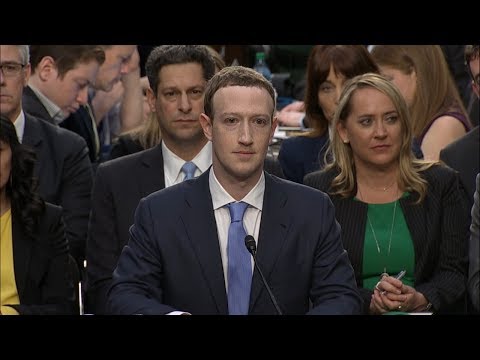
“We didn't take a broad enough view of our responsibility, and that was a big mistake.”Congress hearing before the U.S. Senate, 2018 · full transcript →
Zuckerberg on facebook, in his own words
“We didn't take a broad enough view of our responsibility, and that was a big mistake.”
“It's not enough to just connect people.”
“…giving more people a voice gives power to the powerless…”
“…people should decide what is credible, not tech companies…”
“…people were really missing from the internet…”
Where to watch
 Mark Zuckerberg on Data Privacy: Facebook's Duty to Protect Users2018 · 382 min · full transcriptBest single source on what Zuckerberg thinks Facebook got wrong and how its responsibilities changed.
 Mark Zuckerberg on Free Expression: Voice, Safety, and Democracy2019 · 78 min · full transcriptMost complete statement of his philosophy on Facebook as a platform for voice, democracy, and safety.
 Mark Zuckerberg on Building the Future: Facebook, AI, and Risk2012 · 25 min · full transcriptExplains why Facebook was created in the first place and how it evolved by learning from users.
 Mark Zuckerberg on Early Facebook Identity: Real Names, Schools, and Scale2012 · 32 min · full transcriptShows why real identity, schools, and trust were central to early Facebook.
 Mark Zuckerberg on the Social Graph: Build for People2013 · 36 min · full transcriptBest for understanding the social-graph idea behind Facebook and why Zuckerberg thought the web was missing people.
 Mark Zuckerberg on Free Speech and Content Moderation: A Long Journey Back2025 · 171 min · full transcriptUseful for his later view that Facebook should return closer to a voice-first model with less ideological moderation.
Questions people ask
- How does Mark Zuckerberg think Facebook improves and learns as a company?
- What did Mark Zuckerberg say Facebook was originally built to do?
- What did Mark Zuckerberg say about Facebook's responsibility for privacy and misuse of data?
- What did Mark Zuckerberg say about building products around people and the social graph?
- What did Mark Zuckerberg say about fake accounts and political ads?
- What did Mark Zuckerberg say about political content moderation on Facebook?
Sources
Every quote above, word for word from the transcripts. Numbers match the text.
“So for me, the thing that I was really fascinated by and and always have been is, people, right, and and how how people work. You know, I was in college. I I studied psychology and computer science. And, you know, one of the things that you learn when you study psychology is that there are all these parts of the brain which are geared just towards understanding people. Right? Understanding language, how how to communicate with each other, understanding facial expressions, emotions, processing. Yet when I looked out at the Internet, right, in in 2004, which is when I was getting started, you can find almost anything else that you wanted. Right? You could find news, movies, music, reference materials. But the thing that mattered the most to people, which was other people and, like, understanding what's going on with them, it just wasn't there.”
“…people were really missing from the internet…”
“It kind of became clear to me that a lot of the software that we use should have people at the center of it, right? And people want to learn about people; that's like a really core thing, um, in our psychology. So I, I thought that, you know, whether there was, uh, central, uh, central social network kind of at the core of that or just like some kind of social libraries or API or something, that there needed to be something that made it so that was like a common framework that, that, um, everyone could use to develop.”
“Facebook, I didn't start it to start a company…”
“…start with the problem that you're trying to solve in the world…”
“…people have this deep thirst to understand what's going on with with those around them.”
“…school email addresses were the original source of identity…”
“I think the key is building a company which is focused on learning as quickly as possible.”
“I think the key is building a company which is focused on learning as quickly as possible. Right? Companies are are learning organisms, and you can make decisions that either make it so that you learn faster or you learn slower. And, you know, in a lot of ways, a company is like following the scientific method. Right? You you try a bunch of different hypotheses. And if you set up the experiments well, then you kind of learn what to do. And I think that's that's an important philosophy. So there are all these different decisions that we make inside the company, you know, everything down to, really empowering individual engineers. We we invest in this huge, testing framework. Right? At any given point in time, there aren't... There's not just one version of Facebook running in the world. Right? There's probably tens of thousands of versions running because engineers here have the power to, to try out an idea and and and ship it to, you know, maybe 10,000 people or a 100,000 people.”
“…we just kind of cared more than those other companies about making it exist…”
“…you just have to kind of keep running through the walls…”
“…the whole point of social media is basically, you know, giving people the ability to share, what they want…”
“…we were trying to give people the ability to share as much as possible…”
“…giving more people a voice gives power to the powerless…”
“I believe that we must continue to stand for free expression…”
“…people should decide what is credible, not tech companies…”
“Democracy depends on the idea that we hold each other's right to express ourselves and be heard…”
“So the solution here is to verify the identities of anyone who's getting a wide amount of distribution and to get a lot better at identifying and taking down fake accounts. So we now require you to provide a government ID and to prove your location if you want to run political ads or if you're going to run a large page. You can still say controversial things if you want, but you have to stand behind them with your real identity and face accountability. Our AI systems have also gotten a lot more advanced at detecting clusters of fake accounts that aren't behaving the way that people would. So we now remove billions of fake accounts a year, mostly within minutes of signing up and before they really have a chance to…”
“Senator, yes. That's our that's our approach. If there is an imminent threat of harm, we're going to take a conservative position on that and make sure that we flag that and understand that more broadly. But overall, I wanna make sure that we provide people with the most voice possible. I I want the widest possible expression, and I don't want anyone at our company to make any decisions based on the the, political ideology of the content.”
“I was really worried from the beginning about basically becoming this sort of decider of what is true in the world…”
“I think the more voice is the is the answer on this…”
“You know, it... It's like a legitimate public health crisis, you know, in the in the beginning. And it's... You know, even people who are, like, the most ardent First Amendment, you know, defenders, the the Supreme Court has this clear precedent. It's like, alright. You you can't yell fire in a crowded theater. There are times when if there's an emergency, your your ability to speak can temporarily be curtailed in order to get an emergency under control. So I was sympathetic to that at the beginning of COVID. It seemed like, okay. You have this virus. It seems like it's killing a lot of people. I don't know if we didn't know at the time how dangerous it was gonna be. So at the beginning, it kind of seemed like, okay. We should give a little bit of deference to the government and the health authorities on how we should play this. But when it went from, you know, two weeks to flatten the curve to, you know, in, like, in the beginning, it was like, okay.”
“You start one of these if you care about about giving people a voice. You, you know, I didn't... Wasn't too deep on our content policies for, like, the first ten years of the company. It was just kinda well known across the company that we were trying to give people the ability to share as much as possible. And issues would come up, practical issues. Right? So if someone's getting bullied, for example, we deal with that, or we put in place systems to to fight bullying. Right. You know, if someone is saying, hey. You know, someone's pirating copyrighted content on on the service, it's like, okay. We'll build controls to make it so we'll find IP protected content. But it was really in the last ten years that people started pushing for, like, ideological based censorship.”
“Yeah. So, I mean, that's basically the journey that I've been on. Right? Started off very pro free free speech, free expression. You know? And then over the last ten years, there were the... Been these two big episodes. It was the Trump election and the aftermath where I feel like, in retrospect, I deferred too much to the kind of critique of the media on what we should do. Mhmm. And since then, I think, generally, trust in media has fallen off a cliff. Right? So I I don't think I'm alone in that journey.”
“We didn't take a broad enough view of our responsibility, and that was a big mistake.”
“And it was my mistake, and I'm sorry.”
“It's not enough to just connect people.”
“But it's clear now that we didn't do enough to prevent these tools from being used for harm as well, and that goes for fake news, for foreign interference in elections and hate speech, as well as developers and data privacy. We didn't take a broad enough view of our responsibility, and that was a big mistake. And it was my mistake, and I'm sorry. I started Facebook. I run it, and I'm responsible for what happens here. So now we have to go through our... All of our relationship with people and make sure that we're taking a broad enough view of our responsibility.”
“I believe it's important to tell people exactly how the information that they share on Facebook is going to be used.”
“If they delete their account, the answer is no. That's why we actually offer two options. We offer deactivation, which allows you to shut down or suspend your account but not delete the information because actually a lot of people wanna, at least for some period of time... I mean, we hear students with exams coming up wanna not be on Facebook because they they wanna make sure that they can focus on the exam. So they deactivate their account temporarily, but then want the ability to turn it back on when they're ready. You can also delete your account, which is wiping everything. And if you do that, then you can't get it back.”
How this guide was made: drafted with AI from the full transcripts of the recordings cited, then checked: every quotation must match a transcript word for word and be the speaker's own words, and an independent review gates accuracy. Methodology and corrections.

