Mark Zuckerberg on Competition
Zuckerberg treats competition as a signal to learn faster, build what people actually value, and take bold bets on the next platform instead of defending the current one.
- Competition is won by understanding what people value and shipping it fast.
- He is comfortable adapting good features from rivals if it helps users.
- He sees stagnation as more dangerous than risky moves.
- He tries to compete by shaping product feel and culture, not just matching functions.
- He also competes by investing early in the next platform, like AI and glasses.
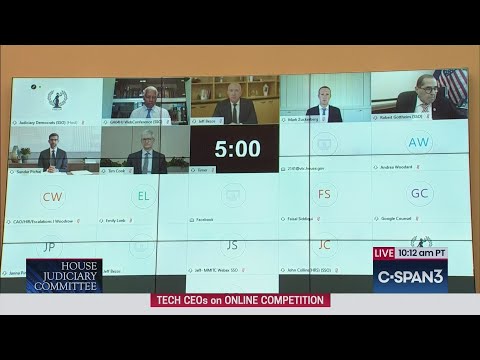
“I view it as our job to understand what people are finding valuable…”House Judiciary Committee antitrust hearing, 2020 · 2:39:50
Competition starts with understanding what people value
Zuckerberg’s basic view is that competition is not mainly about watching rivals. It starts with figuring out what people find useful, meaningful, or enjoyable, then building around that faster than others do. He describes this as the company’s job and ties it to a culture of learning quickly.123
That helps explain why he often talks about user needs before market structure. His early framing of Facebook was built around people’s desire to understand what is going on with others around them, and his advice is to start from the problem in the world rather than from the company or the competitor.456
“I view it as our job to understand what people are finding valuable…”House Judiciary Committee antitrust hearing, 2020 · full transcript →
He accepts feature competition, including borrowing what works
Zuckerberg does not present product competition as a purity test where every useful idea must be invented from scratch. He openly says Meta has adapted features that others had already introduced. In his frame, if a feature is proving valuable, the important question is whether you can integrate it well into your own product for your users.71
That approach makes competition more practical and less romantic. Instead of treating rivalry as a battle over originality alone, he treats it as a race to understand what matters and execute well. The standard is whether people find the result valuable, not whether the idea emerged first inside one company.12
“We have certainly adapted features that others have…”House Judiciary Committee antitrust hearing, 2020 · full transcript →
His edge is speed: the bigger risk is standing still
A core part of Zuckerberg’s competitive philosophy is that fast-changing markets punish caution more than they punish mistakes. He repeats that the biggest risk is not taking any risk, and says teams should make mistakes on both sides rather than become paralyzed. That means competing through iteration, experiments, and rapid correction.8910
This is why he emphasizes learning speed so much. A company that learns quickly can recover from wrong turns and catch shifts early, while a slower company can look safer in the short term but fall behind structurally. For Zuckerberg, competitive advantage comes from how fast an organization can test, learn, and respond.23
He tries to compete on product feel, not just product features
Zuckerberg’s view of competition is not only functional. In discussing Threads, he contrasts it with Twitter not just by format but by atmosphere, arguing that the emotional tone of a product matters. He says how people feel is really important, which means competition can be about building a healthier or more appealing culture around similar mechanics.1213
That is why his product playbook begins with creating something that sparks joy before worrying about full monetization. In this view, a challenger does not win only by copying the category leader’s capabilities. It can also win by making the same category feel different to use and better to return to.1413
He competes by betting early on the next platform
Zuckerberg does not think competition is limited to the current market. He tries to compete by investing ahead of the next wave, especially when the future is not fully clear yet. In AI, he says they want enough capacity to build for things that are only on the horizon, which shows a willingness to spend and prepare before demand is obvious.15
The same pattern shows up in hardware. He argues that glasses are the ideal form factor and explicitly names a primary competitor there, showing that he sees platform transitions as major competitive openings. Rather than only defending social apps on phones, he wants Meta positioned where the next computing habits form.1617
His AI comments also suggest he expects competition to fragment rather than collapse into one winner. He does not think there will be one AI for everything, so competing well means serving many contexts and use cases instead of assuming a single dominant interface.1819
Zuckerberg on competition, in his own words
“I view it as our job to understand what people are finding valuable…”
“We have certainly adapted features that others have…”
“I expect them to be our primary competitor.”
Where to watch
 Mark Zuckerberg on Antitrust And Platform Power2020 · 399 min · full transcriptBest for his direct defense of how Meta thinks about competition, user value, and adapting rival features.
 Mark Zuckerberg on Threads and Open Source AI: Building for Scale2024 · 69 min · full transcriptBest for how he tries to differentiate Threads from Twitter through product feel, culture, and long-term scaling.
 Mark Zuckerberg on Startup Strategy: Move Fast, Take Risks2012 · 35 min · full transcriptBest for his core philosophy that fast execution and risk-taking are essential in competitive markets.
 Mark Zuckerberg on Open Source AI: Llama 3, Scale, and Safety2024 · 79 min · full transcriptBest for how he thinks about competing in AI through scale, open models, and preparing early for the next wave.
 Mark Zuckerberg on the Future of Human Connection: AI Glasses and Holograms2024 · 146 min · full transcriptBest for his view that the biggest competitive battles are often platform shifts, especially glasses.
Questions people ask
- How does Mark Zuckerberg think Facebook improves and learns as a company?
- What did Mark Zuckerberg say about Meta AI and Llama 3?
- What did Mark Zuckerberg say about reasoning in AI?
- What did Mark Zuckerberg say about risk and why entrepreneurs should take it?
- What did Mark Zuckerberg say about the phases of Facebook and Instagram?
- What did Mark Zuckerberg say about being called crazy for a big vision?
Sources
Every quote above, word for word from the transcripts. Numbers match the text.
“I view it as our job to understand what people are finding valuable…”
“I think the key is building a company which is focused on learning as quickly as possible.”
“I think the key is building a company which is focused on learning as quickly as possible. Right? Companies are are learning organisms, and you can make decisions that either make it so that you learn faster or you learn slower. And, you know, in a lot of ways, a company is like following the scientific method. Right? You you try a bunch of different hypotheses. And if you set up the experiments well, then you kind of learn what to do. And I think that's that's an important philosophy. So there are all these different decisions that we make inside the company, you know, everything down to, really empowering individual engineers. We we invest in this huge, testing framework. Right? At any given point in time, there aren't... There's not just one version of Facebook running in the world. Right? There's probably tens of thousands of versions running because engineers here have the power to, to try out an idea and and and ship it to, you know, maybe 10,000 people or a 100,000 people.”
“…people have this deep thirst to understand what's going on with with those around them.”
“…start with the problem that you're trying to solve in the world…”
“So for me, the thing that I was really fascinated by and and always have been is, people, right, and and how how people work. You know, I was in college. I I studied psychology and computer science. And, you know, one of the things that you learn when you study psychology is that there are all these parts of the brain which are geared just towards understanding people. Right? Understanding language, how how to communicate with each other, understanding facial expressions, emotions, processing. Yet when I looked out at the Internet, right, in in 2004, which is when I was getting started, you can find almost anything else that you wanted. Right? You could find news, movies, music, reference materials. But the thing that mattered the most to people, which was other people and, like, understanding what's going on with them, it just wasn't there.”
“We have certainly adapted features that others have…”
“…the biggest risk you can take is not taking any risk.”
“…the biggest risk is not taking any risk…”
“…you want to make mistakes evenly on both sides…”
“I think Twitter index is very strongly on just being quite negative and critical.”
“I think how people feel is really important.”
“…phase one is build a thing that kind of sparks some joy…”
“…we always wanna have enough capacity to build something that we can't quite see that were on the horizon yet.”
“I think what you ideally have is glasses.”
“I expect them to be our primary competitor.”
“…we don't have one app that we go to for everything. I don't think that we want one AI.”
“I think it's progressive. And I don't think AGI is one thing.”
How this guide was made: drafted with AI from the full transcripts of the recordings cited, then checked: every quotation must match a transcript word for word and be the speaker's own words, and an independent review gates accuracy. Methodology and corrections.

