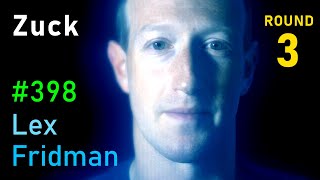
Mark Zuckerberg on Artificial Intelligence
Mark Zuckerberg sees AI as a widely distributed, personal, and increasingly agentic technology that should help people create, work, and connect rather than funnel everyone through one central system.
- AI should be personal, conversational, and enjoyable to use, not just smart.
- He favors open models and broad access because they spread innovation, competition, and power.
- He expects AI to become agentic: systems that pursue goals over multiple steps for people and businesses.
- He thinks AI’s biggest upside is invention and creativity more than simple automation.
- He does not think the future is one all-purpose AI; he expects many specialized AIs instead.

“…it should, like, get to know you and, like, what you think is funny and, like, what you ate.”This Past Weekend with Theo Von #579, 2025 · 1:34:57
He wants AI to feel personal, useful, and fun
Zuckerberg does not frame AI mainly as a machine for solving abstract benchmark problems. He says the point is to build something people actually want to use in daily life, which means it must be more than just highly intelligent. In his view, good AI should be conversational, engaging, and personally relevant.12
That personal quality matters because he thinks AI should know the user over time: their interests, humor, habits, and context. Instead of acting like a detached answer engine, it should feel more like an ongoing relationship that gets better as it understands the person using it.32
This also fits his broader product instinct that how technology makes people feel matters, not just the raw information it delivers. He repeatedly leans toward products that create enjoyment and comfort, which helps explain why he talks about personal AI as something people might talk with naturally rather than just prompt occasionally.452
“…it should, like, get to know you and, like, what you think is funny and, like, what you ate.”This Past Weekend with Theo Von #579, 2025 · full transcript →
He believes the future is many specialized AIs, not one master system
A central part of Zuckerberg's AI view is that people will not want a single giant AI for everything. He expects an ecosystem of different assistants and agents for different roles, just as people use different apps and services for different needs.67
That idea shapes both consumer and business products. He wants creators, businesses, and ordinary users to be able to make agents that reflect their own goals, voice, and workflows, instead of depending on one generic chatbot.86
He extends the same logic to AGI. Rather than treating AGI as one abrupt event or one monolithic machine, he describes progress as gradual and plural, with capabilities arriving in stages across different systems.9

“…there shouldn't just be kind of one big AI that people interact with.”SIGGRAPH 2024 keynote fireside chat, Denver · full transcript →
He thinks AI should act on your behalf, not just answer questions
Zuckerberg expects AI to move beyond simple chat into agents that can work toward goals over time. His ideal personal agent understands what someone is trying to accomplish and keeps helping, rather than waiting for one-off prompts.10
He uses the same frame for companies. In his view, every business will eventually have an AI agent interacting with customers, handling support and sales-like conversations, and guiding people who may not even know exactly what they need yet.1112
This is why he emphasizes reasoning and multi-step interaction. He sees the next stage of AI as more holistic: taking intent, using tools, and carrying out a sequence of actions that serves the user's actual objective.12

“…give every person in the world a very capable personal agent that can understand their goals…”Huge Conversations with Cleo Abram, 2024 · full transcript →
He argues that open access is better for innovation and even for safety
Zuckerberg consistently argues for sharing AI technology broadly. His default instinct is that inventions should not stay locked inside a few labs, because broader access helps more people build on them and spreads the benefits more widely.13
He also makes a strategic case that openness improves the overall ecosystem. If many people and organizations can use and adapt strong models, there is more competition, more experimentation, and less dependence on a single provider.1415
On safety, his argument is distinctive: he thinks concentrated AI power can itself be dangerous, and that checks and balances come from distributing capability. He explicitly suggests that wide access can be a defense against misuse by any one actor.1617

“…our ethos is that we want to share what’s invented broadly…”Lex Fridman Podcast #383, 2023 · full transcript →
He wants guardrails around clear harms, while preserving broad expression
Zuckerberg is not arguing for a anything-goes approach. He says there are some uses AI should plainly refuse, especially when it would help someone commit crimes or facilitate obvious abuse.18
At the same time, he draws a distinction between clear harms and more debatable disputes, especially around speech and contested claims. His posture is to stop known dangerous uses while still allowing as much expression as possible.1920
This balancing act helps explain his broader AI politics. He wants systems that are useful and widely available, but bounded where the risk is concrete and direct rather than using safety as a reason to centralize all control.191820
“…you can't ask it to help you commit a crime…”Lex Fridman Podcast #383, 2023 · full transcript →
He sees AI's biggest upside in creation, productivity, and science
Zuckerberg does not present AI mainly as a labor replacement story. He says its primary purpose is invention: helping people make new things, express ideas, and build tools that were previously too hard or too expensive to create.2117
That belief runs from consumer products to business use. He talks about AI as a driver of productivity and creativity, but the deeper theme is empowerment: more people being able to build, serve customers, and create experiences for others.11817
He also extends the promise of AI beyond software into science and health. He is notably optimistic that work at the intersection of AI and biology can accelerate discovery and potentially speed progress against disease.22
“…the primary purpose for AI is going to be invention of new things, not automation…”Huge Conversations with Cleo Abram, 2024 · full transcript →
Zuckerberg on artificial intelligence, in his own words
“…it should, like, get to know you and, like, what you think is funny and, like, what you ate.”
“…our ethos is that we want to share what’s invented broadly…”
“…the primary purpose for AI is going to be invention of new things, not automation…”
“…give every person in the world a very capable personal agent that can understand their goals…”
“…there shouldn't just be kind of one big AI that people interact with.”
“I think it's progressive. And I don't think AGI is one thing.”
Where to watch
 Mark Zuckerberg on Meta AI Agents: Muse, Privacy, and Open Source2024 · 70 min · full transcriptBest single overview of his case for personal agents, invention over automation, privacy, and open source AI.
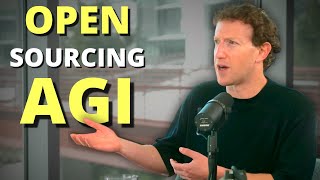 Mark Zuckerberg on Open Source AI: Llama 3, Scale, and Safety2024 · 79 min · full transcriptBest for how he thinks about Llama 3, open source scale, AGI as gradual progress, and the move toward agents.
 Mark Zuckerberg on AI Moderation: Open Models, Safety, and Speech2023 · 167 min · full transcriptBest for his reasoning on openness, moderation, safety guardrails, and where AI should be restricted.
 Mark Zuckerberg on Open Source AI: Why Every Business Needs an AI2024 · 59 min · full transcriptBest for his practical view that every business will have an AI and that users should create their own agents.
 Mark Zuckerberg on AI and Personal Technology: Fun, Useful, Human2025 · 98 min · full transcriptBest for understanding why he wants AI to be personal, conversational, enjoyable, and woven into everyday life.
 Mark Zuckerberg on Mixed Reality And AI: Meta’s Next Platform2023 · 45 min · full transcriptBest for how AI fits into his larger platform vision around mixed reality, devices, and human connection.
Questions people ask
- What did Mark Zuckerberg say a personal AI assistant should know about you?
- What did Mark Zuckerberg say about Meta AI and Llama 3?
- What did Mark Zuckerberg say about curing disease and AI?
- What did Mark Zuckerberg say about reasoning in AI?
- What did Mark Zuckerberg say about the purpose of AI?
- What did Mark Zuckerberg say about whether AGI should have a body?
Sources
Every quote above, word for word from the transcripts. Numbers match the text.
“…our goal on this is not just to build something that's like... Oh, yeah. It's gonna be super smart.”
“I do think this is this is a big a big focus for us. And we're building this Meta AI. It's our... We we call it personal AI. I mean, our goal on this is not just to build something that's like... Oh, yeah. It's gonna be super smart. Right? It's it's like, yeah. We're we're trying to solve full general intelligence and super intelligence and all that. But I think in order to build a product that people are gonna wanna use, you're gonna wanna build something that's fun to use. That means, like, you're not just gonna wanna, like, type to it. You wanna, like, have a conversation. Right? And and and it's not just about having it be, like, only able to answer hard questions. It should, like, get to know you and, like, what you think is funny and, like, what you ate. Right? So that way, you know, it can... Like... Or, you know, what your hobbies are. So that way it can kinda relate to you.”
“…it should, like, get to know you and, like, what you think is funny and, like, what you ate.”
“I think how people feel is really important.”
“…phase one is build a thing that kind of sparks some joy…”
“…there shouldn't just be kind of one big AI that people interact with.”
“…we don't have one app that we go to for everything. I don't think that we want one AI.”
“We wanna empower all the people who use our products to basically create agents for themselves.”
“I think it's progressive. And I don't think AGI is one thing.”
“…give every person in the world a very capable personal agent that can understand their goals…”
“I think in the future, every business is gonna have an AI agent that interfaces with their customers.”
“Reasoning, I think, is another example. It's like, okay, yeah, maybe you want to chat with a creator or, you know, you're a business and you're trying to interact with a customer. You know, that interaction is not just like, okay, the person sends you a message and you just reply, right? It's like a multi step interaction where you're trying to think through how do I accomplish the person's goals. And, you know, a lot of times when a customer comes, they don't necessarily know exactly what they're looking for or how to ask their questions. So it's not really the job of the AI to just respond to the question. It's like you need to kind of think about it more holistically. It really becomes a reasoning problem. Right? So if someone else, you know, solves reasoning or makes good advances on reasoning and we're sitting here with a basic chatbot, then our product is lame compared to what other people are building.”
“…our ethos is that we want to share what’s invented broadly…”
“I am kind of hopeful that in the next generation of computing, we're gonna return to a zone where the open ecosystem wins…”
“The the main thing that most people in the world are gonna see is the new version of Meta AI. Right? So it's... And, you know, the most important thing about what we're doing is the upgrade to the model. We're rolling out Llama three. We're doing it both as open source for dev community, and it is now going to be powering Meta AI. So there's a lot that I'm sure we'll go into around Llama three, but I think the bottom line on this is that with Llama three, we now think that Meta AI is the most intelligent AI assistant that people can use that's freely available. We're also integrating Google and Bing for real time knowledge. We're going to make it a lot more prominent across our apps.”
“…the best antidote to someone having an AI that could potentially hack into systems is having everyone have access to an AI…”
“And that's based on three major principles that we have. One is that empowering people is the source of prosperity in the world, and it has been throughout history. Two is that the primary purpose for AI is going to be invention of new things, not automation. And then the third principle is that the foundation for safety for the future is basically establishing the right checks and balances and balance of power rather than restricting access.”
“…you can't ask it to help you commit a crime…”
“…the danger is basically amplifying the kind of known set of harms…”
“…we want to allow people to express as much as possible…”
“…the primary purpose for AI is going to be invention of new things, not automation…”
“The Chan Zuckerberg initiative is primarily focused on curing diseases. And the way we're doing that is not by focusing on any single disease. It's by focused on kind of basic technology at the intersection of AI and biology to accelerate the pace of science. And we originally thought that kind of a hundred years when we started was sort of around the time frame to be able to cure and prevent and, like, deal with all diseases. I know there's a chance that that happens sooner than, you know, because of because of all the work with with AI. I guess I'm I'm more optimistic about that now. Would that means that, like, we are gonna live forever, or we just have healthier lives for the period that we're supposed to be living? And then at some point, like, your human body is done. I I don't I don't think we understand that yet enough.”
How this guide was made: drafted with AI from the full transcripts of the recordings cited, then checked: every quotation must match a transcript word for word and be the speaker's own words, and an independent review gates accuracy. Methodology and corrections.