Mark Zuckerberg on Business Strategy
Zuckerberg’s strategy is to start from a deep human need, learn faster than competitors, take asymmetric long-term bets, and build platforms that can support the next wave before it fully arrives.
- Start with a real human problem, not with company-building for its own sake.
- Strategy is a learning system: ship, test, and organize to learn faster.
- In fast-changing markets, avoiding risk is often the riskiest move.
- Make long-term infrastructure and platform bets before the opportunity is obvious.
- Build for retention and usefulness first; monetization comes later.
Start with a durable human need
Zuckerberg’s strategy begins with the problem, not the corporate plan. He says the right starting point is the problem you want to solve in the world, and in Facebook’s case that meant helping people understand the people around them better.12
That explains why he often frames products in human terms rather than category terms. His earliest motivation was understanding how people work and communicate, which led him to see a gap online around helping people make sense of each other.3
This way of thinking matters strategically because it anchors product decisions in behavior that is likely to persist even as formats and technologies change. If the underlying need is strong enough, the company can evolve the product around it over time.23
Treat strategy as a system for learning faster
For Zuckerberg, a company wins by learning faster than the environment changes. He says the key is building a company focused on learning as quickly as possible, and he describes companies as learning organisms that should be set up to test hypotheses and discover what works.45
This turns strategy from a static plan into an operating system. Instead of trying to predict everything in advance, you build processes that let teams ship, test, and see what resonates with people.56
That logic also explains his emphasis on empowering engineers and building products iteratively. The goal is not just speed for its own sake, but faster feedback about what users actually value.57
Take risks early, because stagnation compounds
Zuckerberg’s view of strategic risk is unusually clear: in a world that changes quickly, the biggest risk is not taking any risk. He repeats this idea across settings, which shows it is not just startup rhetoric but a core management principle.8910
He does not argue for reckless behavior. His standard is to make mistakes on both sides rather than only on the side of caution, because over-indexing on safety can cause a company to miss whole waves of change.1110
This helps explain hard choices in his story, including walking away from selling too early and staying committed to an independent path. His advice is blunt: if you do not want to sell, do not enter a process that pulls you toward selling.12

“…the biggest risk is not taking any risk…”Y Combinator Startup School Q&A, Stanford, 2012 · full transcript →
Invest ahead of the curve in capacity and platforms
A big part of Zuckerberg’s strategy is preparing for opportunities before they are fully visible. He says he wants enough capacity to build something that is still only on the horizon, which is his logic for large infrastructure bets such as compute.13
That same pattern appears in his platform thinking. He argues that the next platform after phones will be more immersive, and that the ideal form factor is glasses because they can understand context and become a more natural interface.1415
Strategically, this means he is willing to fund long arcs of development where the payoff depends on being early enough to shape the category. The bet is not just on a single product feature, but on being ready when a new computing layer arrives.131415
Build ecosystems, not just one product
Zuckerberg’s more recent strategy thinking is strongly ecosystem-oriented. In AI, he argues there should not be one giant assistant for everything, but many agents and models shaped for different people, creators, and businesses.1617
That leads to a distributed view of value creation. He expects every business to have an AI agent for customer interaction, and he wants Meta’s tools to let people and brands create those agents for themselves.1819
He makes a similar argument for more open ecosystems in computing, saying the next generation could shift back toward openness. In business terms, this is a strategy for scale through platforms and developer participation rather than trying to own every use case directly.21
Win on usefulness and feel before monetization
Zuckerberg’s product strategy is not just about utility in a narrow sense. He says his job is to understand what people find valuable, and in products like Threads he explicitly includes how people feel as part of that value.722
That is why he describes an ordered playbook: first build something that sparks joy, then drive retention and growth, and only later focus on monetization. This is a strategy of compounding engagement instead of forcing economics too early.23
It also helps explain why he pays attention to culture and tone in competitive products. If a rival is organized around a negative experience, he sees an opening to build a broader and friendlier alternative rather than merely copying features.
Zuckerberg on business strategy, in his own words
“…we always wanna have enough capacity to build something that we can't quite see that were on the horizon yet.”
Where to watch
 Mark Zuckerberg on Building the Future: Facebook, AI, and Risk2012 · 25 min · full transcriptBest short overview of his core strategy: solve a real human problem, learn fast, and stay willing to take big risks.
 Mark Zuckerberg on Startup Strategy: Move Fast, Take Risks2012 · 35 min · full transcriptBest for his operating style under uncertainty, including risk-taking, experimentation, and decision-making as a founder.
 Mark Zuckerberg on Threads and Open Source AI: Building for Scale2024 · 69 min · full transcriptBest for his modern product playbook: joy, retention, growth, then monetization, plus competitive positioning.
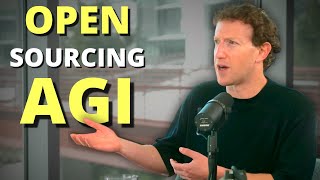 Mark Zuckerberg on Open Source AI: Llama 3, Scale, and Safety2024 · 79 min · full transcriptBest for understanding his logic behind early infrastructure bets and why scale investments matter before they look obvious.
 Mark Zuckerberg on Open Source AI: Why Every Business Needs an AI2024 · 59 min · full transcriptBest for his ecosystem strategy in AI: many specialized agents, open models, and tools for businesses.
 Mark Zuckerberg on The Metaverse: Meta's Next Chapter2021 · 81 min · full transcriptBest for his long-horizon platform strategy and why he is willing to bet on the next computing medium.
Questions people ask
- How does Mark Zuckerberg think CEOs should run a large company?
- How does Mark Zuckerberg think Facebook improves and learns as a company?
- What did Mark Zuckerberg say about Meta AI and Llama 3?
- What did Mark Zuckerberg say about reasoning in AI?
- What did Mark Zuckerberg say about risk and why entrepreneurs should take it?
- What did Mark Zuckerberg say about the phases of Facebook and Instagram?
Sources
Every quote above, word for word from the transcripts. Numbers match the text.
“…start with the problem that you're trying to solve in the world…”
“…people have this deep thirst to understand what's going on with with those around them.”
“So for me, the thing that I was really fascinated by and and always have been is, people, right, and and how how people work. You know, I was in college. I I studied psychology and computer science. And, you know, one of the things that you learn when you study psychology is that there are all these parts of the brain which are geared just towards understanding people. Right? Understanding language, how how to communicate with each other, understanding facial expressions, emotions, processing. Yet when I looked out at the Internet, right, in in 2004, which is when I was getting started, you can find almost anything else that you wanted. Right? You could find news, movies, music, reference materials. But the thing that mattered the most to people, which was other people and, like, understanding what's going on with them, it just wasn't there.”
“I think the key is building a company which is focused on learning as quickly as possible.”
“I think the key is building a company which is focused on learning as quickly as possible. Right? Companies are are learning organisms, and you can make decisions that either make it so that you learn faster or you learn slower. And, you know, in a lot of ways, a company is like following the scientific method. Right? You you try a bunch of different hypotheses. And if you set up the experiments well, then you kind of learn what to do. And I think that's that's an important philosophy. So there are all these different decisions that we make inside the company, you know, everything down to, really empowering individual engineers. We we invest in this huge, testing framework. Right? At any given point in time, there aren't... There's not just one version of Facebook running in the world. Right? There's probably tens of thousands of versions running because engineers here have the power to, to try out an idea and and and ship it to, you know, maybe 10,000 people or a 100,000 people.”
“…you have the power to go put that online and, you know, see whether it resonates and connects with people…”
“I view it as our job to understand what people are finding valuable…”
“…the biggest risk you can take is not taking any risk.”
“…the biggest risk is not taking any risk…”
“I think Peter was the person who who told me this really pithy quote that in a world that's changing so quickly, the biggest risk you can take is not taking any risk. And I I really think that that's true. Right? Mean, a lot of people, I think, think that, you know, whenever it comes to... Whenever you get yourself into a position where you have to make some some big shift in in direction or do something, you know, there there are always... People are gonna point to the the downside risks of that decision. And, locally, they're maybe right. Right? I mean, if for any given decision that you're gonna make, there's upside and downside. But in aggregate, if you are stagnant and you don't make those changes, then, then I think you're guaranteed to fail, right, and and not not catch up.”
“…you want to make mistakes evenly on both sides…”
“I mean, if you don't want to sell your company, don't get into a process where you're talking to people about selling your company.”
“…we always wanna have enough capacity to build something that we can't quite see that were on the horizon yet.”
“The next platform and medium will be even more immersive: an embodied internet…”
“I think what you ideally have is glasses.”
“…there shouldn't just be kind of one big AI that people interact with.”
“…we don't have one app that we go to for everything. I don't think that we want one AI.”
“I think in the future, every business is gonna have an AI agent that interfaces with their customers.”
“We wanna empower all the people who use our products to basically create agents for themselves.”
“You want to know that you own your items, not a platform.”
“I think how people feel is really important.”
“…phase one is build a thing that kind of sparks some joy…”
How this guide was made: drafted with AI from the full transcripts of the recordings cited, then checked: every quotation must match a transcript word for word and be the speaker's own words, and an independent review gates accuracy. Methodology and corrections.


