Jamie Dimon on Inflation And Rates
Jamie Dimon sees inflation as more persistent than markets assume and thinks rates may stay higher for longer because deficits, geopolitics, and the unwind of easy money keep pressure on the system.
- He is more worried about sticky inflation than a clean soft landing.
- He thinks the bigger issue is the path of rates, not one small Fed move.
- He sees deficits, past easy money, and geopolitical shocks as ongoing inflation forces.
- He believes markets may be underpricing risk, especially in long bonds.

“I don't think it makes a piece of difference whether a rate goes up 25 basis points or more.”FII Institute Board of Changemakers panel, World Economic Forum, 2023 · 16:04
Dimon thinks inflation is more persistent than many investors expect
Dimon does not sound convinced that inflation will simply fade away on schedule. His basic stance is that the economy may look solid in the present while inflation remains harder to extinguish than consensus expects, which is why he is less comfortable with the standard soft-landing story.12
He frames this as a reason for caution, not panic. The point is that strong current conditions can coexist with bigger future macro problems, so investors should not confuse resilience today with a permanently easy path tomorrow.1
For him, the key question is higher for longer, not a single Fed meeting
Dimon repeatedly pushes people to look beyond whether the next move is 25 basis points. He argues that a tiny step up or down matters less than the overall level and duration of rates, because that broader path is what changes financing costs, valuations, and economic behavior.4
He is also skeptical of overconfident forecasting. His warning is that central banks have been wrong before, so investors should be humble about any neat rate-cut timetable and stay prepared for a wider range of outcomes than markets often price in.
“I don't think it makes a piece of difference whether a rate goes up 25 basis points or more.”FII Institute Board of Changemakers panel, World Economic Forum, 2023 · full transcript →
Deficits, easy money, and geopolitics are why he thinks inflation can stay sticky
Dimon links inflation persistence to structural forces, not just short-term demand swings. He worries that large fiscal deficits and the aftereffects of very easy monetary policy can keep price pressures alive longer than expected, even if headline data occasionally improve.1
He also ties inflation to the world becoming less stable. Trade frictions, war, sanctions, and broader geopolitical conflict can disrupt supply, investment, and confidence, making inflation both stickier and more volatile than in a calmer global environment.
He believes markets may be too complacent, especially about long bonds
Dimon’s caution shows up clearly in how he talks about fixed income. He has said he would not be a buyer of long-dated government bonds, which fits his broader view that inflation and rates may not settle down as smoothly as markets hope.10
That view follows from his wider skepticism about forecasts and his sense that investors can become too comfortable after a period of calm. If inflation proves stickier or shocks prove larger, long-duration assets can look much more vulnerable than they do in optimistic scenarios.1

“Personally, no. I would not be a buyer.”Master Investor podcast interview, Davos, 2024 · full transcript →
Higher rates expose weak risk management and force more realism
Dimon also treats higher rates as a stress test for the financial system. When rates rise after a long period near zero, hidden weaknesses in funding, liquidity, and balance-sheet management become visible very quickly.
That matters for anyone thinking about inflation and rates because the impact is not confined to the Fed or Treasury markets. A higher-rate world changes who can refinance, which business models still work, how banks manage duration risk, and where investors discover they were relying on cheap money.4
Dimon on inflation and rates, in his own words
“It looks a little bit more like the seventies to me…”
“I don't think it makes a piece of difference whether a rate goes up 25 basis points or more.”
“Personally, no. I would not be a buyer.”
Where to watch
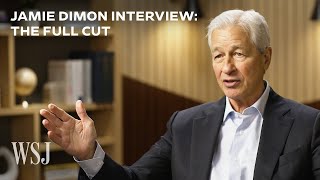 Jamie Dimon on Economy and Geopolitics: Inflation, War, and AI2021 · 38 min · full transcriptBest single overview of why he worries inflation may not fade cleanly and why soft-landing optimism may be too strong.
 Jamie Dimon on Global Economy Outlook: Cautious on Rates, War, and Inflation2023 · 71 min · full transcriptShows his higher-for-longer mindset and why he focuses on the overall rate path more than one Fed move.
 Jamie Dimon on Economy, AI & Risk: Bonds, Geopolitics and Leadership2024 · 61 min · full transcriptUseful for his market application: why he is cautious on long bonds and sees risk as underpriced.
 Jamie Dimon on Recession Risk: Geopolitics, Rates, and Banking2023 · 68 min · full transcriptAdds his view that the unwind of QE and inflation could push rates higher than markets expect.
 Jamie Dimon on Bank Regulation: Risk, Capital, and Resilience2017 · 56 min · full transcriptExplains how rising rates reveal liquidity and interest-rate risk inside banks and the broader system.
 Jamie Dimon on Global Growth And Banking: Trade, Tech, and Talent2018 · 18 min · full transcriptHelpful context on how trade uncertainty can delay investment and reinforce macro caution.
Questions people ask
Sources
Every quote above, word for word from the transcripts. Numbers match the text.
“I'm a little more worried that it may not be so soft and inflation may not quite go away…”
“It looks a little bit more like the seventies to me…”
“I don't think it makes a piece of difference whether a rate goes up 25 basis points or more.”
“Personally, no. I would not be a buyer.”
How this guide was made: drafted with AI from the full transcripts of the recordings cited, then checked: every quotation must match a transcript word for word and be the speaker's own words, and an independent review gates accuracy. Methodology and corrections.
