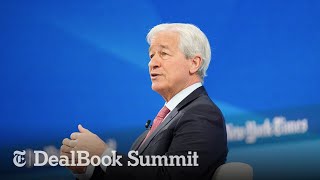
Jamie Dimon on America's Economy
Jamie Dimon sees America’s economy as fundamentally strong but too often weakened by bad policy, fiscal excess, geopolitical risk, and complacency about inflation and long-term resilience.
- America has exceptional structural advantages and long-run economic strength.
- The biggest economic drags are self-inflicted: weak policy on growth, regulation, education, housing, infrastructure, and immigration.
- He is cautious on inflation, deficits, and the idea that the economy will glide to a soft landing.
- He thinks geopolitics now matters more than small rate moves or day-to-day market noise.
- He is optimistic about technology and AI over time, but not on a neat timetable and not without disruption.

“America has the best hand ever dealt of any country on this planet today, ever.”The David Rubenstein Show interview, 2017 · 8:45
America starts from a position of unusual strength
Dimon’s basic view is that the United States has extraordinary built-in advantages. He points to the country’s geography, resources, neighbors, institutions, financial markets, and tradition of freedom and enterprise as the foundation of the world’s most dynamic economy. That is why he remains fundamentally optimistic about America even when he is worried about the near term.123
He does not describe America as a fading economy. He sees it as a country with a very strong hand, whose prosperity came from both natural advantages and a constitutional system that rewards innovation, investment, and risk-taking. In his view, the long-run base is still powerful.124
“America has the best hand ever dealt of any country on this planet today, ever.”The David Rubenstein Show interview, 2017 · full transcript →
The biggest weaknesses are often self-inflicted
Dimon argues that America’s growth problems are less about a lack of potential and more about policy mistakes. Across his comments, the recurring list is practical and familiar: immigration, education, infrastructure, housing, taxes, regulation, and workforce participation. He thinks many of these problems are fixable if leaders focus on competence instead of ideology.5
He is especially frustrated by policy and regulatory burden that absorbs talent and capital without improving outcomes. His point is not that rules are always bad; he has also said stronger capital and stress testing helped rebuild the banking system. But he believes too much energy goes into low-value compliance instead of cyber, privacy, AI, lending, housing, and productive growth.8910
That is why he talks about growth as a national priority. He connects stronger growth to better wages, broader opportunity, and the ability to pay for public goals, rather than treating growth as separate from fairness or social stability.5

“Good policy is free for God's sakes.”WSJ CEO Council interview, 2021 · full transcript →
He is wary of inflation, deficits, and easy soft-landing stories
Dimon repeatedly warns against overconfidence about the near-term economy. Even when he says consumers look healthy and the economy appears strong on the surface, he also says inflation may be stickier than markets expect and that the landing may not be soft. He is skeptical of precise macro forecasts and thinks policymakers should show more humility after getting major calls wrong.11121314
A core reason is fiscal policy. He views heavy spending, large deficits, and the aftereffects of quantitative easing as forces that can keep inflationary pressure alive. That makes him less focused on tiny rate adjustments and more focused on the broader path of rates, prices, and financial conditions.151213
This caution also shapes his market view. He has said he would not buy long-dated government bonds, which fits his broader concern that inflation, rates, and future shocks are still not fully priced in.1612

“I'm a little more worried that it may not be so soft and inflation may not quite go away…”WSJ CEO Council interview, 2021 · full transcript →
Geopolitics is now an economic variable, not a side issue
For Dimon, the most important forces acting on America’s economy are geopolitical. He keeps returning to war, great-power rivalry, terrorism, remilitarization, trade realignment, and nuclear risk as the backdrop that can reshape inflation, supply chains, confidence, and capital spending. He thinks investors and policymakers make a mistake when they treat these risks as secondary.171819
He also links economic strength directly to national security. In his view, America’s military position, its alliances, and the dollar’s standing depend on preserving industrial capacity, secure supply chains, and broad economic power. That is why he emphasizes rebuilding capabilities in areas like manufacturing, semiconductors, pharma inputs, cyber, and other strategic industries.2021
This makes his economic outlook more conditional than many headline summaries suggest. He is not simply bullish or bearish. He thinks the economy is resilient, but he also believes resilience can be tested hard if geopolitical shocks spread through energy, trade, and markets.1722

“Those tectonic plates, they're still shifting, they're still moving, they're still the most important things that are taking place in the world.”CNBC / Reagan National Economic Forum conversation, 2024 · full transcript →
Technology can lift growth, but only with realism and discipline
Dimon is strongly optimistic about technology and AI over the long run. He expects AI to improve productivity and even save lives, and he treats innovation as one of America’s enduring strengths. This is one reason he does not sound pessimistic about the country’s long-run economic capacity.232425
But he is equally clear that technology booms do not unfold in a straight line. He expects spending waves, false starts, uneven winners, and benefits that arrive later and in different forms than investors initially expect. That is why his AI view is optimistic without being naive.252627
He also warns that technology raises new national vulnerabilities, especially in cyber. So even one of the biggest future growth engines comes with the need for better systems, stronger institutions, and more serious risk management.28

“Will it in total pay off? Probably, just like the internet did.”Master Investor podcast interview, Davos, 2024 · full transcript →
His bottom line: be optimistic about America, but stop being complacent
Put together, Dimon’s view is that America can grow faster and remain the world’s strongest economy, but only if it takes its own strengths seriously. He thinks the country should be more confident about what it is, more honest about what is broken, and more practical about fixing it.43
That leads to a distinctive mix of optimism and warning. He is optimistic because America still has exceptional assets; he is worried because policy drift, inflationary deficits, weak execution, and geopolitical danger can erode those assets over time. In his framing, the real risk is not that America lacks capacity, but that it wastes it.112174
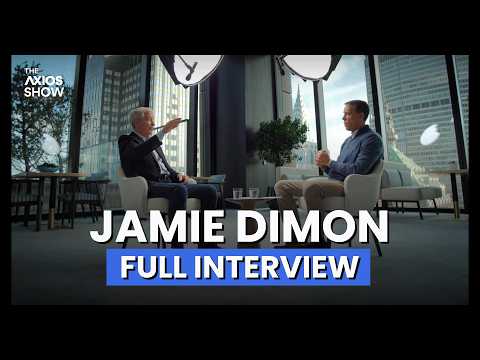
“Did America have failures? Absolutely. Should we look at that and tear down with this unbelievable country done? Absolutely not, so the real risk is our heart, our soul, our grit, our courage. That is the actual real risk because that will drive the economy. America's military strength is predicated upon America's economic strength, our economic strength is predicated in keeping this wonderful system going, fixing it where it did something wrong, but there's too much today, like just tearing it down. It quite bothers me that we don't celebrate the values of virtues, particularly in this 250th year of the anniversary. So yeah, I am worried about that. It is a troubled time, but we're gonna get through this too.”Axios Show interview, 2024 · full transcript →
Dimon on america's economy, in his own words
“America has the best hand ever dealt of any country on this planet today, ever.”
“Good shape. We have all the food, Warner, an energy we need, the Atlantic and the Pacific, wonderful neighbors in Canada, Mexico, and these things were given us by God. Then we have the things we're given to us by the Enlightenment and our founding fathers, you know, which is the free enterprise, freedom of religion, freedom of speech. If you're democrat, repeat freedom of enterprise, surprise. But those things led to the most dynamic and prosperous economy the world's ever seen, the wisest, deepest, most transparent financial markets, universities, schools, unbelievable innovation, and if you made a very low corruption, a very strong rule of law, though that's getting weaker these days too. If you made that list and go around the world, Turkey, Brazil, China, Russia, India, they don't have that. They sure would break; they would give an arm and a leg to other kinds of stuff. So.”
“I'm a little more worried that it may not be so soft and inflation may not quite go away…”
“Those tectonic plates, they're still shifting, they're still moving, they're still the most important things that are taking place in the world.”
“I am powerfully optimistic about how technology is going to be rapidly shape our world.”
“Did America have failures? Absolutely. Should we look at that and tear down with this unbelievable country done? Absolutely not, so the real risk is our heart, our soul, our grit, our courage. That is the actual real risk because that will drive the economy. America's military strength is predicated upon America's economic strength, our economic strength is predicated in keeping this wonderful system going, fixing it where it did something wrong, but there's too much today, like just tearing it down. It quite bothers me that we don't celebrate the values of virtues, particularly in this 250th year of the anniversary. So yeah, I am worried about that. It is a troubled time, but we're gonna get through this too.”
Where to watch
 Jamie Dimon on America’s Future: AI, Risk, and Renewal2024 · 40 min · full transcriptBest concise overview of how he links America’s economic future to values, geopolitics, AI, and national resilience.
 Jamie Dimon on Economy and Banking: Dodd-Frank, Brexit, Leadership2017 · 24 min · full transcriptBest statement of his belief that America has enormous structural strengths but is holding itself back with bad policy.
 Jamie Dimon on Geopolitics and Economic Security: Truth Forward2024 · 39 min · full transcriptBest for understanding why he sees geopolitics and economic security as central to the U.S. economic outlook.
 Jamie Dimon on Economy and Geopolitics: Inflation, War, and AI2021 · 38 min · full transcriptBest for his caution on inflation, deficits, the consumer, and why he doubts easy soft-landing narratives.
 Jamie Dimon on Global Economy Outlook: Cautious on Rates, War, and Inflation2023 · 71 min · full transcriptBest for his wider macro framework: higher-for-longer rates, inflation risk, technology upside, and a dangerous world.
 Jamie Dimon on Growth and Inequality: Growth Pays for Everything2020 · 43 min · full transcriptBest for his argument that stronger growth is necessary to reduce inequality and fund national priorities.
Questions people ask
- What did Jamie Dimon say about America’s economic strengths?
- What did Jamie Dimon say about forecasting and humility?
- What did Jamie Dimon say about the return on AI investment?
- What did Jamie Dimon say is the biggest domestic risk to America?
- What did Jamie Dimon say about media and public policy?
- What did Jamie Dimon say about regulation and cyber risk?
Sources
Every quote above, word for word from the transcripts. Numbers match the text.
“America has the best hand ever dealt of any country on this planet today, ever.”
“Good shape. We have all the food, Warner, an energy we need, the Atlantic and the Pacific, wonderful neighbors in Canada, Mexico, and these things were given us by God. Then we have the things we're given to us by the Enlightenment and our founding fathers, you know, which is the free enterprise, freedom of religion, freedom of speech. If you're democrat, repeat freedom of enterprise, surprise. But those things led to the most dynamic and prosperous economy the world's ever seen, the wisest, deepest, most transparent financial markets, universities, schools, unbelievable innovation, and if you made a very low corruption, a very strong rule of law, though that's getting weaker these days too. If you made that list and go around the world, Turkey, Brazil, China, Russia, India, they don't have that. They sure would break; they would give an arm and a leg to other kinds of stuff. So.”
“This country is not, was not a tribe. It was not a nationality. It was an idea.”
“Did America have failures? Absolutely. Should we look at that and tear down with this unbelievable country done? Absolutely not, so the real risk is our heart, our soul, our grit, our courage. That is the actual real risk because that will drive the economy. America's military strength is predicated upon America's economic strength, our economic strength is predicated in keeping this wonderful system going, fixing it where it did something wrong, but there's too much today, like just tearing it down. It quite bothers me that we don't celebrate the values of virtues, particularly in this 250th year of the anniversary. So yeah, I am worried about that. It is a troubled time, but we're gonna get through this too.”
“Good policy is free for God's sakes.”
“The system is completely recovered, part that's Dodd-Frank.”
“The biggest risk is to regulation.”
“Regulation. You know, the biggest risk is to regulation. The resources going into stupid stuff that should be going to cyber, privacy, AI, and, and, you know, we got eight thousand people read documenting forms from five years ago because the regular said we didn't cross the T and dot the I. We spent billions of dollars doing K White Way. I'm sure he's tortured you and KY, CAML, BSA. We haven't found one bad guy. Billions of dollars, billions. And of course, it's in his board time. It's, it's, it's computer time. It's regulatory time. It's brain time. That's the whole thing. And we—this is the one we should be worried about. So blockchain is real. Okay? Because it's a technology. It's not that complicated technology. It's, it's a ledger of data.”
“…the consumer's in pretty good shape right now…”
“I'm a little more worried that it may not be so soft and inflation may not quite go away…”
“It looks a little bit more like the seventies to me…”
“People prepare for possibilities and probabilities, not calling one course of action since I've never seen anyone call it. I want to point out the central banks 18 months ago were 100% dead wrong. Okay? So maybe there should be humility about financial forecasting. I—I would be quite cautious about what might happen next year.”
“I don't think it makes a piece of difference whether a rate goes up 25 basis points or more.”
“Personally, no. I would not be a buyer.”
“Those tectonic plates, they're still shifting, they're still moving, they're still the most important things that are taking place in the world.”
“I just would put on your table the most serious thing facing mankind is nuclear proliferation.”
“I think you—you'd be foolish not to look at some of these things taking place today…”
“We must maintain the strongest military in the world.”
“The reserve currency is not — this is an IQ test.”
“I would add to that the free Western world, 'cause that's what worries me the most…”
“I am powerfully optimistic about how technology is going to be rapidly shape our world.”
“AI, I think it's gonna, again, in context, it's gonna save lives.”
“Will it in total pay off? Probably, just like the internet did.”
“Will it pay off the way you expect on the time table you expect? Definitely not.”
“When I look at AI itself, the amount of money being spent is huge. Will it in total pay off? Probably, just like the internet did. Will it pay off the way you expect on the time table you expect? Definitely not. And you remember so we had Yahoo and now Netscape and all these companies that went bankrupt, but Google made it. You know, Facebook made it like and these are big powerful companies. And then there all these ancillary benefits from the internet like your iPhones and your things like that. So yes, it it is a powerful tool that will create a huge…”
“Our biggest risk here is cyber.”
How this guide was made: drafted with AI from the full transcripts of the recordings cited, then checked: every quotation must match a transcript word for word and be the speaker's own words, and an independent review gates accuracy. Methodology and corrections.