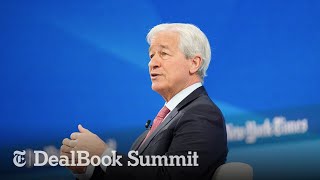
Jamie Dimon on Leadership
Jamie Dimon sees leadership as disciplined truth-telling in service of a bigger purpose: learn constantly, set high standards, kill bureaucracy, and stay resilient under pressure.
- Leadership starts with purpose, not ego or money.
- Great leaders demand facts, truth-telling, and direct debate.
- Culture comes from high standards, anti-bureaucracy, and attention to detail.
- Resilience matters: setbacks should bruise your finances or pride, not your identity.
- A leader’s job is to keep learning and prepare the organization for stress, not just good times.

“Leaders understand that they didn't build this country. I speak to a lot of my friends. I remind them, they didn't charge the beach at Normandy or do the Humvee in a desert in Iran or a mountain in Iraq. So everything they earned, they did not earn it on their own. Somebody earned it before they got here. And that should be a humbling thing for all leaders. If you want to be a leader, it can't be about money, and it can't be about you. It's about, eventually, what you do and what you leave behind and what you did when you walked the planet.”Harvard Business School Class Day, 2009 · 34:12
Leadership is about purpose and responsibility, not status
Dimon’s starting point is moral, not managerial. He argues that leadership cannot be mainly about personal wealth, prestige, or self-importance; it has to be tied to purpose, contribution, and what you leave behind. In his view, leaders should feel humbled by how much they inherited from others and responsible for using that inheritance well.12
That is why he links leadership to effort and conduct. Do your best, treat people properly, and stand up when something is wrong. For Dimon, responsibility is not abstract; it shows up in daily behavior, how you use authority, and whether people are better off because you were there.342
“Leaders understand that they didn't build this country. I speak to a lot of my friends. I remind them, they didn't charge the beach at Normandy or do the Humvee in a desert in Iran or a mountain in Iraq. So everything they earned, they did not earn it on their own. Somebody earned it before they got here. And that should be a humbling thing for all leaders. If you want to be a leader, it can't be about money, and it can't be about you. It's about, eventually, what you do and what you leave behind and what you did when you walked the planet.”Harvard Business School Class Day, 2009 · full transcript →
Tell the truth early and get the best answer, not your answer
Dimon believes weak leadership shows up when people around the table tell the boss what the boss wants to hear. A healthy team has real truth-tellers, open information, and direct confrontation with problems. He wants leaders to put the facts on the table, strip away spin, and make it safe to say what is actually happening.567
That also changes how he sees decision-making. The leader’s job is not to play oracle or dominate every call; it is to make sure the best decision gets made by getting the right people in the room and removing bureaucracy that blocks candor. He treats layers, politics, and endless follow-up meetings as signs that leadership has failed to create clarity.86
He pairs this with intellectual humility. In a complicated world, confusion is normal, and pretending certainty is dangerous. Leaders need enough confidence to act, but enough honesty to admit when conditions are messy and to keep searching for better information.910

“If you've got 10 people around the table and there's only one truth teller, you have a problem.”America Business Forum interview, Miami, 2024 · full transcript →
Set standards through details, merit, and anti-bureaucracy
Dimon’s version of high standards is concrete. He says nothing is too small to care about, and he connects leadership to details, facts, analysis, and execution. Culture is not slogans; it is whether leaders notice the little things, insist on follow-through, and refuse complacency.1167
He is especially hostile to bureaucracy because he thinks it drives out strong people, distances leaders from customers, and creates internal politics. In his view, bureaucracy is not just inefficient; it is culturally corrosive. Leaders have to keep organizations close to reality by simplifying processes, pushing authority to capable people, and staying connected to what customers and frontline teams actually experience.87
That same philosophy shapes how he thinks about talent. He favors rewarding the full spectrum of performance and backing strong people when they take on ugly, difficult assignments. Leadership means protecting merit from internal politics and supporting good people through hard jobs, not just celebrating visible wins.12

“I'm relentless: detail, facts, analysis, no bullshitting, no meetings after meetings.”WSJ CEO Council interview, 2021 · full transcript →
Resilience means separating failure from self-worth
Dimon returns often to the idea that careers include setbacks, criticism, and painful reversals. What matters is whether you recover, learn, and keep moving. One of his clearest leadership lessons is to separate external loss from identity so that disappointment does not become paralysis.13
He also rejects the spectator mentality. The people who matter are the ones in the arena doing the work, taking the blows, and trying again. Leadership, in his telling, requires thick skin, fortitude, and the willingness to keep acting even when outcomes are uncertain or unfair.14
That resilience is practical, not sentimental. Learn from mistakes once, do not keep relearning the same lesson, and build the emotional steadiness to perform in crisis. Pressure reveals character, judgment, and whether a leader can still think clearly when events get rough.159
“It was my net worth, not my self-worth.”Harvard Business School Class Day, 2009 · full transcript →
Learn constantly and prepare for the world as it is
For Dimon, leaders are never finished learning. He treats reading, travel, observation, and conversations with other people as core parts of the job, because the world changes too fast for fixed knowledge to be enough. Continuous learning is how leaders keep perspective and avoid running organizations from stale assumptions.10
He also thinks leadership has to be grounded in risk reality, not optimism. Being risk conscious does not mean eliminating risk; it means understanding it, pricing it, and preparing for bad outcomes that others ignore. The leader’s duty is not to engineer smooth stories, but to make sure the institution can withstand stress.161718
That mindset extends beyond finance. He repeatedly points leaders toward larger forces such as geopolitics, cybersecurity, public policy, and economic resilience. Good leadership looks past the quarter, faces the biggest threats directly, and invests in strength before the crisis arrives.192021
“Learning is a lifelong thing. It doesn't end at Harvard Business School. It's your responsibility. I think if you're in any profession at all, you have to do it consistently, all the time. I think I spend probably 50% or 60% of my time learning, reading, talking to people, traveling. It's the only way you can keep on top of this global world of ours. And it's even tougher now because of the globality of the businesses you're all going to deal in. How? Reading is the most important one. But the second one, which is often forgotten, is talking to other people. You can learn more, from speaking to people, in 15 minutes than if you spent your life doing something.”Harvard Business School Class Day, 2009 · full transcript →
Dimon on leadership, in his own words
“If you've got 10 people around the table and there's only one truth teller, you have a problem.”
“I'm relentless: detail, facts, analysis, no bullshitting, no meetings after meetings.”
“It was my net worth, not my self-worth.”
“The credit does not go to the critic in the stand.”
“Risk conscious does not mean getting rid of risk.”
“…heart and curiosity and give a damn…”
Where to watch
 Jamie Dimon on Leadership and Resilience: Harvard Class Day2009 · 41 min · full transcriptBest single overview of Dimon’s leadership philosophy: resilience, truth-telling, standards, merit, and purpose.
 Jamie Dimon on Leadership Lessons: Heart, Curiosity, Grit2021 · 92 min · full transcriptBest for the roots of his style: heart, curiosity, grit, treatment of people, and anti-bureaucratic management.
 Jamie Dimon on America's Future and AI: Freedom, Resilience, Growth2024 · 46 min · full transcriptBest for how he wants leaders to operate in uncertainty: firsthand learning, candor, and culture enforcement.
 Jamie Dimon on Banking and Policy: Growth, Risk, and Resilience2021 · 32 min · full transcriptBest for his operating habits as a CEO: details, facts, customer focus, and intolerance for complacency.
 Jamie Dimon on Risk Management: Build the Fortress Balance Sheet2015 · 66 min · full transcriptBest for seeing how his leadership principles show up in risk discipline and preparation for worst cases.
Questions people ask
- What did Jamie Dimon say about bureaucracy in companies?
- What did Jamie Dimon say about how he judges performance and leadership?
- What did Jamie Dimon say about leadership, luck, and obligation to society?
- What did Jamie Dimon say about lifelong learning at Harvard Business School?
- What does Jamie Dimon think great management requires?
- What did Jamie Dimon say gives life purpose?
Sources
Every quote above, word for word from the transcripts. Numbers match the text.
“Leaders understand that they didn't build this country. I speak to a lot of my friends. I remind them, they didn't charge the beach at Normandy or do the Humvee in a desert in Iran or a mountain in Iraq. So everything they earned, they did not earn it on their own. Somebody earned it before they got here. And that should be a humbling thing for all leaders. If you want to be a leader, it can't be about money, and it can't be about you. It's about, eventually, what you do and what you leave behind and what you did when you walked the planet.”
“Have a purpose, you know, have—and that it could be art, it could be science, it could be military, it could be business, it could be—it could be just being a great parent, a great teacher, you know, but have a purpose and then do the best you can, you know, give it, give it your all. Don't, like, be one of those people who complain all the time, you know, you give it your best and, uh, and then treat everyone properly. Everyone, you know, like I—and including, like, if there's a bully beating up on someone, you had to stand up to someone, you were not allowed to allow a bully to do it. So how you treat people, what you do, and so in my hierarchy of life, the most important thing is my family, uh, still is. The second thing is my country because I think this country is the…”
“…you do the best you can in whatever you do…”
“…heart and curiosity and give a damn…”
“If you've got 10 people around the table and there's only one truth teller, you have a problem.”
“I'm relentless: detail, facts, analysis, no bullshitting, no meetings after meetings.”
“I'm relentless: detail, facts, analysis, no bullshitting, no meetings after meetings. Share all the information. Put it on the table. Put the dead cats on the table. Go through system by system by system by system. Get out on the road. You know, visit other companies. They all do things better than you. Learn, learn, learn, learn, learn, and be relentless about doing it. Big companies slow down. They become complacent. They become bureaucratic. All that stuff, arrogance, you know, is the petri dish of politics. You know, as Jeff Bezos says, you know, that kind of stuff leads to stasis and death. And if you don't believe me, you know, you look at all the companies who failed, huge, wonderful companies. And, you know, it's because of things like that. So, I'm kind of relentless about driving stuff. Nothing's too small to care about.”
“People have often said to me, OK, Jamie, you're the big boss. You get paid the big bucks to decide. Now decide. My experience has always been that if you get the right people in the room, the answer is often waiting to be found. You don't have to guess. The job of a leader is not to make the decision. It's to make sure the best decision is made, and therefore you need other people. You have to kill bureaucracy. I think that bureaucracy is the Petri dish of politics. It pushes out good people. You lose touch with your customers. It often emanates from headquarters. If you go to headquarters of companies-- I think headquarters are often the disease-- and you see the receptionist treating the employees badly or their customers badly, you probably have a company that has a problem. Headquarters don't exist, except for the fact that there's a client in front of someone, somewhere, whether it's a Benihana or whether it's a JPMorgan Chase.”
“If you're not confused, you don't know what's going on.”
“Learning is a lifelong thing. It doesn't end at Harvard Business School. It's your responsibility. I think if you're in any profession at all, you have to do it consistently, all the time. I think I spend probably 50% or 60% of my time learning, reading, talking to people, traveling. It's the only way you can keep on top of this global world of ours. And it's even tougher now because of the globality of the businesses you're all going to deal in. How? Reading is the most important one. But the second one, which is often forgotten, is talking to other people. You can learn more, from speaking to people, in 15 minutes than if you spent your life doing something.”
“Nothing's too small to care about.”
“So we judge the full spectrum of how people perform. And then the greatest misconception of all is, when a unit doesn't perform, don't blame the boss. I mean, don't pay the boss. Well, sometimes, you want to give your best person the worst job. I've asked a lot of people to go do a job that I know is going to be the hardest turnaround, the meanest job, 24/7, that they're not going to look good doing it. And you know what I say to them? I'm going to pay you the same as the rest of your partners, and I've got your back. I'm not going to allow the politics inside hurt you. If something goes wrong, we're all going to get on an airplane and come help you.”
“It was my net worth, not my self-worth.”
“The credit does not go to the critic in the stand.”
“You don't learn a lot from the second kick in the mule.”
“Risk conscious does not mean getting rid of risk.”
“I always look what I call the fat tails and manage that we can handle all the, all the fat tails.”
“The fortress balance sheet is that you run a company serving clients well.”
“Our biggest risk here is cyber.”
“Those tectonic plates, they're still shifting, they're still moving, they're still the most important things that are taking place in the world.”
“We must maintain the strongest military in the world.”
How this guide was made: drafted with AI from the full transcripts of the recordings cited, then checked: every quotation must match a transcript word for word and be the speaker's own words, and an independent review gates accuracy. Methodology and corrections.