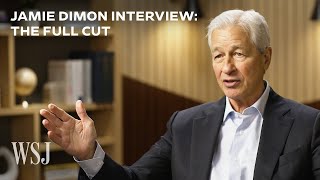
Jamie Dimon on Banking
Jamie Dimon sees banking as essential infrastructure: it should allocate capital, serve clients through good and bad times, and be built to survive shocks through strong balance sheets, liquidity, and practical regulation.
- Banks matter because they allocate capital and support the real economy, not just markets
- A good bank does not avoid risk; it understands, prices, and survives it
- Strong capital, liquidity, resolution planning, and stress resilience make banking safer
- Bad regulation is not the same as good supervision; complexity can weaken lending without reducing danger
- Banking works best when it stays client-focused, detail-oriented, and able to keep lending in stress

“We are a—we will stand by good clients in thick or thin…”WSJ CEO Council interview, 2021 · 29:53
Banking is a public good when it allocates capital well
Dimon treats banking as part of the basic machinery of a functioning economy. In his view, the job is to connect people, businesses, and capital so money gets deployed into productive uses rather than speculation for its own sake1.
That is why he talks about banking as service, not just finance. He ties a well-run bank to jobs, local communities, and broader opportunity, and he argues that standing by good clients matters most when conditions worsen234.
“We are a—we will stand by good clients in thick or thin…”WSJ CEO Council interview, 2021 · full transcript →
The first duty of a bank is to survive stress
Dimon does not define risk management as avoiding risk altogether. He argues that banks must take risk to serve clients, but they need to understand it, price it correctly, and prepare for bad outcomes that show up somewhere in finance sooner or later56.
His signature idea is the fortress balance sheet. By that he means enough capital, liquidity, sound accounting, and earnings power that the bank can keep operating under pressure instead of becoming the source of instability itself78.
This view is practical rather than theoretical. A bank proves its quality in stress, when leverage, weak reserves, or optimistic assumptions get exposed and confidence disappears fast910.

“The fortress balance sheet is that you run a company serving clients well.”Acquired live interview, New York City, 2015 · full transcript →
Capital and liquidity made the system safer after the crisis
Dimon broadly defends the core post-2008 reforms. He says recovery and resolution planning, higher capital, stronger liquidity, and bail-in structures materially improved the banking system and made a repeat of the old crisis less likely111213.
His point is not that every rule is good. It is that some reforms directly addressed the real weaknesses that caused the crisis, especially too little loss-absorbing capacity and too little liquidity to handle stress1213.
So his position is neither anti-regulation nor pro-regulation in the abstract. He supports rules that make failure manageable and the system resilient, while rejecting rules that add burden without improving safety111213.

“What worked is the resolution, recovery, capital, liquidity.”Senate Banking Committee hearing, September 2022 · full transcript →
Fragile banks usually fail from bad risk management and weak supervision
When Dimon discusses more recent banking turmoil, he emphasizes that capital alone does not explain what went wrong. He argues that some failures were driven more by liquidity pressure and interest-rate risk than by simple capital shortages.
That leads to a sharper criticism: regulation can look tough on paper while supervision misses the real problem. He says narrow stress tests and bureaucratic compliance can create false confidence if they do not examine how deposits run, how securities lose value, or how quickly liquidity disappears15.
His broader lesson is that banks should be allowed to fail, but the system should not let a manageable failure turn into panic. Once confidence breaks, fear spreads faster than balance-sheet facts, which is why supervision and credible resolution matter so much1012.

“…this is not a regulation problem, it's a supervision problem…”Bloomberg TV interview, October 2022 · full transcript →
Bank regulation should be calibrated so banks can still serve customers
Dimon repeatedly argues that regulation should be judged by outcomes, not volume. If capital and liquidity rules are set so rigidly that banks cannot deploy resources to help clients in normal times or under stress, the system becomes less useful without clearly becoming safer1316.
He also points to fragmentation as a serious problem. When multiple regulators overlap, responsibility gets blurred and it becomes harder to fix obvious issues, as he argues in housing finance and mortgages17.
The practical standard he keeps returning to is whether the system supports growth, lending, and customer needs while preserving resilience. In his view, good policy can improve banking without costing anything except the willingness to simplify and calibrate rules better1913.
A great bank wins through client service and operational discipline
Dimon links safe banking to good management. He argues that resilience is not only a balance-sheet choice but also a cultural one: leaders must care about details, share facts, challenge complacency, and keep the organization learning202122.
That discipline shows up in how the bank serves customers. He favors channels and products that work for clients, whether physical branches, digital tools, or a mix of businesses that fit together around customer needs238.
This is why he presents banking as a long-term operating business, not a short-term trading exercise. The goal is to serve clients well in good times and bad with a structure strong enough to keep doing the job74.
Dimon on banking, in his own words
“The fortress balance sheet is that you run a company serving clients well.”
“What worked is the resolution, recovery, capital, liquidity.”
“…this is not a regulation problem, it's a supervision problem…”
Where to watch
 Jamie Dimon on Risk Management: Build the Fortress Balance Sheet2015 · 66 min · full transcriptBest single explanation of Dimon’s banking philosophy: risk, fat tails, and the fortress balance sheet.
 Jamie Dimon on Bank Regulation: Capital, Liquidity, and Overdraft Fees2022 · 168 min · full transcriptShows how he thinks about capital, liquidity, Dodd-Frank, and why regulation must be calibrated.
 Jamie Dimon on Bank Regulation: Risk, Capital, and Resilience2017 · 56 min · full transcriptBest for his view that recent bank failures were mainly about liquidity, rates, and weak supervision.
 Jamie Dimon on Banking and Policy: Growth, Risk, and Resilience2021 · 32 min · full transcriptExplains the management culture he thinks a strong bank needs: detail, discipline, and client focus.
 Jamie Dimon on Economy and Banking: Dodd-Frank, Brexit, Leadership2017 · 24 min · full transcriptUseful overview of why he believes the banking system recovered and which reforms actually helped.
 Jamie Dimon on Banking Turmoil: First Republic, Regulation, and Debt Ceiling2022 · 18 min · full transcriptBest short discussion of banking turmoil, panic, supervision, and why this was not another 2008.
Questions people ask
- What did Jamie Dimon say about JPMorgan Chase’s strategy?
- What did Jamie Dimon say about open banking and customer data?
- What did Jamie Dimon say is the greatest pleasure of running a bank?
- What did Jamie Dimon say worked in Dodd-Frank and what still needs fixing?
- What does Jamie Dimon think great management requires?
- Why does Jamie Dimon think bank branches still matter?
Sources
Every quote above, word for word from the transcripts. Numbers match the text.
“The beauty about it, it is one of the flywheels, spin wheels, that creates these great economies. It's the meeting of minds and people and capital and distribution of capital. Capital deployed the right way is meaningful, deployed the wrong way can destroy a country. And that's not just banks. It's venture capitalists, private equity. It's hedge funds. It's all these various things. And then when you wake up in the morning, you read the paper, almost everything in there is going to affect you. And people like talking to you at a cocktail party because, what do you think of this, and what do you think of that? Which is different in certain industries. They're very kind of narrow in their own industry. So it's a fascinating field. And it's high-paced. It's fast. It's risky. So yeah, I would go into it.”
“This is my contribution to making it a better world is running a good JP Morgan Chase.”
“This is my contribution to making it a better world is running a good JP Morgan Chase. I tell people if I don't do a good job at JP Morgan Chase, I hurt the opportunities for our people. I hurt the opportunities for the 2,000 hamlets we do business in. We can't be philanthropic. We can't help people grow. And if I do a good job, we can do all those things. You know, I'm not an artist. I'm not a tennis player. I'm not a musician. I'm not a politician. This is my contribution.”
“We are a—we will stand by good clients in thick or thin…”
“Risk conscious does not mean getting rid of risk.”
“I always look what I call the fat tails and manage that we can handle all the, all the fat tails.”
“The fortress balance sheet is that you run a company serving clients well.”
“A lot of our middle market clients use investment banking products. A lot of our consumer clients use some FX. So, all of our businesses feed each other. There's no extraneous. We got rid of everything that didn't fit a strategy. And then you start building client businesses and client services, fortress balance sheet, fortress accounting, all those various things.”
“…when the tide goes out, you see he was swimming naked.”
“…panic is the one thing that scares people…”
“The system is completely recovered, part that's Dodd-Frank.”
“What worked is the resolution, recovery, capital, liquidity.”
“What worked is the resolution, recovery, capital, liquidity. That was all good. Most, a lot of things in there had nothing to do with all that. Lehman Brothers simply wouldn't happen today. Too much capital, too much bail-in debt, too much liquidity, etc. Regulations have be calibrated. So the things that don't work is, you know, I mentioned yesterday we're going to have a trillion dollars of cash at one point unable to deploy to help clients because you're going to run into these red lines of various capital things, and my request is people should just thoughtfully look at the effect of these things and our regulatory system also made it very…”
“…this is not a regulation problem, it's a supervision problem…”
“I'd rather use our capital to grow our business.”
“I wish one day we would fix that problem.”
“Good policy is free for God's sakes.”
“Nothing's too small to care about.”
“I'm relentless: detail, facts, analysis, no bullshitting, no meetings after meetings.”
“I'm relentless: detail, facts, analysis, no bullshitting, no meetings after meetings. Share all the information. Put it on the table. Put the dead cats on the table. Go through system by system by system by system. Get out on the road. You know, visit other companies. They all do things better than you. Learn, learn, learn, learn, learn, and be relentless about doing it. Big companies slow down. They become complacent. They become bureaucratic. All that stuff, arrogance, you know, is the petri dish of politics. You know, as Jeff Bezos says, you know, that kind of stuff leads to stasis and death. And if you don't believe me, you know, you look at all the companies who failed, huge, wonderful companies. And, you know, it's because of things like that. So, I'm kind of relentless about driving stuff. Nothing's too small to care about.”
“So I'm not old fashioned. Yes. If it works for the client, that's what we do. If it didn't work for the client, I wouldn't do it. I mean, we're always forward-looking. Like, what do they want? So the client... I think a million people, almost a million people a day visit our branches. They want our branches. We open accounting branches. We educate them in branches. Small businesses use the branches. Private clients use the branches. Middle market clients use the branches. So we want our branches. And if they weren't working, I'd close them. We also are hugely digital. I mean, I think almost 80mn people use various digital things. So giving people more of what they want - some physical locations, online trading, online payments, online data, wealth management.”
How this guide was made: drafted with AI from the full transcripts of the recordings cited, then checked: every quotation must match a transcript word for word and be the speaker's own words, and an independent review gates accuracy. Methodology and corrections.