Jamie Dimon on Politics & Government
Jamie Dimon sees politics and government as decisive for national strength: good policy can unlock American growth and security, while weak execution, fragmentation, and bad regulation can waste major advantages.
- America has exceptional advantages, but policy mistakes hold it back.
- Government should focus on growth drivers like education, infrastructure, immigration, housing, and work.
- National security, economic strength, and alliances are inseparable.
- Dimon supports regulation that makes the system safer, but thinks a lot of rulemaking is badly calibrated and wasteful.

America is strong by nature, but weak policy can squander it
Dimon’s starting point is that the United States begins with extraordinary strengths: geography, resources, institutions, innovation, deep markets, and the rule of law. He treats that as a huge strategic advantage, not a guarantee of success, because countries can still damage themselves through bad choices.12
That is why he often argues that the biggest constraints on American performance are self-inflicted. His politics is less about ideology than execution: if a country with this many advantages is underperforming, leaders should ask what policies are blocking growth and confidence.2
He also worries about civic confidence itself. When people stop believing in the country’s strengths, he thinks they weaken the economic system that supports prosperity, security, and resilience.3
Government should fix the practical foundations of growth
Dimon repeatedly pushes politics back toward concrete problem-solving. He points to areas like immigration, education, infrastructure, housing, and work as the places where better government would raise long-term growth and widen opportunity.45
His instinct is not to chase partisan victories but to improve the conditions that let people participate in the economy. That includes better local cooperation among mayors, governors, businesses, nonprofits, and universities, which he sees as proof that democratic government can work when it is close to real needs.5
He also links growth to social stability. In his view, jobs, skills, and broader opportunity are not separate from politics; they are part of how a country reduces inequality, strengthens communities, and keeps democracy healthy.3
“I would make work great again.”Aspen Institute conversation, 2023 · full transcript →
Security policy and economic policy are the same national project
Dimon thinks many political leaders and investors focus too much on short-term economics and not enough on geopolitics. He argues that war, terrorism, great-power rivalry, and global instability are now the main forces shaping outcomes, which means government must think strategically, not just tactically.67
For that reason, he argues that the U.S. must remain militarily strong and economically strong at the same time. He sees those as mutually reinforcing: economic vitality supports military power, and military credibility protects the broader system in which the U.S. and its allies operate.893
This is also why he emphasizes preparedness. Rather than assuming the world will stay stable, he wants governments and major institutions to plan for worse scenarios, especially when the global environment is becoming more dangerous.67
America should lead with allies, not drift into isolation
Dimon’s foreign-policy instinct is internationalist but hard-headed. He thinks the U.S. should defend national security and confront real unfairness, yet do so from a position of strength and in close coordination with allies.101112
That is why he argues for engagement with China rather than total disengagement. He sees China as a serious national-security challenge, but still believes direct communication is necessary and that blanket decoupling would be dangerous and unrealistic.131415
He extends the same logic to the broader Western alliance. In his view, weakening Europe or allowing fragmentation among allies would undercut both prosperity and security, while stronger coordination across North America, Europe, and Asia would make the U.S. more effective.161712
Regulation should make the system safer, not more bureaucratic
Dimon is not anti-regulation in principle. He explicitly credits post-crisis reforms, capital, liquidity, and resolution tools with making the banking system far safer than it was before 2008.181920
His complaint is that regulation often becomes fragmented, excessive, and poorly calibrated. When that happens, institutions spend money, time, and attention on box-checking instead of real risks like cyber threats, privacy, and new technologies.2122
He also thinks the structure of government can itself block reform. When too many agencies have overlapping authority, even obvious improvements in areas like housing and mortgages become hard to execute, which turns politics into paralysis.23
Business should engage government, but put the country first
Dimon believes business leaders should participate in public debates because policy decisions shape growth, jobs, and national strength. But he frames that role as stewardship, not as a grab for office or ideology.24
His own way of putting it is that leadership starts with serving the institution and communities you already influence well. Running a major company responsibly, supporting workers and local communities, and speaking plainly about policy are all part of that contribution.2526
That approach explains his politics more broadly: he wants practical competence, serious risk management, and a bias toward national renewal. The point is not partisan identity; it is whether leaders can strengthen work, growth, institutions, and the country’s long-term position.243

“I look at business like I wear the damn Jersey.”The David Rubenstein Show interview, 2017 · full transcript →
Dimon on politics & government, in his own words
“I would make work great again.”
Where to watch
 Jamie Dimon on Geopolitics and Economic Security: Truth Forward2024 · 39 min · full transcriptBest single overview of how Dimon connects geopolitics, military strength, economic strength, alliances, and domestic policy.
 Jamie Dimon on Economy and Banking: Dodd-Frank, Brexit, Leadership2017 · 24 min · full transcriptBest concise statement of his belief that America’s biggest political failures are self-inflicted policy mistakes.
 Jamie Dimon on China Trade Relations: America First, Not Alone2023 · 38 min · full transcriptBest for his view that the U.S. should lead with allies and engage China without becoming naive.
 Jamie Dimon on Growth and Inequality: Growth Pays for Everything2020 · 43 min · full transcriptBest for his argument that politics should focus on growth, inequality, jobs, skills, and democratic renewal.
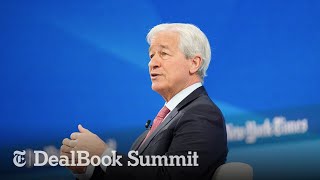 Jamie Dimon on Global Risk: War, China, and Inflation2023 · 33 min · full transcriptBest for understanding why he thinks government must take geopolitical risk and national preparedness more seriously.
 Jamie Dimon on Recession Risk: Geopolitics, Rates, and Banking2023 · 68 min · full transcriptBest for his mix of domestic growth priorities, criticism of bad regulation, and emphasis on work.
Questions people ask
- What did Jamie Dimon say about America First and America Alone?
- What did Jamie Dimon say about America’s economic strengths?
- What did Jamie Dimon say is the biggest domestic risk to America?
- What did Jamie Dimon say about local communities and democracy in America?
- What did Jamie Dimon say about media and public policy?
- What did Jamie Dimon say about regulation and cyber risk?
Sources
Every quote above, word for word from the transcripts. Numbers match the text.
“America has the best hand ever dealt of any country on this planet today, ever.”
“Good shape. We have all the food, Warner, an energy we need, the Atlantic and the Pacific, wonderful neighbors in Canada, Mexico, and these things were given us by God. Then we have the things we're given to us by the Enlightenment and our founding fathers, you know, which is the free enterprise, freedom of religion, freedom of speech. If you're democrat, repeat freedom of enterprise, surprise. But those things led to the most dynamic and prosperous economy the world's ever seen, the wisest, deepest, most transparent financial markets, universities, schools, unbelievable innovation, and if you made a very low corruption, a very strong rule of law, though that's getting weaker these days too. If you made that list and go around the world, Turkey, Brazil, China, Russia, India, they don't have that. They sure would break; they would give an arm and a leg to other kinds of stuff. So.”
“Did America have failures? Absolutely. Should we look at that and tear down with this unbelievable country done? Absolutely not, so the real risk is our heart, our soul, our grit, our courage. That is the actual real risk because that will drive the economy. America's military strength is predicated upon America's economic strength, our economic strength is predicated in keeping this wonderful system going, fixing it where it did something wrong, but there's too much today, like just tearing it down. It quite bothers me that we don't celebrate the values of virtues, particularly in this 250th year of the anniversary. So yeah, I am worried about that. It is a troubled time, but we're gonna get through this too.”
“I would make work great again.”
“One of the great benefits, particularly off the beaten path, is democracy works. And that local communities, all these cities, the mayor, the governor, business, not for profits, university - they're all working together to build the river walk, bring in jobs, teach the kids what they need to do for that local business. And that works.”
“…this may be the most dangerous time. The world has seen in decades…”
“Those tectonic plates, they're still shifting, they're still moving, they're still the most important things that are taking place in the world.”
“We better have the best military in the world Bar None.”
“We must maintain the strongest military in the world.”
“We don't win from a position of weakness.”
“America First is OK, but not America Alone.”
“It's still a haven because of that strength, the rule of law, the strength of America's economy, innovation, the growth, the United States military, which not just protects America, it protects a good part of the western world. So it's still very strong. But yes, a lot of this uncertainty is challenging that a little bit. So you're going to be reading about this non-stop until, hopefully, these tariffs and trade wars settle down and go away, so people can say, I can rely on America. So I wrote... in my letter, I wrote America First is OK, but not America Alone. And so if you talk about... and again, I'm not worried about the markets as much as I am about keeping the western world together, free and safe for democracy. And that, to me, means you want to strengthen the economic relationships. If there's unfairness, deal with it. But yeah, we should be careful.”
“I'm not afraid of China.”
“I think China and America should engage.”
“I don't think we have any engagement right now, and so - but that can start tomorrow.”
“The goal should be, in my view, to strengthen Europe and get them closer, not to get them weaker and get them further.”
“I would add to that the free Western world, 'cause that's what worries me the most…”
“The system is completely recovered, part that's Dodd-Frank.”
“The system has literally two and a half times capital…”
“What worked is the resolution, recovery, capital, liquidity. That was all good. Most, a lot of things in there had nothing to do with all that. Lehman Brothers simply wouldn't happen today. Too much capital, too much bail-in debt, too much liquidity, etc. Regulations have be calibrated. So the things that don't work is, you know, I mentioned yesterday we're going to have a trillion dollars of cash at one point unable to deploy to help clients because you're going to run into these red lines of various capital things, and my request is people should just thoughtfully look at the effect of these things and our regulatory system also made it very…”
“The biggest risk is to regulation.”
“Regulation. You know, the biggest risk is to regulation. The resources going into stupid stuff that should be going to cyber, privacy, AI, and, and, you know, we got eight thousand people read documenting forms from five years ago because the regular said we didn't cross the T and dot the I. We spent billions of dollars doing K White Way. I'm sure he's tortured you and KY, CAML, BSA. We haven't found one bad guy. Billions of dollars, billions. And of course, it's in his board time. It's, it's, it's computer time. It's regulatory time. It's brain time. That's the whole thing. And we—this is the one we should be worried about. So blockchain is real. Okay? Because it's a technology. It's not that complicated technology. It's, it's a ledger of data.”
“Hard for our regulators. So we talk about housing here. There are seven people with independent authority on mortgages, so it's almost impossible to change them in a way that would benefit America. And, you know, I wish one day we would fix that problem. We vulcanize the system. Thank you. Thanks, Mr. Dimon. Thank you, Senator Hassoff. Uh, anyone concludes hearing, anyone listening today heard a lot from you about the strength of your industry, how well capitalized your banks are, how well you weathered the pandemic, how well your—how well your depositors did, how generously your banks have changed your overdraft fee schedule. But let's be clear, you're well capitalized and you've thrived throughout the pandemic because of the capital requirements and safety and soundness measures you passed.”
“I look at business like I wear the damn Jersey.”
“This is my contribution to making it a better world is running a good JP Morgan Chase.”
“This is my contribution to making it a better world is running a good JP Morgan Chase. I tell people if I don't do a good job at JP Morgan Chase, I hurt the opportunities for our people. I hurt the opportunities for the 2,000 hamlets we do business in. We can't be philanthropic. We can't help people grow. And if I do a good job, we can do all those things. You know, I'm not an artist. I'm not a tennis player. I'm not a musician. I'm not a politician. This is my contribution.”
How this guide was made: drafted with AI from the full transcripts of the recordings cited, then checked: every quotation must match a transcript word for word and be the speaker's own words, and an independent review gates accuracy. Methodology and corrections.