Jamie Dimon on Risk
Jamie Dimon treats risk as something to understand, price, and survive, with special attention to fat-tail shocks, liquidity, and complacency.
- Risk management is not avoiding risk; it is understanding it, pricing it, and surviving bad outcomes.
- His core operating principle is a fortress balance sheet: strong capital, liquidity, and conservative discipline so the firm can keep serving clients in stress.
- He worries most about underpriced tail risks, especially geopolitics, debt, inflation, and cyber threats.
- He thinks many blowups come less from headline capital levels than from bad liquidity management, narrow stress tests, and weak supervision.
- He is optimistic about technology and AI, but insists that new tools bring uneven payoffs and serious new risks.
Risk is not something to eliminate; it is something to understand and survive
Dimon’s starting point is practical: every business takes risk, so the goal is not zero risk. The real job is to know what risks you are taking, price them correctly, and make sure the organization can live through a wide range of outcomes rather than optimizing for the best case.1
That is why he focuses so much on extreme scenarios. He repeatedly emphasizes fat tails: low-probability, high-damage events that many institutions treat as remote until they become existential. In his view, durable risk management begins by assuming that somewhere, sometime, the bad scenario does happen.2
This also explains his skepticism toward confident forecasting. He prefers preparation over prediction, arguing that leaders should stay humble about what they can know in advance and remain cautious about what comes next.3
The fortress balance sheet is his main defense against bad surprises
Dimon’s signature answer to risk is the fortress balance sheet. He treats balance-sheet strength not as a slogan but as an operating system: enough capital, enough liquidity, and enough conservatism that the firm can keep functioning when markets, depositors, or counterparties become unstable.45
In his framing, resilience matters because the institution’s purpose is to keep serving clients through stress, not just to post strong numbers in easy conditions. That is why he links risk discipline to client service and why he sees capital and liquidity as tools that make continuity possible when others have to pull back.46
He also argues that some post-crisis reforms were genuinely effective on these essentials. Resolution, recovery, capital, and liquidity are examples he points to as parts of the system that improved the odds that a large institution can absorb shocks without spreading panic.67
Liquidity problems can sink firms even when capital looks fine
A major theme in Dimon’s thinking is that apparent safety can be misleading. When rates rise or funding conditions change, hidden weaknesses get exposed quickly, and institutions that looked healthy under one regime can fail under another.8
That is why he distinguishes capital from liquidity. He argues that some banking failures were driven more by liquidity strain and interest-rate risk than by simple lack of capital, which means risk managers and regulators have to pay attention to how funding behaves under stress, not just to static ratios.9
He extends this criticism to supervision and testing. Narrow stress tests and bureaucratic checklists can produce false comfort if they miss the actual channel through which a bank can fail, and he has argued that some recent turmoil reflected a supervision problem as much as a regulation problem.10
The biggest risks are often outside finance
Dimon does not confine risk to bank balance sheets or market variables. He consistently points to geopolitics as the biggest area of concern, including war, nuclear proliferation, and broader threats to democratic stability. In his view, those risks can reset the whole economic environment and overwhelm normal business planning.1112
He also worries that markets and policymakers can become too casual about structurally dangerous issues such as deficits, inflation, and debt-related instability. His point is that leaders should not get distracted by small rate moves while ignoring the larger path of rates, inflation, and fiscal pressure.1314
At the societal level, he sees civic weakness itself as a risk factor. Economic resilience depends not only on policy and finance, but also on confidence, values, and the willingness to maintain the institutions that support growth and security.
Complacency is a recurring cause of failure
One of Dimon’s strongest warnings is against complacency. He believes organizations get into trouble when they assume the environment is stable, trust their models too much, or stop looking honestly at what is changing around them.1718
This is why he favors broad situational awareness over narrow optimization. Panic can spread quickly once confidence breaks, so the better strategy is to prepare early, communicate clearly, and avoid structures that only work if conditions remain benign.19
His broader leadership lesson is that arrogance and bureaucracy are themselves risk multipliers. Companies fail not only because the external world changes, but because internal habits make them slow to notice, slow to adapt, and too sure of their own safety.18
He is optimistic about technology, but only with risk discipline
Dimon is not a pessimist about risk. He is often strongly optimistic about technology and sees AI as a major force for productivity, innovation, and even saving lives over time.202122
But his optimism is paired with caution about timing, execution, and second-order effects. He expects AI to create large total value while producing uneven winners, messy investment cycles, and outcomes that do not follow the timetable people expect.232425
He also singles out cyber as the biggest near-term AI-related danger. That fits his larger framework: embrace tools with long-run upside, but identify the channel through which they can do the most damage and prepare for that first.26
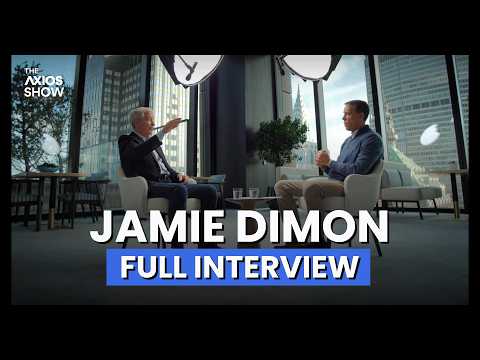
“Our biggest risk here is cyber.”Axios Show interview, 2024 · full transcript →
Dimon on risk, in his own words
“Our biggest risk here is cyber.”
Where to watch
 Jamie Dimon on Risk Management: Build the Fortress Balance Sheet2015 · 66 min · full transcriptBest single explanation of his risk philosophy: price risk properly, plan for fat tails, and build the fortress balance sheet.
 Jamie Dimon on Bank Regulation: Risk, Capital, and Resilience2017 · 56 min · full transcriptShows how he thinks failures really happen: liquidity strain, rate risk, and weak supervision rather than simplistic capital narratives.
 Jamie Dimon on Economy, AI & Risk: Bonds, Geopolitics and Leadership2024 · 61 min · full transcriptBest overview of the macro risks he thinks markets may be underpricing, from geopolitics to inflation to long bonds.
 Jamie Dimon on America’s Future: AI, Risk, and Renewal2024 · 40 min · full transcriptUseful for his broader view that national, civic, AI, and cyber risks matter as much as financial ones.
 Jamie Dimon on Banking Turmoil: First Republic, Regulation, and Debt Ceiling2022 · 18 min · full transcriptA concise look at his views on panic, supervision, and why stress episodes can spread even when they are not 2008-style crises.
Questions people ask
- What did Jamie Dimon say about JPMorgan Chase’s strategy?
- What did Jamie Dimon say about forecasting and humility?
- What did Jamie Dimon say about the return on AI investment?
- What did Jamie Dimon say is the biggest domestic risk to America?
- What does Jamie Dimon say causes companies to fail?
- What did Jamie Dimon say about regulation and cyber risk?
Sources
Every quote above, word for word from the transcripts. Numbers match the text.
“Risk conscious does not mean getting rid of risk.”
“I always look what I call the fat tails and manage that we can handle all the, all the fat tails.”
“People prepare for possibilities and probabilities, not calling one course of action since I've never seen anyone call it. I want to point out the central banks 18 months ago were 100% dead wrong. Okay? So maybe there should be humility about financial forecasting. I—I would be quite cautious about what might happen next year.”
“The fortress balance sheet is that you run a company serving clients well.”
“A lot of our middle market clients use investment banking products. A lot of our consumer clients use some FX. So, all of our businesses feed each other. There's no extraneous. We got rid of everything that didn't fit a strategy. And then you start building client businesses and client services, fortress balance sheet, fortress accounting, all those various things.”
“What worked is the resolution, recovery, capital, liquidity.”
“What worked is the resolution, recovery, capital, liquidity. That was all good. Most, a lot of things in there had nothing to do with all that. Lehman Brothers simply wouldn't happen today. Too much capital, too much bail-in debt, too much liquidity, etc. Regulations have be calibrated. So the things that don't work is, you know, I mentioned yesterday we're going to have a trillion dollars of cash at one point unable to deploy to help clients because you're going to run into these red lines of various capital things, and my request is people should just thoughtfully look at the effect of these things and our regulatory system also made it very…”
“…when the tide goes out, you see he was swimming naked.”
“It was more about liquidity than it was about capital.”
“…this is not a regulation problem, it's a supervision problem…”
“I just would put on your table the most serious thing facing mankind is nuclear proliferation.”
“We need to keep the world free and safe for democracy.”
“I don't think it makes a piece of difference whether a rate goes up 25 basis points or more.”
“…the debt thing is potentially catastrophic…”
“I think you—you'd be foolish not to look at some of these things taking place today…”
“And if you're not, you're not going to do well. And if you look at the failure of companies, it's often complacence, arrogance, bureaucracy. You think you're so good that you forget to actually look at what's happening out there. So, to me, we've always used technology to make it better, make things better, faster, quicker, cheaper for clients. That technology was digital. We've always been big analytics. We started using... and then AI was, I think 12 years ago, we started using it. Again, it's all about what works for the client? How can you make it work better for your banker or for your employee to do something better for a client? So that should be a constant state of affairs at a company.”
“…panic is the one thing that scares people…”
“I am powerfully optimistic about how technology is going to be rapidly shape our world.”
“AI, I think it's gonna, again, in context, it's gonna save lives.”
“I think it is as real as the Internet, electricity, the steam engine, the tractor.”
“Will it in total pay off? Probably, just like the internet did.”
“Will it pay off the way you expect on the time table you expect? Definitely not.”
“When I look at AI itself, the amount of money being spent is huge. Will it in total pay off? Probably, just like the internet did. Will it pay off the way you expect on the time table you expect? Definitely not. And you remember so we had Yahoo and now Netscape and all these companies that went bankrupt, but Google made it. You know, Facebook made it like and these are big powerful companies. And then there all these ancillary benefits from the internet like your iPhones and your things like that. So yes, it it is a powerful tool that will create a huge…”
“Our biggest risk here is cyber.”
How this guide was made: drafted with AI from the full transcripts of the recordings cited, then checked: every quotation must match a transcript word for word and be the speaker's own words, and an independent review gates accuracy. Methodology and corrections.


