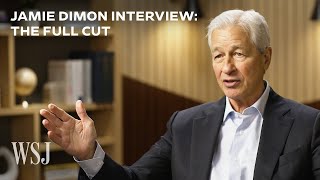
Jamie Dimon on Regulation
Jamie Dimon supports tougher post-crisis safeguards when they make the system safer, but argues regulation should be simpler, better calibrated, and paired with stronger supervision so banks can keep serving the economy effectively.
- He says core post-crisis reforms on capital, liquidity, resolution, and recovery made banking safer.
- He argues many rules are badly calibrated and can trap capital and liquidity instead of helping clients and growth.
- He thinks recent bank failures exposed supervision and risk-management weaknesses more than a simple lack of capital.
- He believes regulatory complexity and overlapping agencies create bureaucracy, especially in areas like housing and mortgages.
- He worries excessive compliance work diverts talent and money from more important risks like cyber, privacy, and AI.

“Hard for our regulators. So we talk about housing here. There are seven people with independent authority on mortgages, so it's almost impossible to change them in a way that would benefit America. And, you know, I wish one day we would fix that problem. We vulcanize the system. Thank you. Thanks, Mr. Dimon. Thank you, Senator Hassoff. Uh, anyone concludes hearing, anyone listening today heard a lot from you about the strength of your industry, how well capitalized your banks are, how well you weathered the pandemic, how well your—how well your depositors did, how generously your banks have changed your overdraft fee schedule. But let's be clear, you're well capitalized and you've thrived throughout the pandemic because of the capital requirements and safety and soundness measures you passed.”Senate Banking Committee hearing, September 2022 · 2:45:38
He believes the best bank regulation after 2008 actually worked
Dimon’s starting point is not anti-regulation. He says the strongest parts of the post-crisis framework made the banking system materially safer, especially rules around resolution, recovery, capital, and liquidity. In his view, those changes are a major reason a Lehman-style collapse is far less likely today.123
That matters because his criticism of regulation comes from a pro-stability position. He is not arguing for weaker banks; he is arguing that the system should preserve the reforms that improved resilience and market confidence.23
His main complaint is not regulation itself, but bad calibration
Dimon repeatedly argues that regulation should be calibrated to real-world effects. His concern is that once good safeguards are in place, additional layers can start blocking banks from using balance-sheet capacity to support customers, markets, and the economy.3
He describes cases where banks can end up holding very large amounts of cash or capital that cannot be deployed because of hard regulatory thresholds. His broader point is that policy should be judged by whether it improves safety without unnecessarily reducing lending, market-making, and client service.34
This is why he frames good policy as unusually high-value: better rules can strengthen safety and growth at the same time, while bad rules impose costs without delivering much public benefit.4
He thinks recent bank failures were more about supervision and liquidity than capital
Dimon’s view of banking stress is that regulators and bankers can miss the wrong risks if they focus too narrowly on formal ratios. He argues that some recent failures were driven more by interest-rate exposure, liquidity fragility, and weak risk management than by a simple shortage of capital.5
He is especially skeptical of systems that create false comfort. If stress tests or rulebooks check boxes but fail to capture how deposits run, how bond portfolios reprice, or how panic spreads, then the framework looks tougher on paper than it is in practice.67
That is why he draws a distinction between regulation and supervision. Writing more rules is not enough if examiners and firms are not identifying practical vulnerabilities in time.65
He sees complexity and overlap as a serious policy failure
Dimon argues that parts of the U.S. regulatory structure have become too fragmented to fix problems efficiently. He points to housing and mortgages as a clear example, where too many officials and agencies have overlapping authority, making reform extremely difficult.9
His concern is not just inconvenience. When authority is scattered, accountability weakens, reform slows, and rules can harden into a system that is costly but not especially effective.9
This helps explain why he often criticizes bureaucracy more than the goal of regulation itself. He appears to prefer fewer, clearer, more coherent rules over a sprawling framework with duplicative oversight.9
“Hard for our regulators. So we talk about housing here. There are seven people with independent authority on mortgages, so it's almost impossible to change them in a way that would benefit America. And, you know, I wish one day we would fix that problem. We vulcanize the system. Thank you. Thanks, Mr. Dimon. Thank you, Senator Hassoff. Uh, anyone concludes hearing, anyone listening today heard a lot from you about the strength of your industry, how well capitalized your banks are, how well you weathered the pandemic, how well your—how well your depositors did, how generously your banks have changed your overdraft fee schedule. But let's be clear, you're well capitalized and you've thrived throughout the pandemic because of the capital requirements and safety and soundness measures you passed.”Senate Banking Committee hearing, September 2022 · full transcript →
He believes overregulation can drain resources from the risks that matter most
Dimon warns that large organizations can end up spending enormous amounts of money, technology time, management attention, and board attention on compliance tasks with limited payoff. He argues this is especially harmful when those same resources are needed for cyber defense, privacy, AI, and other fast-moving risks.11
His management philosophy reinforces this point. He emphasizes facts, detail, speed, and cutting bureaucracy, which fits his broader argument that regulation should focus institutions on real risks instead of procedural box-checking.
In practical terms, his view is that an overloaded rulebook can make the system feel stricter while actually making it less adaptive. If talent is tied up documenting old forms and satisfying low-value process demands, it is not fully available to manage emerging threats.11

“Regulation. You know, the biggest risk is to regulation. The resources going into stupid stuff that should be going to cyber, privacy, AI, and, and, you know, we got eight thousand people read documenting forms from five years ago because the regular said we didn't cross the T and dot the I. We spent billions of dollars doing K White Way. I'm sure he's tortured you and KY, CAML, BSA. We haven't found one bad guy. Billions of dollars, billions. And of course, it's in his board time. It's, it's, it's computer time. It's regulatory time. It's brain time. That's the whole thing. And we—this is the one we should be worried about. So blockchain is real. Okay? Because it's a technology. It's not that complicated technology. It's, it's a ledger of data.”Aspen Institute conversation, 2023 · full transcript →
For consumers and the economy, he wants protection without freezing opportunity
Dimon’s regulatory view extends beyond banks’ balance sheets. He argues that overregulation can slow growth, reduce lending, make housing harder to finance, and ultimately hurt lower-income Americans the most when access to credit and opportunity gets constrained.49
At the same time, he does not reject consumer protection. On data sharing, for example, he supports the idea that customers should control their own data, while insisting rules should give people meaningful choice rather than broad, open-ended access.13
So his practical standard is balance: strong safeguards, clear customer protections, and a system that still allows banks to serve clients, support growth, and respond to new risks.1334

“Open banking, no one we have never been against open banking, I believe you own your data. And if you tell us to give your data to someone, I'm totally fine with that. What happened, what these guys want, is access to your data, okay, and all of it. So I want to give you the choice, say, I want to give them this data, but not that data. I want this but not that, I want it to last for six weeks. For example, some of these companies took your data, you signed up to. Raise your hands, be honest. How many of you do any of these outside parties that take money from your bank account? Just raise your hands. In a lot of those cases, you signed up years ago, they're still taking your data.”Stanford Graduate School of Business talk, 2017 · full transcript →
Dimon on regulation, in his own words
“Regulation. You know, the biggest risk is to regulation. The resources going into stupid stuff that should be going to cyber, privacy, AI, and, and, you know, we got eight thousand people read documenting forms from five years ago because the regular said we didn't cross the T and dot the I. We spent billions of dollars doing K White Way. I'm sure he's tortured you and KY, CAML, BSA. We haven't found one bad guy. Billions of dollars, billions. And of course, it's in his board time. It's, it's, it's computer time. It's regulatory time. It's brain time. That's the whole thing. And we—this is the one we should be worried about. So blockchain is real. Okay? Because it's a technology. It's not that complicated technology. It's, it's a ledger of data.”
Where to watch
 Jamie Dimon on Bank Regulation: Capital, Liquidity, and Overdraft Fees2022 · 168 min · full transcriptBest single discussion of what Dimon thinks Dodd-Frank got right, what is poorly calibrated, and how capital and liquidity rules affect lending.
 Jamie Dimon on Bank Regulation: Risk, Capital, and Resilience2017 · 56 min · full transcriptBest for his argument that recent bank stress was more about liquidity, rates, and risk management than simply capital.
 Jamie Dimon on Banking Turmoil: First Republic, Regulation, and Debt Ceiling2022 · 18 min · full transcriptBest short explanation of his distinction between supervision problems and regulation problems during the banking turmoil.
 Jamie Dimon on Economy and Banking: Dodd-Frank, Brexit, Leadership2017 · 24 min · full transcriptUseful for his concise defense of the parts of Dodd-Frank that helped the banking system recover.
 Jamie Dimon on Banking and Policy: Growth, Risk, and Resilience2021 · 32 min · full transcriptBest for the wider economic case that overregulation hurts growth, execution, and opportunity.
Questions people ask
- What did Jamie Dimon say about open banking and customer data?
- What did Jamie Dimon say worked in Dodd-Frank and what still needs fixing?
- What does Jamie Dimon think great management requires?
- What did Jamie Dimon say about regulation and cyber risk?
- What did Jamie Dimon say about too many regulators and overlapping authority?
Sources
Every quote above, word for word from the transcripts. Numbers match the text.
“The system is completely recovered, part that's Dodd-Frank.”
“What worked is the resolution, recovery, capital, liquidity.”
“What worked is the resolution, recovery, capital, liquidity. That was all good. Most, a lot of things in there had nothing to do with all that. Lehman Brothers simply wouldn't happen today. Too much capital, too much bail-in debt, too much liquidity, etc. Regulations have be calibrated. So the things that don't work is, you know, I mentioned yesterday we're going to have a trillion dollars of cash at one point unable to deploy to help clients because you're going to run into these red lines of various capital things, and my request is people should just thoughtfully look at the effect of these things and our regulatory system also made it very…”
“Good policy is free for God's sakes.”
“It was more about liquidity than it was about capital.”
“…this is not a regulation problem, it's a supervision problem…”
“…panic is the one thing that scares people…”
“Hard for our regulators. So we talk about housing here. There are seven people with independent authority on mortgages, so it's almost impossible to change them in a way that would benefit America. And, you know, I wish one day we would fix that problem. We vulcanize the system. Thank you. Thanks, Mr. Dimon. Thank you, Senator Hassoff. Uh, anyone concludes hearing, anyone listening today heard a lot from you about the strength of your industry, how well capitalized your banks are, how well you weathered the pandemic, how well your—how well your depositors did, how generously your banks have changed your overdraft fee schedule. But let's be clear, you're well capitalized and you've thrived throughout the pandemic because of the capital requirements and safety and soundness measures you passed.”
“Regulation. You know, the biggest risk is to regulation. The resources going into stupid stuff that should be going to cyber, privacy, AI, and, and, you know, we got eight thousand people read documenting forms from five years ago because the regular said we didn't cross the T and dot the I. We spent billions of dollars doing K White Way. I'm sure he's tortured you and KY, CAML, BSA. We haven't found one bad guy. Billions of dollars, billions. And of course, it's in his board time. It's, it's, it's computer time. It's regulatory time. It's brain time. That's the whole thing. And we—this is the one we should be worried about. So blockchain is real. Okay? Because it's a technology. It's not that complicated technology. It's, it's a ledger of data.”
“Open banking, no one we have never been against open banking, I believe you own your data. And if you tell us to give your data to someone, I'm totally fine with that. What happened, what these guys want, is access to your data, okay, and all of it. So I want to give you the choice, say, I want to give them this data, but not that data. I want this but not that, I want it to last for six weeks. For example, some of these companies took your data, you signed up to. Raise your hands, be honest. How many of you do any of these outside parties that take money from your bank account? Just raise your hands. In a lot of those cases, you signed up years ago, they're still taking your data.”
How this guide was made: drafted with AI from the full transcripts of the recordings cited, then checked: every quotation must match a transcript word for word and be the speaker's own words, and an independent review gates accuracy. Methodology and corrections.