Demis Hassabis on DeepMind
Demis Hassabis sees DeepMind as a long-term effort to build general intelligence and turn it into a tool for scientific discovery, human progress, and careful real-world impact.
- DeepMind’s core mission is to build AGI, then use it to solve major problems in science and society.
- Hassabis thinks intelligence should be general, flexible, and adaptive across many tasks, not a narrow system for one benchmark.
- DeepMind uses learning systems, especially reinforcement learning in games and other environments, because they can discover strategies rather than follow hand-coded rules.
- The point of DeepMind is not only economic value but accelerating discovery in biology, medicine, climate, and other hard domains.
- He believes progress toward AGI must be paired with serious work on safety, incentives, and responsible deployment.

“Step one, fundamentally solve intelligence, and then we feel if we were to do that then step two would naturally follow, use it to solve everything else.”Royal Society lecture, October 2016 · 8:04
DeepMind began with a two-step mission: build AGI, then apply it broadly
Hassabis describes DeepMind’s founding idea in remarkably consistent terms over many years: first build general intelligence, then use it to help solve the world’s hardest problems. For him, DeepMind is not just an AI company chasing products or benchmarks. It is a focused attempt to understand intelligence deeply enough to engineer it, and then turn that capability toward science, medicine, and other high-impact fields.123456
That mission explains why DeepMind’s ambitions were always larger than a single application. Hassabis ties the value of AGI to its breadth: a truly general system would matter because it could transfer across domains and become a powerful tool for discovery. He also treats the mission as intellectual as well as practical, linking the project of building intelligence to understanding the mind itself.786
He often frames AI as a general-purpose technology with unusually wide downstream effects. In his view, DeepMind exists to push toward that general capability, not just to make one narrow system work a little better.91011
“Step one, fundamentally solve intelligence, and then we feel if we were to do that then step two would naturally follow, use it to solve everything else.”Royal Society lecture, October 2016 · full transcript →
His definition of intelligence is generality, not narrow excellence
A central part of Hassabis’s view is that intelligence should be judged by range. He repeatedly defines it in terms of doing well across many kinds of tasks, which is why DeepMind aims beyond specialist systems. A machine that dominates one game or one benchmark is interesting, but not enough.1213
That is also why he emphasizes flexibility and adaptation. The kind of AI DeepMind wants is one that can handle novelty, shift between problems, and keep learning rather than rely on brittle rules or handcrafted logic.141516
This perspective shapes how he talks about AGI today. He sees current frontier models as important parts of the final architecture, but still incomplete without capabilities like continual learning, memory, consistency, and long-term reasoning. And he thinks active agents matter because general intelligence must be able to pursue goals and solve problems, not only respond to prompts.1718

“…the ability to perform well across a wide range of tasks…”MIT CBMM talk, 2015 · full transcript →
DeepMind’s research philosophy is to build learning systems that discover for themselves
Hassabis consistently contrasts DeepMind’s approach with older rule-based AI. His view is that hand-coded systems break down in complex, changing environments, while learning systems can improve from experience and find solutions that designers did not explicitly specify.1516
This is why reinforcement learning became so central to DeepMind. The goal is to create agents that learn from observations, feedback, and interaction with an environment, rather than from a giant list of instructions. In Hassabis’s framing, that is closer to the nature of intelligence itself.191420
He uses DeepMind’s early game work as proof of this philosophy. The key breakthrough was not just high performance, but the fact that systems discovered new strategies that even their creators had not anticipated. That is one reason AlphaGo mattered so much to him: it showed that a learning system could produce novel and effective ideas, not merely imitate existing ones.2122
“That was, for us, really our first big 'aha' moment, watershed moment, at DeepMind. This is now from four or five years ago. We realised we were onto something with these kinds of techniques. It was able to discover something new that even the programmers and the brilliant researchers of that system did not know how to do. We hadn't thought about that solution to the game. More recently, a couple of years ago, we started work on what is probably still our most famous program, a program called AlphaGo. AlphaGo was a system to play the ancient Chinese board game of Go. This is what Go looks like, for those who don't know, and this is what they play in China and Korea and Japan instead of chess. Go is actually a very simple game. There are only two rules, basically, and I could teach you it in five minutes, but it takes at least a lifetime, some would say many lifetimes, to master the game.”Royal Society lecture, October 2016 · full transcript →
Games were DeepMind’s training ground because they make intelligence measurable
Hassabis’s attachment to games is not incidental; it is part of DeepMind’s design. He sees games as structured worlds with clear goals, feedback, and scalable difficulty, which makes them ideal testbeds for building general learning algorithms.2320
For DeepMind, games offered a way to study intelligence in grounded environments before moving into messier real-world domains. They let researchers measure progress precisely while still demanding planning, adaptation, and strategy. That is why systems such as Atari agents, AlphaGo, AlphaZero, and later lines of work became foundational rather than side projects.2421
This logic extends into Hassabis’s newer emphasis on agents and world models. He increasingly points toward systems that can act in environments, use tools, reason over time, and understand the physical world. In that sense, games were never the destination; they were a disciplined path toward more general intelligence.172526

“…the goal is to maximize the score…”Cheltenham Science Festival talk, 2018 · full transcript →
The real purpose of DeepMind is scientific discovery at scale
Hassabis’s deepest motivation for DeepMind is that AI can become a scientific instrument. He returns again and again to the idea that building AGI matters because it could accelerate discovery in biology, medicine, climate, energy, and mathematics.27282930
That is why he treats successes like AlphaGo and AlphaFold as more than technical demonstrations. AlphaGo helped show that AI could generate original strategies, while AlphaFold showed that these methods could be redirected toward foundational scientific problems with huge downstream consequences. In his view, this is the clearest sign that DeepMind’s original mission can cash out in the real world.12122
He also speaks about AI as a technology that could reshape the pace of human progress. The strongest version of the DeepMind vision is not automation for its own sake, but a world where AI amplifies human thinking and opens a new period of discovery.31301032
DeepMind’s culture aims to combine scientific ambition, startup speed, and caution
Hassabis presents DeepMind as a place built for unusually ambitious science. He has said the project required gathering exceptional people and pursuing a mission bold enough that many outsiders initially found it confusing. That ambition is paired with a view of the company as a vehicle for science first, entrepreneurship second.3385
He also describes DeepMind as combining the strengths of an academic lab and a startup: rigorous ideas, long time horizons, and fast execution. More recently, he has described the organization as central to Google and Alphabet, which reflects how he sees DeepMind maturing from an independent lab into a broader engine for real-world AI systems.343510
At the same time, he is clear that capability alone is not enough. He worries about race dynamics, misaligned incentives, and the need for technical safety work and responsible boundaries around applications. In his view, building DeepMind well means advancing quickly without treating speed as the only value.36373839

“I’m an entrepreneur second, I’m a scientist first. It’s just that this was the right vehicle to make this happen, and it seems to have born out, but if I could have made it happen in academia, I would have just done it in academia, it just wasn’t possible under the constraints academia has. And that’s why we also sold the company to Google because it was about what accelerates the mission and the science, and ultimately that’s what I want to do with my life is I want to understand what’s going on here in the universe. Both inside here in the brain and externally out there in the universe. And I guess that’s what’s always driven me is this deep desire to understand what seems to me to be an incredibly interesting and fascinating mysteries that are going all around us and I don’t really understand why more people don’t think about that all the time - I can barely sleep because I’m just fascinated and also troubled by the things around us that we seemingly don’t understand - all the big questions, you know the meaning of life - how did the universe start, what is consciousness, all these questions, which I feel like a blaring klaxon in my mind that I would like to understand and my attempt at doing that is to build AI first.”DeepMind podcast interview, 2019 · full transcript →
Hassabis on deepmind, in his own words
“What we mean by 'solve intelligence' is actually, to just unpack that slightly, to fundamentally understand this phenomenon of intelligence, what it is.”
“…the hallmark of this kind of AI is that it's flexible and adaptive…”
“AI to accelerate scientific discovery and help with things like human health is the reason I spent my whole career on AI.”
“…we're about to enter a new golden age of, of discovery helped by and powered by AI tools…”
Where to watch
 Demis Hassabis on Frontier AI: AGI, science, and society2024 · 57 min · full transcriptBest overview of why DeepMind exists, how the mission evolved, and why Hassabis ties AGI to science and society.
 Demis Hassabis on AI for Scientific Discovery: From Games to Science2016 · 84 min · full transcriptStrongest single explanation of DeepMind’s mission and the technical path from games to scientific discovery.
 Demis Hassabis on General Artificial Intelligence: DeepMind and AlphaGo2015 · 68 min · full transcriptBest for understanding Hassabis’s definition of intelligence and DeepMind’s early AGI research philosophy.
 Demis Hassabis on Agents and AGI: What’s Missing for General Intelligence2023 · 41 min · full transcriptBest for his current view on agents, what today’s models still lack, and where DeepMind thinks AGI is headed.
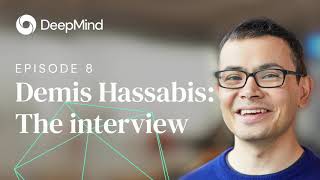 Demis Hassabis on Artificial General Intelligence: Building It Safely2019 · 37 min · full transcriptUseful for DeepMind’s culture, safety mindset, and Hassabis’s long-term conception of AGI.
 Demis Hassabis on AI for Scientific Discovery: From Games to Proteins2021 · 93 min · full transcriptBest if you want the bridge from DeepMind’s game systems to AlphaFold and scientific discovery.
Questions people ask
- How does Demis Hassabis think AI benefits should be distributed around the world?
- How will Demis Hassabis know when AGI has been achieved?
- What did Demis Hassabis say AGI is?
- What did Demis Hassabis say about AGI safety and bad actors?
- What does Demis Hassabis think should be done about AI regulation and the race between labs?
- Why does Demis Hassabis think AGI should be built in a research-facility model rather than a race between companies?
Sources
Every quote above, word for word from the transcripts. Numbers match the text.
“…step one, solve intelligence, step two, use it to solve everything else…”
“Step one, fundamentally solve intelligence, and then we feel if we were to do that then step two would naturally follow, use it to solve everything else.”
“What we mean by 'solve intelligence' is actually, to just unpack that slightly, to fundamentally understand this phenomenon of intelligence, what it is.”
“Step one, solve intelligence; step two, use it to solve everything else.”
“Well, the broad arcs of it have gone. I mean, unbelievably well, perhaps. You know, when we started DeepMind in 2010, that's... Can you imagine we used to go to, try to go to VCs in the UK, which there weren't very many, and with that as the business plan. It was literally step one, solve intelligence, step two, use it to solve everything else, and people were quite confused. But we really meant it, and- Actually, we may go back to exactly using that mission statement because, so by solve intelligence, we meant build AGI. Ideally, also understand the nature of intelligence on the way to building AGI and perhaps using AGI to help that, Help us understand our own brains and minds better.”
“DeepMind started with the idea and still continues now as Google DeepMind with, we want to build AGI, right? That's the aim. This general system that can exhibit all the cognitive capabilities humans can, and that's important because of all the things we've just discussed. That's the only way, obviously, you would have massive economic value, but actually that's not the interesting thing about it from my perspective. It's more from a theoretical standpoint. That's when we would know we would have a fully general system, right? At least an approximation to it if it can do things the human mind can do because, as far as we know, you know, we're this generalized intelligence.”
“One of my dreams as well is to try and better understand our own human minds.”
“I’m an entrepreneur second, I’m a scientist first. It’s just that this was the right vehicle to make this happen, and it seems to have born out, but if I could have made it happen in academia, I would have just done it in academia, it just wasn’t possible under the constraints academia has. And that’s why we also sold the company to Google because it was about what accelerates the mission and the science, and ultimately that’s what I want to do with my life is I want to understand what’s going on here in the universe. Both inside here in the brain and externally out there in the universe. And I guess that’s what’s always driven me is this deep desire to understand what seems to me to be an incredibly interesting and fascinating mysteries that are going all around us and I don’t really understand why more people don’t think about that all the time - I can barely sleep because I’m just fascinated and also troubled by the things around us that we seemingly don’t understand - all the big questions, you know the meaning of life - how did the universe start, what is consciousness, all these questions, which I feel like a blaring klaxon in my mind that I would like to understand and my attempt at doing that is to build AI first.”
“It's a dual purpose technology…”
“AI is gonna be, and already is one of the most transformative technologies maybe humanity will ever invent.”
“AI holds, you know, enormous promise for the future…”
“…the ability to perform well across a wide range of tasks…”
“Yeah, artificial - I mean there’s not an agreed definition of artificial general intelligence, but the way that Shane and I think about artificial general intelligence is a system that is capable of a wide range of tasks, and if we think about human level artificial general intelligence, then we’re talking about system that can pretty much do the full spectrum of cognitive tasks that humans can at least as good as humans are able to do, that’s you know one reasonable definition of artificial general intelligence.”
“…the hallmark of this kind of AI is that it's flexible and adaptive…”
“…we're actually solving a lot of problems now that couldn't have been solved with the rule-based systems…”
“…step one, solve intelligence; step two, use it to solve everything else.”
“So, agents are that path, and I think we're just getting going.”
“You have to have an active system, uh, that can actively solve problems for you to get to AGI.”
“AI is the science of making machines smart.”
“…the goal is to maximize the score…”
“That was, for us, really our first big 'aha' moment, watershed moment, at DeepMind. This is now from four or five years ago. We realised we were onto something with these kinds of techniques. It was able to discover something new that even the programmers and the brilliant researchers of that system did not know how to do. We hadn't thought about that solution to the game. More recently, a couple of years ago, we started work on what is probably still our most famous program, a program called AlphaGo. AlphaGo was a system to play the ancient Chinese board game of Go. This is what Go looks like, for those who don't know, and this is what they play in China and Korea and Japan instead of chess. Go is actually a very simple game. There are only two rules, basically, and I could teach you it in five minutes, but it takes at least a lifetime, some would say many lifetimes, to master the game.”
“The key thing about what AlphaGo did here is that it played this move, and the thing about Go is, in Asia, it's considered to be like an art form, but it's sort of objective art, because, you know, later on any one of us could come up with an original move. We could just play a random move, and it might be original, but the key thing is whether, did it make a difference and impact the game, the result of the game? That's what determines whether it's a beautiful and truly creative move. And in fact, move 37 did exactly that, because you'll see the two stones here that I've outlined in the bottom left, they're surrounded by white stones, so they're in big trouble, but later on, about 100 moves later on, the fighting that was going on in the bottom-left hand corner spilled out into the centre of the board, ran all the way across the board, and those two stones down the bottom left ended up joining up with that move 37 stone, and that move 37 stone was in exactly the right place to decide that whole battle, which ended up winning AlphaGo that game.”
“…games is the common thread running through my life…”
“You can think of it as like an Apollo Programme effort for AI.”
“I think this year, with the way that agents are working and tool use, it started to become really useful…”
“This model is reverse engineering intuitive physics.”
“I always thought AI would be the ultimate tool for science.”
“AI to accelerate scientific discovery and help with things like human health is the reason I spent my whole career on AI.”
“I think ultimately, you know, it could be the best tool ever for accelerating scientific discovery.”
“…we're about to enter a new golden age of, of discovery helped by and powered by AI tools…”
“I see the computer as an extension of our minds…”
“And I would be quite pessimistic about some of the problems we are facing as a society, like climate change and sustainability or inequality. I think these are going to get exacerbated in the next few years. And I’d be pessimistic about our ability to solve that if there wasn’t something like AI on the way, in the near future. I think in order to solve some of these big problems, challenges society has, we either need an exponential improvement in human behaviour, more cooperation, less selfishness, more collaboration, or we need an exponential improvement in technology, and unfortunately the way politics is going right now, I don't really see much evidence of the former and um you know we don’t seem to be able to get our act together globally to do something about climate anywhere near fast enough to deal with the problem and so I think we have to double down on a technical solution.”
“…what if we really went at this and put some of the brightest minds in the world together…”
“…the brain is the only existence proof we have in the universe that intelligence is possible…”
“…we're the engine room of the whole of Google and the whole of Alphabet…”
“We’re cognisant of some of the technical questions around AGI - making sure that they do exactly what we want, how do we programme in our values, how do we specify our goals? So these are all the theoretical and technical questions around AGI that people like Nick Bostrom are worried about, and so we and Shane leads our safety team that works on a lot of these questions from a research and technical perspective, and I think there’s a lot more work that needs to be done there. And I think that’s what we’re going to see over the next decade or two.”
“The problem is we're in a kind of prisoner's dilemma where, By definition, if you take more time to release something or make something safer, that's harder than just putting it out there and and letting it see what happens. So a defector has some advantage. This is the classic problem with the race to the bottom dynamic, And we've got to change that somehow, and I think urgently. And I think part of that is some form of government involvement. The hard part there, of course, is that anything to do with regulation, it's too slow. Like, this is every week there's something new. If we were to regulate something two years ago, it'd be just like, it's like ancient history now.”
“I was very worried about—15 years ago, 10 years ago, about this race dynamic happening as more and more people, more and more companies, more and more ambitious tech leaders realized what I had known for 20-plus years of how important this technology was going to be. And we talked about some of this in the room about the dangers of this kind of race dynamic. And unfortunately, we've ended up, because of the way the technology's gone, so. If I could have waved the magic wand, what I would have done was build AGI, the general technology, more in a research facility, perhaps like a CERN, maybe all the best minds helping critique each other's ideas and making sure we were rigorous with the scientific method and the testing of it and understanding each step that we took.”
“I think there are ways of minimising that. I think we’ll have to think carefully about that. Like, at the moment, we are at the stage where these systems are still quite nascent. They can do impressive things like play Go, but they are not yet properly general purpose, or, you know, you couldn’t use them for anything very dangerous or in the real world. So, we’ve committed that we won’t do certain applications, you know, obviously like things like military and surveillance, so which we think would be bad for society. We don’t think AI should be applied to those things, and we certainly wouldn’t do it ourselves. But if you publish some great algorithms, you have to think about the indirect impact of that if other people - bad actors and so on around the world - potentially use your algorithms for things that you would not have agreed with. We have to use this time now to think about what principles need to be put in place, whether that’s carefully thought out regulation, whether that is technical solutions to these problems, mathematical proofs, more engineering solutions. So, like one of the projects we have here, we call it the Virtual Brain Analytics Project and it’s inspired by what we do in neuroscience with FMRI machines to brain scan people while they’re doing tasks to see what parts of the brain light up, so we can understand what the brain is doing better. And we should be doing the equivalent of that with our virtual brains, our artificial neural networks. So, I think there’s both sort of behavioural, there’s experimental understanding and then there’s mathematical understanding of these systems, and we should do all of those. And what I’m hoping is that we will eventually, in the next few years, have a much better understanding of these systems than we have today, and we may even have some mathematical proofs about…”
How this guide was made: drafted with AI from the full transcripts of the recordings cited, then checked: every quotation must match a transcript word for word and be the speaker's own words, and an independent review gates accuracy. Methodology and corrections.


