Demis Hassabis on AlphaFold
Demis Hassabis sees AlphaFold as proof that general AI can become a practical scientific tool by finding useful structure in biology at enormous scale.
- AlphaFold was a test of Hassabis’s broader mission: build general AI, then apply it to major scientific problems.
- He chose protein folding because it is a foundational biology problem with huge downstream value, a clear objective, lots of data, and a massive search space.
- Hassabis thinks biology is especially suited to AI because living systems are rich, complex information-processing systems that learning algorithms can model well.
- For him, AlphaFold matters not just because it is accurate, but because it is fast and broadly usable, turning protein structure prediction into a practical resource for scientists worldwide.
- He treats AlphaFold as evidence that AI can help scientists discover patterns, generate hypotheses, and accelerate a wider scientific golden age.

AlphaFold fits Hassabis’s original AI mission
Hassabis presents AlphaFold as part of a much larger plan, not as a one-off biology project. His long-term goal was to build general intelligence and then use it on important real-world problems, especially in science1234.
That is why he often links AlphaFold back to DeepMind’s earliest purpose. In his telling, games were the proving ground, but the destination was always scientific discovery, with biology as one of the first places where a sufficiently capable learning system could be genuinely useful56.
He picked protein folding because it is a root problem in biology
Hassabis emphasizes that AlphaFold targeted a foundational problem rather than a narrow application. He describes this kind of target as a root-note problem: solve something central, and many downstream advances become easier8.
Protein folding fit his criteria well. Across his talks, he explains that AI works especially well when a domain has large search spaces, good data, and clear ways to evaluate progress, and protein structure prediction had those properties along with enormous scientific value.
This is also why AlphaFold became such a strong demonstration case for AI in science. It was hard enough to matter, measurable enough to train against, and broad enough that success would benefit many parts of biology and medicine rather than just one niche task.
“We call them kind of root note problems…”SXSW lecture, 2024 · full transcript →
Hassabis thinks biology is unusually well matched to AI
A central idea in Hassabis’s view is that biology is not just another field to automate. He argues that AI may be an especially natural way to represent and model biological systems, because those systems are complex, pattern-rich, and difficult to capture with hand-built rules91011.
That belief helps explain why AlphaFold mattered so much to him. If biology is fundamentally a domain where learning systems can uncover structure that is hard for people to specify directly, then success on protein folding is a sign that AI can do more than speed up existing workflows; it can become part of the scientific language of the field91112.
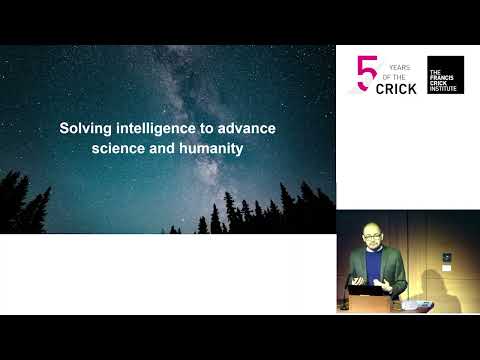
“AI might be the right description language for biology, just the same way that math is the right description language for physics.”Crick Insight Lecture Series, 2021 · full transcript →
AlphaFold showed that AI can solve problems its designers cannot hand-solve
Hassabis contrasts learning systems with older expert-system approaches. Rather than hard-coding the solution, the aim is to build systems that can learn evaluation functions, detect patterns, and find strategies that humans did not explicitly program13.
That is the deeper lesson he draws from the path from AlphaGo to AlphaFold. AlphaGo convinced him that learning systems could generate genuinely new strategies, and AlphaFold extended that confidence into science: the point of these systems is to solve problems that the designers themselves do not yet know how to solve directly14.
So in Hassabis’s view, AlphaFold is not just an engineering success. It is evidence that general learning methods can cross from games into scientific discovery and produce useful answers in domains that are too complex for brute force or hand-crafted rules alone.
Its real impact comes from speed, scale, and open access
Hassabis repeatedly stresses that AlphaFold’s significance is practical, not merely symbolic. It was not only accurate; it was fast enough to compute structures at a scale that made a global scientific resource possible.
That changed what protein prediction meant in practice. Instead of remaining a difficult, slow task, AlphaFold became a broadly accessible tool that researchers could use across biology, helping spread the benefits of the system far beyond the original research team.
He sees this as one of the clearest examples of AI improving science in three ways at once: making discoveries faster, spreading them more widely, and beginning to accelerate discovery itself. That is why AlphaFold stands, for him, as a turning point in how science can be done16.
For Hassabis, AlphaFold is an early sign of a broader scientific transformation
Hassabis does not treat AlphaFold as the endpoint. He sees it as an early example of AI becoming a general scientific instrument, one that can surface patterns and insights from vast data and help scientists form new hypotheses1617.
This connects to his larger optimism about the next phase of science. If systems like AlphaFold can take on hard analysis and pattern-finding work, human scientists can spend more of their time on interpretation, conjecture, and creative reasoning17.
That is why he talks about a coming golden age in science. AlphaFold matters not only because it solved one famous problem, but because it demonstrated a model for how AI can contribute to discovery across many fields1819.

“I think we're going to sort of live through a kind of golden age the next 10, 20 years.”Royal Society x Nobel Prize conversation, 2024 · full transcript →
Hassabis on alphafold, in his own words
“I believe it could be the ultimate tool to help with science.”
“I think we're going to sort of live through a kind of golden age the next 10, 20 years.”
Where to watch
 Demis Hassabis on AI for Science: AlphaFold and the Future of Biology2024 · 29 min · full transcriptBest concise account of how Hassabis connects DeepMind’s AGI mission to AlphaFold and to biology as a natural domain for AI.
 Demis Hassabis on AI in Science: A New Golden Age2024 · 80 min · full transcriptBest for understanding why he sees AlphaFold as a turning point in how science is done and shared.
 Demis Hassabis on Scientific Discovery: AI for Biology2021 · 89 min · full transcriptBest deep technical and conceptual explanation of why learning systems can work in biology and what AlphaFold proved.
 Demis Hassabis on Scientific Discovery with AI: From Games to Biology2024 · 64 min · full transcriptBest broad narrative from games to biology, including why protein folding was the right first major science problem.
 Demis Hassabis on Artificial Intelligence: AlphaFold and AGI2024 · 24 min · full transcriptBest short interview on why he thinks AI can be the ultimate scientific tool and why AlphaFold’s impact may just be beginning.
Questions people ask
Sources
Every quote above, word for word from the transcripts. Numbers match the text.
“…step one, solve intelligence; step two, use it to solve everything else.”
“Step one, solve intelligence; step two, use it to solve everything else.”
“…we started DeepMind in 2010 as an industrial research lab with a mission to build Artificial General Intelligence…”
“…my original ambition in AI is to build, uh, what we sometimes called artificial general intelligence…”
“Games are the perfect proving ground for AI systems.”
“…games are kind of microcosms of interesting parts of life…”
“We call them kind of root note problems…”
“AI may be potentially the perfect description language for biology…”
“I think that AI is potentially the perfect description language for biology.”
“AI might be the right description language for biology, just the same way that math is the right description language for physics.”
“Any pattern that can be generated or found in nature can be efficiently discovered and modeled by a classical learning algorithm…”
“Let's let the AlphaGo system itself learn its own evaluation function.”
“The promise of these systems is that they will be able to solve things we, as the designers, do not know how to solve yet.”
“I believe it could be the ultimate tool to help with science.”
“And I think one of the uses of AI is to find patterns and insights in huge amounts of data and then surface that to the human scientists to make sense of and make new hypotheses and conjectures. So it seems to me very compatible with the scientific method.”
“I think we're going to sort of live through a kind of golden age the next 10, 20 years.”
“…science is the most important, and the scientific method is probably the greatest invention humanity’s ever come up with.”
How this guide was made: drafted with AI from the full transcripts of the recordings cited, then checked: every quotation must match a transcript word for word and be the speaker's own words, and an independent review gates accuracy. Methodology and corrections.


