Confidence and Stories
Why coherent explanations can feel more valid than they are.

“What is characteristic of the way associative memory works is that it produces an interpretation of the world that is coherent.”Long Now lecture, 2018 · 35:54
The lesson
This chapter is about a simple but dangerous fact: confidence often comes from how a story feels, not from how well it is supported. Kahneman’s account of fast and slow thinking explains why. Fast thinking happens automatically and quickly, while slow thinking is effortful and more deliberate, so much of belief begins with impressions that arrive before checking does12.
System 1 builds those impressions through association, and its product is a coherent interpretation of what is in front of us. That coherence matters because once the mind has a story that fits together, it tends to treat that fit as a sign of truth or probability345. This helps explain why people can feel sure even when the underlying evidence is thin: the mind experiences coherence directly, but not the missing information.
One source of this misplaced confidence is substitution. When a hard question is difficult to answer, System 1 often answers an easier related question instead, automatically and without notice6. Because the easier answer comes fluently, it can feel like a valid response to the original question; this is one way familiarity and ease can stand in for logic or evidence7.
Another source is the tendency to treat what is available as if it were the whole picture. Kahneman describes a pattern in which people rely on the information they have, form a story from it, and then believe the thought they have produced89. That is why weak evidence can yield strong belief: if the evidence hangs together, the mind may not spontaneously ask what relevant facts are absent.
The result is overconfidence. Kahneman points to cases where judgments felt compelling even though they had little or no predictive validity, and he repeatedly warns that confidence should not be mistaken for accuracy1011. A practical response is not to reject intuition altogether, since it is indispensable, but to distrust confident stories enough to seek an outside view, missing base-rate information, or reasons the coherent account might be wrong1213.
4 principles from Daniel Kahneman
Treat coherence as a cue, not proof
A story that fits together smoothly will often feel true, complete, and probable. Use that feeling as a signal to investigate further, especially when the evidence is limited or one-sided.
“What is characteristic of the way associative memory works is that it produces an interpretation of the world that is coherent.”
Ask whether you answered an easier question
When a judgment comes quickly on a hard issue, check whether you substituted a simpler question without noticing. In practice, restate the original question and ask what evidence would actually answer it.
“And the general idea is very straightforward. When we're asked a question that we cannot answer, typically, System one is going to come up with the answer to a related question that is easier and it's going to use that answer to the wrong question, to the question that hasn't been asked in place of the question that was asked. We call that a mechanism of substitution, It's substituting an easier question for a hard one. It happens automatically. People are not aware that it happens. And it is the source of many intuitions that don't come from expertise and they are much less likely to be correct than the intuition that do come from expertise, but they come with equal confidence or just about.”
Look for what is missing, not just what is present
The mind naturally builds belief from the information at hand and often ignores absent evidence. Before trusting a conclusion, ask what outside-view data, base rates, or comparisons are not in the current story.
“What you see is all there is…”
Do not read confidence as accuracy
Strong conviction can appear even when judgment is unreliable. Separate how certain someone sounds, including yourself, from whether the judgment has been validated against outcomes.
“The correlation between our predictions and what actually happened was essentially zero.”
In his own words
The quotes behind the lesson, word for word from the transcripts. Numbers match the lesson above.
“…fast thinking is something that happens to you primarily, and slow thinking is something that you do…”
“System One rules, really, and we can't turn over everything to System Two.”
“System 1 can be identified with associative memory…”
“What is characteristic of the way associative memory works is that it produces an interpretation of the world that is coherent.”
“Your thinking flows along causal lines. This happens intuitively and it's not... And one of these feels okay. It feels more coherent. And the coherence that we experience can be turned into a judgment of probability. That is the confidence that we experience is a judgment of probability. Now I'm going to skip the other example. And I said earlier that people have intuitions that are not necessarily true and that people are confident in judgments that are not necessarily true. And I would like to sort of present a tentative theory about how that happens.”
“And the general idea is very straightforward. When we're asked a question that we cannot answer, typically, System one is going to come up with the answer to a related question that is easier and it's going to use that answer to the wrong question, to the question that hasn't been asked in place of the question that was asked. We call that a mechanism of substitution, It's substituting an easier question for a hard one. It happens automatically. People are not aware that it happens. And it is the source of many intuitions that don't come from expertise and they are much less likely to be correct than the intuition that do come from expertise, but they come with equal confidence or just about.”
“The law of least effort is really a fundamental psychological principle.”
“…we believe what we see. We believe what we think.”
“What you see is all there is…”
“The correlation between our predictions and what actually happened was essentially zero.”
“Overconfidence is really the enemy of good thinking.”
“We call one of them the inside view much later, and the other the outside view.”
“Don't trust yourself too much.”
Reflect
- Think of a recent judgment you felt very sure about. What made you confident: strong evidence, or a story that fit together smoothly?
- Where in your work do you face hard questions that invite substitution, such as replacing a forecast with an impression or a probability with a feeling?
- Recall a project or person you judged from the inside view. What outside-view comparison or base-rate information would have improved that judgment?
Check your understanding
Go deeper
 Daniel Kahneman on Intuition And Knowing: How System 1 Shapes Belief2011 · 47 min · full transcript
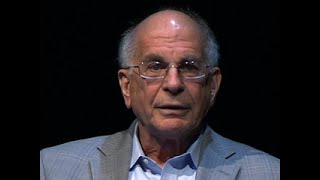 Daniel Kahneman on System 1 and System 2: Fast and Slow Thinking2018 · 78 min · full transcript
 Daniel Kahneman on System 1 and System 2: Why We Misjudge2012 · 31 min · full transcript
 Daniel Kahneman on Biases in Conflict: Why Hawks Sound Right2009 · 93 min · full transcript
 Daniel Kahneman on Noise and Judgment: Why Doubt Yourself2021 · 42 min · full transcript
 Daniel Kahneman on Behavioral Economics: System 1, Bias, and Nudge2016 · 68 min · full transcript
- What did Daniel Kahneman say about confidence and probability?
- What did Daniel Kahneman say about how people answer hard questions?
- What did Daniel Kahneman say about luck and overconfidence?
- What did Daniel Kahneman say about the demand for overconfidence?
- What did Daniel Kahneman say about ambiguity and context?
- What did Daniel Kahneman say about why people believe what they hear from others?