Charlie Munger on Psychology of Misjudgment
Munger sees psychology of misjudgment as a practical map of the predictable mental forces that push even smart people away from reality, especially when incentives, denial, and social influence combine.
- Misjudgment is patterned, not random, so it can be studied and guarded against.
- Incentives are one of the strongest causes of bad decisions, and people usually underestimate their power.
- Denial makes people reject unpleasant reality and keep doing what no longer works.
- Good judgment requires multiple mental models and a habit of testing whether facts fit together.
- The worst mistakes come when several biases reinforce each other in a lollapalooza effect.

Misjudgment is systematic, so you can prepare for it
Munger treats bad judgment as something regular and recurring, not as a series of isolated blunders. He became deeply interested in the subject because talented people repeatedly go wrong in recognizable ways, and he thinks the human mind has standard failure modes that deserve direct study.123
That view matters because it turns judgment into a practical discipline. If mistakes come from recurring patterns, then better decisions depend less on raw IQ and more on recognizing the forces that predictably distort thinking.23
“Well, I am very interested in the subject of human misjudgment…”Harvard lecture, 1995 · full transcript →
Reality wins, so judgment must fit the world as it is
For Munger, clear thinking starts with respect for reality. He insists that ideas have to cohere with the rest of the world, and that facts are only useful when they fit into a broader structure of models.456
This is why he pushes a latticework approach instead of single-factor thinking. A person who uses only one narrow framework will miss the full shape of a problem, while a person with several models is better able to notice when something does not make sense.567
His practical test is simple: first ask whether you can understand what is in front of you. When people move ahead without that understanding, complexity itself becomes a source of misjudgment.8
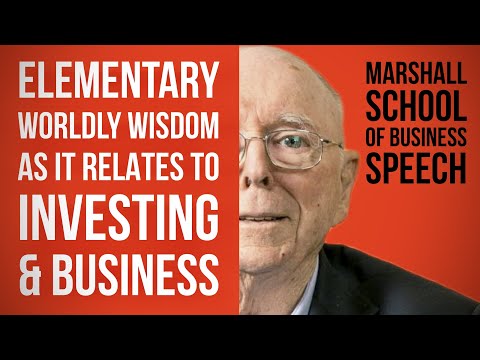
“If the facts don't hang together on a latticework of theory, you don't have them in a usable form.”USC Business School lecture, 1995 · full transcript →
Incentives are the most underestimated driver of behavior
Munger returns again and again to incentives because they reshape what people see, say, and do. He says even someone who has long studied incentives can still underestimate their power, which tells you how central they are to his account of human error.9
This applies far beyond compensation plans. Reinforcement changes behavior by rewarding actions, and repeated rewards can make bad thinking feel successful for a long time. In markets, applause, gains, and rising prices can all strengthen behavior that is not truly rational.910
He also believes corrupt systems invite corrupt conduct. Easy money is especially dangerous because it weakens restraint and encourages behavior that would look foolish or unethical under better incentives.11
Denial and commitment make people cling to error
Munger thinks one of the most destructive forces in misjudgment is denial. When reality is painful, people often prefer a comforting story, and that keeps them investing time, money, and pride in things that no longer work.1213
He pairs denial with consistency and commitment. Once people have acted publicly or repeatedly, the action itself starts changing what they believe, which makes backing away from a mistake harder than it should be.14
This is why he values hearing bad news early. A healthy decision process does not protect ego; it forces unpleasant facts into the open before commitment and self-justification grow stronger.15

“What... If I had to name one factor that dominates human bad decisions, it would be what I call denial. If the truth is unpleasant enough, people kind of... Their mind plays tricks on them, they they think it isn't really happening. And, of course, that causes enormous destruction of business where people go on throwing money into the way they used to do things, even though it isn't gonna work at all well in in the way the world is now having changed. And And if you want an example of how denial is affecting things, take the world of investment management. How many managers are going to beat the indexes, all costs considered?”Daily Journal Corporation annual meeting, Los Angeles, 2023 · full transcript →
Social proof and combined biases can overpower intelligence
Munger does not think intelligence alone protects people. Crowds, status, and market signals can pull people into behavior they would reject in calmer settings, which is why speculative manias and institutional craziness recur.21610
He is especially interested in what happens when several tendencies operate at once. Incentives, social proof, commitment, and reinforcement can combine into what he calls a lollapalooza effect, producing decisions far worse than any one bias would cause alone.1710
That is his broader warning about psychology: smart people do not merely make isolated errors. Under the wrong conditions, they can be pushed by multiple forces in the same direction until bad judgment feels normal, moral, and obvious.173
“I would say the one thing that causes the most trouble is when you combine a bunch of these together, you get this Lollapalooza effect. And again, if you read the psychology textbooks, they don't discuss how these things combine, at least not very much. Do they multiply? Do they add? How does it work? I think it would be just an automatic subject for research, but it doesn't seem to turn the psychology establishment on. I think this is a man for Mars approach to psychology. I just reached in and took what I thought I had to have.”Harvard lecture, 1995 · full transcript →
The cure is disciplined rationality, patience, and not being crazy
Munger's response is not a formula that eliminates error. It is a way of living: become more rational, defer gratification, and avoid the common emotional traps that wreck judgment. He treats rationality almost as a duty for anyone capable of it.1819
That means resisting prediction games, envy, self-pity, and the urge to chase easy outcomes. Instead of trying to outguess every cycle, he favors steady work, patience, and decisions grounded in what can actually be understood.2019
He also ties judgment to character. Deserving what you want, honoring commitments, and building systems that surface bad news all reduce the odds that psychology will lead you somewhere foolish.211519
Munger on psychology of misjudgment, in his own words
“What... If I had to name one factor that dominates human bad decisions, it would be what I call denial. If the truth is unpleasant enough, people kind of... Their mind plays tricks on them, they they think it isn't really happening. And, of course, that causes enormous destruction of business where people go on throwing money into the way they used to do things, even though it isn't gonna work at all well in in the way the world is now having changed. And And if you want an example of how denial is affecting things, take the world of investment management. How many managers are going to beat the indexes, all costs considered?”
“I would say the one thing that causes the most trouble is when you combine a bunch of these together, you get this Lollapalooza effect. And again, if you read the psychology textbooks, they don't discuss how these things combine, at least not very much. Do they multiply? Do they add? How does it work? I think it would be just an automatic subject for research, but it doesn't seem to turn the psychology establishment on. I think this is a man for Mars approach to psychology. I just reached in and took what I thought I had to have.”
“If the facts don't hang together on a latticework of theory, you don't have them in a usable form.”
“The human mind has enormous power but it also has standard misfunctions.”
Where to watch
 Charlie Munger on Human Misjudgment: 24 Causes of Error1995 · 91 min · full transcriptThe core lecture: Munger lays out the major causes of misjudgment and why these errors are patterned.
 Charlie Munger on Worldly Wisdom: Mental Models for Investing1995 · 82 min · full transcriptBest for seeing how psychology fits into his broader latticework of mental models and practical judgment.
 Charlie Munger on Decision Making: Rationality, Incentives, and Life2017 · 120 min · full transcriptShows how he turns psychological insight into daily conduct: rationality, patience, and resisting corrupting incentives.
 Charlie Munger on Investing and Life: Daily Journal Q&A2023 · 155 min · full transcriptUseful for his later emphasis on denial as a dominant cause of bad decisions in business and investing.
 Charlie Munger on Investing and Mental Models: Berkshire Q&A1995 · 138 min · full transcriptGood companion on how to avoid misjudgment by staying inside what you can understand and facing bad news early.
Questions people ask
- What did Charlie Munger say about consistency and commitment?
- What did Charlie Munger say about denial and bad decisions?
- What did Charlie Munger say about incentives?
- What did Charlie Munger say about rationality and success in life?
- What did Charlie Munger say is the biggest cause of human misjudgment?
- Why did Charlie Munger study human stupidity so early?
Sources
Every quote above, word for word from the transcripts. Numbers match the text.
“Well, I am very interested in the subject of human misjudgment…”
“The human mind has enormous power but it also has standard misfunctions.”
“I was able to learn from my dead grandfather, great grandfather when I was a little boy. What I learned at a very young age when I was just a kid, I could see some of the adults around me were nuts and yet they were very talented. I could see how much irrationality there was in very talented people. And so I got interested in seeking out the patterns and understanding why it happened and learning tricks to cope and so on. And I did that when I was a little kid. And of course it helped me. Who is not helped by an early start in a promising activity? And what activity could be more promising than diagnosing stupidity?”
“…all reality has to respect all other reality…”
“You've got to have models in your head.”
“If the facts don't hang together on a latticework of theory, you don't have them in a usable form.”
“That is a different set of incentives from rising in an economic establishment where the reward system, again the reinforcement, comes from being a truffle hound. That's what Jacob Viner, great economist called it, the truffle hound, an animal so bred and trained for one narrow purpose that he wasn't much good at anything else. And that is the reward system in a lot of academic departments. It is not necessarily for the good. It may be fine if you want new drugs or something. You want people stunted in a lot of different directions so they can grow in one narrow direction. But I don't think it's good teaching psychology them the masses. In fact, I think it's terrible.”
“The first question is can I understand it?”
“First, under recognition of the power of what psychologists call reinforcement and economists call incentives. Well, you say everybody knows that. Well, I think I've been in the top 5% of my age cohort all my life in understanding the power of incentives. And all my life, I underestimated it. And never a year passes, but will I get some surprise that pushes my limit a little farther.”
“If you think about the doctrines I've talked about, namely, one, the power of reinforcement. After all, you do something and the market goes up and you get paid and rewarded and applauded and what have you. You're getting a lot of reinforcement if you make a bet in a market and the market goes with you. Also, there's social proof. I mean, the prices in the market are the ultimate form of social proof, reflecting what other people think. And so the combination is very powerful. Why would you expect general market levels to always be totally efficient, say even in 1973, at the pit or in 1972 or whatever it was when the Nifty fifty were in their heyday, if these psychological motions are correct, you would expect some waves of irrationality which carry general levels to...”
“Easy money corrupts, and really easy money tends to corrupt absolutely.”
“…what people wish is what they believe…”
“What... If I had to name one factor that dominates human bad decisions, it would be what I call denial. If the truth is unpleasant enough, people kind of... Their mind plays tricks on them, they they think it isn't really happening. And, of course, that causes enormous destruction of business where people go on throwing money into the way they used to do things, even though it isn't gonna work at all well in in the way the world is now having changed. And And if you want an example of how denial is affecting things, take the world of investment management. How many managers are going to beat the indexes, all costs considered?”
“It's not just reciprocation tendency and role theory that caused that. It's consistency and commitment tendency. Each person as he acted as a guard or a prisoner, the action itself was pounding in the idea. Wherever you turn this consistency and commitment tendency is affecting you. In other words, what you think may change what you do, but perhaps even more important, what you do will change what you think. And you can say everybody knows that. I want to tell you I didn't know it well enough or early enough.”
“Charlie and I are always, we're more interested in bad news always than good news. We figure good news takes care of itself. And one, we only give a couple of instructions to people when they go to work for us, and one of them is to think like an owner and the second one is to just tell us the bad news immediately because good news takes care of itself, and we can take bad news but we don't like bad news late.”
“It's more like a mob at a football game.”
“I would say the one thing that causes the most trouble is when you combine a bunch of these together, you get this Lollapalooza effect. And again, if you read the psychology textbooks, they don't discuss how these things combine, at least not very much. Do they multiply? Do they add? How does it work? I think it would be just an automatic subject for research, but it doesn't seem to turn the psychology establishment on. I think this is a man for Mars approach to psychology. I just reached in and took what I thought I had to have.”
“If you're capable of understanding the world, you have a moral obligation to become rational.”
“Well, that's the easy rationality. If you're just not crazy, you have a big advantage over 95% of the people because most people have all kinds of crazy patches. And if you just are consistently not crazy, you had a you had a big advantage in life. And if you're patient and a gratification defer in addition to being not crazy, then it's practically a cinch. And then if you're exceptionally good at satisfying your commitments to other people, then you got... You you just automatically improved your resources and your chances in life enormously. And it's so simple. And why don't more people do it?”
“It's kind of a snare and a delusion to outguess macroeconomic cycles.”
“The best way to get what you want in life is to deserve what you want.”
How this guide was made: drafted with AI from the full transcripts of the recordings cited, then checked: every quotation must match a transcript word for word and be the speaker's own words, and an independent review gates accuracy. Methodology and corrections.

