Human Skills
Technology cannot replace the growth that comes from doing the human work.
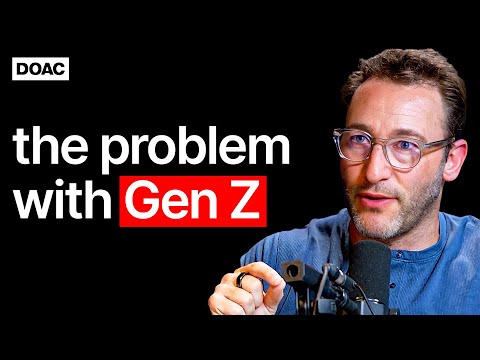
“You know, you're sitting watching TV, and, you know, someone you love is trying to tell you something and you're like, "Uh-huh, uh-huh," and you're still watching. You're not even listening to me, and we turn around and repeat all the words back to them. That's not listening. That's hearing the words that were spoken to you. Listening is when the other person feels heard, right? And where you are in pursuit of meaning, not the word spoken. You're not so literal, right? And I think in the cases of, like, your friend, the—is to go from an advice-giving mode. And men suffer from this more than women, which is we—our intention is to fix everything, right? All we want to do is fix, fix, fix, fix. We see the problem; here's the solution. But sometimes that's not what people need. People need to feel…”The Diary of a CEO interview, 2022 · 18:23
The lesson
Sinek’s warning about AI is not mainly about whether machines can produce useful output. It is about what humans lose when they stop doing the work that develops judgment, patience, and character. In this chapter’s terms, he is focused on humanity, not just efficiency, and he argues that our imperfections are part of what makes us valuable rather than a flaw to engineer away12.
That is why struggle matters. If you outsource too much of thinking, relating, or creating, you may get a faster result while missing the growth that normally comes from effort. Sinek connects this concern to a broader cultural pattern: impatience and instant gratification train people to expect speed, even in parts of life where trust, fulfillment, and maturity only develop slowly345.
The skills most at risk are the human ones that cannot be downloaded by exposure alone; they have to be practiced. Leadership itself is a skill, and one of its first duties is caring for people, which requires empathy rather than treating others as output-producing units678. Listening belongs in the same category: it is not merely hearing words or waiting to reply, but helping the other person actually feel heard910.
Technology can help exchange information, but Sinek argues it is poor at building trust and emotional understanding on its own. He points to the limits of digital communication and the importance of in-person moments, small talk, and ordinary interactions that create shared reality over time114. This is also why phones in meetings, emotional topics handled by email, or constant digital distraction can quietly erode the conditions in which empathy and accountability grow1213.
The practical response is not to reject tools, but to be deliberate about what humans must still do themselves. Sinek’s model is to build skills, teach them, and lead others with them, while remembering that helping and growth are shared responsibilities rather than solo performances141516. In practice, that means creating settings where people must listen, work through tension, tell the truth about themselves, and take responsibility instead of letting convenience remove every meaningful struggle1718.
5 principles from Simon Sinek
Do not outsource all struggle
Use technology to assist output, but keep the parts of work that build judgment, resilience, and craft in human hands. If you remove every difficulty, you may gain speed while losing the growth that difficulty was supposed to produce.
“What makes people beautiful is not that we get everything right. It's that we get many things wrong.”
Practice human skills on purpose
Empathy, listening, conflict resolution, and accountability are not automatic side effects of getting older or getting promoted. Treat them as trainable skills that need repetition, feedback, and deliberate use in real relationships.
“Leadership is a skill like any other.”
Let trust grow slowly
Do not expect deep trust, loyalty, or fulfillment to appear instantly. Build environments with repeated, low-stakes human interaction, because relationships strengthen through steady consistency rather than one dramatic moment.
“Trust doesn't form in an event, in a day.”
Match the medium to the human need
Use digital tools for information exchange, but switch to face-to-face or live conversation when emotion, nuance, or relationship is involved. This helps people feel understood and reduces the flattening effects of purely transactional communication.
“For the exchange of information and the exchange of ideas, technology is absolutely wonderful for speeding transactions, it's wonderful for resourcing and finding people, but it is terrible for creating human connections. You cannot form trust through the internet. There's something called a mirror-neuron which they've recently discovered that is one of the things that contributes to how people relate to each other and how we empathize. It's the feeling you get, it's the same part of the brain that lights up -- they did these pictures-- they did MRIs. They gave people a picture of someone smiling. And then in our own brain, when we see someone smiling, the same part of the brain lights up when we smile. It's what creates empathy and it is necessary to create trust. Again this very human bond.”
Help others without removing accountability
Support is important, but growth still requires the other person to participate and take responsibility. The goal is not to rescue people from every hard thing; it is to help them do the hard thing themselves.
“…helping someone is a team sport…”
Moments to watch
In his own words
The quotes behind the lesson, word for word from the transcripts. Numbers match the lesson above.
“What makes people beautiful is not that we get everything right. It's that we get many things wrong.”
“There's a premium on being human.”
“Trust doesn't form in an event, in a day.”
“Relationships are formed this way. We're waiting for a meeting to start and we go, "How's your dad? I heard he was in the hospital." "Oh, he's really good. Thanks for asking. He's actually at home now." "Oh, I'm really glad." "It was really amazing." "I know. It was really scary for a while." That's how you form relationships. "Hey, did you ever get that report on—" "Oh my god, no, I didn't. I'll help you out." "I totally—I can help you out with that." "Really?" That's how trust forms. Trust doesn't form in an event, in a day. Even bad times don't form trust immediately. It's the slow, steady consistency. And we have to create mechanisms where we allow for those little innocuous interactions to happen. But when we allow cell phones in conference rooms, we just—Okay, have the meeting.”
“So, you have a generation growing up with lower self-esteem that doesn't have the coping mechanisms to deal with stress—stress. Right? Now, you add in the sense of impatience. Right? They've grown up in a world of instant gratification. You want to buy something, you go on Amazon; it arrives the next day. You want to watch a movie, log on and watch a movie. You don't check movie times. You want to watch a TV show, binge. You don't even have to wait week to week to week. Right? I know people who skip seasons just so they can binge at the end of the season. Right? Instant gratification. You want to go on a date? You don't even have to learn how to be like—you don't even have to learn and practice that skill. You don't have to be the uncomfortable one who just says yes when you mean no, and says no when you mean no, and mean yes when you—you…”
“Leadership is a skill like any other.”
“…it's about taking care of those in our charge…”
“You want to be a great leader? Start with empathy.”
“Listening is when the other person feels heard…”
“You know, you're sitting watching TV, and, you know, someone you love is trying to tell you something and you're like, "Uh-huh, uh-huh," and you're still watching. You're not even listening to me, and we turn around and repeat all the words back to them. That's not listening. That's hearing the words that were spoken to you. Listening is when the other person feels heard, right? And where you are in pursuit of meaning, not the word spoken. You're not so literal, right? And I think in the cases of, like, your friend, the—is to go from an advice-giving mode. And men suffer from this more than women, which is we—our intention is to fix everything, right? All we want to do is fix, fix, fix, fix. We see the problem; here's the solution. But sometimes that's not what people need. People need to feel…”
“For the exchange of information and the exchange of ideas, technology is absolutely wonderful for speeding transactions, it's wonderful for resourcing and finding people, but it is terrible for creating human connections. You cannot form trust through the internet. There's something called a mirror-neuron which they've recently discovered that is one of the things that contributes to how people relate to each other and how we empathize. It's the feeling you get, it's the same part of the brain that lights up -- they did these pictures-- they did MRIs. They gave people a picture of someone smiling. And then in our own brain, when we see someone smiling, the same part of the brain lights up when we smile. It's what creates empathy and it is necessary to create trust. Again this very human bond.”
“There should be no cell phones in conference rooms. None. Zero.”
“The next time you want to tell somebody something, email is fantastic for the exchange of information, right? It's fantastic. Here's the report you wanted. The meeting's at 4:00. Fantastic. What did you think of my idea? Do not reply on an email. That's an emotional question. Email is a rational tool. You get up from your desk, you walk the 30 feet, and you say, "Wanted to tell you what I thought of your idea," and I promise you, not only will that information be better received, but you will start to create relationship because oxytocin starts to get released.”
“We came up with three words, three actions that everybody who goes through Air Force Top Gun is required to do, which is build, teach, lead. Which is the idea that you build a skill set, you teach that skill set to other people, and then you build leaders, and you lead, right? This whole idea that you have a responsibility to build, to teach, and to lead. Accumulate and give, and serve. And the thing that is so powerful is the Commandant of the Weapons School, after we— he the work, he took those words, and he put them on the coin.”
“…helping someone is a team sport…”
“And I think that it's not about giving up on someone, it's that it's a—it's that it's a—that helping someone is a team sport. Success is a team sport. And if you find that you're the only player in their life when they should be the primary player, you can only be—you can only do the assists. You'll never be the one making the baskets. That's their job, right? But if they won't take the pass, then at some point, you stop throwing the ball. And, um, it's not about giving up on people. It's that they have—it's about accountability to take responsibility for oneself.”
“That I'm not 100% honest with myself. Because if I'm not honest with myself, I won't be honest to others. Um, you know, and when somebody asks me a question that I'm afraid of the answer—not because I'm afraid of offending them, but I'm afraid of how I feel about the answer myself, you know. Uh, I think that would be it.”
“Vulnerability minus boundaries is not vulnerability.”
Reflect
- What part of your work or life are you tempted to hand over for speed, even though doing it yourself is what develops your judgment or character?
- In your daily interactions, where are you hearing words but not helping the other person feel heard?
- What one rule or habit could you introduce to create more real trust-building moments: fewer phones, more in-person feedback, more small talk, or more direct accountability?
Check your understanding
Go deeper
 Simon Sinek on Human Skills: Why AI Can't Replace Growth2025 · 126 min · full transcript
 Simon Sinek on Millennial Work Expectations: Loyalty, Purpose, and Patience2017 · 15 min · full transcript
 Simon Sinek on Empathy and Infinite Games: The Game You're In2019 · 35 min · full transcript
 Simon Sinek on Purpose-Driven Leadership: Help Others to Help Yourself2022 · 105 min · full transcript
 Simon Sinek on Vulnerability and Leadership: Why Both Matter2021 · 53 min · full transcript
 Simon Sinek on Community and Choice: Why Constraint Matters2025 · 59 min · full transcript