Friendship and Fitness
A meaningful life is built with people, not just achievements.
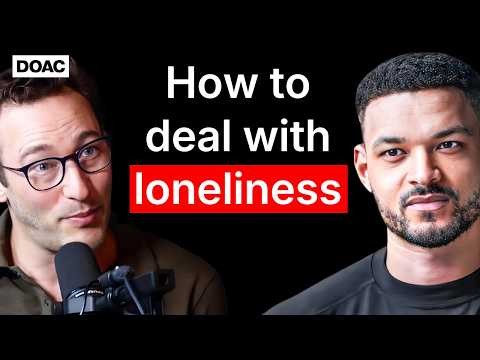
“I like to call it mental fitness rather than mental health…”The Diary of a CEO interview, 2022 · 6:39
The lesson
Sinek treats friendship and belonging as core conditions for a meaningful life, not optional extras after success. Across these conversations, he argues that people do not do life, work, or recovery alone; they need love, support, and communities where they are known by others rather than reduced to performance or status12. This is also why he pushes back on a purely individual model of fulfillment and points toward shared forms of growth and purpose instead of private achievement alone34.
That perspective changes how to think about struggle. Sinek prefers the language of mental fitness because it suggests an ongoing practice with stronger and weaker days, rather than a fixed state you either have or lack5. He also describes loneliness as compatible with hope, which means difficulty is not a personal failure and does not cancel the possibility of connection or progress6. In that frame, the goal is not to appear fine by yourself, but to build relationships where you do not have to carry pain alone7.
For Sinek, good friendship is less about solving and more about presence. He repeatedly emphasizes that support works best when people feel heard, and that helping someone is collaborative rather than something one person does to another89. That requires resisting the urge to fix everything and instead staying with the person long enough to understand what they mean, what they feel, and what part they themselves are ready to play in change1011.
He also broadens belonging beyond intimate moments. Small talk matters because it creates shared reality and common ground, which makes deeper trust and more serious conversation possible later. In the same way, communities become stronger when people practice consideration for others and participate in spaces where different parts of life mix instead of remaining separate and isolated.
The practical implication is that friendship must be treated as a skill and a habit. Sinek warns that many adults sacrifice friends for work even though work cannot provide the same support in hard times, while real trust grows when we ask for help rather than only offering it1213. Vulnerability helps, but only with boundaries; otherwise it becomes display rather than connection. A meaningful life, then, is built by maintaining mutual, honest, bounded relationships that make endurance possible.
5 principles from Simon Sinek
Treat mental fitness as an ongoing practice
Do not think of emotional wellbeing as a finished state. Expect fluctuations, and build regular habits of support, reflection, and connection so that hard periods are part of the practice rather than proof that you are broken.
“I like to call it mental fitness rather than mental health…”
Do not struggle alone
When things are heavy, the goal is not independence but companionship. Build friendships where you can be honest about pain and where others can stay present without rushing you past it.
“I need somebody to sit in the mud with me…”
Listen to understand, not to fix
Support starts with making the other person feel heard. Before giving advice, slow down, ask questions, and understand what kind of help is actually needed and what responsibility remains theirs.
“Listening is when the other person feels heard…”
Use small talk to build shared reality
Do not dismiss ordinary conversation as shallow. Brief, simple exchanges create familiarity and common ground, which makes deeper trust and better conversations possible later.
Build trust by asking for help
Mutuality deepens relationships more than constant competence does. Let trusted people support you, and share honestly with boundaries so vulnerability creates connection instead of performance.
“We don't build trust by offering help; we build trust by asking for it.”
In his own words
The quotes behind the lesson, word for word from the transcripts. Numbers match the lesson above.
“We cannot do this thing called career or life alone.”
“I think we have to have love in our lives…”
“He's half right. The mistake that Maslow made, he's only thought of us as individuals, and as individuals, yes, I need food and shelter first. But as a member of a group, I need friends and I need love. And self-actualization is not the thing I'm actually in pursuit of. As a member of a group, it's shared actualization that I'm looking for. And unfortunately, for various reasons, which we don't have to go down that rabbit hole, the past 30, 40 years, especially in the West, we have doubled down on individualism. We have doubled down on my own career. We've doubled down on how do I find love, how do I find happiness. We've doubled down on selfishness, and it worked for a while. It worked when the economy was really good, like in the 80s and 90s and 2000s. So awesome.”
“Our sense of joy and fulfillment and love and purpose comes from our ability to serve another human being.”
“I like to call it mental fitness rather than mental health…”
“I am lonely and optimistic simultaneously.”
“I need somebody to sit in the mud with me…”
“…helping someone is a team sport…”
“Listening is when the other person feels heard…”
“And I think that it's not about giving up on someone, it's that it's a—it's that it's a—that helping someone is a team sport. Success is a team sport. And if you find that you're the only player in their life when they should be the primary player, you can only be—you can only do the assists. You'll never be the one making the baskets. That's their job, right? But if they won't take the pass, then at some point, you stop throwing the ball. And, um, it's not about giving up on people. It's that they have—it's about accountability to take responsibility for oneself.”
“You know, you're sitting watching TV, and, you know, someone you love is trying to tell you something and you're like, "Uh-huh, uh-huh," and you're still watching. You're not even listening to me, and we turn around and repeat all the words back to them. That's not listening. That's hearing the words that were spoken to you. Listening is when the other person feels heard, right? And where you are in pursuit of meaning, not the word spoken. You're not so literal, right? And I think in the cases of, like, your friend, the—is to go from an advice-giving mode. And men suffer from this more than women, which is we—our intention is to fix everything, right? All we want to do is fix, fix, fix, fix. We see the problem; here's the solution. But sometimes that's not what people need. People need to feel…”
“…your friends will be there for you, your work won't.”
“We don't build trust by offering help; we build trust by asking for it.”
Reflect
- When you feel lonely, is it usually about being alone, or about feeling unseen or misunderstood? What would help you be more known by someone you trust?
- Think of a recent conversation where you tried to help someone. Did you mainly fix, advise, or truly listen until they felt heard?
- What friendships or communities have you neglected in favor of work or achievement, and what one concrete action could you take this week to invest in them?
Check your understanding
Go deeper
 Simon Sinek on Loneliness and Mental Fitness: Sit in the Mud2022 · 120 min · full transcript
 Simon Sinek on Friendship and Belonging: Why Friends Matter More2024 · 24 min · full transcript
 Simon Sinek on Community and Choice: Why Constraint Matters2025 · 59 min · full transcript
 Simon Sinek on Purpose-Driven Leadership: Help Others to Help Yourself2022 · 105 min · full transcript
 Simon Sinek on Purpose-Driven Leadership: Why Service Matters2020 · 96 min · full transcript
 Simon Sinek on Vulnerability and Leadership: Why Both Matter2021 · 53 min · full transcript