Satya Nadella on Microsoft
Nadella sees Microsoft as a platform company that stays relevant by empowering others, adapting to each technology wave, and turning cloud and AI into practical productivity gains people can trust.
- Microsoft’s aim is relevance, not mere survival.
- Its job is to build platforms so others can create more.
- Culture matters because renewal starts with learning, empathy, and bold execution.
- Cloud and AI matter only if they improve real productivity and the real economy.
- Trust and human control are essential as Microsoft pushes AI into every product.

Microsoft exists to stay relevant by being useful
Nadella’s basic test for Microsoft is not whether it endures as a famous company, but whether it remains useful in a changing world. He treats relevance as a daily discipline: Microsoft has to build for where technology and customer needs are going, not where they used to be.12
That view explains why he talks about the company less as a monument and more as an active participant in each new computing era. He sees Microsoft operating in an industry with little franchise protection, which means the company must keep earning its place through forward-looking bets and practical execution.23
Its mission is to build platforms that let others build
Nadella consistently describes Microsoft as a platform company. In his framing, Microsoft’s role is to create the tools, infrastructure, and application layers that help developers, organizations, and communities make their own things happen.45
This is why cloud is so central in his picture of Microsoft. He does not present cloud as just a destination or a product category, but as a new computing form that supports everything above it, from data and tooling to business applications and AI systems.675
Even his earlier mobile-first, cloud-first language fits this platform view. Mobile is about the movement of the human experience across contexts, while cloud is the computing fabric underneath it, so Microsoft’s job is to serve people and builders across devices, workloads, and environments.869
Renewing Microsoft starts with culture, not just strategy
Nadella presents Microsoft’s renewal as a cultural reset as much as a business shift. He was told not to imitate prior leaders, and that helped shape an approach centered on authenticity, empathy, and a willingness to rethink how the company works.1011
Empathy is not, for him, soft decoration around strategy. It is how Microsoft better understands unmet needs, listens to customers, and invents products people actually need. That is one reason he links leadership quality directly to innovation quality.11
He also argues that Microsoft had to move from certainty to learning. His shorthand is the shift from know-it-alls to learn-it-alls, which captures a company that adapts, studies its own successes and failures, and does more of what works instead of defending old assumptions.1213
This cultural reset is paired with execution discipline. Nadella’s version of ambition is not loose vision-talk; it is boldness plus step-by-step delivery. That is the logic behind his repeated emphasis on dreaming and executing at the same time.143
Microsoft wins by choosing the waves where it has permission to matter
Nadella does not describe strategy as trying to win every trend. He argues that Microsoft should act where customers expect it to contribute and where it can do something better, not out of envy or fear of missing out.1516
That principle helps explain Microsoft’s big pivots. The company moved hard into cloud because its customers expected it to provide core computing infrastructure, and Nadella treats that as an example of knowing where the brand and business have permission to win.1716
He applies the same lens to AI. Microsoft’s opportunity is not just to have access to powerful models, but to combine infrastructure, deployment, productivity software, and enterprise relationships into something durable. In that sense, Microsoft’s edge comes from assembling the stack and making it useful, not from assuming one breakthrough alone will decide the future.1819205
Cloud and AI matter only if they raise productivity in the real economy
Nadella’s standard for Microsoft’s cloud and AI push is economic impact. He keeps returning to whether these tools truly change the productivity curve and show up in the real economy, not just in benchmarks or impressive demos.212223
That is why he talks about AI as workflow change, not only model progress. He sees the big opportunity in redesigning knowledge work, spreading capability across the enterprise, and making AI part of everyday output rather than a side experiment.182419
This also explains Microsoft’s full-stack positioning. Nadella connects Azure, data, developer tools, productivity software, security, and Copilot into one system meant to help organizations become more resilient and more capable. The value, in his account, comes from deployment at scale.252675
Trusted AI is the next test of what Microsoft is for
Nadella thinks AI will spread across all of Microsoft’s products, but he does not treat capability alone as success. As systems become more agentic, he says trust becomes the central issue, especially in enterprise settings where auditability, governance, and security matter.2427
He is especially cautious about autonomy without control. His view is that systems can assist, route, and automate, but they still have to serve human goals and remain under human control. That turns trust from a compliance feature into a core product principle.282029
This ties back to his broader sense of purpose for Microsoft. The company should use its scale to help solve real problems and expand human achievement, not create new harms. In Nadella’s view, that is what makes an AI strategy worthy of Microsoft’s mission.3031
Nadella on microsoft, in his own words
“…longevity is not a goal, relevance is…”
“We want to make things so that others can make things and make things happen.”
Where to watch
 Satya Nadella on Microsoft's AI Future: Dream and Execute2025 · 43 min · full transcriptBest single overview of how Nadella connects Microsoft’s history, relevance, and AI future.
 Satya Nadella on AI Phase Shifts: OpenAI, Agents, and the Next Stack2025 · 85 min · full transcriptBest on Microsoft’s strategy logic: where to compete, how culture changed, and why envy is a bad guide.
 Satya Nadella on Digital Transformation: Tech Intensity for the Future2020 · 69 min · full transcriptBest view of Microsoft as a full-stack company spanning cloud, productivity, security, and transformation.
 Satya Nadella on Developer Platforms: Cloud, AI, and Windows2016 · 20 min · full transcriptBest statement of Microsoft’s mission as a platform that empowers developers and organizations.
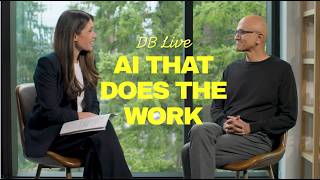 Satya Nadella on Copilot and AI Products: Trust, Agents, and ROI2025 · 26 min · full transcriptBest on Copilot, agents, trust, governance, and how Microsoft wants AI products to work in practice.
 Satya Nadella on Leadership: Empathy, Culture, and Change2017 · 24 min · full transcriptBest on the leadership and empathy-based cultural changes behind Microsoft’s turnaround.
Questions people ask
- How did Satya Nadella change Microsoft’s culture?
- What advice did Satya Nadella say he would give his successor?
- What does Satya Nadella say about strategy and permission to win?
- What does Satya Nadella say matters more than longevity for Microsoft?
- Why does Satya Nadella still want to lead Microsoft?
- What did Satya Nadella say about Microsoft’s mission in the age of AI?
Sources
Every quote above, word for word from the transcripts. Numbers match the text.
“…longevity is not a goal, relevance is…”
“It's kind of fascinating. This is our fiftieth year, and I think a lot about it, right? And the way to think about, you know, I think longevity is not a goal; relevance is. And so, think the thing that I have to do, and all 200,000 of us have to do every day is: Are we doing things that are useful and relevant for the world as we see it evolving, not just today, but tomorrow? Like, we have to basically, you know, and we live in an industry where there's no franchise value, right? So, that's the other hard part, which is, if you take the R and D budget that we will spend this year, it's speculation on what's going to happen five years from now. And so, you got to basically go in with that attitude, that saying, Look, we are doing things that we think are going to be relevant.”
“Dream and execute, dream and execute.”
“We want to make things so that others can make things and make things happen.”
“We're introducing more than 50-plus new products and partnerships to create a new opportunity for you. We’ve always been a platform company and our goal is to build the most complete end-to-end stack from infrastructure, to data, to tooling to the application extensibility so that you can apply the power of this technology to build your own applications. And so today I want to highlight our top news for this event across every layer of this Copilot stack. So let's dive right in with infrastructure. You know, we have the most complete scalable AI infrastructure that meets your needs in this AI era. We're building Azure as the world's computer. We have the most comprehensive global infrastructure with more than 60-plus datacenter regions, more than any other cloud provider.”
“Cloud is not a single destination; cloud is a new form of computing.”
“Azure is the world's computer.”
“Mobile first is not about the mobility of any single device; it is the mobility of the human experience.”
“Our vision, simply put, is to thrive in this world of mobile first, cloud first…”
“Don't try to be like us.”
“My pursuit is, is there growing sense of empathy for people around me.”
“…go from being the know-it-alls to learn-it-alls…”
“…do more of the former and less of the latter…”
“The advice I got from Steve Ballmer when I took on the job is the advice that I think of all the time, which is be bold. Because if you're not bold, you're not gonna do anything. And be right because if you're not right, you won't amount to much. And so that ability to sort of get past the status quo by really boldly thinking of a future that doesn't exist, but then executing, right? At the end of the day, business is about being able to earn the stripes one step at a time. And I think that's what this company has exhibited. What has it has taught me all through my career at Microsoft, which is you gotta dream and execute, dream and execute.”
“…you shouldn't do things out of envy…”
“Sometimes it's okay to fast follow, and it worked out. But you shouldn't do things out of envy. That was one of the hardest lessons, I think, we've learned. Uh, do it because you have permission to do this, and you can do it better. Like, both of those matter to me. The brand permission, like, uh, you know, Geoffrey Moore once said this to me, which I say, "Hey, why don't you go do things which your customers expect you to do?" I love that, right? Which is cloud was one such thing, which is the cust you know, in fact, when I first remember showing up in Azure, people would tell me, "Oh, it's a winner-take-all.”
“And I had a point of view on what I wanted to do if I was going to become CEO. We now need to make Microsoft thrive in a mobile-first and a cloud-first world. It was not about trying to criticize our past or praise the past. Uh, it was about what do we do in the future. One of the things you tried to do and change the culture was to change what was known as a very proprietary culture at, uh, Microsoft. Microsoft said, “This is the way we do things. We don’t want to cooperate with other firms necessarily, competitors or other kinds of firms.” How did you change that culture? I said, “Look, let me not view things as zero-sum. If anything, let me approach, uh, even who are our traditional competitors, and say, ‘Well, customers are heterogeneous. They use some of what we do and some of what you do. Let’s…”
“This is like lean for knowledge work in particular.”
“Copilot in the AI era is the coming together, in fact, of all of these, uh, functions.”
“…the real model is my model that routes.”
“…we need something that truly changes the productivity curve…”
“The real test here, Emily, is what happens in the real economy?”
“The real benchmark is, is the world growing at 10%.”
“…every product of Microsoft will have some of the same AI capabilities…”
“The case for digital transformation has never been more urgent.”
“We call this, and it's key to business resilience as well as transformation, tech intensity.”
“I think that trust is going to be the maximum, biggest issue for us.”
“Autopilots are fantastic until you have to do something with the output of an autopilot.”
“…anything that doesn't serve humans or is not in human control is not worth doing…”
“Our purpose and actions must always be aligned to help solve the world's challenges, not create new ones.”
“We as a company are optimistic about what technology can do for us.”
How this guide was made: drafted with AI from the full transcripts of the recordings cited, then checked: every quotation must match a transcript word for word and be the speaker's own words, and an independent review gates accuracy. Methodology and corrections.


