Satya Nadella on Leadership: Empathy, Culture, and Change

What Nadella talks about
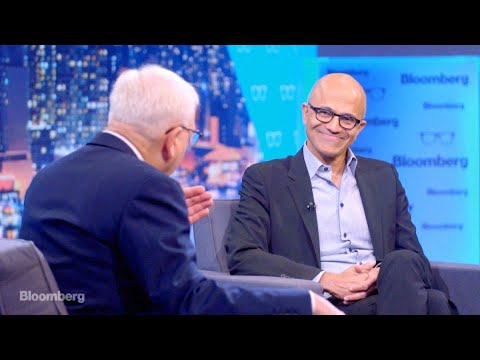
Satya Nadella gave this interview on The David Rubenstein Show on Bloomberg in 2017, discussing leadership at Microsoft, empathy, culture change, and the company’s mobile-first, cloud-first strategy.
Also known as: The David Rubenstein Show: Satya Nadella; Bloomberg interview with David Rubenstein.
Satya Nadella discusses how becoming CEO of Microsoft required him to be himself rather than imitate Bill Gates or Steve Ballmer. He describes the advice he received from both leaders and how their candor shaped his approach.
A major theme is empathy: Nadella explains how raising a son with cerebral palsy changed his perspective, made him a better parent and leader, and taught him to listen more deeply to customers and employees. He connects empathy directly to innovation and business strategy.
He also explains how he changed Microsoft’s culture toward mobile-first, cloud-first, and more open collaboration. Along the way, he talks about LinkedIn, women’s pay and opportunity, and the responsibility of a CEO to drive measurable progress.
David Rubenstein interviews Nadella throughout, with Nadella answering at length.
In his words
“Don't try to be like us.”
“Just be your own.”
“My pursuit is, is there growing sense of empathy for people around me.”
“Empathy is core to innovation.”
“If you do a good job, maybe you will have another job. If not, you won’t.”
Key points
- Bill Gates and Steve Ballmer told him not to try to be like them; he had to be himself.
- His son’s disability reshaped his worldview and made empathy central to his leadership.
- He sees empathy as essential to innovation because businesses must understand unmet customer needs.
- He chose hard, high-attrition assignments like Bing because he was drawn to the challenge.
- Microsoft had to shift from protecting legacy strengths to building for a mobile-first, cloud-first world.
- He pushed Microsoft toward openness and partnerships rather than a zero-sum mindset.
- He learned from a public mistake about women’s pay and tied senior compensation to diversity progress.
Full transcript: Satya Nadella, The David Rubenstein Show interview (2017)
You've now had to follow Bill Gates and Steve Ballmer, two legendary figures. Their clear message was, "Don't try to be like us." Did Steve say, "If you do this well, we'll be happy?" Look, if you do a good job, maybe you will have another job. If not, you won't. The result of having empathy made you a better CEO. My pursuit is, is there growing sense of empathy for people around me. Did you get a standing ovation for what you've done at the company? No, I get a lot of people asking me, "Hey, look, go come home and fix my computer." Would you fix your tie, please? Well, people wouldn't recognize me if my tie was fixed, but okay. Just leave it this way. All right. I don't consider myself a journalist.
And nobody else would consider myself a journalist. I began to take on the life of being an interviewer, even though I have a day job of running a private equity firm. How do you define leadership? What is it that makes somebody tick? You've now had to follow Bill Gates and Steve Ballmer, two legendary figures. Did you feel at that time that you were really ready for the job following those legends, or were you saying, "I, I, I can do a better job than they did"? The best advice I got from both Bill and Steve, I think, helped me a lot, because their clear message was, "Don't try to be like us.
Don't even bother to sort of say, 'Oh, I'm succeeding these people.' Just be your own." In fact, I remember very distinctly even during the interview process, this is for the board was conducting. They asked me, "Hey, do you want to be the CEO?" And I, I said, "Only if you want me to be the CEO." And the feedback I got was, "Well, but people who want to be CEOs are like, 'I want to be CEO.'" I said, "Look, that's not me." And I remember going and talking to Steve, and he says, "Yeah, just be yourself. It's too late to change." Since you've been the CEO 3 and 1/2 years, the stock is up about, I guess, it's about a 120%. When you go to your annual shareholder meetings, do you get a standing ovation for what you've done? Do you get
No, I get a lot of people asking me, "Hey, look, go come home and fix my computer." Okay. You are a native of India. What part of India? I was born in Hyderabad, which is in the central part of India. And so growing up, your parents doted on you, I assume. Yeah, they did. And they told you you were going to be prime minister or something important in the country. What did they want you to be? They just wanted me to stop playing cricket and take my studies a little more seriously. Now, you were an avid cricket player. Is that right? Yes, that is correct. I was in love with it, yeah. And when did you realize you weren't going to be a professional cricket player? Pretty soon, you know. Quickly I realized that at best
I would play, you know, what is considered perhaps first-class cricket in India, but I was not going to go much further than that. But, you know, then that's when my dad, in fact, I remember one of the big decisions that changed my life was, you know, my entire outlook was so provincial when I look back at it, which is, "Hey, I want to stay in Hyderabad, maybe study economics and political science and work for a bank." That was about the extent of my ambition. He looks at me and he says, "What are you doing? You got to get out of this place." And so he pushed me out to get to an engineering school, and that pretty much, of course, defined the trajectory afterwards. Your father was a member of the senior civil service, which was an important position, I guess, in India. Is that right?
Yeah, my dad was a very different guy than me in terms of, let me say, his academic prowess. So, it is always humorous when you look at my report cards and he says, "Oh, I couldn't, I don't understand how anybody can have these kind of marks." But the nice thing about it was he would say it in such endearing ways that it never made me feel bad. You mean the marks weren't high enough or weren't— Not high enough. They weren't high enough. Because, yeah, the guy had never met an exam he didn't ace, as he would say. Okay. And so he was like, he—it is astounding to me that he would have a son who couldn't ace an exam. Now, your father's still alive? Yes. And he must be very proud of what you've achieved. Not enough. So, you went to college in India and
then you decided to get graduate school in the United States. So, where did you go? I went to University of Wisconsin-Milwaukee for my computer— That's when I switched from electrical engineering to computer science. But when you're in India, University of Wisconsin-Milwaukee can't be that well known in India. So, how did you happen to wind up there? I'd never been west of Bombay quite frankly and then I showed up in Milwaukee. Did you have a winter coat or what? That was my first very valued possession in life, a winter coat, which is very important. Unfortunately, I picked up this bad habit of smoking in India in college and the one nice thing about going to school in Milwaukee is you, if you're a smoker, you had to go out in the winter and smoke. And that one winter in Milwaukee cured me of my smoking habit. Oh, good.
So, you got a job after you graduated at Sun Microsystems, and what was your job there? I was a software developer. Okay. And then you got recruited to go to another company called Microsoft, and that was in 1992. That's right. So, but you also had applied to go to the University of Chicago School of Business. So, how did you decide to do one or the other? You know, quite frankly, David, I was very committed to saying, "Oh, I want to go to the business school. Maybe, who knows, maybe even go to Wall Street." Aha, that was sort of my the highest calling of mankind, right? Says David Rubenstein. Right, right. And I thought, wow, maybe that's what I should do. And then, somewhere along the lines I started talking to people and I
said, hey, why would you do that? You're in tech, and you should really come back. It was an amazing time because Windows NT, which eventually became our server business and what have you, was just starting out, and I subsequently went and did some combination of part-time and other courses and actually finished my MBA, which I find stunning in my life. Were commuting, in other words, you were working and then on weekends you were commuting to the University of Chicago, and that must have taken a lot of energy to do both, right? Oh, it was crazy. So, you're beginning your ascent up, but you're dealing with some personal issues. Your first child was born with cerebral palsy, and he is now 21 years old. So, how did you realize that was going to change your life, and how have
you dealt with that issue? Yeah, even I was 29 years old when Zane, our son, was born. And if you had even asked me, maybe even an hour before he was born, what was going through my head, it was all about, oh, is the nursery going to be ready? What's going to happen to our weekends now we have a son? And when will Anu, my wife, get back to her job and so on. But, obviously everything changed that night. He was born because of an undetected in utero distress asphyxiation with severe brain damage, and that led to cerebral palsy, and he's quadriplegic now. Um,
The first, I would say, David, maybe even two years or more even, I was more about like, why did this happen to me? What happened to us? And all of these plans that I had are now all been thrown up in the air and changed. Um, whereas Anu, my wife, what came naturally to her as a mother was she said, "Okay, I'm not going back to my job. I'm going to really care for my son, drive him around for the therapy after therapy." And I watched that without schooling me. I got schooled, that nothing happened to me.
What happened was to my son, and that it was time for me to understand that, realize that, see life through his eyes, and then do my duty as a father. That to me, perhaps, you know, it didn't come in one moment. It's something that I think took time. But as I figured it out, it changed me both as obviously a parent, but also who I am today and how I approach everything. Now, your wife was trained as an architect. That's right. And she's given up doing that for a while. That's right. Now, you have two daughters. One of your daughters has severe learning disabilities as well. And how did that affect you and your wife? In fact, one of the things that happened because of our son was,
we built up a tremendous community of people, whether this was the therapists or other parents which, you know, of children with disabilities. And so, we were involved in that community. By the time our youngest daughter came into our lives, I must say we had the richness of this community to support us. And it turned when we recognized very early on—and Anu and I, and Anu in particular, was very quick to realize—that she will need additional help. And so, we found the school actually in Vancouver, BC, which was all around neuroplasticity. The idea was to—you can train your brain
to learn. So, instead of compensating. And so, we decided that, you know what, we're going to move the family to Vancouver. Zane was going to stay with me in Seattle. My daughters and my wife were going to live in Vancouver. We were going to commute again over the weekends. But, the thing that all, quite honestly, that is where it came all naturally to us, because in some sense Zane had taught us what it takes to give, you know, people with disabilities the best shot. And so, it's something that we took on. And your son lives with you now? Yes. And one of the qualities that you say you got from all this was empathy, and that the result of having empathy made you a better CEO and a better person. Is
that fair? Yeah, in fact, when I look at empathy, most people think empathy is just something that you reserve for your life and your family and your friends or what have you. But the reality is I think it's an existential priority for a business. Because if you look at it, like what is our business? Our business is to meet unmet, unarticulated needs of customers. There is no way our innovation to meet unmet, unarticulated needs is going to come about if we don't listen. Not just listen to the words, but go deep to understand what the needs are behind it. So, I think empathy is core.
To innovation. Um, and life’s experience, if you listen and you learn from, teaches you. I mean, I wouldn’t claim, as I’ve sort of even talked about, it with any innate capability of empathy that I was born with. If anything, it’s life that has taught me. Uh, and if anything, my pursuit is every year is a growing sense of empathy for people around me. What did Steve say? If you do this well, we’ll be happy. If you don’t do it well, you might not get another job. One of the things that is amazing of both Bill and Steve is their candor. It’s not like they sugarcoat anything. They’re very, very honest about most things in life or everything in life. And they were so very clear. Look, if you do a good job, maybe you will have
another job. If not, you won’t. You’re rising up in Microsoft. You’re running the Business Solutions division at one point. But then they say to you, we’d like you to run the search business called Bing. And did you say you can’t compete against Google? I don’t want to do that. Or did you say, “No, I’m happy to do that.” Ha. You know, it is, um, I had just, um, uh, been promoted, uh, to lead our Business Solutions, um, uh, team. And, um, I mean, I was, I was loving that job. It’s something that I’d
aspired to do. And, um, and Steve comes around and he says, “Hey, you know what? I have an idea for you. I think you should go run this, uh, group, uh, that’s got high attrition. And we have a very tough task ahead. Uh, and I don’t know whether it’s a good career move. But, uh, yeah, I need help. And, um, you know, think wisely and choose.” And I was like, “Wow, this is an interesting choice, uh, in front of me.” And I remember very distinctly, um, you know, going that night, uh, to the building in which, uh, the Bing team and our search team was housed. Um, and it was, what? Maybe 9:00 or so. And the parking lot was full. People were
in. I said, “Wow, what’s, what’s the deal here? I mean, these people are like working, uh, and inspired.” And, uh, and so I said, “Well, I got to join this team. I got to like the, the, the fight, uh, that they showed, uh, caused me to not take the easy path, uh, and get in.” Okay. What did Steve say? If you do this well, we’ll be happy. If you don’t do it well, you might not get another job? That’s correct. And that was, you know, Steve was one of the things that it’s amazing about Bill and Steve is, uh, their candor. Uh, it’s not like they sugarcoat anything. Uh, they’re very, very honest about most things in life or everything in life. And they would say very clearly, “Look, if you do a good job, maybe you’ll have another job. If not, you won’t.”
So, you did a pretty good job, and then they came along and asked you to run another business which was not that competitive at the time, and that was your cloud computing business. How did it happen that Amazon, uh, which was not a computer company, more or less, became a giant in cloud, and Microsoft right nearby wasn’t a giant there? The interesting thing is what happens when a company becomes successful is this beautiful virtuous cycle that gets created between your concept of product, your capability, and your culture. Right? You really have all these three things falling into gear, and they’re working super well. But then, what happens is the concept that made you
successful runs out of gas. It’s not growing anymore. You now need new capability. And in order to have that new capability, you need a culture that allows you to grow that new capability. Right? We, our server business was growing strong double digits. It was a high margin business. Uh, and you look around, uh, you know, uh, on the other side of the lake, uh, here is a very low-margin business, uh, called the cloud, and people would look at that and say, “Why would we do that, uh, when we have such an amazing fast-growing, uh, uh, high-margin business?” And that, I think, is the challenge. And so, to be able to see these secular trends long before they become conventional wisdom,
change your business model, change your technology, and change the product is the challenge of business. Uh, you know, in tech, it’s unforgiving, but quite frankly, now that tech is part of every business, I think all of us have to deal with it. So, you get to be the CEO of this company. You’re following two legendary figures. How do you go to them and say, “By the way, a lot of things you did, I don’t want to do anymore. I’m going to change things.” I was a consummate insider, right? I’d spent 25 years, 22 years or so, when I became CEO, um, growing up in the company that Bill and Steve built. Uh, I understood like the back of my palm all the things we got right, and all the things we got wrong. Um,
and I had a point of view on what I wanted to do if I was going to become CEO. We now need to make Microsoft thrive in a mobile-first and a cloud-first world. It was not about trying to criticize our past or praise the past. Uh, it was about what do we do in the future. One of the things you tried to do and change the culture was to change what was known as a very proprietary culture at, uh, Microsoft. Microsoft said, “This is the way we do things. We don’t want to cooperate with other firms necessarily, competitors or other kinds of firms.” How did you change that culture? I said, “Look, let me not view things as zero-sum. If anything, let me approach, uh, even who are our traditional competitors, and say, ‘Well, customers are heterogeneous. They use some of what we do and some of what you do. Let’s
"Figure out a way to combine forces where it's market expansive and it satisfies customers." So, at least that's how I've approached it. Uh, and it's a lesson I learned in my early days at Microsoft. Historically, Windows and Office were your two cash cows. They are still the biggest source of profit? Absolutely. So, after those two, and you suspect they'll be major sources of profit for a long time. Absolutely. But after that, you have other things. You spent $26 billion, the biggest acquisition ever for Microsoft, to buy LinkedIn. What does LinkedIn have to do with Microsoft? If you look at it, we have a billion users of Windows and Office or Microsoft 365. And what is the common thread there? They're all professionals. Uh
They're all people who are trying to get things done. So, we have the professional cloud and the professional devices in the world. And the vision was to combine that with the professional network of LinkedIn. Uh, in fact, if you look at some of the integrations that we have since launched, uh, you can be in Outlook, uh, you can get an email—I can get an email from David Rubenstein, I can go look up your LinkedIn profile, which I hope you have. Uh, I'll get one today, but yes. And then sort of look up uh, all of the connect mutual connections we may have. So, the idea that the professional network and the professional content can be brought together, I think ultimately can be a
big driver of productivity. So, that is one. But one of the other pieces, which has been a real game-changer for us, is LinkedIn is the uh way people do business-to-business sales. And if you want to be able to reach customers and sell, this integration is going to be a game-changer. Same thing with talent management. So, I think we have lots of synergies between the products that are now coming through. You gave a statement about women's pay. I just gave such an absolute nonsensical answer. When I talked to women who are very close to me, very senior, very successful women uh that are key to Microsoft, and heard even their own personal experiences, that's when it struck me. Did you hear from your wife about that?
Absolutely. My mom and my wife. Almost everything you've done since you've been CEO last 3 and 1/2 years has worked perfectly. You know, the stock is up, the market value is up, everybody likes you. The only thing that I could find that anybody criticized you for was you gave a statement about women's pay at one point and you correctly, I think, changed your position the next day, but can you explain what happened? Absolutely. I was asked about, you know, pay equity. In fact, you know, I just gave such an absolute nonsensical answer which Maria Klawe who was interviewing
me was kind enough to correct me while I was on stage itself because I was answering a question literally using some past—I mean, my own personal experience without understanding the broader context, the depth of that question. Which is, what is a person like me who is a CEO of a company doing to make sure that one, women can fully participate in our companies and in our economies; there is equal pay for equal work, and more importantly, there is equal opportunity for equal work. That was the real question. It was not about like, okay, what worked for you and what
career advice do you have for me? It was a great learning moment for me. It's something that I've obviously taken back. In fact, when I talked to women who are very close to me, work, you know, very senior, very successful women who are key to Microsoft and heard even their own personal experiences, that's when it struck me how, you know, the job of a CEO in particular is to make sure that everyone, whether it's gender diversity or ethnic diversity, can first come into the company, do their best work, so that we can then serve our customers. So, that's a realization which I thought I had, quite frankly, but I was—I'm glad I messed up so publicly because I think I internalized
the lessons from it. Did you hear from your wife about that? Absolutely. From, at that time, my mom was alive. For my mom and my wife, my wife had to give up her career because of our son. But in my—even in my mom's case, she struggled. She, in fact, now I realize it a lot more than I even did, obviously growing up, was the trade-off she had to make where the system that she was working in did not support her re-entry into the workforce after, you know, she had both myself and my sister. So, you have, um, about 125,000 employees, something like that? So, what percentage are male, what percentage are female, and how many
senior women do you have? Technology is not a place where a lot of women have risen to the top yet, relatively speaking. In fact, one of the things that we have made some good progress on is on the women's representation, which we have a long way to go. I mean, you got to remember that in tech we have a particularly tougher issue because of our technology disparity in terms of gender diversity. But let's start with the progress which is: in the last year we made—we've gone from around, you know, we improved to 27.7% of women coming into the organization, which is around two points more than historical. And on the technology side, where we've improved by four points. So,
that's, I would say, movement in the right direction, but not enough, obviously. One of the other things our board also did was to change the compensation system for me as well as my direct reports to say, "Look, numeric progress, besides all the work that we may do, programs we may have in the talk, let's even tie compensation of the senior most people, including the CEO, to real numerical progress," and so we're doing everything. But quite frankly, it's going to take continuous vigilance, continuous push, and it's a top-of-mind issue for all of us. You've only been doing this three and a half years, which is a relatively short tenure for Microsoft CEOs. How many more
Years. Would you like to do this? Uh, you know, I have been at Microsoft now for 25 years, and I think the thing that I feel that gives me that source of energy is really that sense of purpose of the company. Because I, quite honestly, it's not—I don't know how I'll market—it's probably not even up to me as to how many years I will be there, and I think it's going to be fun for me to do it each day, and it's a real privilege to do it each day.
From YouTube captions, lightly punctuated for readability. Timestamps link to the video above. Errors are possible.
Cite this recording
Satya Nadella, “The David Rubenstein Show interview (2017)”, 2017. Transcript and video: Thinkers Archive, https://thinkersarchive.com/satya-nadella/leadership-david-rubenstein-show-2017/
Quoting a passage? Link to its exact moment: every timestamp above has its own anchor (for example https://thinkersarchive.com/satya-nadella/leadership-david-rubenstein-show-2017/#t-141).