Satya Nadella on Leadership
Satya Nadella sees leadership as the work of being authentically yourself, building a learn-it-all culture, and using empathy to drive better judgment, innovation, and change.
- Be yourself as a leader instead of imitating predecessors.
- Empathy is a practical leadership capability, not a soft extra.
- Great cultures move from know-it-all behavior to learn-it-all behavior.
- Leadership includes protecting confidence while demanding growth and results.
- Lead change by being bold, staying relevant, and keeping humans in control.
“I feel like as a leader, sometimes you get to speak from both sides of the mouth, which is I need growth and I need profit.”Stanford GSB conversation, 2018 · 27:01
Leadership starts with being yourself
Nadella’s first principle is that a leader cannot succeed by copying someone else. When he became CEO, the key advice he carried forward was not to imitate the leaders before him but to lead in his own way. That makes leadership less about style mimicry and more about clarity, self-knowledge, and conviction.
He also describes leadership as future-oriented. His focus was not on replaying old arguments about the past, but on deciding what the company needed to become next. That is a useful lesson for any leader taking over a team or institution: inherit the past honestly, but lead toward the future.
This helps explain why purpose matters so much in his approach. He returns to the idea that energy for leadership comes from a sense of mission, not from holding the title itself.
Empathy is a core operating skill
For Nadella, empathy is not sentimental language. He treats it as a disciplined way of understanding other people deeply enough to serve them well, whether they are family members, colleagues, or customers. He describes his own pursuit as expanding his sense of empathy for the people around him.4
He ties that outlook to leadership effectiveness. In his view, empathy begins with respect for another person’s perspective, history, and circumstances. Without that starting point, leaders become less able to listen, less able to learn, and less able to understand unmet needs.5
This is one reason empathy connects directly to innovation in his thinking. If leaders do not understand what others are going through, they will miss what products, policies, or decisions are actually needed.45
Culture improves when people become learn-it-alls
Nadella’s best-known cultural idea is simple: strong organizations learn faster when they stop acting like they already know everything. He frames the shift as moving away from know-it-all behavior and toward learn-it-all behavior. That changes how people ask questions, receive feedback, and adapt.67
He also links culture to inclusion. In his view, a culture is only truly healthy when people feel included, because inclusion determines whether people can contribute fully and whether the organization can actually learn from them.
This matters for leadership because culture is not separate from performance. A leader who creates psychological room for learning and inclusion gives the organization a better chance to improve, especially during periods of technological or strategic change.6
A leader must build confidence and still demand performance
Nadella’s view of leadership includes a tension many managers mishandle: people need confidence, but organizations also need results. He talks about leadership judgment as knowing when to support a teammate’s confidence and when to push for more. That balance is part of what makes leadership hard.9
He does not present high standards and human support as opposites. Instead, he sees leaders as responsible for helping people grow while also being honest about outcomes. His account of taking on difficult assignments shows a willingness to accept real accountability: perform well and you earn the next chance; fail and you may not.
In practical terms, this means leaders should avoid empty encouragement. Confidence-building matters, but it has to be connected to real learning, real work, and real execution.9
“I feel like as a leader, sometimes you get to speak from both sides of the mouth, which is I need growth and I need profit.”Stanford GSB conversation, 2018 · full transcript →
Lead change by choosing relevance over ego
Nadella often describes leadership in changing industries as the ability to stay relevant. The goal is not survival for its own sake, but continued usefulness in a world that keeps shifting. That mindset pushes leaders to ask what new reality they must respond to, not what past identity they want to preserve.11
He is also explicit that strategy should not come from envy. Leaders should not chase competitors just because they feel threatened. They should act where they have permission to win and where they can genuinely do better for customers.1213
That is why boldness in his framework is paired with execution. Leaders need the courage to imagine a different future, but they also have to earn credibility step by step in the real economy.

“…longevity is not a goal, relevance is…”The Circuit with Emily Chang panel, 2025 · full transcript →
Technology leadership should enlarge human agency
In Nadella’s later discussions of AI, leadership becomes inseparable from stewardship. He argues that major technologies should be used to expand what people can do, not to diminish human ambition or remove human control.
That principle sharpens into a test for responsible leadership: systems should serve people, and people should remain in control. This is especially important as AI becomes more autonomous, because trust, governance, and oversight become central leadership responsibilities.
So even when the technology is advancing quickly, his standard for leaders remains human-centered. The point of innovation is not automation alone; it is helping people and organizations achieve more with tools they can trust.
Nadella on leadership, in his own words
“My pursuit is, is there growing sense of empathy for people around me.”
“…longevity is not a goal, relevance is…”
Where to watch
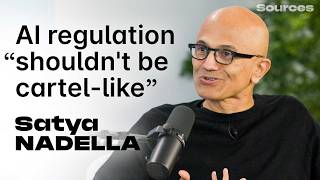
 Satya Nadella on Leadership and Empathy: Build a Learn-It-All Culture2018 · 54 min · full transcriptBest single conversation for his leadership philosophy: empathy, culture, confidence, mission, and the learn-it-all idea.
 Satya Nadella on Leadership: Empathy, Culture, and Change2017 · 24 min · full transcriptShows how he became himself as CEO and why empathy sits at the center of his leadership.
 Satya Nadella on AI Phase Shifts: OpenAI, Agents, and the Next Stack2025 · 85 min · full transcriptStrong on strategic leadership: when to move, where you have permission to win, and why envy is a bad guide.
 Satya Nadella on Microsoft's AI Future: Dream and Execute2025 · 43 min · full transcriptUseful for his view that leaders must dream, execute, and stay relevant through major shifts.
 Satya Nadella on AI Revolution: Human Agency and the Future of Work2025 · 24 min · full transcriptExtends his leadership thinking into the AI era with a focus on human agency and mission.
 Satya Nadella on Copilot and AI Products: Trust, Agents, and ROI2025 · 26 min · full transcriptBest for how leadership should handle trust, control, and responsibility as AI becomes more capable.
Questions people ask
- How did Satya Nadella change Microsoft’s culture?
- What advice did Satya Nadella say he would give his successor?
- What does Satya Nadella say about strategy and permission to win?
- What does Satya Nadella think it takes to build empathy at Microsoft?
- Why does Satya Nadella still want to lead Microsoft?
- What did Satya Nadella say leaders need to do for employees?
Sources
Every quote above, word for word from the transcripts. Numbers match the text.
“My pursuit is, is there growing sense of empathy for people around me.”
“It's a great question, because in fact, it is such a big word, and it is hard. In fact, even recently at Microsoft, we realized that it's important for us to even understand what are the necessary conditions to even develop empathy. So one of the words we have put into our sort of parlance is respect. For example, if you don't start from a place so having some respect for the other person's views, where they come from, their complete history, it's really hard to develop empathy.”
“Let's not be know-it-alls, let's be learn-it-alls.”
“…go from being the know-it-alls to learn-it-alls…”
“I feel like as a leader, sometimes you get to speak from both sides of the mouth, which is I need growth and I need profit.”
“…longevity is not a goal, relevance is…”
“…you shouldn't do things out of envy…”
“Sometimes it's okay to fast follow, and it worked out. But you shouldn't do things out of envy. That was one of the hardest lessons, I think, we've learned. Uh, do it because you have permission to do this, and you can do it better. Like, both of those matter to me. The brand permission, like, uh, you know, Geoffrey Moore once said this to me, which I say, "Hey, why don't you go do things which your customers expect you to do?" I love that, right? Which is cloud was one such thing, which is the cust you know, in fact, when I first remember showing up in Azure, people would tell me, "Oh, it's a winner-take-all.”
How this guide was made: drafted with AI from the full transcripts of the recordings cited, then checked: every quotation must match a transcript word for word and be the speaker's own words, and an independent review gates accuracy. Methodology and corrections.