Satya Nadella on Platform Shifts
Satya Nadella sees platform shifts as moments when computing changes at every layer, and leaders win by recognizing the new stack early, building across it, and focusing on real customer value.
- Platform shifts remake the whole stack, not just one product category.
- The job is to stay relevant by catching new waves early without copying rivals out of envy.
- AI is a platform shift on the scale of the PC, web, cloud, and mobile, with impact from infrastructure to apps to work itself.
- Winning requires a platform approach: infrastructure, tools, data, security, and application builders all matter together.
- The real measure of a shift is broad economic and customer impact, not technical novelty alone.

“We went from the bicycle to the steam engine with the launch of ChatGPT.”Microsoft Build keynote, 2023 · 2:12
Platform shifts change the whole architecture of computing
Nadella treats platform shifts as deeper than product cycles. In his framing, they reset how software is built, how users interact with computers, and where value in the stack gets created. That is why he describes AI as a moment when every layer of software is being permanently altered, not a feature add-on to existing tools.12
He connects this to Microsoft’s long history of living through major transitions, from earlier developer platforms to cloud and now AI. His point is that some moments are visibly different in kind, with a broader and deeper scope than normal upgrades. He places the current moment in that category.34
Microsoft’s test is relevance, not longevity
Nadella explains strategy during a platform shift with a simple standard: stay relevant to how the world is evolving. He does not describe success as preserving the old franchise. He describes it as doing useful work in the next wave of computing.56
That leads to a disciplined view of competition. He argues companies should not chase trends because rivals did. They should act where customers expect them to play and where they have a real right to win. In his telling, strong strategy comes from understanding structural position, customer permission, and then executing the obvious things well.789
AI is the latest major shift, and it reaches from infrastructure to expertise
Nadella puts AI in the same class as the PC, the web, cloud, and mobile. He uses unusually strong language to signal the size of the break, arguing that the launch of ChatGPT marked a dramatic acceleration in what computers can do.101
What makes this shift important for him is not only better models. It is the way AI can move computing from information access toward expertise access, from tools you operate manually toward systems that assist, reason, and act. That is why he talks about runtimes, copilots, devices, and application extensibility together rather than as separate announcements.111213
He also emphasizes that AI broadens who can do sophisticated work. In his view, the shift lowers barriers for more people while expanding what advanced builders can create, which is a hallmark of a true platform transition.1415
“We went from the bicycle to the steam engine with the launch of ChatGPT.”Microsoft Build keynote, 2023 · full transcript →
The next shift is toward agents that work across apps and workflows
Nadella’s more specific prediction is that platform shifts now move application logic upward into an agentic layer. Instead of software staying trapped inside one SaaS application at a time, agents will call tools, query systems, and orchestrate work across many apps and data sources.161718
That is why he talks about an open agentic web and insists the future is not about one model or one endpoint. The important unit is the full system: multiple models, agents, data, workflows, and the rails around them. In this view, the new platform is open, interoperable, and orchestration-heavy.192021
For builders, this changes what must be designed. The hard part is no longer only the interface of a single application. It is the coordination layer across business processes, long-running tasks, permissions, and grounding data.222324
Winning a platform shift means building the stack and proving real-world value
Nadella repeatedly returns to a platform approach. He argues that major shifts reward companies and developers who build coherently across infrastructure, developer tools, models, security, and application extensibility. That is how he describes Microsoft’s role in cloud, AI, and the emerging agentic web.231325
But he is equally clear that technical change is not the final scorecard. A platform shift matters only if it creates broad impact in the economy and in everyday work. He asks whether the technology changes real productivity and growth, not just benchmarks or demos.262728
This is why he often frames AI deployment as workflow redesign for knowledge work. The opportunity is large, but the value comes when organizations actually change how work gets done and when builders create applications that people across sectors can use.293031
Nadella on platform shifts, in his own words
“We went from the bicycle to the steam engine with the launch of ChatGPT.”
“…we're just about getting into these middle innings of another platform shift…”
Where to watch
 Satya Nadella on AI Phase Shifts: OpenAI, Agents, and the Next Stack2025 · 85 min · full transcriptBest single explanation of how Nadella thinks about platform shifts strategically: permission to win, avoiding envy, and reading new waves.
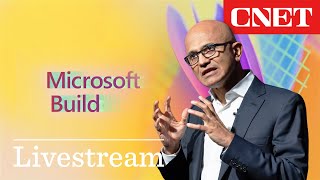 Satya Nadella on AI Platform Shift: Build 2023 Vision2023 · 133 min · full transcriptHis clearest keynote case that AI is a full platform shift changing every layer of the software stack.
 Satya Nadella on SaaS to Agents: The Next Platform Shift2025 · 11 min · full transcriptMost concise statement of what the next shift means for application architecture: from SaaS screens to agents orchestrating work.
 Satya Nadella on AI Transformation: Build the Future Stack2024 · 53 min · full transcriptShows how he maps the AI shift across the full stack, from infrastructure and runtimes to copilots and end-user experience.
 Satya Nadella on Agentic Software Development: Build the Full Stack2025 · 119 min · full transcriptBest view of his latest thinking: the agentic web as the next platform and the need for open, scalable rails.
 Satya Nadella on Universal Windows Apps: Mobile First, Cloud First2014 · 179 min · full transcriptUseful older reference for how he framed an earlier platform shift around mobile-first, cloud-first and developer platforms.
Questions people ask
- What advice did Satya Nadella say he would give his successor?
- What did Satya Nadella say about AI turning information access into expertise access?
- What did Satya Nadella say about Copilot agents and async work?
- What did Satya Nadella say about Microsoft Copilot democratizing expertise?
- What did Satya Nadella say about how AI is changing software development?
- What does Satya Nadella say about strategy and permission to win?
Sources
Every quote above, word for word from the transcripts. Numbers match the text.
“Every layer of the software stack is going to be changed forever.”
“And so it's an exciting time. And in fact, every layer of the software stack is going to be changed forever. And no better place to start than the actual developer stack, right? We as developers, how we build is fundamentally changing. In fact, when I think about how we build, I look, I think about first CodeSpaces, right? Being able to set up that environment in seconds versus minutes, a Dev box, you know, instead of waiting for a day for your managed Dev box to be set up, you have it in less than an hour.”
“You know, developer conferences are always most exciting, most fun when there's these fundamental changes that you can sense in the air. You know, I've marked all my adult life by coming to PDCs and Builds for the last three decades. I still remember, you know, distinctly the first time Win32 was discussed, I guess it was ‘91, .NET, Azure, right? These are moments that I marked my life with. And it just feels like we're yet again at a moment like that. It's just that the scale, the scope is so much deeper, so much broader this time around, right?”
“…we're just about getting into these middle innings of another platform shift…”
“…longevity is not a goal, relevance is…”
“It's kind of fascinating. This is our fiftieth year, and I think a lot about it, right? And the way to think about, you know, I think longevity is not a goal; relevance is. And so, think the thing that I have to do, and all 200,000 of us have to do every day is: Are we doing things that are useful and relevant for the world as we see it evolving, not just today, but tomorrow? Like, we have to basically, you know, and we live in an industry where there's no franchise value, right? So, that's the other hard part, which is, if you take the R and D budget that we will spend this year, it's speculation on what's going to happen five years from now. And so, you got to basically go in with that attitude, that saying, Look, we are doing things that we think are going to be relevant.”
“…do more of the former and less of the latter…”
“…you shouldn't do things out of envy…”
“Sometimes it's okay to fast follow, and it worked out. But you shouldn't do things out of envy. That was one of the hardest lessons, I think, we've learned. Uh, do it because you have permission to do this, and you can do it better. Like, both of those matter to me. The brand permission, like, uh, you know, Geoffrey Moore once said this to me, which I say, "Hey, why don't you go do things which your customers expect you to do?" I love that, right? Which is cloud was one such thing, which is the cust you know, in fact, when I first remember showing up in Azure, people would tell me, "Oh, it's a winner-take-all.”
“We went from the bicycle to the steam engine with the launch of ChatGPT.”
“I think that our industry has to have a common vision. It was a time that connected us to incredible things. My name for this vision is, information at your fingertips. And three decades later, we find ourselves in a new era. One where access to information becomes access to expertise. From the farm, to the lab, from the boardroom, to the classroom, this new generation of AI is for everyone, everywhere. Now, anyone can save time with a personal assistant. With GitHub Copilot, I’m saving about 50% of time.”
“We believe the Windows Copilot Runtime will be for AI.”
“We're introducing more than 50-plus new products and partnerships to create a new opportunity for you. We’ve always been a platform company and our goal is to build the most complete end-to-end stack from infrastructure, to data, to tooling to the application extensibility so that you can apply the power of this technology to build your own applications. And so today I want to highlight our top news for this event across every layer of this Copilot stack. So let's dive right in with infrastructure. You know, we have the most complete scalable AI infrastructure that meets your needs in this AI era. We're building Azure as the world's computer. We have the most comprehensive global infrastructure with more than 60-plus datacenter regions, more than any other cloud provider.”
“It's lowering both the floor and raising the ceiling at the same time…”
“That brings us to the very top of the stack. Microsoft Copilot. We built Copilot so that you have the ability to tap into the world’s knowledge as well as the knowledge inside of your organization and act on it. Now, Copilot has had a remarkable impact. It's democratizing expertise across organizations. It's having a real cascading effect. Right. In fact, it reminds me like of the very beginning of the PC era where work, the work artifact and the workflow. We're all changing. And it's just, you know, really having broad enterprise business processes impact. It's lowering, I always say this, it’s lowering both the floor and raising the ceiling at the same time, for anything any one of us can do.”
“I think that something of that scale, or if not more, is going to happen again with the application logic.”
“I have a basket of my agents…”
“The best grounding data is all in there…”
“…building out this open agentic web at scale…”
“It's not about any one of them…”
“But still, picking a model can be a bit of a chore, and you need to be able to route your queries to the right one fast. And so we are making that easier, too. Our new model router will automatically choose the best OpenAI model for the job. No more sort of those manual model selections. An approach today, though, goes from having apps that you built or agents you build only bind to one model to truly becoming multi-model.”
“With Copilot Studio, anyone can build copilots that have agent capabilities and work on your behalf, and independently, and proactively orchestrate tasks for you. Simply provide your Copilot a job description or choose from one of our pre-made templates and equip it with the necessary knowledge and actions, and Copilot will work in the background and act asynchronously for you. That's I think, one of the key things that's going to really change in the next year where you're going to have Copilots plus agents with this async behavior. You can delegate authority to Copilots to automate long running business processes.”
“So that was a quick, comprehensive, whatever you want to call it, walk through the full stack and how we're creating new opportunity for you across the agentic web. We're taking, really, a systems approach, a platform approach, which you can expect from Microsoft across every layer of the stack, whether it's GitHub and GitHub Copilot, enabling an open ecosystem for the software development lifecycle, Microsoft 365 Copilot and Teams and Copilot Studio, enabling agents for every role and business process, and an agent factory in Foundry, enabling you to build any AI app, any agent, using any data, all running on world class infrastructure.”
“And all of this on a robust set of rails for management, identity, and security. Ultimately, though, all of this is about creating opportunity to fuel your ambition. I think back to some of the developers I've had the chance to meet over the course of the last year. Right? A father in Spain using Foundry to help speed the diagnosis of rare diseases like the one affecting his son. A startup in South America building an app to gamify wellness. An airline in Japan using Phi to help flight attendants complete reports even when they're 30,000 feet above.”
“Our vision, simply put, is to thrive in this world of mobile first, cloud first…”
“The real benchmark is, is the world growing at 10%.”
“The real test here, Emily, is what happens in the real economy?”
“It's not for technology's sake, but it is for that broad impact.”
“This is like lean for knowledge work in particular.”
“At the end of the day, it's not about innovation, that is only useful for a few. It's about really being able to empower that everyone, And it comes down to you all as developers and builders of this new world. For us, it's never, never about celebrating tech for tech's sake. It's about celebrating what we can do with technology to create magical experiences that make a real difference in our countries, in our companies, in our communities. Already, this new generation of AI is having an incredible impact, thanks to all of you, the passion you bring and the hard work you put in.”
“After all, the big winners are going to be people like yourselves who are going to build these applications, not just people who create platforms like us. The winners need to be across every sector of the economy in every part of the world. That's our goal. For us, it's never been about the technology. It's about what people can do with it. And that's what is core to our mission. And I want to leave you with this one real, powerful example. Earlier this year, World Bank conducted a study for students in Nigeria using Copilot. What they found was pretty remarkable. By their analysis, it was the best, most effective educational intervention involving tech.”
How this guide was made: drafted with AI from the full transcripts of the recordings cited, then checked: every quotation must match a transcript word for word and be the speaker's own words, and an independent review gates accuracy. Methodology and corrections.

