Satya Nadella on Productivity
For Satya Nadella, productivity is the real test of AI: it should help people do more with less, turn knowledge into action, and show up in measurable business outcomes under human control.
- Productivity means changing the productivity curve, not just adding new tools.
- Copilot is central because it helps people access knowledge and act on it in the flow of work.
- Real productivity must be measurable in business outcomes like efficiency, operating leverage, and ROI.
- AI productivity only matters if it is trusted, secure, and kept under human control.
- Doing more with less is about amplifying people and organizations, not demanding more effort from them.

“People who use Copilot are spending less time searching for information, they're holding more effective meetings, they're able to collaborate on work artifacts, whether they are Word documents, spreadsheets, emails. All of them have richer context about their role, about their organization so that they can collaborate much more and stay in focus. And of course, we're just getting started. The way to think about this is Copilot will be the new UI that helps us gain access to the world's knowledge and your organization's knowledge. But most importantly, it's your agent that helps you act on that knowledge.”Microsoft Ignite keynote, 2023 · 4:20
Productivity is the point of AI, not a side benefit
Nadella treats productivity as the standard by which AI should be judged. He is not interested in novelty for its own sake; he wants technology that changes how much useful work people and organizations can actually get done. That is why he says the goal is to change the productivity curve, not merely to add another layer of software.1
He also frames this in broad economic and organizational terms. In his view, AI matters when it empowers people in their jobs, communities, and countries, and when it helps organizations achieve more rather than simply automate for its own sake.23
Copilot raises productivity by turning knowledge into action
Nadella’s core idea is that productivity improves when AI becomes the interface between people, knowledge, and work. He describes Copilot as the new UI for accessing both the world’s knowledge and an organization’s knowledge, which means less time hunting for information and more time using it.456
But access alone is not enough. What makes Copilot productive in his framework is that it helps people act on knowledge inside meetings, documents, spreadsheets, email, and other daily workflows. He presents this as a shift from passive software to active assistance in the flow of work.67
This is why he talks about the present moment as the age of copilots and argues that adoption should happen now. He sees AI not as a specialized feature but as the organizing layer across work and applications.8910
“People who use Copilot are spending less time searching for information, they're holding more effective meetings, they're able to collaborate on work artifacts, whether they are Word documents, spreadsheets, emails. All of them have richer context about their role, about their organization so that they can collaborate much more and stay in focus. And of course, we're just getting started. The way to think about this is Copilot will be the new UI that helps us gain access to the world's knowledge and your organization's knowledge. But most importantly, it's your agent that helps you act on that knowledge.”Microsoft Ignite keynote, 2023 · full transcript →
Doing more with less means amplification, not pressure
Nadella connects productivity to a management philosophy: organizations should stop treating productivity as suspicion, pressure, or surveillance. His push to stop endless productivity paranoia suggests that better output comes from better tools and systems, not from assuming people are the problem.11
That is why he repeatedly uses the phrase doing more with less. In his telling, AI is the ultimate amplifier because it changes what applications can do and how work gets delivered, allowing people and teams to extend their capability instead of just working harder.12
He pairs this with a people strategy. Leaders need to help employees learn new skills, do meaningful work, and build human, social, and knowledge capital, because sustainable productivity depends on capable and engaged people, not just efficient processes.13

“When it comes to doing more with less, AI is the ultimate amplifier. It's going to change what an application looks like, what the design language of an application is, and how it gets built and how it gets delivered. We are committed to making the promise of AI real for you and doing this responsibly. We've built the next-generation supercomputers in Azure that are being used by US Open AI as well as customers like Meta to train some of the largest, most powerful AI models. Azure provides almost 2x higher compute throughput per GPU and near-linear scaling to thousands.”Microsoft Ignite keynote and partner announcements, 2023 · full transcript →
Real productivity has to show up in ROI and operating leverage
Nadella does not leave productivity at the level of aspiration. He says AI should improve efficiency and operating leverage, and he wants organizations to connect usage directly to business outcomes. In his view, if AI is productive, leaders should be able to see it in sales, marketing, finance, and other functions.1415
That is why measurement is so important in his framework. He highlights analytics that let leaders correlate Copilot and agent usage with business metrics over time, because productivity claims need to be tied to KPIs rather than enthusiasm.1615
This also changes the implementation challenge. For Nadella, ROI is not only about model quality; it is a change-management problem that reshapes workflows and work artifacts. Productivity gains come when organizations tune AI usage to how work is actually done.1615
Trust, safety, and human control are required for productive AI
Nadella’s view is that AI cannot deliver productivity at scale unless people trust it. He calls trust the biggest issue and puts safety at the center of the platform, which shows that reliability and governance are not separate from productivity but conditions for it.171819
This becomes even more important as AI systems move from answering questions to acting as agents. Nadella likes the potential of autopilot-style systems, but he insists that the critical question is what happens when people must work with the output, review it, and remain responsible for it.2021
So his productivity model is not full autonomy for its own sake. It is human-led augmentation: systems that automate parts of work, stay observable and governable, and remain under meaningful human control. That is how productivity can scale without creating new risks.2119
Productivity grows when AI is tailored to real workflows
Nadella does not describe productivity as coming from one generic assistant dropped into every company unchanged. He emphasizes that organizations need copilots and agents tailored to their own data, workflows, and security needs because no two business processes are the same.22
He extends this to agents that can automate business processes while being grounded in data from Microsoft 365, SharePoint, Fabric, and the web. The implication is practical: productivity rises when AI is connected to the actual systems where work happens.2324
This is also why he sees AI spreading across every product and every app. Productivity is not one destination application; it is a capability woven into the software stack people already use.2510
“GPTs are a new way for anyone to create a tailored version of ChatGPT that's more helpful for very specific tasks at work or at home. And going forward, you will be able to use both plug-ins and GPTs in Copilot to tailor your experience. And it goes beyond that. You will, of course, need to tailor your copilot for your very specific needs: your data, your workflows, as well as your security requirements. No two business processes, no two companies are going to be the same. And that's why today we're announcing Copilot Studio.”Microsoft Ignite keynote, 2023 · full transcript →
Nadella on productivity, in his own words
“We need to stop the endless productivity paranoia.”
“Safety is the most important feature of our AI platform.”
Where to watch
 Satya Nadella on AI in Business: Copilot, agents, and ROI2024 · 76 min · full transcriptBest for understanding Nadella’s current view that AI productivity must produce measurable ROI, operating leverage, and secure adoption.
 Satya Nadella on OpenAI Tools: AI Will Transform Every Microsoft Product2023 · 32 min · full transcriptBest for his blunt test of AI: whether it truly changes the productivity curve in the real world.
 Satya Nadella on Enterprise AI: Doing More With Less2023 · 42 min · full transcriptBest for his broader philosophy of doing more with less and treating AI as an amplifier of human capability.
 Satya Nadella on Copilots and Azure AI: Ignite's age of copilots2023 · 63 min · full transcriptBest for seeing why he thinks Copilot is the new interface for knowledge, action, and daily work.
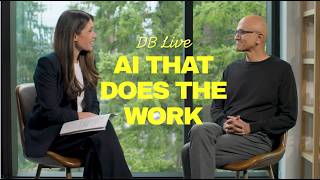 Satya Nadella on Copilot and AI Products: Trust, Agents, and ROI2025 · 26 min · full transcriptBest for the limits of productivity without trust, governance, and human control as agents become more autonomous.
Questions people ask
- What did Satya Nadella say Copilot will do for work and knowledge?
- What did Satya Nadella say about AI and productivity?
- What did Satya Nadella say about measuring ROI from Copilot and AI agents?
- What did Satya Nadella say leaders need to do for employees?
- How did Satya Nadella say Copilot changes work and workflow?
Sources
Every quote above, word for word from the transcripts. Numbers match the text.
“…we need something that truly changes the productivity curve…”
“At the end of the day, though all of this innovation will only be useful if it's empowering all of us in our careers, in our communities, in our countries.”
“Our mission is to empower every person and every organization on the planet to achieve more…”
“Copilot is the UI for AI.”
“Copilot will be the new UI that helps us gain access to the world's knowledge and your organization's knowledge.”
“People who use Copilot are spending less time searching for information, they're holding more effective meetings, they're able to collaborate on work artifacts, whether they are Word documents, spreadsheets, emails. All of them have richer context about their role, about their organization so that they can collaborate much more and stay in focus. And of course, we're just getting started. The way to think about this is Copilot will be the new UI that helps us gain access to the world's knowledge and your organization's knowledge. But most importantly, it's your agent that helps you act on that knowledge.”
“Copilot in the AI era is the coming together, in fact, of all of these, uh, functions.”
“This is the Age of copilots.”
“It's not a question if you should adopt Copilot, but when. And I can give you the answer to when, It's now.”
“Every app is becoming an AI app.”
“We need to stop the endless productivity paranoia.”
“When it comes to doing more with less, AI is the ultimate amplifier. It's going to change what an application looks like, what the design language of an application is, and how it gets built and how it gets delivered. We are committed to making the promise of AI real for you and doing this responsibly. We've built the next-generation supercomputers in Azure that are being used by US Open AI as well as customers like Meta to train some of the largest, most powerful AI models. Azure provides almost 2x higher compute throughput per GPU and near-linear scaling to thousands.”
“And as leaders, we need to re-recruit our employees. Re-recruiting doesn't end when the job offer is accepted. Leaders must continuously help their employees learn new skills or risk losing them. Employees must be empowered and energized to do meaningful work so that they can thrive. To do so, organizations require a new system to build human, social, and knowledge capital across the entire organization. You need to help people feel aligned to the company's mission, purpose, and business priorities. You need to help them connect with each other where they are and wherever they are working. You need to help them continuously build new skills in the flow of work, and you need to have all these things working in harmony to have a workforce that thrives.”
“It improves efficiency. It improves operating leverage. And to do that, we are building our three platforms Copilot, Copilot devices and Copilot an AI stack. That's it. Those are the three platforms. But before I dive into all of the news across the platforms, I want to talk about that something that we are prioritizing above all else. That is security. At this conference, you'll hear us talk a lot about our Secure Future initiative, the progress we are making, the principles of secure by design, secure by default, secure by operations. But most importantly, our commitment to continuous improvement, because this is not just a destination, a stand down, a one milestone thing, we’ll never be done.”
“Our goal is to show how Copilot usage is ultimately directly translating into business outcomes across sales, marketing, finance and more. And there are many, many more examples. This is fundamentally the process because it's really a question of change management. So this is a, think of Copilot Analytics as a tool for all of us to change how work, workflow, and work artifacts, are all getting done. That I think is ultimately how we get ROI. So that's a look at Microsoft 365 Copilot, Copiot Studio, and agents, and autonomous agents that end-to-end system for AI-driven business transformation.”
“After users start using Copilot and all of these agents, one of the fundamental things that all business leaders want to do is to figure out how do we measure ROI. And so today, we are very excited to announce Copilot Analytics. Yeah. You know, if you take, let's say, a sales territory manager, you say they can now correlate the specific Copilot usage to a business metric like their win rate over time. And it's not just Copilot, it's Copilot and all the agents that you built, you can look at their usage and start tuning even the usage, to the business KPIs.”
“I think that trust is going to be the maximum, biggest issue for us.”
“Safety is the most important feature of our AI platform.”
“Because when you sort of build an application at your organizational level, you want to be able to manage AI costs, performance, safety and security. And that's why we are very excited to share that we are bringing really new management capabilities to Foundry. For example, we are introducing AI Reports that will help developers document and share their applications use case and most importantly, eval results. Because I think one of the ways we are going to be able to think about and talk about, and reason about what your application does, is through the evals of the models on which it's built. Safety is the most important feature of any AI app. And we'll continue to ensure we have the best tools to build these secure AI apps, including things like Prompt Shields, so that you can detect and block manipulation of outputs, for your business content.”
“Autopilots are fantastic until you have to do something with the output of an autopilot.”
“…anything that doesn't serve humans or is not in human control is not worth doing…”
“GPTs are a new way for anyone to create a tailored version of ChatGPT that's more helpful for very specific tasks at work or at home. And going forward, you will be able to use both plug-ins and GPTs in Copilot to tailor your experience. And it goes beyond that. You will, of course, need to tailor your copilot for your very specific needs: your data, your workflows, as well as your security requirements. No two business processes, no two companies are going to be the same. And that's why today we're announcing Copilot Studio.”
“And so this is all sort of all available on Foundry. We're excited also introducing a new service to help you simplify the creation of all of these AI powered agents. Our new Agent Service helps developers build, deploy, and scale AI apps that automate business processes. You know, I showed you before how you can use Copilot Studio to build agents just with few clicks. But as developers, you want a code first approach to building an agent, and that's what the agent service really enables. You can build agents that are grounded in data wherever it lives. Public data from the web, enterprise data in Microsoft 365, SharePoint, or you can leverage even Fabric's OneLake to unify your data across all of your clouds.”
“Microsoft Fabric brings all your data as well as your analytic workloads into this one unified experience. Fabric has been our biggest data launch perhaps since SQL Server, and the reception to the preview has been just incredible. 25,000 customers are already using it, and today I am thrilled to announce the general availability of Microsoft Fabric. Let's roll the video. Microsoft Fabric is redesigning how we work with data. By bringing all your data and analytics tools into a single experience with Fabrics Data Lake, OneLake, your Teams can connect to data from anywhere and all work from the same copy across engines.”
“…every product of Microsoft will have some of the same AI capabilities…”
How this guide was made: drafted with AI from the full transcripts of the recordings cited, then checked: every quotation must match a transcript word for word and be the speaker's own words, and an independent review gates accuracy. Methodology and corrections.

