Sell the Why
Lead with the customer's benefit, not the product's features.

“…sell the problem you’re solving, not the product…”Forbes Next1000 Summit interview, 2021 · 11:43
The lesson
Blakely’s selling method starts with the customer’s problem, not with the product description. In her account of learning sales door to door, she says people are quickly filtering for what the interaction will do for them, so the seller has to make the benefit clear fast rather than leading with the object being sold12. That fits the origin of Spanx itself: the company began from a specific frustration she personally felt as a consumer, which gave her a concrete problem to communicate instead of a vague pitch about apparel innovation34.
That focus on the problem shapes how to explain a product. Blakely emphasizes differentiation and being able to explain in a short window why your offer matters and why existing options are not good enough5. In practice, this means connecting your message to the customer’s felt outcome—how they will feel, what improves, or what friction disappears—rather than listing features and hoping they infer the value themselves1.
She also learned that the same message should not be delivered the same way to every person. She describes her door-to-door years as training in adapting to different personality types, and her broader approach shows a willingness to change the form of the pitch while keeping the core benefit intact1. Her Neiman Marcus story is the clearest example: when words were failing, she switched to a live demonstration that made the benefit instantly visible and understandable7.
Honesty is part of the sales method, not separate from it. Blakely argues that customers want a real conversation rather than polished corporate talk, and she says being open about being small and early can make people more willing to help rather than less8910. That approach works because trust grows when the seller sounds like a person solving a real problem instead of a script pushing a product.
Underlying all of this is a mindset of curiosity and courage. Blakely repeatedly pushes past not knowing, asking deeper why-questions, and refusing to let fear of embarrassment control the interaction111213. For selling, that means you keep probing for the root issue, keep refining the message around that issue, and keep finding ways to make the value obvious until the customer truly gets it.
5 principles from Sara Blakely
Lead with the customer’s benefit
Start by naming the problem you solve and why it matters to the other person. If your listener cannot quickly see what changes for them, you are likely talking about the product instead of its value.
“…sell the problem you’re solving, not the product…”
Explain your difference concisely
Be able to say in a short span why your offer is different and why current alternatives fall short. Tight messaging forces you to clarify the real reason someone should care.
“…differentiate yourself and be obsessive about it…”
Adapt the pitch to the person
Keep the core benefit steady, but change the way you communicate it based on who is in front of you. If explanation is not working, demonstration, humor, or a different framing may help the customer understand faster.
“I did it for seven years in a company. I was in an office equipment company where most people, you know, kind of rotated out every four to six months. And I think the things that it taught me, it taught me the importance of differentiating myself. It taught me about what's in it for me. We'd talk about it, WIIFM—that when you get a moment with someone, they're looking for the what's in it for them. And I learned I need to deliver that in my message very quickly or I lose them. Yes, you know, so it wasn't like, "Hey, I'm selling a fax machine." It was like, "Hey, I really believe I can improve your life and improve the quality of what you're doing, because the business, just like yours..." You know, I made it about them. Yes.”
Use honesty to create trust
Talk with people like people, not targets. Being direct about who you are and where you are in the journey can lower skepticism and open doors that polished language cannot.
“…customers want to be talked to and not talked at…”
Keep asking why until you reach the root
Better selling comes from understanding the underlying issue, not stopping at the first surface objection or feature request. Use repeated why-questions to uncover what the customer actually cares about.
“I'm always like why, why, why, why, why—'til I get to the very last why I can get, because that's really where the truth always is. And so why is our, as human beings, the biggest fear failure? Well, it's because we don't want to be embarrassed, right? So it's really ultimately fear of embarrassment, which then led me to fear of what other people think of me is the real root of the issue. So that is where I spent a lot of time working myself. I've been a student of that for, for since I'm 16. I've been working on not caring what other people think about me, and it took me a minute. But I realized that not caring what other people think about me doesn't have to mean I don't care about…”
In her own words
The quotes behind the lesson, word for word from the transcripts. Numbers match the lesson above.
“I did it for seven years in a company. I was in an office equipment company where most people, you know, kind of rotated out every four to six months. And I think the things that it taught me, it taught me the importance of differentiating myself. It taught me about what's in it for me. We'd talk about it, WIIFM—that when you get a moment with someone, they're looking for the what's in it for them. And I learned I need to deliver that in my message very quickly or I lose them. Yes, you know, so it wasn't like, "Hey, I'm selling a fax machine." It was like, "Hey, I really believe I can improve your life and improve the quality of what you're doing, because the business, just like yours..." You know, I made it about them. Yes.”
“…sell the problem you’re solving, not the product…”
“…my inspiration was my own butt…”
“I am just a frustrated consumer.”
“…differentiate yourself and be obsessive about it…”
“I went in and halfway through the pitch, I could tell I was losing her. So I said, you know what? Will you please come to the bathroom with me? And she was like so buttoned up. I mean, Neiman Marcus, like her pen matched her belt that matched her shoes. And she was like, what? You're like, what am I going to do in the bathroom? I was like, just follow me in the bathroom and show you my own panty line. And I went in the stall with Spanx in my pants and without it in my pants. And she was like, oh, I totally get it. It's awesome. And I'm going to put it in seven stores. Wow. Yeah, just like that.”
“…customers want to be talked to and not talked at…”
“I think customers want to be talked to and not talked at. And I think a lot of companies talk at a customer and it's very sort of glossy speak and it doesn't seem real. And from day one, I just, I never tried to hide that I was the girl in my apartment with the red backpack. It's like, this is who I am. And, um, I find that people end up rooting for you and opening more doors if you're really honest early on. Some people start businesses and try to come across that they're much bigger than they are because they feel like that's the only way they're going to be taken seriously.”
“…you don't have to apologize for being out of your home or your apartment or being small…”
“What you don't know can be your greatest asset if you let it…”
“I'm always like why, why, why, why, why—'til I get to the very last why I can get, because that's really where the truth always is. And so why is our, as human beings, the biggest fear failure? Well, it's because we don't want to be embarrassed, right? So it's really ultimately fear of embarrassment, which then led me to fear of what other people think of me is the real root of the issue. So that is where I spent a lot of time working myself. I've been a student of that for, for since I'm 16. I've been working on not caring what other people think about me, and it took me a minute. But I realized that not caring what other people think about me doesn't have to mean I don't care about…”
“My definition of greatness would be going for it no matter what, despite fear…”
Reflect
- Take something you are trying to sell—an idea, product, service, or even yourself in an interview—and rewrite the pitch so the first sentence is about the other person’s problem, not your offer.
- Where do you rely on features, credentials, or jargon and expect the listener to figure out the benefit on their own? How could you make the outcome visible in one concrete example or demonstration?
- Think of a conversation where you were tempted to sound bigger, more polished, or more certain than you really were. What would a more honest but still confident version of that message sound like?
Check your understanding
Go deeper
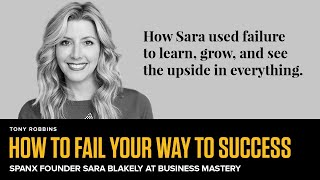 Sara Blakely on Fear of Failure: Embracing Embarrassment2019 · 12 min · full transcript
 Sara Blakely on Entrepreneurship: Going for It Despite Fear2016 · 60 min · full transcript
 Sara Blakely on Female Entrepreneurship: My Inspiration Was My Own Butt2013 · 17 min · full transcript
 Sara Blakely on Brand Building: The Skinny on Spanx2019 · 18 min · full transcript
 Sara Blakely on Startup Tips: Hire Weaknesses, Stay Clear2012 · 4 min · full transcript
 Sara Blakely on Mindset And Failure: Bootstrapping Spanx2021 · 27 min · full transcript