Measure Success Broadly
Money matters, but it is not the whole scoreboard.

“…money is really fun to make, really fun to spend, and really fun to give away…”No Magic Pill podcast interview, 2026 · 4:25
The lesson
Blakely treats success as a wider scorecard than wealth alone. In the 2020 interview, she emphasizes that a good life and a good business depend on mindset, gratitude, relationships, health, and how you treat people, not just income or valuation. That matters because money can distort your priorities if it becomes the only metric, while a broader measure keeps you focused on what makes success sustainable over time1.
Her view of money is notably positive, but not worshipful. She rejects the idea that money is inherently corrupting and instead sees it as useful for building, enjoying, and giving; at the same time, she argues that money does not transform character so much as reveal and amplify it234. The practical implication is that working on your values and habits before external success arrives is part of preparing for success itself.
Because success magnifies who you already are, gratitude and self-awareness are protective disciplines, not soft extras. The 2020 conversation frames mindset as a skill that helps people get through hard periods, and the 2026 interview suggests that even major achievements or exits do not solve inner struggles automatically56. If you want money and ambition to lead somewhere healthy, you have to build the internal capacity to handle them.
Blakely also separates outward success from emotional ease. She describes making a major life decision that was right and still experiencing real grief afterward, which shows that achievement and loss can coexist78. That is an important correction to the fantasy that the 'right' career move, sale, or milestone will feel clean and uncomplicated.
Taken together, her framework invites ambition without narrowing your life around it. Build boldly, but keep asking what kind of person success is enlarging, whether your health and relationships are intact, and whether your work still aligns with what matters most to you910. In Blakely's view, broad success is not anti-money; it is money placed inside a fuller human picture.
4 principles from Sara Blakely
Treat money as a magnifier, not an identity
Money can be useful and enjoyable, but it will not fix character problems or create meaning by itself. Prepare for success by strengthening generosity, humility, and self-knowledge before external rewards get larger.
“I do not subscribe at all to "money is the root of all evil.”
Build inner habits that can carry outer success
Mindset is a skill, not a personality trait you either have or lack. Deliberately practice the frames, inputs, and routines that help you stay grounded when pressure, wealth, or change increase.
“I think money just makes you more of who you already were…”
Expect mixed emotions even after the right win
A good decision can still involve sadness, grief, or disorientation. When a milestone feels emotionally complicated, do not assume that means it was wrong; it may mean the change is real and costly.
“You can make the right decision and still be sad.”
Keep ambition connected to meaning
Blakely's version of ambition is not just chasing more. Keep asking what life is asking of you and whether your work still reflects care, purpose, and the person you want success to enlarge.
“…what is life trying to tell me?”
Moments to watch
In her own words
The quotes behind the lesson, word for word from the transcripts. Numbers match the lesson above.
“I think money just makes you more of who you already were…”
“…money is really fun to make, really fun to spend, and really fun to give away…”
“I do not subscribe at all to "money is the root of all evil.”
“I feel like success just makes you more of who you already were. I feel like money and success just does that, so it's like it holds a magnifying glass up to who you are. People always ask me that, and I am like, I don't know who else to be, I am who I am. So the money, the success, and so I like to say if you were a jerk before you got really successful, and a lot of money, you become a bigger jerk, really. And if you were insecure, you'll become more insecure, if you were nice, you become nicer. If you were generous, you become become more generous, it's literally just a magnifying glass.”
“What I would say is positive mindset is a skill. So I would say if you are that person and you're at home right now, listen to anything that helps you have a positive frame of mind, because right now, more than ever, your greatest weapon and the greatest thing that's going to get you through this and maybe determine who really thrives first, who survives through this, yeah, is going to be mindset. So listening to, you know, I have my favorites. I grew up on Wayne Dyer, you know, there's Tony Robbins, Wayne Dyer. There's so many great up-and-coming people in this space. Louis, your stuff is so positive to listen to. I would do that. There's a lot of golden nuggets that you could learn also right now from other...”
“So, I let it go. I went into profound grief. And then the second part of the equation that I was going to tell you is I don't know if this triggered it or it was going to happen inevitably, but to make an enormous life decision at the exact same time that you go into severe perimenopause is probably not ideal. So, if I could go back and say, "Sara, what about the timing of this?" But I was in such hormonal imbalance and my body was in extreme fluctuations that I wasn't used to. >> Yeah. >> And that compounded how I was feeling. It, it gave me very deep depths of sadness.”
“You can make the right decision and still be sad.”
“You can miss it and still not want it back.”
“…what is life trying to tell me?”
“Put your soul into whatever you do…”
Reflect
- If you listed your current scorecard for success, what percentage is financial and what percentage covers health, relationships, integrity, and peace of mind? What should change?
- What traits in you would likely get amplified by more money or recognition: generosity, insecurity, curiosity, control, calm, ego? What evidence do you already see?
- Think of a decision you believe is right but emotionally difficult. How can you make room for grief or discomfort without using it as proof that the decision is wrong?
Check your understanding
Go deeper
 Sara Blakely on Success and Happiness: Mindset, Gratitude, and Focus2020 · 73 min · full transcript
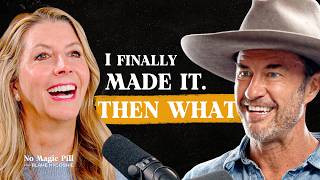 Sara Blakely on Post-Success Purpose: Grief, Growth, and Enough2026 · 68 min · full transcript
 Sara Blakely on Entrepreneurship: Perseverance, Authenticity, and Spanx2016 · 4 min · full transcript
 Sara Blakely on Entrepreneurship and Leadership: Building Spanx2023 · 22 min · full transcript
 Sara Blakely on Betting on Yourself: Build What Women Need2025 · 21 min · full transcript
 Sara Blakely on Mortality And Regret: Don’t Forget You’re Going To Die2016 · 8 min · full transcript