Practice Failing
Make failure a repeated family or team ritual, not just an inspirational idea.

“My definition of greatness would be going for it no matter what, despite fear…”School of Greatness podcast interview, 2016 · 58:19
The lesson
Blakely’s core reframing is simple: failure should be judged by whether you tried, not by whether the outcome worked. That shift matters because it changes the emotional cost of action. If the real loss is holding back, then experiments, awkward attempts, and visible misses become part of progress instead of proof that you should stop.12
Her father’s nightly question works because it turns this idea into a ritual. A repeated question like “what did you fail at?” trains people to notice attempts, discuss them openly, and separate effort from embarrassment. Blakely’s broader point is that fear of failure often reduces to fear of embarrassment and fear of other people’s opinions, so the practice helps weaken that fear through repetition.31
This ritual only works if it rewards the lesson, not the performance. Blakely did not treat setbacks as final verdicts; she treated them as signals to try again, ask better questions, and stay open to a different path. In practice, that means every failure review should end with: what did we learn, what will we try next, and what does this suggest that we could not see before?4
Blakely’s career shows why this matters. She kept moving despite fear, sold in unconventional ways, and was willing to look foolish in order to help someone understand the problem and the solution. A team that practices failure regularly becomes more willing to test, adapt, and communicate boldly because embarrassment loses some of its power.256
To apply this in your own life or team, make the ritual specific and frequent. Ask everyone to name one thing they tried that did not work, what they learned, and what they will do differently next time. The goal is not to celebrate mistakes for their own sake, but to build a culture where initiative is safer, honesty is normal, and trying is rewarded.14
4 principles from Sara Blakely
Define failure as not trying
Judge yourself and others first on willingness to act, not on whether the result was perfect. This lowers the emotional penalty for starting and makes experimentation more likely.
“My definition of greatness would be going for it no matter what, despite fear…”
Make failure a recurring conversation
A ritual works better than a slogan because repetition changes what feels normal. Ask regularly what people attempted, where it fell short, and what they learned.
“Failure for my brother and me became about not trying versus the outcome.”
Trace fear back to embarrassment
When someone avoids trying, the block is often social, not strategic. Naming embarrassment as the real fear helps you design smaller, safer attempts that build courage.
“Turns out there's a really fancy word for crotch called gusset. And that helped me find my search and I found a crotch maker in the very last hour and was able to deliver the Spanx order to Neiman Marcus. When you're the driver of your thoughts, crisis, or in my case, crotches, don't derail you. They push you. You will be embarrassed. But the fear, when the fear of being embarrassed loses its power over you, that's when you become the most powerful. I'm going to tell you one of my most…”
End every setback with a next move
A useful failure practice does not stop at confession; it extracts a lesson and converts it into another attempt. Ask what this result is telling you and what you will test next.
“I basically failed it, and I remember at that moment it being this life-changing moment that set me on a different course. And the way that I initially handled it was, try again. I took the course; I tried it again. And then, when it didn't go as I planned, I asked myself a lot of questions. You know, what is life trying to tell me? Do I have a different path? Maybe I'm supposed to be open to something else. And that's what set me on the journey that ended up creating Spanx.”
In her own words
The quotes behind the lesson, word for word from the transcripts. Numbers match the lesson above.
“Failure for my brother and me became about not trying versus the outcome.”
“My definition of greatness would be going for it no matter what, despite fear…”
“I'm always like why, why, why, why, why—'til I get to the very last why I can get, because that's really where the truth always is. And so why is our, as human beings, the biggest fear failure? Well, it's because we don't want to be embarrassed, right? So it's really ultimately fear of embarrassment, which then led me to fear of what other people think of me is the real root of the issue. So that is where I spent a lot of time working myself. I've been a student of that for, for since I'm 16. I've been working on not caring what other people think about me, and it took me a minute. But I realized that not caring what other people think about me doesn't have to mean I don't care about…”
“I basically failed it, and I remember at that moment it being this life-changing moment that set me on a different course. And the way that I initially handled it was, try again. I took the course; I tried it again. And then, when it didn't go as I planned, I asked myself a lot of questions. You know, what is life trying to tell me? Do I have a different path? Maybe I'm supposed to be open to something else. And that's what set me on the journey that ended up creating Spanx.”
“Turns out there's a really fancy word for crotch called gusset. And that helped me find my search and I found a crotch maker in the very last hour and was able to deliver the Spanx order to Neiman Marcus. When you're the driver of your thoughts, crisis, or in my case, crotches, don't derail you. They push you. You will be embarrassed. But the fear, when the fear of being embarrassed loses its power over you, that's when you become the most powerful. I'm going to tell you one of my most…”
“I did it for seven years in a company. I was in an office equipment company where most people, you know, kind of rotated out every four to six months. And I think the things that it taught me, it taught me the importance of differentiating myself. It taught me about what's in it for me. We'd talk about it, WIIFM—that when you get a moment with someone, they're looking for the what's in it for them. And I learned I need to deliver that in my message very quickly or I lose them. Yes, you know, so it wasn't like, "Hey, I'm selling a fax machine." It was like, "Hey, I really believe I can improve your life and improve the quality of what you're doing, because the business, just like yours..." You know, I made it about them. Yes.”
Reflect
- If you judged failure as not trying rather than not winning, what project or conversation would you start this week?
- What is one recent setback you can rewrite in Blakely’s format: what happened, what did it teach you, and what will you try next?
- Where does fear of embarrassment still shape your decisions, and what small public attempt could help weaken it?
Check your understanding
Go deeper
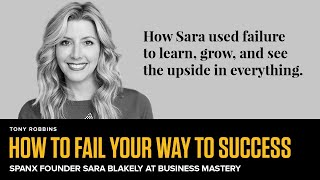 Sara Blakely on Fear of Failure: Embracing Embarrassment2019 · 12 min · full transcript
 Sara Blakely on Entrepreneurship and Leadership: Building Spanx2023 · 22 min · full transcript
 Sara Blakely on Entrepreneurship: Going for It Despite Fear2016 · 60 min · full transcript
 Sara Blakely on Mindset And Failure: Bootstrapping Spanx2021 · 27 min · full transcript