Sam Altman on Y Combinator
Altman treats Y Combinator as a place that teaches founders the fundamentals: pick a compelling idea, build something a small group loves, hire exceptional people, and keep momentum through relentless execution.
- YC’s central lesson is to build a product users love enough to recommend.
- Altman ties startup success to four basics: idea, product, team, and execution.
- He sees YC as strongly mission-driven: start with an idea you feel compelled to pursue.
- YC thinking favors elite early teams, careful hiring, and founder-led culture.
- Momentum matters: startups live on growth, and founders must not lose speed or give up.
Y Combinator starts with the idea, not the company form
Altman’s YC view begins with a simple ordering: founders should not decide to start a startup first and then go hunting for something to do. He argues that the right approach is to become obsessed with an idea that feels important enough to build around, because that kind of mission creates the focus and endurance startups need.
That is why he frames startup success around a small set of fundamentals rather than tricks: idea, product, team, and execution. YC, in his telling, is valuable because it keeps founders focused on those basics instead of status, hype, or startup theater.
The number one YC lesson is to build something people love
If there is one idea Altman returns to most, it is that startup success mostly tracks how strongly users love the product. The test is not whether people say the idea sounds interesting, but whether they use it enough to tell friends on their own.
This is also why he pushes founders toward intensity with a small set of users first. A startup does better by making a small number of people love the product than by getting weak approval from a large audience, because deep love is what turns into growth.
He connects this directly to the earliest phase of company building: before anything else, the founder’s only job is to make the product great. YC’s advice is demanding here because it implies that many other concerns can wait until real product love exists.

“The most important thing, the number one lesson we try to teach startups, is that the degree to which you're successful approximates the degree to which you build a product that is so good people spontaneously tell their friends about it. Startups always ask us for the secret to success. They always want to believe it's something other than this, because this is really hard to do. But this is it. If you can build a product that is so good people spontaneously tell their friends about it, you have done 80% of the work that you need to be a really successful startup. If you think about the most successful companies you know — Google,…”Y Combinator talk, 2016 · full transcript →
YC pushes founders toward strong markets and durable advantage
Altman does not treat product love as the only variable. He also wants founders to choose ideas with room to become dominant over time, which means starting in a smaller wedge and growing toward a stronger position rather than trying to own a huge market immediately.
That is why he emphasizes markets that are about to grow quickly and products that are simple to explain. For him, clarity and market timing are signs that a company may be aligned with a real shift rather than just temporary excitement.
Even with new technologies, he warns founders not to imagine that normal business rules disappear. A fast-moving technology wave can create short-term growth, but startups still need moats, better products, and something enduring.
Y Combinator is deeply opinionated about teams and founder behavior
Altman’s YC advice is strict about people. He argues that early hiring quality is among the most important decisions a startup makes, and that founders should be willing to move slower on hiring rather than accept mediocre early employees.
He applies the same standard to cofounders. Random pairings are a mistake in his view; the better path is to work with people you know well and trust under pressure.
He also believes founders set the operating culture by example. If a startup becomes focused, hard-working, detail-oriented, and execution-driven, it is because the founders model those behaviors themselves.
YC teaches momentum, conviction, and resilience
A recurring Altman theme is that startups cannot afford to lose momentum. Growth is a signal that the product is working, and founders have to protect that momentum with speed, focus, and constant forward motion.
But his version of momentum is not frantic activity for its own sake. It is tied to conviction: the willingness to make a strong bet on a future others may not yet believe in, and then keep going through the painful parts of startup building.
This is one reason YC mattered so much to his thinking. He came away more convinced that founders can try things directly instead of waiting for permission, and that many breakthroughs come from acting before consensus forms. At the same time, the founder still has to persist, because companies often die when founders stop.
As companies grow, YC thinking shifts from product to alignment
Altman draws a clear line between the early startup and the scaling company. At first, nearly everything reduces to building a great product; later, the founder has to build an organization that can keep executing without heroics.
That means adding structure once the company reaches real scale: clearer reporting lines, better delegation, and stronger alignment across the team. He sees this as a necessary evolution, not bureaucracy for its own sake.
So Altman’s YC worldview is not just about getting started. It is also about knowing when to change the founder’s job from making the product work to making the company work, while preserving the same standards on clarity and execution.
Where to watch
 Sam Altman on Startup Success: Build Something People Love2016 · 16 min · full transcriptBest short overview of Altman’s YC-style advice on product love, growth, markets, and founder quality.
 Sam Altman on How to Start a Startup: Idea, Product, Team, Execution2014 · 44 min · full transcriptBest starting point for his core YC framework: idea, product, team, and execution.
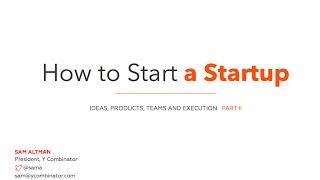 Sam Altman on Team and Execution: Hire Slow, Execute Fast2014 · 46 min · full transcriptBest for understanding how YC thinks about cofounders, hiring, culture, and founder-led execution.
 Sam Altman on Later-Stage Startup Advice: Scaling After Product-Market Fit2014 · 48 min · full transcriptBest for how Altman extends YC principles beyond product-market fit into scaling and alignment.
 Sam Altman on AGI and Startup Building: Build the Future2025 · 47 min · full transcriptBest for seeing how YC shaped his views on conviction, ambition, experimentation, and building durable value in new technology waves.
Questions people ask
- What did Sam Altman say about building something people love versus like?
- What did Sam Altman say about choosing a startup idea?
- What did Sam Altman say about early hires and remote cofounders?
- What did Sam Altman say about growth as a sign of a great product?
- What did Sam Altman say is the biggest secret to startup success?
- What did Sam Altman say about peer groups and choosing good people around you?
How this guide was made: drafted with AI from the full transcripts of the recordings cited, then checked: every quotation must match a transcript word for word and be the speaker's own words, and an independent review gates accuracy. Methodology and corrections.