Quantum Rules
Replace certainty with amplitudes, arrows, and probabilities.
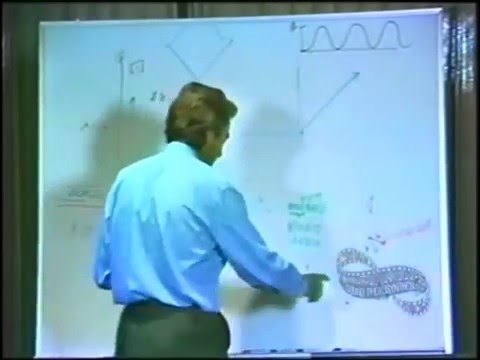
“As you've already learned from the previous discussion, we're going to have a lot of trouble in picturing anything that we haven't directly measured. If we try to say how big a photon is or how it's spread out or what it looks like, we're going to get into some difficulty, because with some experiment it isn't going to behave that way you'd expect. So you're going to be very disappointed, because it's going to be impossible for me to tell you how big a photon is, where it is, and so forth. Nevertheless, depending on your point of view, I'll tell you a series of crazy rules by which you can tell exactly what will happen in any experiment with photons—what's the chance that the photomultiplier will go off in this situation, in that situation—without ever having been able to say.”Auckland lectures, 1979 · 8:51
The lesson
Quantum theory, in Feynman’s presentation, is not mainly a picture of what light or electrons “really are.” It is a method for predicting what will happen in an experiment: what detector clicks, how often an event occurs, and with what probability. He emphasizes that physics is centrally about calculating probabilities, and that quantum mechanics gives a general framework for doing that through amplitudes rather than direct certainties123.
The first shift is to stop expecting an ordinary visual story. In these lectures, Feynman warns that if you ask for a simple picture of a photon’s size, location, or appearance when unmeasured, you will run into trouble; the reliable content of the theory is the prediction rule. That is why he presents quantum mechanics as a set of rules that may feel strange but still tell you exactly what chances to expect in experiments with light45.
The core rule of the chapter is this: when an event can happen in more than one apparent way, you do not add the probabilities for those ways first. Instead, you calculate an amplitude for each alternative, add those amplitudes, and only then turn the result into a probability by squaring it. Feynman states this as a general rule, and he uses arrows as a practical way to represent amplitudes and combine them geometrically679.
This rule explains why quantum predictions differ from common sense. In ordinary reasoning, if one route can produce an outcome and another route can also produce it, you expect the two together to make the outcome more likely. But with amplitudes, alternatives can reinforce or cancel, so two possible contributions can combine to give a larger probability, a smaller one, or even none at all. That is why effects like partial reflection and thin-film interference cannot be handled by treating photons as little pieces with ordinary either-or logic at the level of probabilities1112.
A second operational rule also appears in these lectures: when parts of a process must occur together or in succession, you multiply amplitudes. So the basic toolkit is: assign amplitudes, add them across alternatives, multiply them across linked steps, and square the final amplitude to get the probability. Feynman’s point is not that this matches everyday intuition, but that it is the rule-set that correctly predicts experimental outcomes1337.
5 principles from Richard Feynman
Treat quantum theory as a prediction rule
Use the theory to calculate what outcomes occur and with what probability, rather than demanding a familiar mechanical picture first. When intuition and the rule conflict, keep the rule and test it against experiment.
“It doesn't explain anything. It just gives you numbers…”
Add amplitudes before probabilities
If an event can happen by more than one apparent route, compute an amplitude for each route and combine those first. Only after the total amplitude is found should you convert it into a probability.
“…you have to add the amplitudes first and then make the square…”
Square the final amplitude to get probability
A probability is not the amplitude itself but the square of its length. This final step is what turns the abstract amplitude rule into a measurable prediction.
Expect interference, not ordinary either-or logic
Different alternatives can cancel or reinforce, so combining more possibilities does not always increase the probability. Apply this especially in problems involving reflection, multiple paths, or thin films.
“Either one is something, either one alone, but both is nothing. That works fine for the amplitudes, but to think logically about probabilities, it makes it very difficult, because you usually think if those that would do it, and the greens would do it, and you put them both there, they'll do it even better. So, uh, we can add amplitudes instead of adding probabilities. That is illegal, but adding probabilities is the wrong way. You have to add the amplitudes first and then make the square. Why? I don't know. Nature works that way.”
Multiply amplitudes for linked steps
When a process requires several happenings in sequence or simultaneously, combine them by multiplication. This complements the addition rule for alternatives and gives a complete basic procedure.
“Alright? Either because they have to happen in succession or because they have to happen simultaneously. It doesn't make any difference. You multiply the amplitudes together. I will emphasize that still a little bit further because it it it makes a very big difference. It's where most people who learn quantum mechanics in schools and start... Have the biggest trouble because they don't learn... You see, just like we did. In all of the simple examples, we only had one photon.”
Moments to watch
In his own words
The quotes behind the lesson, word for word from the transcripts. Numbers match the lesson above.
“It doesn't explain anything. It just gives you numbers…”
“The probability of event is what we're calculating in physics.”
“The probability of event is what we're calculating in physics. That's the central question. We discovered that there's a framework in which it can be done. It can always be written as the square, what we call an absolute square, which means the square of the length. Absolute square. Well, I never mind saying the absolute. This line is supposed to say that. The square of another quantity, which we call our amplitude. And that's general. These things I'm telling you are general. I've only given you an examples of it. That's the first problem. The next... Therefore, the probability... The problem of calculating the probability is the same as the problem of calculating the amplitude followed by one minor step, which is after you have the final amplitude to find the square of it.”
“As you've already learned from the previous discussion, we're going to have a lot of trouble in picturing anything that we haven't directly measured. If we try to say how big a photon is or how it's spread out or what it looks like, we're going to get into some difficulty, because with some experiment it isn't going to behave that way you'd expect. So you're going to be very disappointed, because it's going to be impossible for me to tell you how big a photon is, where it is, and so forth. Nevertheless, depending on your point of view, I'll tell you a series of crazy rules by which you can tell exactly what will happen in any experiment with photons—what's the chance that the photomultiplier will go off in this situation, in that situation—without ever having been able to say.”
“And I want to be... Have worked with you because I want to tell you something. The students do not understand it either. And that's because the professor doesn't understand it. Which is not a joke, but a very interesting, I think. And I would like to explain it. My task really is to explain all this is to convince you not to turn away because it appears incomprehensible. That's what it takes four years of us to do to the student. Just to get him so he doesn't run away because it looks crazy. The thing that's exciting about this is that nature is strange as it can be in this sense. That the rules that are gonna be obeyed... That I'm gonna tell you about by which this stuff is analyzed, by which we understand nature.”
“…you have to add the amplitudes first and then make the square…”
“The probability... The problem of calculating the probability is the same as the problem of calculating the amplitude followed by one minor step…”
“Then in the next aspect of the theory, therefore, would be to calculate amplitudes, and I would like to tell you the nature of the rules or the formulas that have been found for computing amplitudes. And there are a number of steps and a number of principles, and they're not very many. We've already got two of them, and there may be four altogether. So we're halfway there. The first... One of the rules is that if a thing appears to be able to happen in more than one way, then we find the amplitude for each way and add. So if there... I summarize that idea in shorthand by saying alternative ways, apparently alternative way, amplitude, total amplitude or final amplitude or whatever, total amplitude, that means the final arrow, is equal to the sum of an amplitude or an arrow that's identical.”
“Either one is something, either one alone, but both is nothing. That works fine for the amplitudes, but to think logically about probabilities, it makes it very difficult, because you usually think if those that would do it, and the greens would do it, and you put them both there, they'll do it even better. So, uh, we can add amplitudes instead of adding probabilities. That is illegal, but adding probabilities is the wrong way. You have to add the amplitudes first and then make the square. Why? I don't know. Nature works that way.”
“What I'm trying to say is a very simple idea that looks mathematical is the total that every photon either ends up here or here. Nobody has ever lost, okay? So, if you start out by supposing that the front surface reflects the particle, then you can't figure out how you can get the back surface to catch up with it and make it not do it so that you can get a zero here or at the next point and so on. And that's the most cogent argument. It says it can't be little spots because if it were little spots that would get reflected and you can catch it back. As a matter of fact, it's virtually impossible to explain this from the point of view of particles.”
“Alright? Either because they have to happen in succession or because they have to happen simultaneously. It doesn't make any difference. You multiply the amplitudes together. I will emphasize that still a little bit further because it it it makes a very big difference. It's where most people who learn quantum mechanics in schools and start... Have the biggest trouble because they don't learn... You see, just like we did. In all of the simple examples, we only had one photon.”
Reflect
- Where in your own thinking do you instinctively add outcomes at the probability level when the situation may really require combining underlying contributions first?
- How would your explanation of quantum mechanics change if you focused less on “what is really happening” and more on “what rule gives the correct prediction”?
- Think of a problem with several possible routes to one result. How would you decide which parts count as alternatives to add and which parts count as linked steps to multiply?
Check your understanding
Go deeper
 Richard Feynman on Probability and Uncertainty: Quantum Rules1964 · 115 min · full transcript
 Richard Feynman on Quantum Reality: Why probabilities come from arrows1979 · 119 min · full transcript
 Richard Feynman on Quantum Electrodynamics: Light, Amplitudes, and Reality1979 · 369 min · full transcript
- How does Richard Feynman say to calculate amplitudes when there is more than one way something can happen?
- What did Richard Feynman say about probability in physics?
- What did Richard Feynman say about why probabilities come from arrows in quantum mechanics?
- How did Richard Feynman explain why a particle model fails for thin-film reflection?
- What did Richard Feynman say about waves in quantum mechanics?
- What did Richard Feynman say about multiplying quantum amplitudes?