Curiosity as Adventure
End with wonder, play, perspective, and the joy of not knowing.
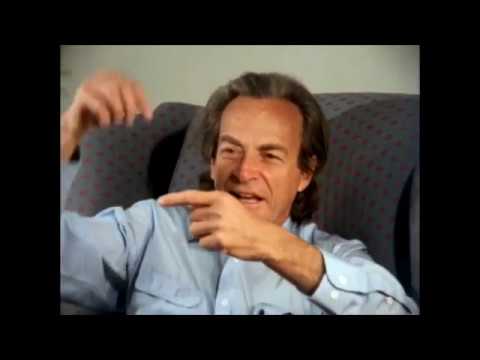
“It's very hard to imagine all the crazy things that things really are like.”BBC documentary, 1983 · 0:11
The lesson
Curiosity begins with a willingness to see that ordinary experience is not the whole story. Feynman keeps pushing past labels and appearances toward a more vivid question: what is actually going on? That shift takes imagination, because familiar things are often built from processes that do not look familiar at all when examined closely1234.
A practical way to strengthen curiosity is to look again from a new point of view. Instead of treating common habits and explanations as settled, try to approach them as if you were seeing them for the first time. This is how hidden assumptions become visible, and it is often the start of a better question567.
For Feynman, this attitude is not about forcing the world into a final tidy picture. It is about exploration: learning more, following puzzles, and accepting that some understanding comes as equations, tests, or partial descriptions rather than intuitive images. You do not need complete certainty or a complete answer in order to keep making progress89101112.
That is why not knowing is not a defect to be hidden. The discipline is to stay honest about what you understand, what you only partly understand, and what resists familiar explanation. If you pretend to know more than you do, you block discovery; if you admit uncertainty, you keep the adventure alive and give experiment a chance to correct you13141516.
Seen this way, understanding does not drain beauty from the world. It increases it by revealing deeper structure beneath what first appears simple. Wonder survives best when paired with inquiry: the more you learn about how the world works, the more there is to admire, and the more reasons you have to continue exploring179.
5 principles from Richard Feynman
Imagine what is really happening
When something seems obvious, ask what processes might lie underneath appearances. Use imagination not to make up stories, but to build better ways of thinking about unseen mechanisms.
“It's very hard to imagine all the crazy things that things really are like.”
Look from a new point of view
Revisit familiar routines, objects, and explanations as if they were strange. This often reveals assumptions you did not notice and opens better questions than the ones you started with.
“What I'm trying to argue for is to think about things from a new point of view.”
Treat inquiry as exploration, not conquest
You do not need a final answer before beginning. Follow what is interesting, gather more information, and let progress come through sustained curiosity rather than the demand for completion.
“…we're exploring; we're trying to find out as much as we can about the world.”
Be comfortable with uncertainty
Work with degrees of confidence instead of pretending to certainty. In practice, that means saying clearly what you know, what you suspect, and what still needs testing.
“I have approximate answers and possible beliefs and different degrees of certainty about different things, but I'm not absolutely sure of anything and I don't have to be.”
Let knowledge deepen wonder
Do not treat explanation and awe as opposites. Understanding can make ordinary things richer by showing how much structure, pattern, and mystery they contain.
“Science knowledge only adds to the excitement and mystery, the awe of a flower.”
In his own words
The quotes behind the lesson, word for word from the transcripts. Numbers match the lesson above.
“It's very hard to imagine all the crazy things that things really are like.”
“Nothing's really as it seems.”
“The world is a dynamic mess of jiggling things if you look at it right.”
“It's interesting that some people find science, so easy and others find it kind of dull and difficult, especially kids. You know? Some of them are just eat it up. And I don't know why it is. It's the same perhaps for all subjects. For instance, lots of people love music and I never could carry a tune. And it's... I lose a great deal of pleasure out of that. And I think people lose a lot of pleasure who find the science dull. In the case of science, I think that one of the things that make it very difficult is it takes a lot of imagination. It's very hard to imagine all the crazy things that things really are like. Nothing's really as it seems. We're used to get, you know, hot and cold and all that hot and cold is is the speeds that the atoms are jiggling.”
“What I'm trying to argue for is to think about things from a new point of view.”
“There's a way of looking at something new as if you never saw it before for the first time.”
“A thing like the history of the idea is an accident of how turn the history around to try to get a new way of looking at it doesn't make any difference. I, I don't care. The only thing that the real test in physics experiment and history is fundamentally irrelevant. The most enduring legacy from his father was not just learning to question the physical world but an enthusiasm for the inquiry, which at 54 Street ill shares today. It has to do with curiosity. It has to do with people wondering what makes something do something, and then to discover that if you try to get answers.”
“…we're exploring; we're trying to find out as much as we can about the world.”
“I don't look at my — my interest in science is to simply find out about the world, and the more I find out, the better it is.”
“It's the kind of a puzzle I love.”
“I have approximate answers and possible beliefs and different degrees of certainty about different things, but I'm not absolutely sure of anything and I don't have to be.”
“But the idea is not to find the complete... Necessary to find a complete answer, but to find out more and more information. It's like exploring. If you're exploring a country, the fact that when you went through the country, it may be that on the other side, you come across a river... Ocean that you'd have to pass and you couldn't pass, doesn't mean that it wouldn't be interesting to explore the new country that you discovered. So in the same way, the question as to whether this is a never ending search or that the search will end with the quark is not exactly relevant to our interest in finding out just more about the way matter is constructed.”
“The first principle of physics is that you must not fool yourself. And you are the easiest person to fool.”
“I can't explain that attraction in terms of anything else that's familiar to you. For example, if we say the magnets attract like as if they were connected by rubber bands, I would be cheating you because they're not connected by rubber bands. I shouldn't be in trouble. You'd soon ask me about the nature of the bands. And secondly, if we were curious enough, you'd ask me why rubber bands tend to pull back together again and I would end up explaining that in terms of electrical forces, which are the very things that I'm trying to use the rubber bands to explain. So I have cheated very badly, you see. So I'm not going to be able to give you an answer to why magnets attract each other except to tell you that they do.”
“I could tell you that the magnetic forces are related to the electrical forces very intimately. That our relationship between the gravity forces and electrical forces remains unknown and so on. But I really can't do a good job, any job of explaining magnetic force in terms of something else that you're more familiar with because I don't understand it in terms of anything else that you're more familiar with.”
“Find out not how nature could be, but how nature is. See, how what's right? Don't find it. You see, I don't think you ever find it a C. See, and your idea is to find out what nature could be—different possibilities. What I think is interesting. Yeah, even if it's wrong, common ground is enthusiastically explored. But is it only shared experience and knowledge that forms a bond between working scientists and separates them from us, the interested layman or even the artist? I mean, scientific fields are…”
“Science knowledge only adds to the excitement and mystery, the awe of a flower.”
Reflect
- Pick one ordinary part of your day and describe it from a completely unfamiliar point of view. What assumptions become visible?
- Where in your work are you pretending to know more than you do? How would your next step change if you stated your uncertainty more honestly?
- What subject has seemed less beautiful to you once it was explained? Can you revisit it by asking what deeper structure the explanation reveals?
Check your understanding
Go deeper
 Richard Feynman on Tuva Adventure: Curiosity as Exploration1988 · 44 min · full transcript
 Richard Feynman on Perspective in Science: Look From Another Point of View45 min · full transcript
 Richard Feynman on Curiosity and the Scientific Method1981 · 26 min · full transcript
 Richard Feynman on Imagining Atomic Reality: why things are really as they are1983 · 67 min · full transcript
- What did Richard Feynman say makes a good person to talk to?
- What did Richard Feynman say about how sudden insights happen?
- What did Richard Feynman say he felt after the atomic bomb was used?
- What did Richard Feynman say he was interested in finding out?
- What did Richard Feynman say about whether science needs a complete final answer?