Ray Dalio on The World Order
Ray Dalio sees the changing world order as a repeatable big cycle in which debt, money, internal conflict, and great-power rivalry drive the rise and decline of empires.
- History rhymes: the biggest shocks make more sense when compared with earlier empire and debt cycles.
- World orders change when debt and money creation, internal conflict, and great-power rivalry reinforce each other.
- Reserve currency strength brings borrowing power, but excess debt eventually pressures central banks to print and weakens money.
- The U.S. faces a late-stage mix of heavy debt, political polarization, and competition with China.
- Dalio’s practical takeaway is simple: be financially sound, diversify, and preserve social cohesion.
Dalio thinks world orders change in recurring big cycles
Dalio’s core idea is that world order shifts are not random one-off events. He argues that the biggest surprises become more understandable when you compare them with earlier periods, because similar patterns have happened many times before across centuries.123
He studies these changes as long arcs in which empires rise, peak, and decline. In his account, the Dutch, British, American, and Chinese cases are especially useful because they show repeating patterns in education, competitiveness, trade, military strength, and capital markets rather than isolated historical accidents.45
This is why he treats history as a practical tool, not as trivia. If the same forces keep recurring, then current events can be understood as another turn in a larger cause-and-effect cycle.67
The engine of change is debt, money, and reserve-currency power
Dalio says reserve-currency empires gain a major advantage because the world wants to hold their money and debt. That gives them unusual borrowing power and supports financial strength for a long time. But the same privilege also makes it easier to overborrow and inflate asset prices.58
In his framework, the turning point comes when debts and deficits grow too large relative to incomes and the market becomes less willing to absorb more government debt. Then policymakers are pushed toward money creation, which relieves pressure in the short run but weakens the currency and raises inflation risk.910
He is explicit that this pattern has appeared across leading empires. When central banks print aggressively during crises, paper money loses value relative to real assets, which is why he ties late-stage debt problems to shifts in the monetary order.1110
Internal conflict is as dangerous as foreign rivalry
Dalio does not see changing world order as only a story about competition between countries. He also sees domestic breakdown as central: widening wealth gaps, political polarization, and the loss of a strong middle can undermine a country from within.121314
He warns that when people lose trust in institutions and the political center weakens, populist leaders rise and democracies are stressed. In his view, the greatest struggle is often internal because a country must decide whether it can make the hard decisions needed to remain successful.1415
That is why his prescription is moral and political as well as economic. He says durable strength requires both fiscal discipline and decent treatment of one another, because social cohesion affects whether a society can navigate conflict without tearing itself apart.1617
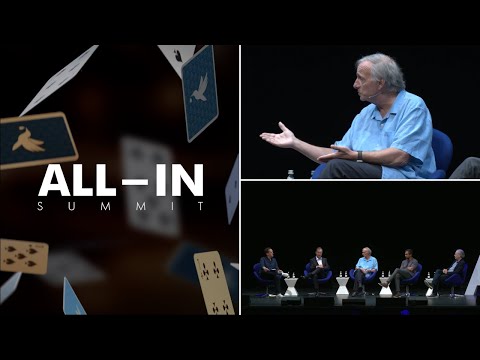
“What is needed is, first of all, a strong middle.”All-In Summit interview, 2023 · full transcript →
China matters because great-power competition is already underway
Dalio places U.S.-China rivalry at the center of the current world-order transition. He describes the rise of a comparable great power as one of the defining forces of the era, and he expects China to remain a major power for the foreseeable future.181920
He treats this rivalry as broader than a shooting war. He lays out several forms of conflict, including trade, technology, geopolitical influence, capital, and military competition, which means the contest can intensify even without direct war.21
This matters because external rivalry interacts with debt and internal conflict. A country becomes more fragile when it is financially stretched at home while facing an increasingly capable challenger abroad.221812

“…the great power conflict between particularly China and the United States…”WSJ News interview, 2025 · full transcript →
His practical lesson is to prepare, diversify, and strengthen the middle
Dalio’s advice is not to panic about decline but to respond to cyclical risks with discipline. At the personal level, he repeatedly comes back to earning more than you spend, saving, and diversifying so you are not overexposed to any one outcome.2324
At the portfolio level, he links the changing world order to protecting against currency weakness and debt stress. He argues that good diversification can sharply reduce risk, and in late-stage debt environments he gives special importance to assets that are less dependent on someone else’s promise to pay.252627
At the national level, he thinks the answer is a strong middle that can contain extremes and make bipartisan, engineered adjustments before crisis forces them. He is worried, but not fatalistic: outcomes depend heavily on whether societies can adapt intelligently and work together.2829
Dalio on the world order, in his own words
“The times ahead will be radically different from those that we've experienced in our lifetimes, though similar to many times before. How do I know that? Because they always have been. Over my roughly fifty years of global macroeconomic investing, I've learned the hard way that the most important events that surprised me did so because they never happened in my lifetime. These painful surprises led me to study the last five hundred years of history for similar situations where I saw that they had indeed happened many times before with the ups and the downs of the Dutch, British, and US empires.”
“…what we need to do, it comes down to just two things, earn more than we spend and treat each other well.”
“It's most often the case that a nation's greatest war is with itself over whether or not it can make the hard decisions needed to sustain success. As for what we need to do, it comes down to just two things, earn more than we spend and treat each other well. All other things I mentioned, strong education, inventiveness, being competitive, and all the rest are just ways of getting at these two things. It's easy to measure if we're doing them. So like people who wanna get fit, let's get on the program and improve our vitals. Let's do that individually and collectively. My goal for sharing this picture of how the world works and a few principles for dealing with it well is to help you recognize where we are and the challenges we face, and to make the wise decisions needed to navigate these times well.”
“…the whole, it all comes down to how people deal with each other…”
Where to watch
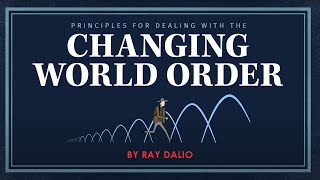 Ray Dalio on Changing World Order: The Big Cycle of Empires2021 · 44 min · full transcriptBest concise overview of Dalio’s big-cycle view of empires, reserve currencies, debt, and printing money.
 Ray Dalio on Changing World Order: Debt, China, and the Cycle2023 · 42 min · full transcriptBest for the five-force framework and how Dalio applies it to the U.S., China, debt, and internal conflict.
 Ray Dalio on World Orders and Cycles: Money, Power, Empires2021 · 93 min · full transcriptBest for the underlying logic of how money, power, education, and competitiveness reinforce each other across centuries.
 Ray Dalio on Debt Cycles: Why Systems Break Down2026 · 63 min · full transcriptBest for Dalio’s late-stage debt-cycle view, reserve-currency strain, and why he says the system is in stage five.
 Ray Dalio on Changing World Order: How to Invest in Uncertainty2025 · 25 min · full transcriptBest for turning the framework into practical investing and risk-management rules.
Questions people ask
- How does Ray Dalio use historical data to study empires and world order?
- What did Ray Dalio say about China's rise as a great power?
- What did Ray Dalio say about gold as a safe asset?
- What did Ray Dalio say about populism and revolution?
- What did Ray Dalio say about tariffs and trade deficits?
- What does Ray Dalio say is the leading indicator of an empire's rise?
Sources
Every quote above, word for word from the transcripts. Numbers match the text.
“The most important events that surprised me did so because they never happened in my lifetime.”
“…what I learned, and I had this repeatedly in my life, that things that surprised me often surprised me because they didn't happen in my lifetime, but they happened many times in history.”
“The times ahead will be radically different from those that we've experienced in our lifetimes, though similar to many times before. How do I know that? Because they always have been. Over my roughly fifty years of global macroeconomic investing, I've learned the hard way that the most important events that surprised me did so because they never happened in my lifetime. These painful surprises led me to study the last five hundred years of history for similar situations where I saw that they had indeed happened many times before with the ups and the downs of the Dutch, British, and US empires.”
“I've studied these big cycles in history going back five hundred years…”
“Well, the leading reserve currency empires, but it applies to all the empires, were the the Dutch, the British, the American, and the Chinese. But you could follow the same pattern. In the book, it was very important for me to not just use words and concepts because that's subjective. It was very important for me to use actual measurements. So as you see in the book, you can see every level of this. You can see where's the education level, what is the military power, each one of those to... And you could see them back going over the five hundred years. And so you can see the arcs and the composition of those arcs and what you see is really in most countries and most dynasties you could see that.”
“I needed therefore to study them in history.”
“Well, I find that almost everything happens over and over again. And we're in this... The blizzard of these things happening. And what I found is that if I'm making a decision that that after I make the decision usually or right at the time, if I pause and reflect and I write my principle down, in other words principle is sort of a recipe, What would I use to... How would I make that decision and what are the criteria around it? I find that I make it much more clear, it becomes clearer and it applies to the next thing that comes along, it'll be that way. Because everything happens over and over and over again, and I think people make the mistake of looking at just the one like it's the first one.”
“…one man's debts are another man's assets…”
“…the demand for the reserve currency um is not sufficient to meet the supply…”
“This creates great domestic hardships and forces the country to choose between defaulting on its debts or printing a lot of new money. It always chooses to print a lot of new money. At first, gradually and eventually massively. That devalues the currency and raises inflation. For the Dutch, this was the financial crisis brought about by financial excesses and paying for the fourth Anglo Dutch war. Similarly, for the British, it was paying for its financial excesses and its debts from the two world wars. And for The US, it's been three cycles of debt finance booms and busts since the nineties with the central bank stepping in each time with stronger measures. When the government has problems funding itself, when there are bad economic conditions, and living standards for most people are declining, and there are large wealth, values, and political gaps, internal conflict between the rich and the poor, as well as different ethnic, religious, and racial groups greatly increases.”
“…when central banks print a lot of money to relieve a crisis, buy stocks, gold, and commodities because their value will rise and the value of paper money will fall.”
“There are pre-existing conditions that represent challenges.”
“What is needed is, first of all, a strong middle.”
“Populous leaders emerge from both sides and pledge to take control and bring about order. That's when democracy is most challenged because it fails to control the anarchy. And it is when the move to a strong populist leader who will bring order to the chaos is most likely. As conflict within the country escalates, it leads to some form of revolution or civil war to redistribute wealth and force the necessary big changes. This can be peaceful and maintain the existing order, but it's more often violent and changing the order. For example, the Roosevelt revolution to redistribute wealth was relatively peaceful and maintained the existing internal order. While the French revolution, the Russian revolution, and the Chinese revolution were much more violent and led to new internal orders.”
“It's most often the case that a nation's greatest war is with itself over whether or not it can make the hard decisions needed to sustain success. As for what we need to do, it comes down to just two things, earn more than we spend and treat each other well. All other things I mentioned, strong education, inventiveness, being competitive, and all the rest are just ways of getting at these two things. It's easy to measure if we're doing them. So like people who wanna get fit, let's get on the program and improve our vitals. Let's do that individually and collectively. My goal for sharing this picture of how the world works and a few principles for dealing with it well is to help you recognize where we are and the challenges we face, and to make the wise decisions needed to navigate these times well.”
“…what we need to do, it comes down to just two things, earn more than we spend and treat each other well.”
“…the whole, it all comes down to how people deal with each other…”
“…the great power conflict between particularly China and the United States…”
“I think China's going to be a big power for the foreseeable future.”
“You have to go back really to the thirties around the world or before. And the third is the great power conflict. In other words, the rise of a great power in the form of China that is a comparable power in the world and that dynamic. So in order to see that, I needed to then study the past five hundred years of history. Now I know people think it's odd because here I am. I'm just trying to make money in the markets. I'm a practical guy dealing with that. But in... But we would not understand that. And the picture of the world is a very different picture than we have grown used to because of the nature of these longer term cycles.”
“Yeah. I'd like to talk about both wars. So the war with China, as I said there are five kinds of wars. There's a trade war, technology war, geopolitical influence war, capital war, and military war. As far as military war goes, I only... Think it's only a Taiwan issue, but that's a big issue. And we could talk about that for a minute. But those others, they'll be rough competitions and we'll have that type of evolution over a period of time. That's what that war looks like. Taiwan has been for a long time a sovereignty issue to China. And it has its roots in what's called the hundred years of humiliation.”
“…the new toxic debt is government debt.”
“Be financially sound, earn more than you spend, and be strong in these ways, and pretty much everything will take care of itself.”
“…if you buy equally good things that are not correlated and that you can do that, you could reduce your return... Your risks by about 80% if you can know how to do that.”
“…good diversification means that you can reduce your risks by 80% without reducing your expected returns…”
“…gold is the you know what like they say it's the one asset you can have that's not somebody else's liability…”
“It's the big cycle and what you have to understand is that gold is not a precious metal that's speculated on like most people have come to think of it as, it is the most established money that it's the second largest reserve currency that central banks hold. And so what we've seen is for various reasons that I pretty much covered, the economic supply demand, the political, the geopolitical, for those reasons central banks themselves have acquired gold to build that up and individuals and others are looking for an alternative money. The question is what is money?”
“The amount of debt that we're in represents a—you can't pretend it—it exists. So it represents a challenge. There are a lot of these challenges, but it is not inevitable. What is needed is, first of all, a strong middle, okay, to bring the country together in terms of rather than to have this fighting because if, if we continue the way we will, we're going to have a conflict. And then there needs to be a good engineering, EX-P exercise that's going to produce, but has to be bipartisan, has to be bipartisan with that strong middle taking control of the extremes because neither side's going to win a...”
“Evolution is in a direction toward improvement, and the greatest force is man's capacity to adapt and invent. And so you see in the charts in the book, you see that this upward movement, life expectancy, health, all the things that we think are better. You see there's a chart and it shows that over a period of time and you barely see the downturns from depressions and wars in that. That is the greatest power, man's ability to invent and adapt is evolution, and that's the greatest power, and that is what gives me justifiable hope.”
How this guide was made: drafted with AI from the full transcripts of the recordings cited, then checked: every quotation must match a transcript word for word and be the speaker's own words, and an independent review gates accuracy. Methodology and corrections.


