Ray Dalio on Artificial Intelligence
Ray Dalio sees AI as a historic force that will transform nearly everything, but he also thinks excitement around it can create classic bubble risks that demand discipline and diversification.
- AI can be revolutionary and still be in a bubble at the same time.
- Dalio thinks AI may be the biggest technological transformation because it can improve thinking across domains.
- The main danger is not just the technology, but how prices, leverage, and excitement build booms and busts.
- He believes human nature and social conflict will matter as much as the technology itself.
- His practical response is not prediction but preparation: diversify, use cause-and-effect thinking, and have a game plan.
“Yes. I study, you know, what was the impact of the printing press and what was the impact for the industrial revolutions and so on? This, in my opinion, is the biggest impact that we have because it will revolutionize all thinking that applies to everything and applies to everything. So whatever you're doing, it will make it much more efficient, much more powerful. But that includes wars, too. You know, everything is going to be radically transformed because anything that we apply thinking to here is going to be very much transformed by it.”Bloomberg interview, 2026 · 12:36
AI is a world-changing technology, not a niche trend
Dalio treats AI as a transformation on the scale of the printing press and the industrial revolutions, and he argues it may be even bigger because it applies to thinking itself. In his view, that makes it different from a normal productivity tool: it can improve how people work across nearly every field.1
He points to broad consequences in economics, medicine, education, manufacturing, and public decision-making. The core idea is that whatever depends on thinking can be made more efficient and more powerful, which is why he sees AI as touching almost everything.1
“Yes. I study, you know, what was the impact of the printing press and what was the impact for the industrial revolutions and so on? This, in my opinion, is the biggest impact that we have because it will revolutionize all thinking that applies to everything and applies to everything. So whatever you're doing, it will make it much more efficient, much more powerful. But that includes wars, too. You know, everything is going to be radically transformed because anything that we apply thinking to here is going to be very much transformed by it.”Bloomberg interview, 2026 · full transcript →
A revolutionary technology can still become a bubble
Dalio’s key distinction is between the quality of a technology and the price people pay for exposure to it. He says history repeatedly shows that revolutionary innovations attract intense enthusiasm, and investors can stop paying attention to valuation when they become convinced the future is obvious.
That is why he is comfortable holding two ideas at once: AI is likely to be truly transformative, and AI investing can still display classic bubble characteristics. He explicitly compares this pattern to earlier episodes where real innovation existed, but speculation and borrowing turned excitement into fragility.3
The real risk is the boom-bust mechanism around AI
Dalio focuses less on whether AI is useful and more on how financial systems behave when everyone wants the same story. In that setup, higher prices create more confidence, more money flows in, and sometimes people borrow against rising wealth, which makes the whole system more vulnerable if conditions tighten.
He warns that the future is highly uncertain and that trying to time these shifts is not the right lesson. Instead, he emphasizes that the danger comes when investors forget that price matters and when changing liquidity, interest rates, or cash needs force selling into crowded trades.4

“The future is very unknown, and people should not be timing.”Diary of a CEO interview, 2026 · full transcript →
Human nature will shape AI’s impact as much as the technology
Dalio does not think AI’s trajectory will be determined by technical capability alone. He says human nature is likely to be the biggest force, and he repeatedly brings the conversation back to how people deal with each other, especially in a time of widening wealth gaps, polarization, and geopolitical rivalry.56
That is why his view of AI includes both optimism and concern. He expects extraordinary gains in capability, but he also warns that the same technology can strengthen conflict, including war, and that the deeper question is whether societies can maintain harmony while absorbing such powerful change.1
Dalio’s practical approach: diversify, understand cause and effect, and plan
Dalio’s response to AI uncertainty is disciplined decision-making rather than bold prediction. He says diversification is essential, and he argues that good diversification can sharply reduce risk without necessarily cutting expected returns, which matters when one theme becomes overwhelmingly popular.89
He also wants decisions grounded in understandable logic. When using algorithms or machine learning, he asks whether the cause-and-effect relationship makes sense and warns that it is dangerous when people cannot explain the logic or when the future is unlike the past.10
More broadly, he argues that major transitions require a game plan. That means facing reality clearly, avoiding delusion, and turning big ideas into practical rules rather than simply getting swept up in the excitement of a powerful trend.111213

“Two considerations. Do you understand the algorithm? And does the cause effect relationship make sense to you? A lot of algorithmic and machine learning means that the person cannot explain the logic of the cause effect relationship and that's the first sign of danger. The second sign of danger or risk is that the future is different from the past. If you have both of those things, where in the markets the future is both likely to be different from the past and most importantly that whatever is discovered becomes put into the price. Right? In other words, if you discover something great and the algorithm discovers it and other people discover the same algorithm, then what's going to happen is the worst, the reverse. Because everybody finding that...”Tony Robbins podcast conversation, 2017 · full transcript →
Dalio on artificial intelligence, in his own words
“Yes. I study, you know, what was the impact of the printing press and what was the impact for the industrial revolutions and so on? This, in my opinion, is the biggest impact that we have because it will revolutionize all thinking that applies to everything and applies to everything. So whatever you're doing, it will make it much more efficient, much more powerful. But that includes wars, too. You know, everything is going to be radically transformed because anything that we apply thinking to here is going to be very much transformed by it.”
“AI basically is eating everything and it might eat itself…”
“My bet is that human nature is going to be the biggest force…”
“Two considerations. Do you understand the algorithm? And does the cause effect relationship make sense to you? A lot of algorithmic and machine learning means that the person cannot explain the logic of the cause effect relationship and that's the first sign of danger. The second sign of danger or risk is that the future is different from the past. If you have both of those things, where in the markets the future is both likely to be different from the past and most importantly that whatever is discovered becomes put into the price. Right? In other words, if you discover something great and the algorithm discovers it and other people discover the same algorithm, then what's going to happen is the worst, the reverse. Because everybody finding that...”
Where to watch
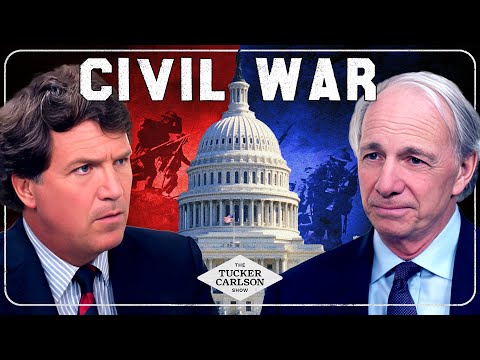
 Ray Dalio on Civil War and AI: America’s Hidden Fault Lines2026 · 43 min · full transcriptBest for Dalio’s biggest-picture view: why AI may be the most transformative technology and why social cohesion will determine its outcome.
 Ray Dalio on AI Bubble and Cycles: Why Busts Follow Booms2026 · 90 min · full transcriptBest for understanding why Dalio thinks AI investing can look like a classic bubble even if the technology is real.
 Ray Dalio on Debt Cycles and World Order: Gold, Tariffs, AI2025 · 49 min · full transcriptBest for seeing AI inside Dalio’s larger framework of debt cycles, geopolitics, and system fragility.
 Ray Dalio on Changing World Order: How to Invest in Uncertainty2025 · 25 min · full transcriptBest for Dalio’s decision framework: how to turn big macro forces like technology into practical investing rules.
 Ray Dalio on Principles and Decision Making: Truth, Learning, and Success2021 · 90 min · full transcriptBest for the underlying mindset behind his AI view: reality-testing, idea meritocracy, and cause-and-effect thinking.
Questions people ask
- How does Ray Dalio think artificial intelligence will change the world?
- What did Ray Dalio say about AI bubbles and why busts follow booms?
- What did Ray Dalio say about adapting to change and future jobs?
- What does Ray Dalio think is dangerous about algorithms?
- What worries Ray Dalio most about the future?
Sources
Every quote above, word for word from the transcripts. Numbers match the text.
“Yes. I study, you know, what was the impact of the printing press and what was the impact for the industrial revolutions and so on? This, in my opinion, is the biggest impact that we have because it will revolutionize all thinking that applies to everything and applies to everything. So whatever you're doing, it will make it much more efficient, much more powerful. But that includes wars, too. You know, everything is going to be radically transformed because anything that we apply thinking to here is going to be very much transformed by it.”
“AI basically is eating everything and it might eat itself…”
“The future is very unknown, and people should not be timing.”
“My bet is that human nature is going to be the biggest force…”
“…the whole, it all comes down to how people deal with each other…”
“So the important thing always is to diversify.”
“…good diversification means that you can reduce your risks by 80% without reducing your expected returns…”
“Two considerations. Do you understand the algorithm? And does the cause effect relationship make sense to you? A lot of algorithmic and machine learning means that the person cannot explain the logic of the cause effect relationship and that's the first sign of danger. The second sign of danger or risk is that the future is different from the past. If you have both of those things, where in the markets the future is both likely to be different from the past and most importantly that whatever is discovered becomes put into the price. Right? In other words, if you discover something great and the algorithm discovers it and other people discover the same algorithm, then what's going to happen is the worst, the reverse. Because everybody finding that...”
“There needs to be a game plan.”
“…truth is, you know, what is reality, how does the reality work?”
“I think that delusion is not going to help you…”
How this guide was made: drafted with AI from the full transcripts of the recordings cited, then checked: every quotation must match a transcript word for word and be the speaker's own words, and an independent review gates accuracy. Methodology and corrections.

