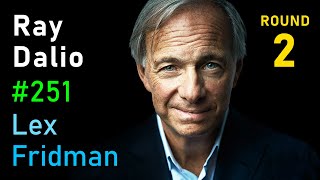
Ray Dalio on Investing
Ray Dalio sees investing as a disciplined process of understanding mechanics, testing decision rules across history, staying humble, and diversifying to protect real purchasing power.
- Understand cause-and-effect, not stories or consensus.
- Be humble: mistakes are inevitable, and learning from them is essential.
- Diversification is central because concentration is the biggest avoidable risk.
- Independent thinking matters because market prices already reflect the consensus view.
- Judge outcomes in real purchasing-power terms, especially in debt-heavy, money-printing environments.

“You have to learn how to fail in order to learn how to succeed…”92nd Street Y conversation with David Rubenstein, 1982 · 29:11
Investing starts with understanding the mechanics
Dalio’s starting point is that markets are driven by understandable cause-and-effect relationships, especially around debt, cash flow, interest rates, and the interaction between assets and liabilities. He pushes investors to study how the machine works rather than react to headlines or opinions.12
That leads him to focus heavily on debt cycles. When debt rises faster than the income that services it, debt-service burdens grow, spending gets squeezed, and asset prices can come under pressure. In his view, that is not ideology but a recurring mechanism investors need to recognize early.23
He also broadens the frame beyond one market or one quarter. The backdrop for investing includes debt and money creation, domestic conflict, geopolitics, nature, and technology, so good investing requires seeing how these larger forces shape the environment for assets.456
Humility is a competitive advantage
Dalio treats humility as essential because investing constantly exposes error. His view is that the best investors are not the ones who avoid being wrong, but the ones who keep discovering where they are wrong and improve their judgment from it.78
That is why he stresses asking whether you are right and building a process that challenges your own thinking. He wants disagreement, stress testing, and independent thinkers around him because confidence without self-questioning is dangerous in markets.91011
He also warns that the future will not simply resemble the recent past. Historical patterns matter, but they must be used with humility, because markets change and anything widely discovered tends to get priced in.121314
“You have to learn how to fail in order to learn how to succeed…”92nd Street Y conversation with David Rubenstein, 1982 · full transcript →
Diversification is the core risk-management tool
Dalio returns again and again to diversification as one of the most important investing principles. He argues that investors can reduce risk dramatically without necessarily reducing expected return if they combine return streams that are truly uncorrelated.151617
This is why he is so wary of concentration. The biggest practical mistake is often becoming too exposed to one exciting asset, one theme, or one market regime. Even when an idea is compelling, concentration makes outcomes too dependent on one bet.18
His portfolio thinking is therefore about balance, correlation, and the interaction among holdings, not just picking individually attractive assets. Getting those relationships right is, in his view, one of the keys to surviving and compounding over time.
To outperform, you must think independently and test your rules
Dalio believes excess returns require independent thinking because the consensus is already embedded in market prices. If you agree with everyone else, you are unlikely to earn more than what is already priced in.11
But independent thinking is not the same as having bold opinions. For Dalio, it means writing down decision criteria clearly enough that they can be examined, challenged, and tested across long spans of history and across countries. He wants investment rules that are as timeless and universal as possible.2021
He also likes turning judgment into explicit rules and algorithms where possible. That forces clarity about what drives a decision and makes it easier to compare an idea with historical experience rather than rely on vague conviction.2223
“By knowing how to balance risk well in terms of the different kinds of investments that you make. And I think you have to have that humility and that curiosity that you're talking about to pull the best out of that, to have people stress test your thinking. I think that those are elements for being a good investor, and they may help other ways. I think your list was, uh, was a very good list. That you have to be an independent thinker against the consensus in order to make money in the markets. You have to bet against the consensus and be right. You have to bet against the consensus because the consensus is in the price, so you have to bet against the consensus.”92nd Street Y conversation with David Rubenstein, 1982 · full transcript →
The real goal is preserving and growing purchasing power
Dalio draws a sharp distinction between making money nominally and getting richer in real terms. In environments where countries can print money and devalue currency rather than default outright, nominal gains can be misleading if purchasing power is eroding.242
That is why debt and monetary conditions matter so much to him as an investor. When debt supply exceeds demand and central banks are pushed toward monetization, the value of money itself can weaken, changing how investors should think about cash, bonds, and stores of value.325
This helps explain why he emphasizes diversification across different kinds of assets and why he sees assets that are not someone else’s liability as having a special role in some environments. The broader point is to think beyond paper gains and ask what will actually hold value across changing monetary regimes.2627
Dalio on investing, in his own words
“You have to learn how to fail in order to learn how to succeed…”
“…how you can dramatically reduce your risk without reducing your return…”
“My mantra is 15 good uncorrelated return streams…”
“You can't get richer by making money.”
“By knowing how to balance risk well in terms of the different kinds of investments that you make. And I think you have to have that humility and that curiosity that you're talking about to pull the best out of that, to have people stress test your thinking. I think that those are elements for being a good investor, and they may help other ways. I think your list was, uh, was a very good list. That you have to be an independent thinker against the consensus in order to make money in the markets. You have to bet against the consensus and be right. You have to bet against the consensus because the consensus is in the price, so you have to bet against the consensus.”
Where to watch
 Ray Dalio on Investing Principles: Failure, Diversification, and Humility1982 · 68 min · full transcriptBest single overview of his investing principles: humility, failure, independent thinking, and diversification.
 Ray Dalio on Debt Cycles: How Countries Go Broke2025 · 51 min · full transcriptShows how Dalio turns debt-cycle thinking into practical portfolio advice and real-return thinking.
 Ray Dalio on Idea Meritocracy: Algorithms, History, and Decisions2017 · 98 min · full transcriptBest for understanding how he tests ideas through history and converts judgment into rules and algorithms.
 Ray Dalio on Changing World Order: How to Invest in Uncertainty2025 · 25 min · full transcriptUseful for seeing how he connects world-order changes to investing under uncertainty.
 Ray Dalio on Debt Cycles and Geopolitics: Why the U.S. Is Vulnerable2025 · 26 min · full transcriptConcise explanation of the debt mechanics he thinks investors must understand now.
Questions people ask
- How does Ray Dalio test his decision rules?
- What did Ray Dalio say about failure and success?
- What did Ray Dalio say about history repeating itself in markets?
- What did Ray Dalio say about using algorithms in decision making?
- What does Ray Dalio think is dangerous about algorithms?
- Why did Ray Dalio say investors have to go against the consensus?
Sources
Every quote above, word for word from the transcripts. Numbers match the text.
“I think it's just important to understand the mechanics.”
“I think it's just important to understand the mechanics. That's why I wrote the book How Countries Go Broke, because there's a mechanical process and people don't understand it, and it's really quite simple. Um, the way it works for, uh, countries is the same. It works for individuals, except countries can print money. Okay, but one man's debts are another man's, uh, liabilities. So, uh, what happens is when debts accumulate faster, then, uh, they're paid back, then debt service costs grow. And so that becomes a higher and higher percentage of one's cash flow. And when that happens, it starts to squeeze out spending. And so then you have a problem.”
“…the demand for the reserve currency um is not sufficient to meet the supply…”
“…the great power conflict between particularly China and the United States…”
“…the whole, it all comes down to how people deal with each other…”
“…we are in what is what I call stage five…”
“You have to learn how to fail in order to learn how to succeed…”
“Through all my failures, but, um, in the book on leadership and in this book I point out that the great leaders and the great investors have failed because you learn a lot from failure. And I have failed many times. We've made some investments that backfire, didn't work out. I missed out on some great investments I should have done like Facebook or Amazon or Netscape. I passed on them all. I've made a lot of mistakes and lost money for people and myself. So I've had lots of failures, and you have to learn from your failures, and…”
“…how do I know I'm right.”
“I wanted a bunch of independent thinkers.”
“By knowing how to balance risk well in terms of the different kinds of investments that you make. And I think you have to have that humility and that curiosity that you're talking about to pull the best out of that, to have people stress test your thinking. I think that those are elements for being a good investor, and they may help other ways. I think your list was, uh, was a very good list. That you have to be an independent thinker against the consensus in order to make money in the markets. You have to bet against the consensus and be right. You have to bet against the consensus because the consensus is in the price, so you have to bet against the consensus.”
“The future is probably going to be a very different version of the present.”
“1974, as you point out, was exactly the opposite. Everybody believed that it was gonna go down. The last thing in the world that you can... That you should go is buy a stock, and that was the exact bottom. So the lessons are that the future is probably going to be a very different version of the present. And don't think that the past is gonna be representative of the future. And that's, you know, sort of a timeless lesson, I think.”
“Two considerations. Do you understand the algorithm? And does the cause effect relationship make sense to you? A lot of algorithmic and machine learning means that the person cannot explain the logic of the cause effect relationship and that's the first sign of danger. The second sign of danger or risk is that the future is different from the past. If you have both of those things, where in the markets the future is both likely to be different from the past and most importantly that whatever is discovered becomes put into the price. Right? In other words, if you discover something great and the algorithm discovers it and other people discover the same algorithm, then what's going to happen is the worst, the reverse. Because everybody finding that...”
“…how you can dramatically reduce your risk without reducing your return…”
“…good diversification means that you can reduce your risks by 80% without reducing your expected returns…”
“My mantra is 15 good uncorrelated return streams…”
“…the risk, um, of being too concentrated in one particular asset…”
“Well, one of the things that I found valuable was if I write my decision rule out, depending on the nature of the decision rule, I can test how it would have worked in in the past and get some sense of it. Like investment decision rules, I have... I say they have to be timeless and universal. So that means I test them from 1900 to the present. I test them in all different countries. And and being able to specify them then allows me to get a sense of distribution of those types of probabilities. Some things are qualitative and it's different, but I think that being aware of what I was describing in the book of how to think about that probability, you know, and so it helps helps you.”
“…we could put our thinking in equations and algorithms…”
“So I would say for all of you, as it has been for me, if you put somebody who knows how to write code next to you and then you think whenever you're making a decision, what are my criteria for making that decision? And you slow yourself down and you write them down. That's why I wrote these principles and then there's economic. You could convert those principles which are in words into equations so that the data can come in and make and operate in parallel with you. And that is a... That you must do. That is a phenomenon that in order to be competitive is is necessary. So I think that's what the future looks like. I think that's where we're heading.”
“Use algorithms to have an idea meritocracy to make better decisions than any individuals could. And that's been really the key to the success. It's one of the... It's in the work principles here. And it's that one of those things that I really wanna emphasize because I think we're now in an era in which when we talk about open source and such things, we're now in an area an era where idea meritocratic thinking can be then systemized to produce better results than any individual can produce.”
“You can't get richer by making money.”
“…one man's debts are another man's assets…”
“…gold is the you know what like they say it's the one asset you can have that's not somebody else's liability…”
“It's the big cycle and what you have to understand is that gold is not a precious metal that's speculated on like most people have come to think of it as, it is the most established money that it's the second largest reserve currency that central banks hold. And so what we've seen is for various reasons that I pretty much covered, the economic supply demand, the political, the geopolitical, for those reasons central banks themselves have acquired gold to build that up and individuals and others are looking for an alternative money. The question is what is money?”
How this guide was made: drafted with AI from the full transcripts of the recordings cited, then checked: every quotation must match a transcript word for word and be the speaker's own words, and an independent review gates accuracy. Methodology and corrections.