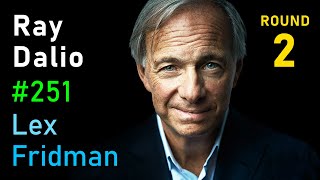
Ray Dalio on Debt Cycles
Dalio sees debt cycles as a mechanical pattern in which credit boosts spending and asset prices for a while, then debt growing faster than income eventually forces deleveraging, money printing, and painful adjustment.
- Debt cycles start because borrowing lets spending rise faster than income.
- The key danger is debt growing faster than the cash flow needed to service it.
- When debt burdens get too large, spending is squeezed, incomes weaken, and the cycle reverses into deleveraging.
- Countries usually avoid outright default by printing money, which weakens currency and raises inflation risk.
- Dalio treats this as a recurring historical pattern, not a one-off event or personality story.
“Credit is the most important part of the economy and probably the least understood.”Bridgewater animated explainer, 2013 · 2:45
Debt cycles are driven by credit, not just by growth
Dalio starts with a simple claim: the economy is understandable if you look at transactions, spending, and credit as a system. In his view, spending drives economic activity, and credit matters because it allows spending to rise ahead of current income. That is why debt cycles are central to how booms and busts happen.123
His basic mechanism is straightforward: borrowing pulls future spending into the present. That makes growth feel stronger in the upswing, but it also creates the obligation that shapes the downswing later. In his formulation, borrowing itself creates the cycle.45
“Credit is the most important part of the economy and probably the least understood.”Bridgewater animated explainer, 2013 · full transcript →
The core warning: debt cannot outgrow income forever
Dalio's main rule is that debt becomes dangerous when it rises faster than income for too long. As debts accumulate, debt-service costs take up a larger share of cash flow, and that gradually crowds out other spending. The problem is not debt in the abstract; it is the mismatch between obligations and the income available to meet them.67
He describes this as mechanical rather than ideological. Once debt service absorbs too much cash flow, households, companies, or countries have less room to spend, invest, or refinance comfortably. That squeeze is the turning point from expansion toward contraction.879

“I think it's just important to understand the mechanics. That's why I wrote the book How Countries Go Broke, because there's a mechanical process and people don't understand it, and it's really quite simple. Um, the way it works for, uh, countries is the same. It works for individuals, except countries can print money. Okay, but one man's debts are another man's, uh, liabilities. So, uh, what happens is when debts accumulate faster, then, uh, they're paid back, then debt service costs grow. And so that becomes a higher and higher percentage of one's cash flow. And when that happens, it starts to squeeze out spending. And so then you have a problem.”Bloomberg interview, 2025 · full transcript →
Booms become bubbles because easy credit feeds optimism
Dalio says long debt cycles build because people naturally prefer borrowing and spending over paying down debt, especially when recent conditions look good. Rising incomes, higher asset prices, and easy lending make leverage feel safe and rewarding. Over time, that turns expansion into a bubble.10
This is why the tops of cycles are so deceptive. Conditions look strongest near the end, precisely because credit has been amplifying spending and asset gains. But the same process leaves the system more fragile, since each cycle tends to end with more debt than the one before.1110
“Because people push it. They have an inclination to borrow and spend more instead of paying back debt. It's human nature. Because of this, over long periods of time, debts rise faster than incomes creating the long term debt cycle. Despite people becoming more indebted, lenders even more freely extend credit. Why? Because everyone thinks things are going great. People are just focused on what's been happening lately. And what's been happening lately? Incomes have been rising. Asset values are going up. The stock market roars. It's a boom. It pays to buy goods, services, and financial assets with borrowed money. When people do a lot of that, we call it a bubble.”Bridgewater animated explainer, 2013 · full transcript →
When the debt peak hits, deleveraging begins
At the peak, the cycle reverses. Since one person's spending is another person's income, a cutback in spending reduces incomes, which weakens creditworthiness and causes borrowing to fall further. Meanwhile debt repayments continue, so the contraction feeds on itself.12
Dalio uses this sequence to explain major breakdowns across eras. Once debt burdens are too large, deleveraging brings falling spending, weaker incomes, lower asset prices, pressure on banks, and often market crashes. In his account, 1929, 2008, and Japan's bust fit the same broad pattern.129
“And since one person's spending is another person's income, incomes begin to go down, which makes people less credit worthy causing borrowing to go down. Debt repayments continue to rise, which makes spending drop even further, and the cycle reverses itself. This is the long term debt peak. Debt burdens have simply become too big. For The United States, Europe, and much of the rest of the world, this happened in 2008. It happened for the same reason it happened in Japan in 1989 and in The United States back in 1929. Now the economy begins deleveraging. In a deleveraging, people cut spending, incomes fall, credit disappears, asset prices drop, banks get squeezed, the stock market crashes, social tensions rise, and the whole thing starts to feed on itself the other way.”Bridgewater animated explainer, 2013 · full transcript →
Countries can print money, so the endgame is often devaluation
Dalio draws an important distinction between countries and ordinary borrowers: countries that control their own currency can print money. That means they often avoid outright default, but only by shifting the pain into currency weakness and inflation. He presents this as the usual path when debts and deficits become too large.713
In late-stage debt problems, he says the supply of government debt can exceed natural demand for holding it. When that happens, central banks are pushed toward buying debt and creating money, which supports the system in nominal terms but undermines the value of paper money. That is why he links debt stress to stronger interest in assets less tied to fiat currency.14151617

“This creates great domestic hardships and forces the country to choose between defaulting on its debts or printing a lot of new money. It always chooses to print a lot of new money. At first, gradually and eventually massively. That devalues the currency and raises inflation. For the Dutch, this was the financial crisis brought about by financial excesses and paying for the fourth Anglo Dutch war. Similarly, for the British, it was paying for its financial excesses and its debts from the two world wars. And for The US, it's been three cycles of debt finance booms and busts since the nineties with the central bank stepping in each time with stronger measures. When the government has problems funding itself, when there are bad economic conditions, and living standards for most people are declining, and there are large wealth, values, and political gaps, internal conflict between the rich and the poor, as well as different ethnic, religious, and racial groups greatly increases.”Podcast with The Investor's Podcast Network, 2021 · full transcript →
Debt cycles are part of a bigger historical and political cycle
Dalio does not treat debt cycles as isolated market events. He places them inside a broader rise-and-decline pattern for countries and empires, where debt, money, internal conflict, and external rivalry reinforce one another. His reason for studying cycles is that the biggest shocks often feel unprecedented only because they did not happen in one's own lifetime.181920
In that larger framework, debt problems become more dangerous when they combine with wealth gaps, political polarization, and geopolitical stress. The hard choices required to restore balance are often domestic political challenges before they are financial ones. His practical summary is simple: a country has to earn more than it spends, and social cohesion matters because adjustment is harder when trust collapses.21222324
“The most important events that surprised me did so because they never happened in my lifetime.”Podcast with The Investor's Podcast Network, 2021 · full transcript →
Dalio on debt cycles, in his own words
“Credit is the most important part of the economy and probably the least understood.”
“Basically, anytime you borrow, you create a cycle.”
“It’s not about the individual. There’s mechanics.”
“So in summary, there are three rules of thumb that I'd like you to take away from this. First, don't have debt rise faster than income because your debt burdens will eventually crush you. Second, don't have income rise faster than productivity because you'll eventually become uncompetitive. And third, do all that you can to raise your productivity because in the long run that's what matters most. This is simple advice for you and it's simple advice for policy makers. You might be surprised, but most people, including most policymakers, don't pay enough attention to this. This template has worked for me, and I hope it will work for you. Thank you.”
“I think it's just important to understand the mechanics. That's why I wrote the book How Countries Go Broke, because there's a mechanical process and people don't understand it, and it's really quite simple. Um, the way it works for, uh, countries is the same. It works for individuals, except countries can print money. Okay, but one man's debts are another man's, uh, liabilities. So, uh, what happens is when debts accumulate faster, then, uh, they're paid back, then debt service costs grow. And so that becomes a higher and higher percentage of one's cash flow. And when that happens, it starts to squeeze out spending. And so then you have a problem.”
“This creates great domestic hardships and forces the country to choose between defaulting on its debts or printing a lot of new money. It always chooses to print a lot of new money. At first, gradually and eventually massively. That devalues the currency and raises inflation. For the Dutch, this was the financial crisis brought about by financial excesses and paying for the fourth Anglo Dutch war. Similarly, for the British, it was paying for its financial excesses and its debts from the two world wars. And for The US, it's been three cycles of debt finance booms and busts since the nineties with the central bank stepping in each time with stronger measures. When the government has problems funding itself, when there are bad economic conditions, and living standards for most people are declining, and there are large wealth, values, and political gaps, internal conflict between the rich and the poor, as well as different ethnic, religious, and racial groups greatly increases.”
Where to watch
 Ray Dalio on The Economic Machine: How Credit Drives Cycles2013 · 31 min · full transcriptBest starting point for Dalio's full mechanical model of short- and long-term debt cycles.
 Ray Dalio on Debt Cycles: How Countries Go Broke2025 · 76 min · full transcriptApplies the big debt-cycle logic directly to countries, debt supply-demand, and monetization risk.
 Ray Dalio on Debt Cycles and Geopolitics: Why the U.S. Is Vulnerable2025 · 26 min · full transcriptShows how Dalio translates debt mechanics into current pressure on rates, spending, and asset prices.
 Ray Dalio on Debt Cycles: How Countries Go Broke2025 · 51 min · full transcriptExplains why countries usually do not fail like companies but instead print and devalue.
 Ray Dalio on Debt Cycles: History Rhymes Across Bubbles2025 · 44 min · full transcriptUseful for understanding how bubbles, tightening, and crashes repeat across 1929, 2008, and other episodes.
 Ray Dalio on Changing World Order: The Big Cycle of Empires2021 · 44 min · full transcriptConnects debt cycles to reserve currencies, money printing, and the broader rise-and-decline of empires.
Questions people ask
- How does Ray Dalio say the short-term debt cycle works?
- What are Ray Dalio's three rules of thumb for the economy?
- What did Ray Dalio say about gold as a safe asset?
- What did Ray Dalio say about how debt cycles work?
- What did Ray Dalio say about populism and revolution?
- What did Ray Dalio say about the long-term debt cycle and debt crises?
Sources
Every quote above, word for word from the transcripts. Numbers match the text.
“The economy works like a simple machine…”
“Credit is the most important part of the economy and probably the least understood.”
“The total amount of spending drives the economy.”
“Basically, anytime you borrow, you create a cycle.”
“It's the most important part because it's the biggest and most volatile part. Just like buyers and sellers go to the market to make transactions, so do lenders and borrowers. Lenders usually wanna make their money into more money, and borrowers usually wanna buy something they can't afford, like a house or a car, or they want to invest in something like starting a business. Credit can help both lenders and borrowers get what they want. Borrowers promise to repay the amount they borrow, called principal, plus an additional amount called interest. When interest rates are high, there is less borrowing because it's expensive. When interest rates are low, borrowing increases because it's cheaper. When borrowers promise to repay and lenders believe them, credit is created.”
“So in summary, there are three rules of thumb that I'd like you to take away from this. First, don't have debt rise faster than income because your debt burdens will eventually crush you. Second, don't have income rise faster than productivity because you'll eventually become uncompetitive. And third, do all that you can to raise your productivity because in the long run that's what matters most. This is simple advice for you and it's simple advice for policy makers. You might be surprised, but most people, including most policymakers, don't pay enough attention to this. This template has worked for me, and I hope it will work for you. Thank you.”
“I think it's just important to understand the mechanics. That's why I wrote the book How Countries Go Broke, because there's a mechanical process and people don't understand it, and it's really quite simple. Um, the way it works for, uh, countries is the same. It works for individuals, except countries can print money. Okay, but one man's debts are another man's, uh, liabilities. So, uh, what happens is when debts accumulate faster, then, uh, they're paid back, then debt service costs grow. And so that becomes a higher and higher percentage of one's cash flow. And when that happens, it starts to squeeze out spending. And so then you have a problem.”
“I think it's just important to understand the mechanics.”
“It’s not about the individual. There’s mechanics.”
“Because people push it. They have an inclination to borrow and spend more instead of paying back debt. It's human nature. Because of this, over long periods of time, debts rise faster than incomes creating the long term debt cycle. Despite people becoming more indebted, lenders even more freely extend credit. Why? Because everyone thinks things are going great. People are just focused on what's been happening lately. And what's been happening lately? Incomes have been rising. Asset values are going up. The stock market roars. It's a boom. It pays to buy goods, services, and financial assets with borrowed money. When people do a lot of that, we call it a bubble.”
“As you can see, the economy works like a machine. In the short term debt cycle, spending is constrained only by the willingness of lenders and borrowers to provide and receive credit. When credit is easily available, there's an economic expansion. When credit isn't easily available, there's a recession. And note that this cycle is controlled primarily by the central bank. The short term debt cycle typically lasts five to eight years and happens over and over again for decades. But notice that the bottom and top of each cycle finish with more growth than the previous cycle and with more debt. Why?”
“And since one person's spending is another person's income, incomes begin to go down, which makes people less credit worthy causing borrowing to go down. Debt repayments continue to rise, which makes spending drop even further, and the cycle reverses itself. This is the long term debt peak. Debt burdens have simply become too big. For The United States, Europe, and much of the rest of the world, this happened in 2008. It happened for the same reason it happened in Japan in 1989 and in The United States back in 1929. Now the economy begins deleveraging. In a deleveraging, people cut spending, incomes fall, credit disappears, asset prices drop, banks get squeezed, the stock market crashes, social tensions rise, and the whole thing starts to feed on itself the other way.”
“This creates great domestic hardships and forces the country to choose between defaulting on its debts or printing a lot of new money. It always chooses to print a lot of new money. At first, gradually and eventually massively. That devalues the currency and raises inflation. For the Dutch, this was the financial crisis brought about by financial excesses and paying for the fourth Anglo Dutch war. Similarly, for the British, it was paying for its financial excesses and its debts from the two world wars. And for The US, it's been three cycles of debt finance booms and busts since the nineties with the central bank stepping in each time with stronger measures. When the government has problems funding itself, when there are bad economic conditions, and living standards for most people are declining, and there are large wealth, values, and political gaps, internal conflict between the rich and the poor, as well as different ethnic, religious, and racial groups greatly increases.”
“…the demand for the reserve currency um is not sufficient to meet the supply…”
“…when central banks print a lot of money to relieve a crisis, buy stocks, gold, and commodities because their value will rise and the value of paper money will fall.”
“…gold is the you know what like they say it's the one asset you can have that's not somebody else's liability…”
“It's the big cycle and what you have to understand is that gold is not a precious metal that's speculated on like most people have come to think of it as, it is the most established money that it's the second largest reserve currency that central banks hold. And so what we've seen is for various reasons that I pretty much covered, the economic supply demand, the political, the geopolitical, for those reasons central banks themselves have acquired gold to build that up and individuals and others are looking for an alternative money. The question is what is money?”
“The most important events that surprised me did so because they never happened in my lifetime.”
“I needed therefore to study them in history.”
“The times ahead will be radically different from those that we've experienced in our lifetimes, though similar to many times before. How do I know that? Because they always have been. Over my roughly fifty years of global macroeconomic investing, I've learned the hard way that the most important events that surprised me did so because they never happened in my lifetime. These painful surprises led me to study the last five hundred years of history for similar situations where I saw that they had indeed happened many times before with the ups and the downs of the Dutch, British, and US empires.”
“Populous leaders emerge from both sides and pledge to take control and bring about order. That's when democracy is most challenged because it fails to control the anarchy. And it is when the move to a strong populist leader who will bring order to the chaos is most likely. As conflict within the country escalates, it leads to some form of revolution or civil war to redistribute wealth and force the necessary big changes. This can be peaceful and maintain the existing order, but it's more often violent and changing the order. For example, the Roosevelt revolution to redistribute wealth was relatively peaceful and maintained the existing internal order. While the French revolution, the Russian revolution, and the Chinese revolution were much more violent and led to new internal orders.”
“…what we need to do, it comes down to just two things, earn more than we spend and treat each other well.”
“It's most often the case that a nation's greatest war is with itself over whether or not it can make the hard decisions needed to sustain success. As for what we need to do, it comes down to just two things, earn more than we spend and treat each other well. All other things I mentioned, strong education, inventiveness, being competitive, and all the rest are just ways of getting at these two things. It's easy to measure if we're doing them. So like people who wanna get fit, let's get on the program and improve our vitals. Let's do that individually and collectively. My goal for sharing this picture of how the world works and a few principles for dealing with it well is to help you recognize where we are and the challenges we face, and to make the wise decisions needed to navigate these times well.”
“The amount of debt that we're in represents a—you can't pretend it—it exists. So it represents a challenge. There are a lot of these challenges, but it is not inevitable. What is needed is, first of all, a strong middle, okay, to bring the country together in terms of rather than to have this fighting because if, if we continue the way we will, we're going to have a conflict. And then there needs to be a good engineering, EX-P exercise that's going to produce, but has to be bipartisan, has to be bipartisan with that strong middle taking control of the extremes because neither side's going to win a...”
How this guide was made: drafted with AI from the full transcripts of the recordings cited, then checked: every quotation must match a transcript word for word and be the speaker's own words, and an independent review gates accuracy. Methodology and corrections.