Ray Dalio on China & Geopolitics
Ray Dalio sees China’s rise and U.S.-China rivalry as part of a repeating great-power cycle shaped by debt, internal cohesion, and how nations manage conflict.
- China’s rise is not a temporary story to him; he expects it to remain a major power for the foreseeable future.
- He views geopolitics through recurring cycles in which debt, domestic disorder, and great-power rivalry reinforce each other.
- The U.S.-China contest is broader than military risk alone, spanning trade, technology, capital, and influence.
- He thinks the biggest danger is the combination of external rivalry with internal political and financial weakness at home.
- His practical response is to study history, build resilience, and diversify rather than assume today’s order will stay intact.
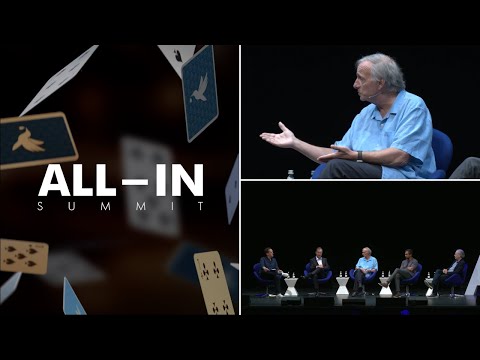
“I think China's going to be a big power for the foreseeable future.”All-In Summit interview, 2023 · 11:43
Dalio sees China’s rise as part of a long historical pattern
Dalio’s starting point is that major geopolitical shifts are easier to understand when you compare them with earlier rises and declines of great powers. He argues that the biggest surprises usually feel surprising only because they did not happen within one lifetime, not because they are unprecedented.123
That leads him to treat China not as a one-off case but as one of the major empire arcs that can be studied alongside the Dutch, British, and American cases. He emphasizes looking at measurable drivers such as education, military power, and other indicators of national strength across centuries.45
Within that framework, he is straightforward that China is likely to remain a major power for a long time. His point is less about making a short-term prediction and more about recognizing a structural shift in the world order.6
“I think China's going to be a big power for the foreseeable future.”All-In Summit interview, 2023 · full transcript →
U.S.-China rivalry matters because money and power move together
Dalio does not separate geopolitics from economics. He sees world orders as built on the interaction of money, credit, reserve-currency status, trade strength, and military capability, so conflict between major powers is also a conflict over who sets the rules of the system.47
In his description, the conflict with China is not just one possible shooting war. It shows up as several overlapping contests: trade, technology, geopolitical influence, capital, and military competition, with Taiwan standing out as the main military flashpoint he highlights.8
This is why he thinks the world can change dramatically over a relatively short period. When a rising power becomes comparable to an established power, the environment shifts across many dimensions at once, not just diplomacy.910
The real danger is the mix of external rivalry and internal weakness
Dalio repeatedly warns that countries become most vulnerable when great-power conflict collides with domestic problems. He points to debt burdens, wealth gaps, polarization, and breakdowns in trust as the pre-existing conditions that make geopolitical stress much more dangerous.1112
He applies this especially to the United States. In his view, heavy government debt and the pressure it creates on the monetary system are not isolated financial issues; they weaken resilience at the same time external competition is intensifying.131415
He also thinks a nation’s biggest struggle is often internal. If a country cannot make hard decisions, keep a broad middle together, and avoid extremes, it becomes less able to handle outside rivals effectively.161718
He is more focused on how countries behave than on simple pro-China or anti-China takes
Dalio’s framework is less about choosing sides and more about understanding cause and effect. He stresses that outcomes depend heavily on how people and countries deal with one another, which means geopolitical risk is shaped by policy choices and political behavior, not fate alone.1920
That is why he keeps returning to basic national disciplines. A country that earns more than it spends, maintains internal cooperation, invests broadly in education, and stays competitive is more likely to sustain power without destabilizing conflict.2122185
He also leaves room for adaptation. Even though he sees today as a dangerous phase of the cycle, he argues that human systems can improve through invention, learning, and better cooperation.2324
His practical takeaway is resilience, diversification, and historical perspective
For investors and decision-makers, Dalio’s geopolitical lesson is not to predict every headline but to prepare for a world order that may be less stable than the one people grew up with. He believes history offers the best guide because similar combinations of debt stress and power rivalry have happened many times before.25263
Financially, that means he favors resilience over concentration. He repeatedly argues for diversification across uncorrelated assets as a way to reduce risk when the macro backdrop includes currency pressure, debt problems, and geopolitical conflict.2728
He also connects geopolitics to money itself. When debt and reserve-currency pressures rise, he becomes more attentive to stores of value that are not someone else’s liability, which is part of why he discusses gold so often in the context of changing world order.2930

“…good diversification means that you can reduce your risks by 80% without reducing your expected returns…”WSJ News interview, 2025 · full transcript →
Dalio on china & geopolitics, in his own words
“I think China's going to be a big power for the foreseeable future.”
“…what I learned, and I had this repeatedly in my life, that things that surprised me often surprised me because they didn't happen in my lifetime, but they happened many times in history.”
“I think we're going to go through, like, it'll be almost a... Like a time warp that we're gonna go through that over the next five to ten years, the world is gonna be very, very different than it is today.”
“Yeah. I'd like to talk about both wars. So the war with China, as I said there are five kinds of wars. There's a trade war, technology war, geopolitical influence war, capital war, and military war. As far as military war goes, I only... Think it's only a Taiwan issue, but that's a big issue. And we could talk about that for a minute. But those others, they'll be rough competitions and we'll have that type of evolution over a period of time. That's what that war looks like. Taiwan has been for a long time a sovereignty issue to China. And it has its roots in what's called the hundred years of humiliation.”
Where to watch
 Ray Dalio on Changing World Order: Debt, China, and the Cycle2023 · 42 min · full transcriptBest concise overview of how Dalio links China, debt, populism, and changing world order.
 Ray Dalio on World Orders and Cycles: Money, Power, Empires2021 · 93 min · full transcriptBest full explanation of his empire-cycle framework and the different forms of U.S.-China conflict.
 Ray Dalio on Changing World Order: How to Invest in Uncertainty2025 · 25 min · full transcriptBest short discussion of why U.S.-China rivalry matters now and how to translate the framework into action.
 Ray Dalio on Global Power Cycles: History Rhymes Again2017 · 23 min · full transcriptBest for understanding why he thinks history rhymes and why the next decade may look very different.
 Ray Dalio on Debt Cycles and World Order: Gold, Tariffs, AI2025 · 49 min · full transcriptBest for connecting geopolitics to debt stress, reserve assets, tariffs, and strategic resilience.
Questions people ask
- How does Ray Dalio use historical data to study empires and world order?
- What did Ray Dalio say about China's rise as a great power?
- What did Ray Dalio say about gold as a safe asset?
- What did Ray Dalio say about populism and revolution?
- What did Ray Dalio say about tariffs and trade deficits?
- What does Ray Dalio say is the leading indicator of an empire's rise?
Sources
Every quote above, word for word from the transcripts. Numbers match the text.
“The most important events that surprised me did so because they never happened in my lifetime.”
“…what I learned, and I had this repeatedly in my life, that things that surprised me often surprised me because they didn't happen in my lifetime, but they happened many times in history.”
“The times ahead will be radically different from those that we've experienced in our lifetimes, though similar to many times before. How do I know that? Because they always have been. Over my roughly fifty years of global macroeconomic investing, I've learned the hard way that the most important events that surprised me did so because they never happened in my lifetime. These painful surprises led me to study the last five hundred years of history for similar situations where I saw that they had indeed happened many times before with the ups and the downs of the Dutch, British, and US empires.”
“Well, the leading reserve currency empires, but it applies to all the empires, were the the Dutch, the British, the American, and the Chinese. But you could follow the same pattern. In the book, it was very important for me to not just use words and concepts because that's subjective. It was very important for me to use actual measurements. So as you see in the book, you can see every level of this. You can see where's the education level, what is the military power, each one of those to... And you could see them back going over the five hundred years. And so you can see the arcs and the composition of those arcs and what you see is really in most countries and most dynasties you could see that.”
“Yes. The classic cycle, the most important leading indicator is the quality of education. Most importantly, broad based education drawn from the largest population because you can never tell who the talent is going to be, where they're gonna come from. So for example if you look at the Chinese dynasties, the great Chinese dynasties and the Confucian approach, it was meritocratic of everybody could sit for exams and so on, broad base of drawing in the populations. And you see that if you go across societies, because that draws on the largest number of population to get education. And it also that creates a reality and a perception that the system is fairer, equal opportunity, not just one of privilege.”
“I think China's going to be a big power for the foreseeable future.”
“…the great power conflict between particularly China and the United States…”
“Yeah. I'd like to talk about both wars. So the war with China, as I said there are five kinds of wars. There's a trade war, technology war, geopolitical influence war, capital war, and military war. As far as military war goes, I only... Think it's only a Taiwan issue, but that's a big issue. And we could talk about that for a minute. But those others, they'll be rough competitions and we'll have that type of evolution over a period of time. That's what that war looks like. Taiwan has been for a long time a sovereignty issue to China. And it has its roots in what's called the hundred years of humiliation.”
“You have to go back really to the thirties around the world or before. And the third is the great power conflict. In other words, the rise of a great power in the form of China that is a comparable power in the world and that dynamic. So in order to see that, I needed to then study the past five hundred years of history. Now I know people think it's odd because here I am. I'm just trying to make money in the markets. I'm a practical guy dealing with that. But in... But we would not understand that. And the picture of the world is a very different picture than we have grown used to because of the nature of these longer term cycles.”
“I think we're going to go through, like, it'll be almost a... Like a time warp that we're gonna go through that over the next five to ten years, the world is gonna be very, very different than it is today.”
“There are pre-existing conditions that represent challenges.”
“Populous leaders emerge from both sides and pledge to take control and bring about order. That's when democracy is most challenged because it fails to control the anarchy. And it is when the move to a strong populist leader who will bring order to the chaos is most likely. As conflict within the country escalates, it leads to some form of revolution or civil war to redistribute wealth and force the necessary big changes. This can be peaceful and maintain the existing order, but it's more often violent and changing the order. For example, the Roosevelt revolution to redistribute wealth was relatively peaceful and maintained the existing internal order. While the French revolution, the Russian revolution, and the Chinese revolution were much more violent and led to new internal orders.”
“…the new toxic debt is government debt.”
“…the demand for the reserve currency um is not sufficient to meet the supply…”
“This creates great domestic hardships and forces the country to choose between defaulting on its debts or printing a lot of new money. It always chooses to print a lot of new money. At first, gradually and eventually massively. That devalues the currency and raises inflation. For the Dutch, this was the financial crisis brought about by financial excesses and paying for the fourth Anglo Dutch war. Similarly, for the British, it was paying for its financial excesses and its debts from the two world wars. And for The US, it's been three cycles of debt finance booms and busts since the nineties with the central bank stepping in each time with stronger measures. When the government has problems funding itself, when there are bad economic conditions, and living standards for most people are declining, and there are large wealth, values, and political gaps, internal conflict between the rich and the poor, as well as different ethnic, religious, and racial groups greatly increases.”
“What is needed is, first of all, a strong middle.”
“We will not agree with each other ever.”
“It's most often the case that a nation's greatest war is with itself over whether or not it can make the hard decisions needed to sustain success. As for what we need to do, it comes down to just two things, earn more than we spend and treat each other well. All other things I mentioned, strong education, inventiveness, being competitive, and all the rest are just ways of getting at these two things. It's easy to measure if we're doing them. So like people who wanna get fit, let's get on the program and improve our vitals. Let's do that individually and collectively. My goal for sharing this picture of how the world works and a few principles for dealing with it well is to help you recognize where we are and the challenges we face, and to make the wise decisions needed to navigate these times well.”
“…the whole, it all comes down to how people deal with each other…”
“Well, I find that almost everything happens over and over again. And we're in this... The blizzard of these things happening. And what I found is that if I'm making a decision that that after I make the decision usually or right at the time, if I pause and reflect and I write my principle down, in other words principle is sort of a recipe, What would I use to... How would I make that decision and what are the criteria around it? I find that I make it much more clear, it becomes clearer and it applies to the next thing that comes along, it'll be that way. Because everything happens over and over and over again, and I think people make the mistake of looking at just the one like it's the first one.”
“…what we need to do, it comes down to just two things, earn more than we spend and treat each other well.”
“Be financially sound, earn more than you spend, and be strong in these ways, and pretty much everything will take care of itself.”
“The greatest power, man's ability to invent and adapt is evolution…”
“Evolution is in a direction toward improvement, and the greatest force is man's capacity to adapt and invent. And so you see in the charts in the book, you see that this upward movement, life expectancy, health, all the things that we think are better. You see there's a chart and it shows that over a period of time and you barely see the downturns from depressions and wars in that. That is the greatest power, man's ability to invent and adapt is evolution, and that's the greatest power, and that is what gives me justifiable hope.”
“I needed therefore to study them in history.”
“Read history and know these things…”
“…if you buy equally good things that are not correlated and that you can do that, you could reduce your return... Your risks by about 80% if you can know how to do that.”
“…good diversification means that you can reduce your risks by 80% without reducing your expected returns…”
“…gold is the you know what like they say it's the one asset you can have that's not somebody else's liability…”
“It's the big cycle and what you have to understand is that gold is not a precious metal that's speculated on like most people have come to think of it as, it is the most established money that it's the second largest reserve currency that central banks hold. And so what we've seen is for various reasons that I pretty much covered, the economic supply demand, the political, the geopolitical, for those reasons central banks themselves have acquired gold to build that up and individuals and others are looking for an alternative money. The question is what is money?”
How this guide was made: drafted with AI from the full transcripts of the recordings cited, then checked: every quotation must match a transcript word for word and be the speaker's own words, and an independent review gates accuracy. Methodology and corrections.