Neil deGrasse Tyson on Mars And Terraforming
Neil deGrasse Tyson treats Mars as a scientifically valuable world and a possible long-term target for settlement, but he insists terraforming is far harder than enthusiasts admit and that the same planetary-engineering power should first be used to preserve Earth.
- Mars matters most as a place to search for life and learn how planets evolve
- Tyson thinks becoming multi-planetary can be exciting, but not mainly as an extinction escape plan
- He says a true two-planet future would require terraforming Mars, not just sending people there
- Terraforming Mars is technically imaginable, but Mars likely lacks enough native ingredients to make it easy
- His sharpest test is simple: if we can remake Mars, we can also repair Earth, so Earth should not be abandoned

“Course, let's be a multi-planet species. Fine. >> Right. But—but I—I would do it for different reasons. I'd do it 'cause it's cool, not because we want to protect human, human species from extinction. No, that wouldn't be the reason to do it. Can I tell you why? Please. List every reason why you think we go extinct. One, we trash Earth. Another, and we can't live off of it anymore. An asteroid is coming. There's some nanobot gone astray, okay? Pandemic. Pan-virus pandemic, okay. So, it seems to me that if we want to be a multi-planet species, Mars would be the one 'cause it's a 24-hour day. It's got seasons. We—we would have to terraform first, but then we all move there. You just ship a billion people there. Here's…”The Joe Rogan Experience, 2017 · 3:40
Mars is valuable first as a scientific world, not a backup fantasy
Tyson's starting point is not romantic escape but scientific discovery. He treats Mars as one of the places where we can ask whether life ever arose beyond Earth, and he stresses that exploration is worthwhile precisely because we do not already know the answer12.
He also connects Mars to a bigger lesson about understanding planets, climates, and our own history. In his view, studying other worlds helps us understand what can happen to planets over time, including worlds that once may have had conditions very different from what they have now3.
He likes the idea of a multi-planet species, but rejects panic as the main reason
Tyson is not opposed to humans becoming multi-planetary. But he draws a firm distinction between doing it because it expands civilization and doing it because people imagine Mars as a practical near-term lifeboat from every danger on Earth4.
His reasoning is straightforward: many threats to humanity are better addressed directly where we already live. If the concern is asteroid impact, disease, or environmental collapse, he sees prevention and problem-solving as more practical than assuming we can relocate huge populations to Mars4.
“Course, let's be a multi-planet species. Fine. >> Right. But—but I—I would do it for different reasons. I'd do it 'cause it's cool, not because we want to protect human, human species from extinction. No, that wouldn't be the reason to do it. Can I tell you why? Please. List every reason why you think we go extinct. One, we trash Earth. Another, and we can't live off of it anymore. An asteroid is coming. There's some nanobot gone astray, okay? Pandemic. Pan-virus pandemic, okay. So, it seems to me that if we want to be a multi-planet species, Mars would be the one 'cause it's a 24-hour day. It's got seasons. We—we would have to terraform first, but then we all move there. You just ship a billion people there. Here's…”The Joe Rogan Experience, 2017 · full transcript →
For Tyson, real settlement of Mars would require terraforming
Tyson does not talk about Mars colonization as though a few habitats solve the problem. His point is that if humanity truly wants to become a two-planet species at scale, Mars would need to be remade into a much more Earth-like environment54.
That is why terraforming matters in his Mars thinking. Mars appeals to him more than many other planets because it already has some familiar features, but familiarity is not the same as habitability, and closing that gap is the central challenge5.
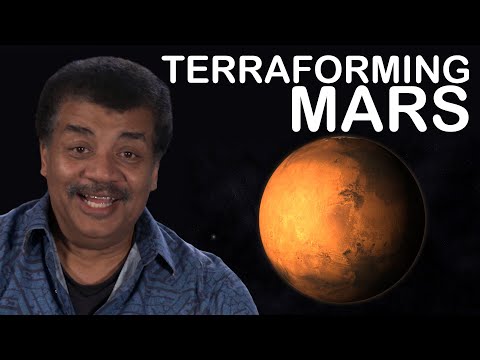
“If we're gonna be a two planet species, I'm thinking, you gotta terraform Mars for that to happen.”StarTalk panel, 2018 · full transcript →
Terraforming is imaginable in principle, but brutally hard in practice
Tyson describes terraforming Mars as a sequence of planetary-scale interventions: warming the planet, restoring liquid water conditions, and building toward an atmosphere more compatible with Earth-like life. He presents this as a serious physical problem, not a slogan5.
His caution is that Mars may not contain enough accessible carbon dioxide and water to do the job by itself. That means the project could demand additional greenhouse inputs or other large engineered interventions, which makes terraforming not impossible in concept but vastly harder than popular talk often suggests5.
His bottom line: if we can fix Mars, we can fix Earth
Tyson's clearest principle is that terraforming Mars does not excuse neglecting Earth. He argues that the level of geoengineering required to make Mars Earth-like would necessarily mean we already possess the ability to restore Earth's damaged systems as well67.
That makes his Mars view practical rather than escapist. Explore Mars, search it for life, and think boldly about the future, but do not pretend a dead planet is easier to repair than the living one we already have673.
Tyson on mars and terraforming, in his own words
“If we're gonna be a two planet species, I'm thinking, you gotta terraform Mars for that to happen.”
“Whatever it takes to terraform Mars to turn it into Earth, if you had the power of geoengineering to do that, then you have the power of geoengineering to turn Earth back into Earth.”
Where to watch
 Neil deGrasse Tyson on Terraforming Mars: Turning It Into Earth2018 · 11 min · full transcriptBest single explanation of how Tyson thinks terraforming Mars would work and why he doubts Mars has enough native resources.
 Neil deGrasse Tyson on Alien Contact: Why It Could Be Dangerous2017 · 43 min · full transcriptShows why Tyson resists using Mars as an extinction panic plan and why he thinks Earth-first problem solving is more practical.
 Neil deGrasse Tyson on Life Beyond Earth: Why It Could Change the World2021 · 47 min · full transcriptBest for Tyson's view that Mars matters scientifically, especially as a place to search for life.
 Neil deGrasse Tyson on Cosmic Discovery: From Mars to Pluto2011 · 143 min · full transcriptAdds Tyson's broader perspective on habitability, water, and why Mars is only one part of the search for life.
 Neil deGrasse Tyson on Universe and Cosmology: From Newton to the Big Bang2008 · 88 min · full transcriptUseful for his wider argument that studying space pays off by teaching us things that matter on Earth.
Questions people ask
- What did Neil deGrasse Tyson say about becoming a multi-planet species?
- What did Neil deGrasse Tyson say about the biggest threats to humanity’s future?
- Why did Neil deGrasse Tyson say we should study Venus and Mars?
- What did Neil deGrasse Tyson say about missions to Europa and the long haul of space exploration?
Sources
Every quote above, word for word from the transcripts. Numbers match the text.
“We don't know what we're going to find. That's why we're sending the spacecraft.”
“…if we found such a signal, it would, dare I say it, change the world.”
“People say, why spend money up there when we spend... Because up there, we might learn about down here. Okay? I don't want a runaway greenhouse effect here. Venus is the best example in the solar system of a planet gone bad. Let's learn about that first. So it turns out the more we learn that asteroid impacts, when they hit, can cast rocks in their surrounding areas into space with escape velocity so they never come back to the planet from which it was launched. If Mars was wet and fertile before Earth was, as all evidence suggests, and if Mars had life before Earth had life, it is possible there were…”
“Course, let's be a multi-planet species. Fine. >> Right. But—but I—I would do it for different reasons. I'd do it 'cause it's cool, not because we want to protect human, human species from extinction. No, that wouldn't be the reason to do it. Can I tell you why? Please. List every reason why you think we go extinct. One, we trash Earth. Another, and we can't live off of it anymore. An asteroid is coming. There's some nanobot gone astray, okay? Pandemic. Pan-virus pandemic, okay. So, it seems to me that if we want to be a multi-planet species, Mars would be the one 'cause it's a 24-hour day. It's got seasons. We—we would have to terraform first, but then we all move there. You just ship a billion people there. Here's…”
“If we're gonna be a two planet species, I'm thinking, you gotta terraform Mars for that to happen.”
“Whatever it takes to terraform Mars to turn it into Earth, if you had the power of geoengineering to do that, then you have the power of geoengineering to turn Earth back into Earth.”
“The day we have the power to terraform Mars, turn Mars into Earth, we'll have the power to turn Earth into Earth.”
How this guide was made: drafted with AI from the full transcripts of the recordings cited, then checked: every quotation must match a transcript word for word and be the speaker's own words, and an independent review gates accuracy. Methodology and corrections.
